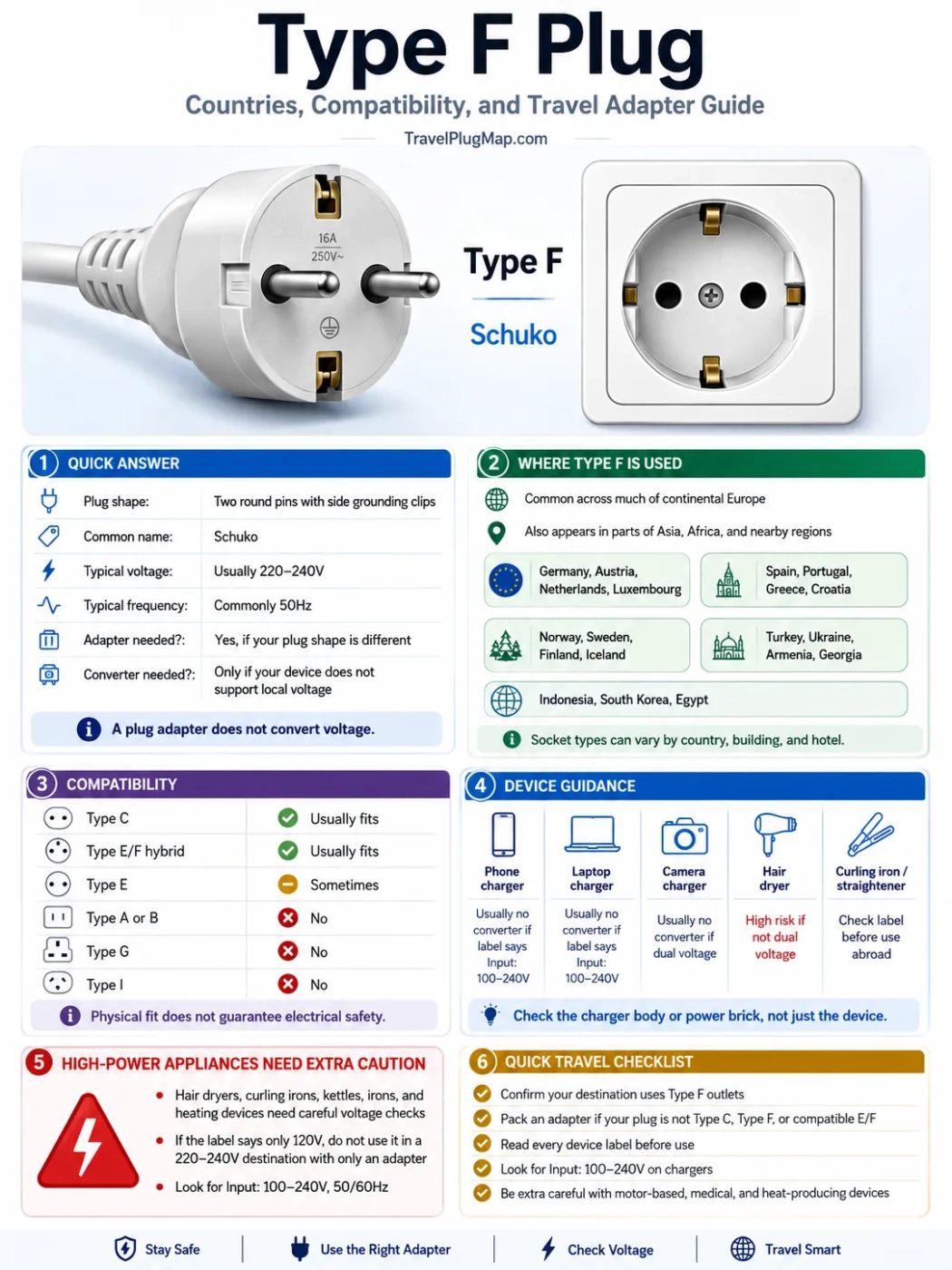
Type F plugs are the round-pin, side-grounded plugs commonly known as Schuko. Travelers usually see Type F outlets across much of continental Europe and in several other regions. The key travel question is simple: you may need a plug adapter if your plug shape is different, but you may also need to check voltage before using appliances.
| Feature | What Travelers Should Know |
|---|---|
| Plug shape | Two round pins with side grounding clips |
| Common name | Schuko plug or Schuko socket |
| Typical voltage | Usually 220–240V in many Type F countries, especially in Europe |
| Typical frequency | Commonly 50Hz, but always check the destination country |
| Adapter needed? | Yes, if your device has Type A, B, G, I, J, K, L, or another non-compatible plug |
| Converter needed? | Only if your device does not support the local voltage |
| Best device advice | Phone and laptop chargers are often dual voltage, but hair dryers and curling irons need extra caution |
A plug adapter does not convert voltage. It only changes the physical plug shape so your device can fit into the wall outlet. For safety, check the device label before plugging in anything that produces heat, moves a motor, or draws high power.
What a Type F Plug and Outlet Look Like
This is a simplified front view. Real Type F power outlets can look slightly different depending on the building, socket manufacturer, and age of installation. Plug shape and voltage are separate issues, so do not use the outlet shape alone to decide whether a device is safe.
What Is a Type F Plug?
A Type F plug is a grounded plug used with Type F sockets. It has two round pins for power and side metal contacts for grounding. Because of these side grounding clips, Type F is different from the ungrounded Type C Europlug, even though both use two round pins.
Type F is often called a Schuko plug, from a German term meaning protective contact. In travel terms, you can think of it as one of the main grounded round-pin plug systems used in continental Europe.
Many small chargers, such as phone chargers, camera chargers, and USB power adapters, use an ungrounded two-pin Type C-style plug. These often fit into Type F outlets. Larger grounded appliances may use Type F or the hybrid Type E/F design often found on European devices.
What Does a Type F Plug Look Like?
A Type F plug has:
- Two round pins
- A round plug body
- Grounding contacts on the side
- No rectangular blades like Type A, Type B, Type G, or Type I
The matching Type F socket has two round holes and side grounding clips. These side clips are an important part of the grounded design. If your device has a grounded plug from a different system, such as Type B from North America or Type G from the UK, you will need a travel adapter for Type F outlets.
Where Is Type F Used?
Type F is common across much of continental Europe and also appears in parts of Asia, Africa, and nearby regions. In many places, Type F is used together with Type C, and in some countries it appears alongside other socket types.
| Region | Examples | Travel note |
|---|---|---|
| Central and Western Europe | Germany, Austria, Netherlands, Luxembourg | Type F is very common; Type C plugs are also often seen on small devices. |
| Southern Europe | Spain, Portugal, Greece, Croatia, Slovenia, Montenegro, Serbia | Type F is common, though some countries may also use other compatible or regional socket types. |
| Northern Europe | Norway, Sweden, Finland, Iceland, Estonia, Latvia, Lithuania | Travelers from the UK, US, Canada, Australia, and Japan usually need a plug adapter. |
| Eastern Europe and nearby regions | Bulgaria, Romania, Moldova, Ukraine, Turkey, Armenia, Georgia, Azerbaijan | Type C and Type F are commonly reported, but older buildings may vary. |
| Other destinations | Indonesia, South Korea, Egypt, Ethiopia, Afghanistan, Kazakhstan | Type F may appear with Type C or other socket types; check the country before packing. |
This table is meant as a practical travel overview, not a guarantee for every wall socket in every building. Hotels, airports, older apartments, cruise cabins, and renovated buildings may have different outlet designs. Some hotels also provide multi-standard sockets, but you should not rely on that.
Is Type F Grounded?
Yes. Type F is a grounded plug and socket system. The grounding connection is made through the side clips on the plug and outlet.
This matters for larger appliances, metal-bodied devices, and some equipment that expects a protective earth connection. A simple two-pin adapter may let a plug fit physically, but it may not preserve grounding. For sensitive or grounded equipment, choose an adapter that properly supports the plug type and grounding arrangement.
For everyday travel charging, many phone chargers and laptop chargers are double-insulated or use two-pin plugs. Still, the safest habit is to read the device label and avoid guessing.
Is Type F Compatible With Other Plug Types?
Type F compatibility depends on both plug shape and grounding.
| Plug type | Will it usually fit a Type F outlet? | Important note |
|---|---|---|
| Type C | Usually yes | Common for small ungrounded devices such as phone chargers. |
| Type E/F hybrid | Usually yes | Many modern European grounded plugs are designed to work with both Type E and Type F sockets. |
| Type E | Sometimes, depending on the plug design | Modern hybrid plugs are common, but older or specific designs may differ. |
| Type A or Type B | No | Travelers from the US, Canada, Mexico, and Japan usually need a Type F adapter. |
| Type G | No | Travelers from the UK, Ireland, Singapore, and some other Type G regions need an adapter. |
| Type I | No | Travelers from Australia, New Zealand, China, and Argentina usually need an adapter. |
Physical fit does not guarantee electrical safety. A plug can fit an outlet while the voltage is still wrong for the device.
Do Travelers Need an Adapter for Type F Outlets?
You need a Type F plug adapter if your device plug does not physically match a Type F outlet. This commonly applies to travelers coming from:
- The United States or Canada with Type A or Type B plugs
- The United Kingdom with Type G plugs
- Australia or New Zealand with Type I plugs
- Switzerland with Type J plugs
- Italy with some Type L plugs
- Denmark with some Type K plugs
If your device already has a Type C plug, it will usually fit a Type F socket. If your device has a modern Type E/F hybrid plug, it will usually work in Type F outlets as well.
For short trips, many travelers carry a compact plug adapter for Type F destinations. For multi-country trips, a multi-region travel adapter may be useful, but it still does not solve voltage problems.
Voltage Is Separate From Plug Shape
Most Type F destinations use around 220–240V, commonly at 50Hz. This is very different from countries such as the United States, Canada, and Japan, where many household outlets are around 100–120V.
A plug adapter does not convert voltage. If you plug a 120V-only appliance into a 230V outlet using only a plug adapter, the device can overheat, fail, or become unsafe.
The most important label to look for is:
Input: 100–240V
If your charger says Input: 100–240V, 50/60Hz, it is usually designed for international voltage ranges. In that case, you normally need only the correct plug adapter for the destination outlet. This is common on phone chargers, laptop chargers, tablet chargers, camera battery chargers, and many USB-C power adapters.
If the label says only 120V, 110V, or a narrow voltage range that does not include the destination voltage, you may need a voltage converter or a different travel-ready device.
Phone Chargers, Laptop Chargers, and USB Devices
Modern phone and laptop chargers are often the easiest devices to use with Type F outlets because many are dual voltage. Check the small print on the charger body, not just the device itself.
| Device | Adapter needed? | Converter needed? | What to check |
|---|---|---|---|
| Phone charger | Yes, if the plug shape is not Type C or Type F | Usually no if it says Input: 100–240V | Read the charger label for voltage and frequency. |
| Laptop charger | Yes, if the plug shape is different | Usually no if it says Input: 100–240V | Check the power brick, not only the laptop. |
| Camera battery charger | Often yes | Usually no if dual voltage | Look for 100–240V and 50/60Hz. |
| Electric shaver | Often yes | Depends on the label | Some shavers are dual voltage, but not all. |
| Hair dryer | Yes, if the plug shape is different | Often risky if not dual voltage | Check for dual voltage and correct wattage support. |
| Curling iron or straightener | Yes, if the plug shape is different | May be needed if not dual voltage | Always check the device label before using high-power heat appliances abroad. |
High-Power Appliances Need Extra Caution
High-power appliances are the main risk when traveling to a Type F country. This includes hair dryers, curling irons, straighteners, kettles, irons, heating pads, and some grooming devices.
These devices draw much more power than a phone charger. Even if you use a plug adapter, the appliance may not be safe unless it supports the local voltage. Some travel hair dryers have a voltage switch, but you must set it correctly before use.
High-power appliances should not be used abroad unless the voltage label clearly supports the destination voltage. If the label is missing, unclear, damaged, or hidden, the safer choice is not to use the appliance.
What About 50Hz and 60Hz?
Frequency is the number of cycles per second in the electrical supply. Many Type F destinations use 50Hz. Some devices list 50/60Hz, which usually means they can work with both common travel frequencies.
For phone chargers, laptop chargers, and many USB chargers, frequency is usually not a problem when the label says Input: 100–240V, 50/60Hz. For motor-based or timing-sensitive devices, frequency can matter more. This may include some clocks, turntables, pumps, fans, and specialized equipment.
If you travel with medical or essential equipment such as a CPAP machine, check the power label and manufacturer guidance before your trip. Many modern CPAP power supplies are dual voltage, but the plug adapter, power cord, grounding, and battery backup needs can vary.
Type F vs Type C: What Is the Difference?
Type C and Type F are often seen together, but they are not the same.
- Type C is a two-round-pin ungrounded plug often used for small, low-power devices.
- Type F is a grounded plug and socket system with side grounding contacts.
- A Type C plug will usually fit into a Type F outlet.
- A grounded Type F plug is larger and is not the same as a simple Type C plug.
For travelers, this means a small two-pin European-style phone charger may fit a Type F outlet without a problem. But a grounded appliance from another country will usually need a proper adapter.
Type F vs Type E: Are They Compatible?
Type E and Type F are both common in parts of Europe, but they handle grounding differently. Type E sockets use a grounding pin in the outlet. Type F sockets use side grounding clips.
Many modern European plugs are Type E/F hybrid plugs. These are designed to work with both Type E and Type F sockets. However, older plug designs or country-specific designs may not always behave the same way.
For travel, the safest approach is to check the destination country and carry an adapter that clearly supports the socket types you expect to use.
Common Mistakes With Type F Outlets
- Assuming a plug adapter also changes voltage
- Using a 120V-only hair dryer in a 230V country
- Checking the device brand name instead of the device label
- Ignoring frequency when using motor-based or medical equipment
- Assuming every European country uses the same socket
- Relying on hotel multi-standard sockets without bringing your own adapter
The most important rule is simple: match the plug shape and check the voltage label. You need both pieces of information before using a device safely.
Travel Checklist for Type F Countries
- Check whether your destination commonly uses Type F outlets.
- Pack a plug adapter if your device plug is not Type C, Type F, or compatible E/F.
- Read the label on every charger or appliance you plan to use.
- Look for Input: 100–240V on phone, laptop, and camera chargers.
- Be careful with hair dryers, curling irons, kettles, irons, and other high-power appliances.
- Check frequency support if the device has a motor, pump, timer, or medical function.
- For CPAP machines or essential medical devices, confirm power requirements before departure.
FAQ
What countries use Type F plugs?
Type F plugs are commonly used in many continental European countries, including Germany, Austria, the Netherlands, Spain, Portugal, Greece, Norway, Sweden, Finland, and others. They also appear in several countries outside Europe. Some destinations use Type F together with Type C or other socket types.
Can I plug a Type C plug into a Type F outlet?
Usually yes. Type C plugs commonly fit into Type F outlets because both use two round pins. However, Type C is normally ungrounded, while Type F is grounded through side contacts.
Do I need a voltage converter for a Type F outlet?
You need a voltage converter only if your device does not support the local voltage. If your charger says Input: 100–240V, you usually need only a plug adapter. If it says 120V only, do not use it in a 220–240V country without proper voltage conversion.
Will my phone charger work with Type F outlets?
In most cases, yes, if the charger label says Input: 100–240V, 50/60Hz. You may still need a plug adapter if your charger plug does not physically fit the Type F socket.
Can I use a US hair dryer in a Type F country?
Only if the hair dryer is dual voltage and set correctly for the destination voltage. Many US hair dryers are 120V-only, which is not safe to use in many Type F countries with only a plug adapter.
Is Type F the same as Schuko?
Yes, Type F is commonly known as Schuko. It has two round pins and side grounding clips. Travelers often see it in Germany and many other countries that use round-pin European-style power outlets.