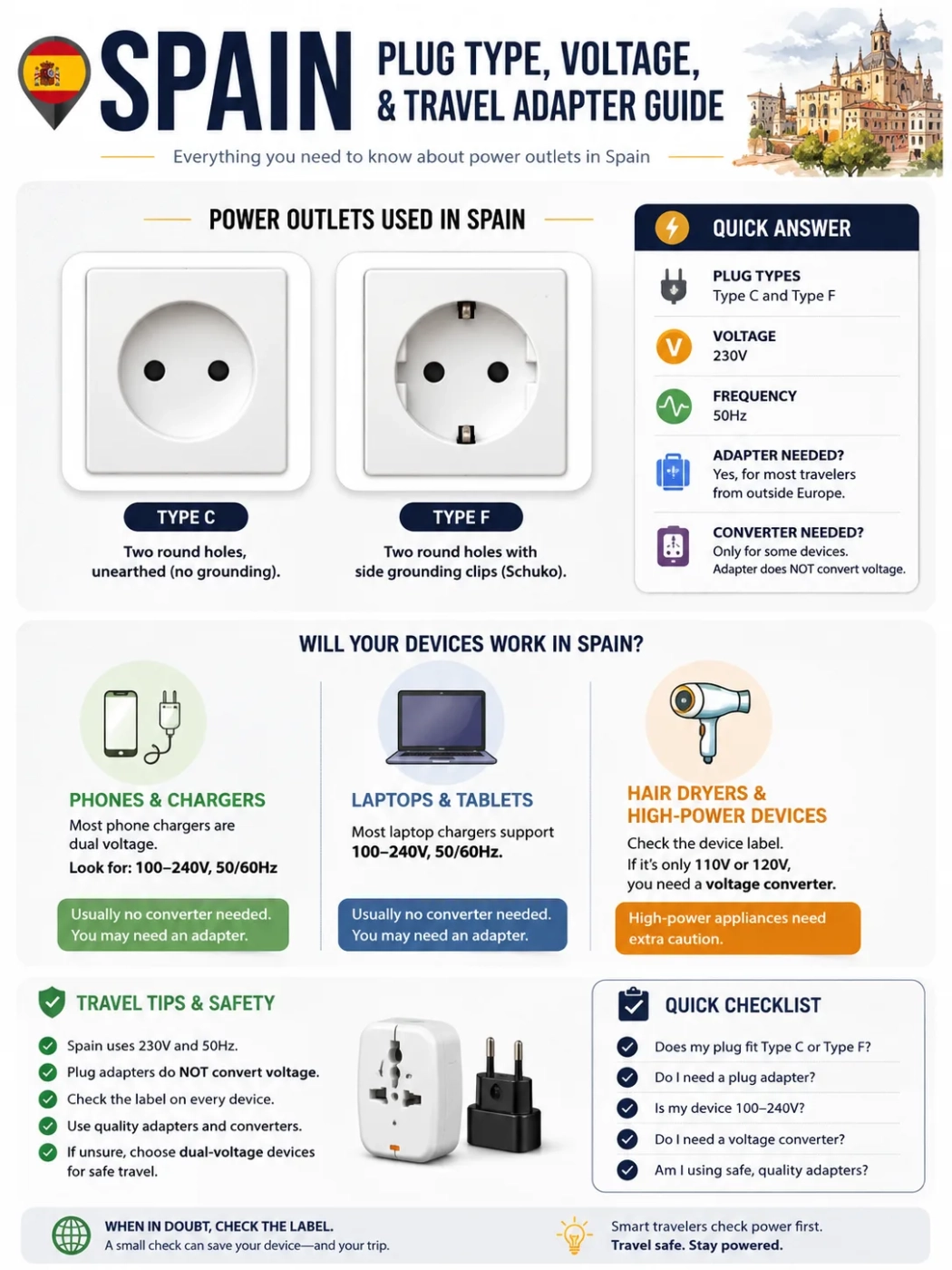
Spain uses Type F power outlets with a standard supply of 230V at 50Hz. Two-pin Type C Europlugs are also widely compatible with Spanish sockets. Travelers arriving with Type A, B, G, I, or other non-European plug shapes will usually need a plug adapter. A voltage converter is only needed when a device is not rated for 230V.
Spain Power Basics for Travelers
| Item | Spain standard | What it means for your trip |
|---|---|---|
| Main wall socket | Type F | Two round-pin European plugs fit; grounded plugs use side earth contacts. |
| Common compatible plug | Type C Europlug | Often used on phone chargers and other small, ungrounded devices. |
| Standard voltage | 230V | Devices made only for 110–120V need extra caution. |
| Frequency | 50Hz | Most modern chargers accept 50/60Hz; some motors, clocks, and medical equipment may be frequency-sensitive. |
| Adapter requirement | Depends on your home plug | Type A, B, G, I, J, K, L, and other plug shapes normally need an adapter. |
| Converter requirement | Device-dependent | Usually unnecessary when the label says Input: 100–240V. |
| Main appliance risk | 120V heat-producing devices | Hair dryers, curling irons, straighteners, kettles, and irons must be checked before use. |
What the Power Outlets Look Like
These are simplified front views of the outlet types associated with Spain. Real sockets can look slightly different depending on the manufacturer, building, and installation age. Hotels may also provide multi-standard sockets or USB charging points. Plug shape and voltage are separate issues, so a plug that fits is not automatically safe to use.
Spain’s Round-Pin System: What Actually Fits
Type F is the main grounded wall-socket style to plan for in Spain. It has two round openings and metal grounding contacts on the sides. A Type C Europlug has two slimmer round pins and no earth connection. It is commonly attached to low-power items such as compact phone chargers, camera chargers, and small electronics.
Travel references often list both Type C and Type F for Spain because Type C plugs normally fit Type F sockets. The distinction matters when grounding is required. A small two-pin charger may work through a basic Europlug connection, while a three-conductor appliance needs an adapter that keeps the earth path intact.
Grounding Can Be Lost With the Wrong Adapter
A mechanical adapter may let a plug enter the socket without preserving grounding. This can happen with low-cost or ungrounded adapters used for a device that originally has a three-prong plug. If your appliance is grounded, use an adapter designed to maintain grounding with a Type F socket. Do not remove a grounding pin or rely on a loose-fitting connection.
Two Checks Before You Plug In
First Check: Will the Plug Fit?
Compare your device plug with Spain’s round-pin outlet. Travelers from the United States, Canada, the United Kingdom, Ireland, Australia, New Zealand, Japan, and many other countries usually need a Spain-compatible plug adapter.
Second Check: Can the Device Accept 230V?
Read the small electrical label on the charger, power brick, or appliance body. A label showing Input: 100–240V, 50/60Hz normally means the power supply can accept Spain’s 230V, 50Hz electricity. In that case, you usually need only the correct plug adapter.
A device marked only 120V, 110V, or a similarly narrow low-voltage range should not be connected directly to a Spanish outlet. A plug adapter does not convert voltage. It changes only the physical connection.
Using Chargers, Medical Devices, and High-Power Appliances
| Device | Plug adapter? | Voltage converter? | What to check |
|---|---|---|---|
| Phone or tablet charger | Yes, if the plug is not Type C or F | Usually no | Look for Input: 100–240V, 50/60Hz. |
| Laptop charger | Usually, for non-European plugs | Usually no | Check the input line on the power brick and the adapter’s current rating. |
| Camera battery charger | Depends on plug shape | Usually no | Confirm 100–240V and 50/60Hz support. |
| Electric toothbrush or shaver | Often | Maybe | Small bathroom devices are not always dual voltage. |
| Hair dryer, curling iron, or straightener | Usually | Possibly | Check the voltage selector, wattage, and exact supported range. |
| Travel kettle or clothes iron | Usually | Possibly | These draw high power and may exceed a converter’s rating. |
| CPAP machine | Usually, for non-European plugs | Often no, but verify | Check the power supply, humidifier rating, frequency support, and manufacturer instructions. |
Phones, Laptops, and USB Chargers
Many modern phone, tablet, laptop, camera, and USB-C chargers are made for international travel. The useful label is Input: 100–240V, often followed by 50/60Hz. That rating means the charger normally accepts Spain’s voltage and frequency without conversion.
You may still need a plug adapter. A dual-voltage charger with a Type A, B, G, or I plug will not fit a Type F socket by itself.
EU common-charger requirements also apply to covered laptops placed on the EU market from 28 April 2026. For covered laptops capable of wired charging, the rules require a USB-C charging connection and compatible USB Power Delivery support where the fast-charging provisions apply. This concerns the device-side charging connection; it does not change Spain’s Type F wall-socket standard or remove the need for the correct travel plug adapter.
Hair Tools and Heat-Producing Devices
Hair dryers, curling irons, straighteners, kettles, and clothes irons deserve more attention because they use much more power than a charger. A North American appliance marked only 120V can overheat or fail rapidly on 230V.
Some travel hair tools have a manual voltage selector. Set it to the correct range before plugging in, and follow the appliance instructions. A converter must be rated above the appliance wattage and suitable for the type of load. Do not assume that a small travel converter can safely run a high-wattage heating appliance.
CPAP Machines and Other Medical Equipment
Many CPAP power supplies accept 100–240V, but the machine, humidifier, heated hose, and separate accessories should all be checked. Confirm the input rating and 50Hz compatibility before departure. Pack the correct Type F-compatible adapter and avoid depending on an adapter that will only be available after arrival.
Adapter Needs by Departure Region
| Traveling from | Adapter likely? | Converter concern |
|---|---|---|
| United States or Canada | Yes, Type A/B to Type F | Check every 120V-only appliance; modern chargers are often 100–240V. |
| United Kingdom or Ireland | Yes, Type G to Type F | Voltage is similar, so a converter is usually unnecessary for correctly rated devices. |
| Australia or New Zealand | Yes, Type I to Type F | Both regions commonly use about 230V, but check the label. |
| Most of continental Europe | Often no for Type C/F plugs | Voltage and frequency are commonly compatible. |
| Japan | Yes, Type A/B to Type F | Japan’s lower voltage means single-voltage appliances need careful checking. |
| Turkey | Usually no for Type C/F plugs | Both use 230V, 50Hz, so device compatibility is normally straightforward. |
One Adapter for Spain, Portugal, and France?
Spain and Portugal use the same broad Type C/F plug family and 230V, 50Hz supply, so the same adapter can often cover both countries. France mainly uses Type E sockets, which also accept many two-pin Type C Europlugs.
A simple two-pin Europe adapter may be enough for ungrounded phone and laptop chargers across this route. Grounded devices need more care because Type E and Type F use different earth-contact designs. Choose an adapter that clearly supports both E and F grounding rather than assuming any round-pin adapter will preserve the earth connection.
Hotels, Airports, and Tourist Areas
Some Spanish hotels can lend an adapter, and newer rooms may include USB ports or multi-standard outlets. Availability is not guaranteed, especially in apartments, rural stays, small guesthouses, or rooms with limited bedside sockets. Pack the adapter you need instead of treating hotel equipment as the main plan.
Do not assume that a hotel’s universal-looking socket changes the voltage. It may accept several plug shapes while still delivering Spain’s normal 230V supply. Airport charging stations and USB ports can also vary in condition and charging speed, so a personal charger and cable remain useful.
The Mistake Most Likely to Damage a Device
The highest-risk mistake is using a 120V-only hair dryer or styling tool with a plug adapter and assuming the adapter makes it safe. The plug may fit, but the appliance still receives 230V. That can cause overheating, failure, or a safety hazard.
Check the printed rating before packing. For a short trip, using a correctly rated appliance supplied by the accommodation can be simpler than carrying a high-wattage converter.
What to Pack for Spain
- A Type F-compatible travel adapter if your home plug is not Type C or F.
- A grounded E/F-compatible adapter for equipment that needs an earth connection.
- Your normal phone and laptop chargers after confirming Input: 100–240V, 50/60Hz.
- A compact multi-port charger if several devices need charging from one outlet.
- A correctly rated extension solution only when it is designed for 230V use and permitted by your accommodation.
- Manufacturer instructions for CPAP machines or other medical equipment.
- No 120V-only heating appliance unless you have a suitable, properly rated power solution.
FAQ
What Plug Type Is Used in Spain?
Spain mainly uses Type F wall sockets. Type C two-pin Europlugs are also commonly compatible with these outlets.
Do US Travelers Need a Plug Adapter for Spain?
Yes. Type A and Type B plugs do not fit Spain’s Type F sockets directly. US travelers also need to check whether each device supports 230V.
Will My Phone Charger Work in Spain?
Usually, if the charger says Input: 100–240V, 50/60Hz. You still need an adapter when the charger plug does not fit a Type F outlet.
Do I Need a Voltage Converter in Spain?
Not for a device rated 100–240V. A converter may be needed for a single-voltage device that does not accept Spain’s 230V supply.
Can I Use a Type C Plug in Spain?
In most cases, yes. Type C Europlugs normally fit Type F sockets, but Type C is ungrounded and should not replace the grounding required by a larger appliance.
Can I Use a 120V Hair Dryer in Spain?
Not with only a plug adapter. A 120V-only hair dryer is not compatible with Spain’s 230V supply unless an appropriate high-wattage converter is used. A dual-voltage or locally supplied hair dryer is often the safer option.