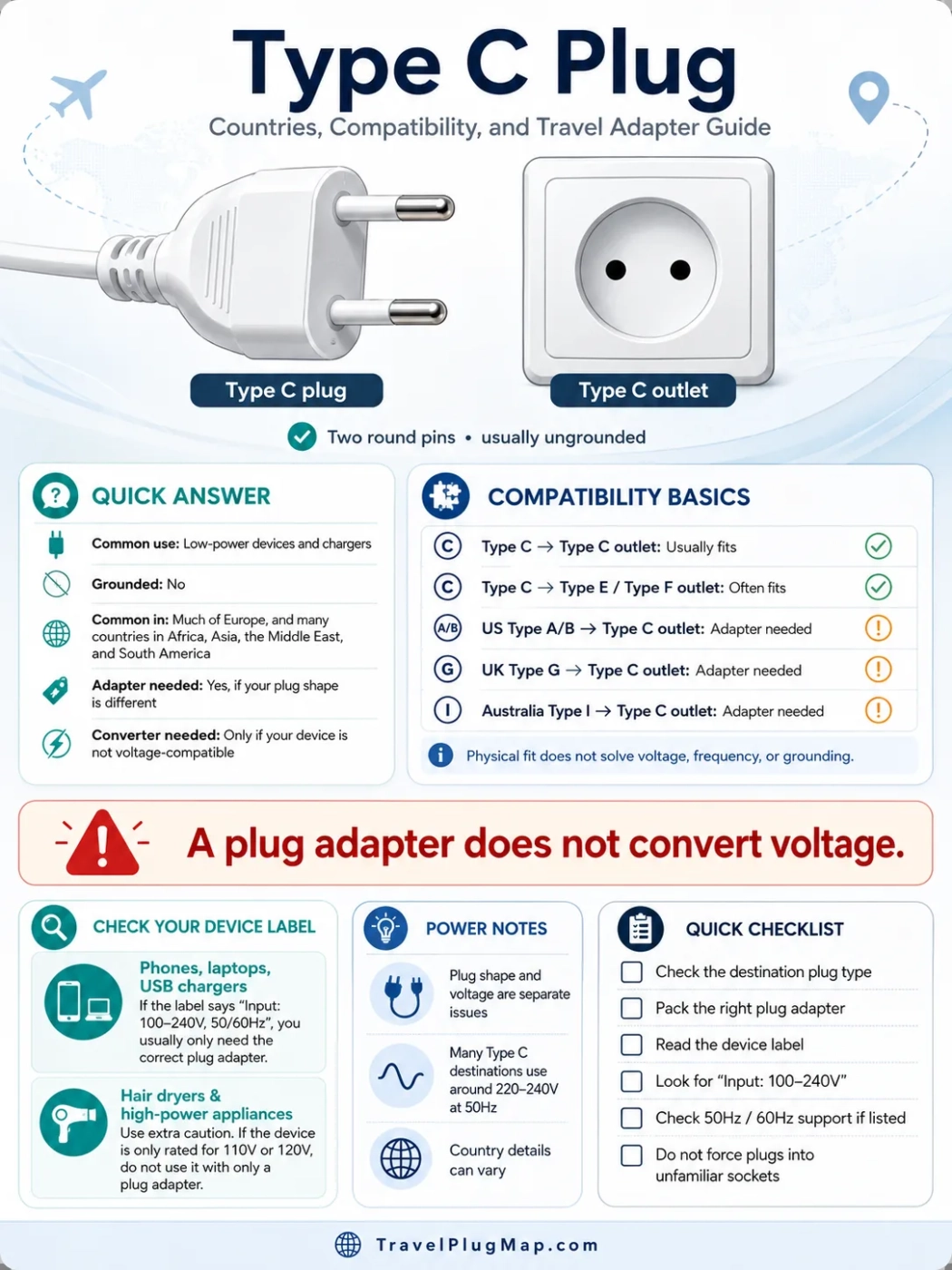
Type C is the familiar two-round-pin plug often associated with European-style travel adapters. It is commonly used for low-power, ungrounded devices such as phone chargers, camera chargers, and some small electronics, but plug shape and voltage are separate issues. Before using any device abroad, check both the outlet type and the device label.
| Question | Practical Answer |
|---|---|
| What does a Type C plug look like? | Two round pins, usually without grounding. |
| Is Type C grounded? | No. Type C is usually an ungrounded two-pin plug. |
| Where is Type C common? | It is widely used or accepted across much of Europe and in many countries in Africa, Asia, the Middle East, and South America. |
| Does a Type C adapter convert voltage? | No. A plug adapter does not convert voltage. |
| Is Type C safe for hair dryers? | Only if the device is compatible with the local voltage and power rating. High-power appliances need extra caution. |
What a Type C Plug and Outlet Look Like
A Type C plug has two round pins. It is often called a Europlug-style plug, especially when used on small travel devices and chargers. The important detail is that Type C normally has no grounding contact, so it is not meant for appliances that require an earth connection.
Many travelers also see Type C plugs used with sockets that are officially Type E, Type F, Type J, Type K, Type L, Type N, or Type O, because many of those outlets are designed to accept two round-pin plugs. Still, compatibility depends on the socket design and the country. Do not assume every round-looking outlet accepts every round-pin plug safely.
What Is a Type C Plug?
A Type C plug is a two-pin plug used for many low-power devices. It is one of the most travel-friendly plug shapes because it is small, simple, and accepted in many countries that use round-pin socket systems.
For travelers, Type C matters in two different ways:
- You may own a device with a Type C plug, such as a European phone charger.
- You may need a plug adapter that lets your home-country plug fit into a Type C or Type C-compatible outlet.
The plug adapter only changes the physical shape. A plug adapter does not convert voltage. If the destination uses a different voltage from your device, the device itself must support that voltage, or you may need a proper voltage converter.
Where Is Type C Used?
Type C plugs are widely used across much of mainland Europe and are also common or accepted in many countries across Africa, Asia, the Middle East, and South America. In practice, Type C often appears alongside other round-pin systems, especially Type E and Type F in Europe.
| Region | What Travelers Should Expect |
|---|---|
| Much of Europe | Type C plugs are commonly accepted, often in Type E or Type F outlets. |
| Parts of Africa | Some countries use Type C alongside other socket types such as Type D, E, F, or G. |
| Parts of Asia | Type C may appear with other local plug types, depending on the country. |
| Middle East | Some destinations use or accept Type C, but Type G, Type F, and other types may also appear. |
| South America | Some countries use Type C or accept Type C plugs, often alongside regional socket types. |
Because plug systems can vary inside the same country, hotels and newer buildings may offer multi-standard sockets. Older buildings may have fewer options. For travel planning, check the destination country’s plug type, voltage, and frequency before packing.
Is Type C Grounded?
Type C is usually not grounded. That means it has no third pin or earth contact. This is fine for many small, double-insulated devices, but it is not ideal for appliances that require grounding.
Examples of devices that often use ungrounded plugs include:
- Phone chargers
- USB chargers
- Camera battery chargers
- Some electric shavers
- Small radios or travel electronics
Examples that may need grounding or higher power include:
- Hair dryers
- Curling irons
- Travel kettles
- Clothes irons
- Some medical or motorized devices
Always check the device label before using high-power appliances abroad. If the plug has a grounding pin at home, do not rely on a simple two-pin Type C adapter unless the device manufacturer clearly supports that use.
Is Type C Compatible With Other Plug Types?
Type C compatibility can be confusing because the plug is common, but the socket may not always be a pure Type C socket. A Type C plug can often fit into several round-pin outlet systems, especially Type E and Type F outlets used in many European countries.
| Situation | Compatibility Guidance |
|---|---|
| Type C plug into Type C outlet | Usually fits physically. |
| Type C plug into Type E or Type F outlet | Often fits because many outlets accept two round pins. |
| Type E or Type F grounded plug into Type C outlet | Usually not suitable because grounded plugs may not fit or may lose grounding. |
| US Type A/B plug into Type C outlet | A plug adapter is needed. |
| UK Type G plug into Type C outlet | A plug adapter is needed. |
| Australia Type I plug into Type C outlet | A plug adapter is needed. |
The safest way to think about it is simple: Type C helps with the physical plug shape, but it does not solve voltage, frequency, grounding, or power-rating questions.
Do Travelers Need an Adapter for Type C Outlets?
You need a travel adapter for Type C outlets if your device has a different plug shape. Travelers from the United States, Canada, the United Kingdom, Ireland, Australia, New Zealand, Japan, and many other countries often need a plug adapter when visiting a Type C destination.
You may not need a plug adapter if your device already has a Type C plug or a plug that is accepted by the local socket. However, many destinations use more than one socket type, so a compact multi-country adapter may be useful for mixed-socket countries. Avoid forcing a plug into a socket. If it does not fit smoothly, use the correct adapter.
Voltage Is Separate From Plug Shape
The Type C plug shape does not tell you whether the local electricity is 110V, 120V, 220V, 230V, or 240V. Many Type C destinations use around 220–240V at 50Hz, but country details can vary. Some places may also have mixed infrastructure or more than one socket type.
The key phrase on modern chargers is Input: 100–240V. If your phone charger, laptop charger, camera charger, or USB charger says Input: 100–240V, 50/60Hz, it is usually dual voltage and can normally handle common travel voltages. In that case, you usually only need the correct plug adapter.
If the label says only 110V, 120V, or a narrow voltage range that does not match your destination, do not plug it in without proper voltage support. That is especially important for high-power appliances.
Phone Chargers, Laptop Chargers, and USB Devices
Most modern phone chargers and laptop power bricks are designed for international voltage ranges. Look for the small printed label on the charger body. If it says Input: 100–240V, the charger is usually suitable for both 120V and 230V countries, as long as you use the correct plug adapter.
For USB-C laptop chargers, tablet chargers, camera chargers, and power banks, the same rule applies: check the input label. Do not rely only on the cable connector. USB-C describes the device-side connector, not the wall plug or voltage compatibility.
Hair Dryers, Curling Irons, and High-Power Appliances
Hair dryers, curling irons, straighteners, kettles, and irons are higher-risk travel devices. They draw much more power than a phone charger and may heat up quickly if used with the wrong voltage.
If your appliance says only 120V and you plug it into a 230V country with only a plug adapter, it can overheat, fail, trip a breaker, or become unsafe. A plug adapter does not convert voltage. For these devices, use a dual-voltage travel appliance or check whether the appliance supports the destination voltage before packing it.
Frequency can also matter for some motorized or timing-based devices. A device rated for 60Hz may behave differently in a 50Hz country. Many simple chargers support both 50Hz / 60Hz, but some appliances do not.
CPAP Machines, Shavers, and Medical Devices
For CPAP machines and medical devices, check the power supply label carefully before traveling. Many CPAP power adapters support Input: 100–240V, but you should confirm the exact rating on your own device and power brick.
Electric shavers vary. Some are dual voltage, while others are designed for one voltage range only. Rechargeable shavers often have a separate charger, so check the charger label rather than the shaver body alone.
Type C Travel Checklist
- Check whether your destination uses Type C, accepts Type C, or uses another socket type alongside it.
- Pack a plug adapter if your device plug is not Type C-compatible.
- Read the device label before use.
- Look for Input: 100–240V on phone and laptop chargers.
- Use extra caution with high-power appliances such as hair dryers and curling irons.
- Remember that a plug adapter does not convert voltage.
- Check frequency support if the device mentions 50Hz or 60Hz only.
- Do not force plugs into loose, damaged, or unfamiliar sockets.
Common Mistakes With Type C Plugs
Assuming Type C Means Europe Only
Type C is strongly associated with Europe, but it is also used or accepted in many countries outside Europe. Always check the specific destination rather than relying on a region name.
Assuming Round Pins Always Fit
Several plug types use round pins, but that does not make them identical. Pin size, spacing, grounding, and socket shape can differ.
Using a Plug Adapter as a Voltage Converter
This is the most important mistake to avoid. A plug adapter does not convert voltage. It only helps the plug fit the outlet.
Ignoring Grounding
Type C is usually ungrounded. If your device requires grounding, use the proper grounded plug system for the destination and avoid unsafe two-pin workarounds.
FAQ
Is Type C the same as the European plug?
Type C is often called the European two-pin plug, but Europe also uses other plug types, especially Type E and Type F. A Type C plug is usually a small, ungrounded two-round-pin plug.
Can I use a Type C plug in a Type F outlet?
In many cases, yes. Type C plugs often fit Type F outlets. However, Type C is ungrounded, so it should be used only with suitable low-power or double-insulated devices.
Can I use a Type C adapter for my phone charger?
Usually, yes, if your phone charger label says Input: 100–240V. The adapter helps the plug fit the outlet, while the charger handles the voltage range.
Do I need a voltage converter for Type C countries?
Not automatically. You need to check the local voltage and your device label. If your device supports Input: 100–240V, a voltage converter is usually not needed for chargers.
Is Type C safe for hair dryers?
Only if the hair dryer supports the destination voltage and power requirements. Many hair dryers are high-power appliances, so do not use a simple plug adapter unless the appliance is clearly rated for the local voltage.
Does Type C work with 50Hz and 60Hz?
The plug shape itself does not control frequency. Check the device label. Many chargers support 50/60Hz, but some motorized or heating devices may be more sensitive.