Dual voltage devices are usually the easiest electronics to travel with because they can work on both 120V and 230V power systems. In most cases, if your device label says Input: 100–240V, 50/60Hz, you only need the correct plug adapter for the country you are visiting.
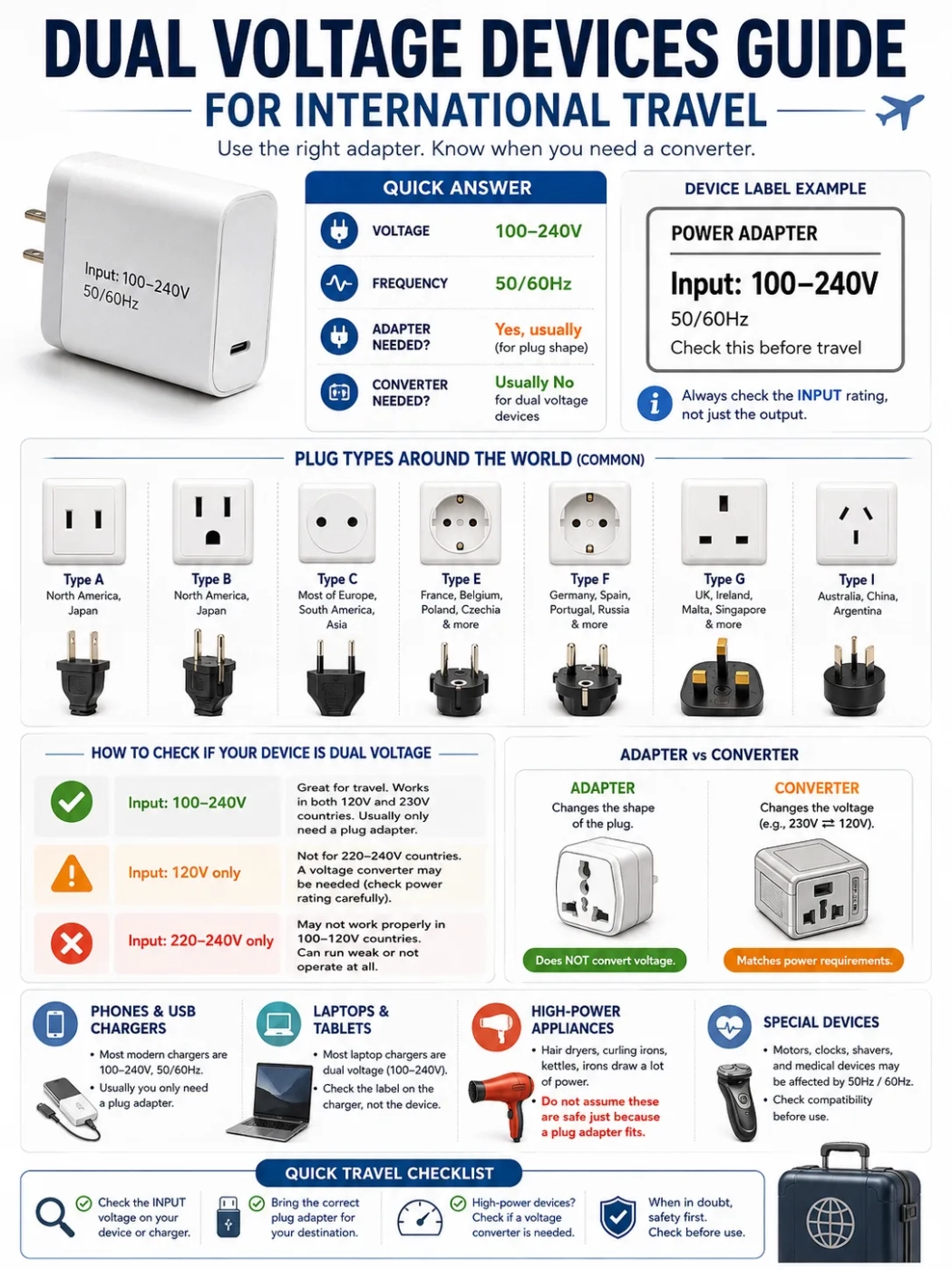
Quick Answer
A dual voltage device can safely accept a wide range of electricity, usually from 100V to 240V. This matters because some countries use around 110–120V, while many others use around 220–240V.
| Device Label | What It Means | Adapter Needed? | Voltage Converter Needed? | Travel Advice |
|---|---|---|---|---|
| Input: 100–240V, 50/60Hz | Works in most countries | Usually yes, if the plug shape is different | Usually no | Use the right plug adapter for the destination |
| Input: 110–120V only | Designed for lower-voltage countries | Maybe | May be needed in 220–240V countries | Be careful with heat-producing appliances |
| Input: 220–240V only | Designed for higher-voltage countries | Maybe | May be needed in 110–120V countries | Check before use |
| No clear voltage label | Uncertain | Depends on plug shape | Do not assume | Check the manual or avoid using it abroad |
What Is a Dual Voltage Device?
A dual voltage device is an electrical device that can work with more than one voltage range. For international travel, this usually means the device can accept both the lower-voltage power used in places like the United States, Canada, and parts of the Americas, and the higher-voltage power used in many countries across Europe, Asia, Africa, and Oceania.
The easiest way to identify a dual voltage device is by reading the small label printed on the charger, power brick, plug, or device body. If it says something like Input: 100–240V, the device is designed to handle a wide voltage range.
This does not mean the plug will physically fit every wall outlet. Plug shape and voltage are separate issues. A device can be dual voltage and still need a travel adapter because the power outlet shape is different.
What “Input: 100–240V” Means
The phrase Input: 100–240V means the device can accept electrical voltage anywhere between 100 volts and 240 volts. This range covers most common household power systems used around the world.
You may also see the full label written like this:
Input: 100–240V~ 50/60Hz
Here is what each part means:
- Input: The electricity the device can receive from the wall outlet.
- 100–240V: The voltage range the device can safely accept.
- 50/60Hz: The frequency range the device can usually handle.
- Output: The electricity the charger sends to your phone, laptop, camera, or other device.
For most travelers, the input line is the most important part. If the input range includes both 100V and 240V, the device is usually travel-friendly for voltage. You still need to match the plug type to the destination country’s socket type.
Travel Adapter vs Voltage Converter
A travel adapter and a voltage converter do different jobs. This is one of the most common travel power mistakes.
A plug adapter does not convert voltage. It only changes the shape of the plug so it can fit into a different power outlet.
| Item | What It Does | What It Does Not Do | When You May Need It |
|---|---|---|---|
| Plug adapter | Lets your plug fit a foreign socket type | Does not change voltage | When the outlet shape is different |
| Voltage converter | Changes voltage from one level to another | Does not guarantee compatibility with every device | When your device is single voltage and the country uses a different voltage |
If your charger says Input: 100–240V, you usually need only a plug adapter. If your device says only 120V or only 230V, you may need a voltage converter, or it may be safer to leave that device at home.
How to Check Your Device Label
Before traveling, check the device label carefully. The label may be printed in small text, so use a bright light if needed.
Where to Look
- On the phone charger plug
- On the laptop power brick
- On the camera battery charger
- On the electric shaver charger
- On the bottom or back of the device
- Inside the user manual or product specifications
What to Look For
Look for the word Input, not only Output. The output line tells you what the charger sends to your device. The input line tells you what the charger can receive from the wall outlet.
For international travel, labels like these are usually good signs:
- Input: 100–240V 50/60Hz
- Input: 110–240V
- Input: 100–240V~
Labels like these need more caution:
- Input: 120V only
- Input: 230V only
- AC 110V
- AC 220V
If the label is missing, damaged, or unclear, do not guess. Check the official product manual or use a device that is clearly marked as dual voltage.
Common Dual Voltage Devices
Many modern travel electronics are dual voltage, especially devices that charge through a power adapter or USB charger. Still, you should check each device label before plugging it in abroad.
| Device | Usually Dual Voltage? | Adapter Needed? | Converter Needed? | What to Check |
|---|---|---|---|---|
| Phone charger | Commonly yes | Usually, if plug shape differs | Usually no | Input: 100–240V |
| Laptop charger | Commonly yes | Usually, if plug shape differs | Usually no | Power brick input label |
| Tablet charger | Commonly yes | Usually, if plug shape differs | Usually no | Charger input rating |
| Camera battery charger | Often yes | Usually, if plug shape differs | Usually no, if 100–240V | Battery charger label |
| Electric shaver | Often, but not always | Depends on plug shape | Only if single voltage | Charger or device label |
| Hair dryer | Not always | Depends on plug shape | Risky if single voltage | Voltage switch or input label |
| Curling iron | Not always | Depends on plug shape | May be needed if single voltage | Exact voltage rating |
| CPAP machine | Often yes, but must be verified | Usually, if plug shape differs | Usually no if 100–240V | Power supply label and medical device instructions |
Phone Chargers and Dual Voltage Travel
Most modern phone chargers are designed for international use, but you should still check the label. If your charger says Input: 100–240V, 50/60Hz, it can usually handle the voltage in most countries.
In that case, your main concern is the plug type. For example, your charger may have a Type A plug, but your destination may use Type C, Type G, Type I, or another socket type. A plug adapter helps the charger fit the local power outlet.
If you use USB charging, remember that the wall charger still connects to the local electricity supply. Check the wall charger input rating, not only the USB cable.
Laptop Chargers and Dual Voltage Travel
Laptop chargers are commonly dual voltage because laptops are sold and used internationally. The voltage information is usually printed on the power brick between the wall cable and the laptop cable.
If the power brick says Input: 100–240V, you usually do not need a voltage converter. You may only need a plug adapter or a different detachable power cable that matches the destination outlet.
Do not assume every laptop charger is the same. Older chargers, replacement chargers, or third-party chargers should always be checked before travel.
High-Power Devices Need More Care
High-power devices are different from phone and laptop chargers. Items that produce heat or use strong motors can draw much more power, and they may be less forgiving when used with the wrong voltage.
Examples include:
- Hair dryers
- Curling irons
- Hair straighteners
- Travel kettles
- Clothes irons
- Heating pads
- Some electric toothbrush bases
- Some kitchen appliances
A single-voltage 120V hair dryer plugged into a 230V outlet can overheat, fail, or become unsafe. A plug adapter alone will not protect it because the adapter does not convert voltage.
If you want to travel with a hair dryer or curling iron, check whether it is clearly marked as dual voltage. Some devices also have a manual voltage switch, such as 110/220V. If your device has a switch, set it correctly before plugging it in.
120V vs 230V Travel Risk
The biggest voltage risk happens when a single-voltage device is used in a country with a different voltage system.
Taking a 120V Device to a 230V Country
This is often the higher-risk direction. A device designed only for 120V may receive nearly double the voltage in a 220–240V country. This can damage the device quickly and may create a safety hazard, especially with heat-producing appliances.
Taking a 230V Device to a 120V Country
A 230V-only device used in a 120V country may not work properly, may run weakly, or may not turn on. Some motor or heating devices may perform poorly. It is still not something to guess about.
Dual voltage devices reduce this problem because they are built to accept a wider voltage range.
What About 50Hz and 60Hz?
Frequency is shown as Hz, usually 50Hz or 60Hz. Many modern chargers marked 50/60Hz can work with both common frequencies.
For phone chargers, laptop chargers, tablet chargers, and many camera chargers, frequency is usually not a major issue when the device label says Input: 100–240V, 50/60Hz.
Frequency can matter more for some devices with motors, clocks, pumps, or timing mechanisms. If you are traveling with a CPAP machine, medical device, electric toothbrush base, or appliance with a motor, check the label and manufacturer instructions carefully.
CPAP Machines and Medical Devices
Many CPAP machines use power supplies that support 100–240V, but this should never be assumed. Check the power supply label and any travel instructions provided with the machine.
If your CPAP power supply is dual voltage, you will usually need the correct plug adapter for the destination country. You may also need to consider battery backup, airline rules, distilled water availability, and whether the device uses a grounded plug.
For medical devices, avoid guesswork. If the label is unclear, confirm compatibility before travel.
When a Plug Adapter Is Enough
A plug adapter is usually enough when all of these are true:
- Your device label says Input: 100–240V.
- The frequency label includes 50/60Hz or supports the destination frequency.
- The destination country uses a different plug type than your home country.
- The device is not a high-risk single-voltage heating appliance.
In this situation, the plug adapter simply helps your device fit the local socket type. The device itself handles the voltage.
When a Voltage Converter May Be Needed
A voltage converter may be needed when your device is single voltage and the destination uses a different voltage. For example, a 120V-only device may need a converter in a 230V country.
However, voltage converters are not a perfect solution for every appliance. High-power devices such as hair dryers, kettles, and irons may need a converter with enough wattage capacity, and even then performance and safety can vary.
For short trips, it is often simpler and safer to use dual voltage travel devices or use appliances provided locally, especially for high-power items.
Common Mistakes to Avoid
- Assuming plug shape equals voltage: The outlet shape does not tell you everything about voltage.
- Using only a plug adapter with a single-voltage appliance: A plug adapter does not convert voltage.
- Checking output instead of input: The input rating is what matters for wall power compatibility.
- Assuming all chargers are dual voltage: Many are, but not all. Check the label.
- Ignoring high-power devices: Hair dryers and curling irons need more caution than phone chargers.
- Forgetting frequency: 50Hz / 60Hz is usually fine for modern chargers but can matter for some motorized devices.
Travel Checklist for Dual Voltage Devices
- Check every device label before packing.
- Look for Input: 100–240V.
- Check whether the label includes 50/60Hz.
- Confirm the plug type used in your destination country.
- Pack the correct plug adapter for the local power outlet.
- Do not rely on a plug adapter to convert voltage.
- Be extra careful with hair dryers, curling irons, kettles, and irons.
- For CPAP machines and medical devices, verify compatibility before travel.
- Consider leaving single-voltage high-power appliances at home.
FAQ
How do I know if my device is dual voltage?
Check the device or charger label. If it says Input: 100–240V, it is usually dual voltage and can work in most countries with the right plug adapter.
Do dual voltage devices need a travel adapter?
Yes, they may still need a travel adapter if the plug shape does not match the destination country’s power outlet. Dual voltage only solves the voltage issue, not the socket shape.
Do I need a voltage converter for my phone charger?
Usually no, if your phone charger says Input: 100–240V, 50/60Hz. You will usually only need the correct plug adapter for the country you are visiting.
Can I use a dual voltage hair dryer abroad?
Usually yes, if it is clearly marked as dual voltage and any voltage switch is set correctly. Hair dryers use a lot of power, so check the label carefully before use.
What happens if I plug a 120V device into a 230V outlet?
If the device is not dual voltage, it may overheat, break, or become unsafe. A plug adapter will not prevent this because it does not convert voltage.
Is 50Hz / 60Hz important for travel electronics?
For many modern chargers, it is usually fine if the label says 50/60Hz. Frequency can matter more for some motorized, timing-based, or medical devices.