A universal travel adapter can help your plug fit into many foreign power outlets, but it does not make every device safe to use abroad. It usually works well for dual-voltage phone chargers, laptop chargers, camera chargers, and small USB devices. It does not convert voltage, and it may not be suitable for high-power appliances such as hair dryers, curling irons, kettles, or irons.
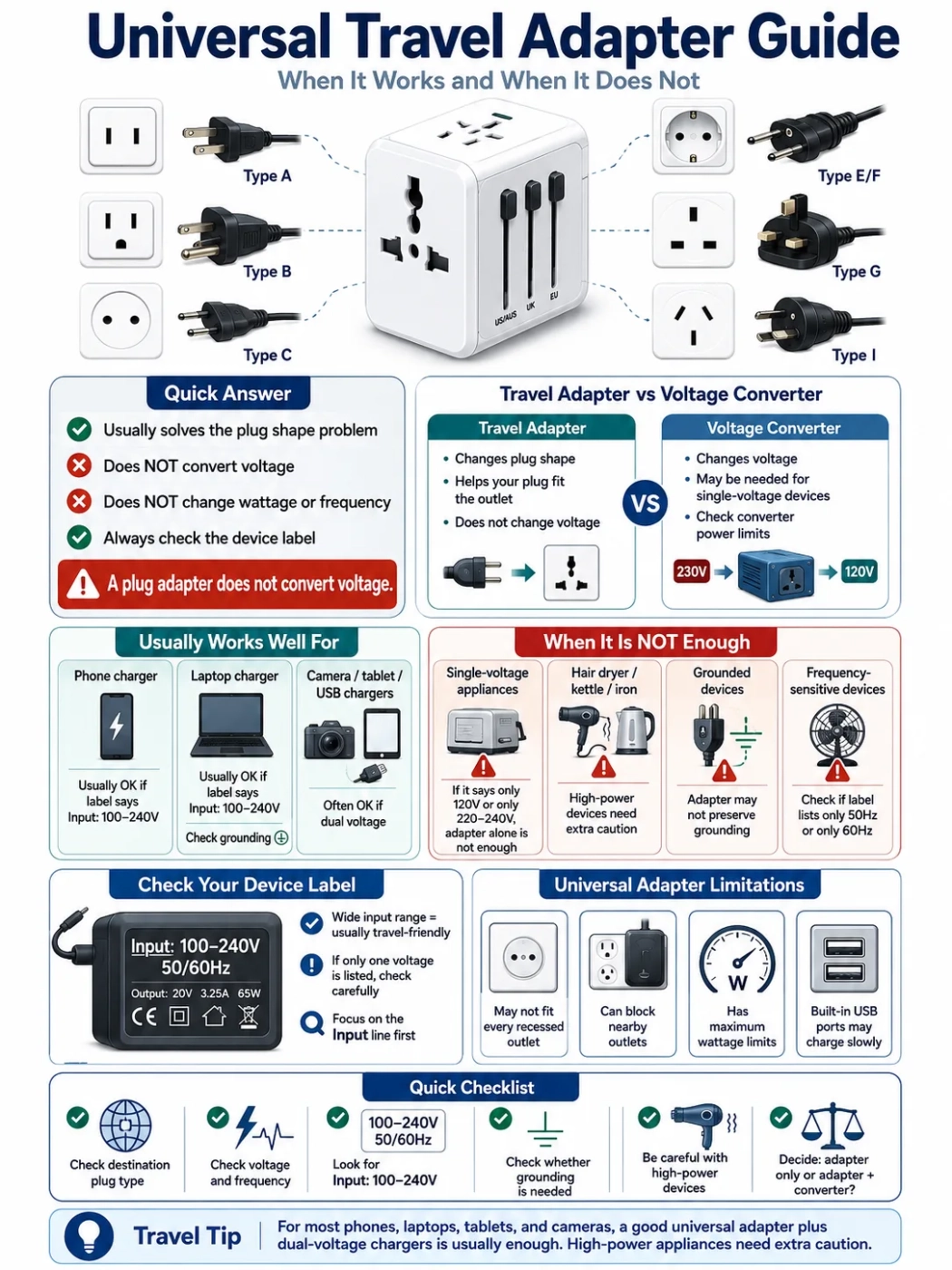
Quick Answer
| Situation | Will a Universal Adapter Help? | What Else to Check |
|---|---|---|
| Charging a phone with a modern charger | Usually yes | Check for “Input: 100–240V” on the charger |
| Using a laptop charger abroad | Usually yes | Check voltage range and plug shape |
| Charging a camera, tablet, smartwatch, or power bank | Usually yes | Check the charger label before use |
| Using a hair dryer, curling iron, kettle, or clothes iron | Often no | Check voltage, wattage, and whether a converter is needed |
| Using a grounded appliance | Sometimes | Make sure the adapter supports grounding if the device requires it |
| Traveling to a country not supported by the adapter | No | Use the correct plug adapter for that destination |
What a Universal Travel Adapter Actually Does
A universal travel adapter is mainly a plug-shape adapter. It helps the plug on your device or charger fit into a different socket type in another country.
For example, a traveler from the United States may need to plug a Type A or Type B plug into a Type G outlet in the United Kingdom, a Type C outlet in parts of Europe, or a Type I outlet in Australia. A universal adapter may include sliding pins or interchangeable plug heads that cover several common outlet types.
That sounds simple, but there is one important limit: a plug adapter does not convert voltage. It changes the physical connection only. The electrical supply behind the wall outlet still has the local voltage and frequency of the country you are visiting.
Universal Adapter vs Voltage Converter
Travelers often confuse travel adapters and voltage converters. They solve different problems.
| Item | What It Does | What It Does Not Do |
|---|---|---|
| Travel adapter | Changes plug shape so your plug can fit the outlet | Does not change voltage or frequency |
| Voltage converter | Changes voltage, such as 230V to 120V or 120V to 230V | Does not always solve plug-shape compatibility by itself |
| Universal travel adapter | Covers several plug types in one travel accessory | Usually does not make single-voltage appliances safe abroad |
If your device is dual voltage, a plug adapter may be enough. If your device is single voltage and the country uses a different voltage, you may need a voltage converter or a different travel-friendly device.
What “Input: 100–240V” Means
The most useful detail on your device charger is the input rating. Look for text such as:
Input: 100–240V, 50/60Hz
This usually means the charger is designed to work across common international voltage ranges. Many phone chargers, laptop chargers, tablet chargers, USB-C chargers, and camera battery chargers have this type of rating.
If your charger says “Input: 100–240V,” it can usually handle both 120V countries and 220–240V countries. In that case, you normally only need the correct plug adapter for the destination’s socket type.
If the label says only “Input: 120V” or only “Input: 230V,” the device may be single voltage. A universal travel adapter alone is not enough when the destination voltage is different.
When a Universal Travel Adapter Works Well
Phone Chargers
Most modern phone chargers are dual voltage. If your charger label says “Input: 100–240V,” a universal travel adapter is usually enough for charging your phone abroad.
The adapter lets the charger fit into the local power outlet. The charger itself handles the voltage. This is why phones are usually low-risk travel devices compared with heating appliances.
Laptop Chargers
Most modern laptop power bricks are also rated for 100–240V and 50/60Hz. In most cases, you can use them internationally with the correct plug adapter.
Still, check the label on the charger brick before you plug it in. Do not rely only on the laptop brand or model. The charger label gives the most relevant information.
USB-C Chargers and Small Electronics
USB-C chargers, tablet chargers, smartwatch chargers, camera chargers, and power bank chargers are commonly dual voltage. A universal adapter may work well for these devices when the adapter supports the destination outlet type.
If your universal adapter has built-in USB or USB-C ports, remember that those ports also have power limits. They may be fine for phones and small devices but may not provide enough power for every laptop.
When a Universal Travel Adapter Does Not Work
It Does Not Convert Voltage
This is the most important rule. A universal travel adapter does not convert voltage. If you plug a 120V-only appliance into a 230V outlet using only an adapter, the appliance may overheat, fail, or become unsafe.
The same idea applies in the other direction. A 230V-only device may not work correctly in a 120V country, even if the plug fits.
It May Not Be Suitable for High-Power Appliances
High-power travel devices need extra care because they draw much more electricity than phone or laptop chargers.
- Hair dryers
- Curling irons
- Hair straighteners
- Electric kettles
- Clothes irons
- Steamers
- Some electric shavers
These devices may be single voltage, high wattage, or both. Even if the plug fits into a universal adapter, the appliance may still be unsafe if the voltage is wrong.
It May Not Support Grounded Devices Properly
Some devices have a grounded plug. Grounding is a safety feature, especially for certain appliances with metal parts or higher power use.
Not every universal travel adapter provides a true grounded connection for every plug type. If your device requires grounding, use an adapter that specifically supports grounded use for the destination socket type. If you are unsure, avoid using that device abroad.
It May Not Fit Every Outlet Type
“Universal” does not always mean every country, every socket, and every situation. Some countries use more than one socket type. Some outlets are recessed. Some sockets may be loose, worn, or shaped in a way that makes bulky adapters difficult to use.
Before traveling, check the plug type used in your destination. A universal adapter is useful only if it supports the outlet type you will actually find there.
Travel Adapter Safety Alerts in 2026
The word “universal” describes compatibility with several plug shapes; it does not confirm that an adapter has safe shutters, correct pin dimensions, secure socket contact, grounding support, suitable internal protection, or accurate electrical markings. Check the adapter itself as well as the device you plan to connect.
- Shutter protection: The socket openings should prevent accidental access to live internal parts.
- Secure outlet fit: Plug pins should enter the socket correctly and the adapter should remain stable without exposing live metal or sitting loosely in the outlet.
- Grounding: If the connected device requires grounding, the adapter must preserve a suitable grounded connection for that plug and socket combination.
- Current and wattage: Stay within the maximum voltage, current, and wattage ratings printed on the adapter.
- Ratings and markings: Avoid adapters with missing, unclear, altered, or inconsistent electrical ratings and product markings.
- UK plug construction: For an adapter intended to connect to a UK BS 1363 socket, check that the UK plug face and fuse arrangement are suitable for that design. A plug that does not fit the socket correctly or uses inadequate protection can create shock, overheating, or fire risks.
- Recall and safety-report status: Check official product safety notices when the brand or model is unfamiliar, the seller information is unclear, or the adapter has no reliable product documentation.
Azara Travel Adaptor SP-128 Recall
On June 25, 2026, the UK Office for Product Safety and Standards published a recall for the Azara Travel Adaptor, model SP-128. The authority reported a serious electric-shock risk because the shutter mechanism could allow access to live parts. The notice also stated that improvements were required to product labelling and marking. Owners were advised to stop using the recalled adapter and contact the distributor for redress. See the official UK recall notice.
Universal Travel Adaptor 931E Recall
The same day, the UK Office for Product Safety and Standards recalled the Universal Travel Adaptor 931E for a high risk of electric shock. The shutters could allow access to live internal parts, and the UK plug face did not meet the dimensional requirements of BS 1363, which meant it could fail to make a secure connection with the socket. The notice also identified marking and labelling issues. Owners were advised to stop using the recalled adapter and contact the distributor for redress. See the official UK recall notice.
EGTECH EGC50 Safety Report
On August 11, 2026, the UK Office for Product Safety and Standards published a product safety report for the EGTECH Travel Adapter, model EGC50, sold via Amazon. The product was assessed as presenting a high risk of electric shock because its insulated shutter operating device (ISOD), also described as the plastic earth pin, was shorter than required by the dimensional requirements of BS 1363. This could prevent the socket shutters from operating correctly and potentially allow access to live parts if an internal fault occurred during use.
The authority stated that the adapter did not meet the Electrical Equipment (Safety) Regulations 2016 or the Plugs and Sockets etc (Safety) Regulations 1994. The import was rejected at the border and destroyed. See the official UK product safety report.
These model-specific safety notices show why plug shape alone is not enough when checking a travel adapter. Shutters, pin dimensions, outlet fit, grounding, fuse protection where required, electrical ratings, and official safety-report or recall status can matter even when an adapter appears to fit the destination socket.
Voltage, Frequency, and Plug Shape Are Separate
Plug shape, voltage, and frequency are three different parts of travel power compatibility.
- Plug type: The physical shape of the plug and socket.
- Voltage: The electrical pressure supplied by the outlet, commonly around 120V or 220–240V depending on the country.
- Frequency: The power cycle rate, usually 50Hz or 60Hz.
A universal adapter mainly solves plug shape. It does not normally change voltage or frequency.
Frequency matters less for many modern electronic chargers because they are often labeled 50/60Hz. It can matter more for some motors, clocks, and appliances designed for one frequency only. If a device label lists only 50Hz or only 60Hz, be more careful.
How to Check Your Device Before Using a Universal Adapter
Before using any device abroad, check the small label printed on the charger, power brick, or appliance body. Do this before you pack, not after you arrive.
Step 1: Find the Input Rating
Look for a line that starts with “Input.” It may be printed very small.
- Input: 100–240V, 50/60Hz: Usually safe for international use with the correct plug adapter.
- Input: 120V, 60Hz: May need a voltage converter in 220–240V countries.
- Input: 220–240V, 50Hz: May not work properly in 120V countries.
Step 2: Check the Plug Type
Compare your plug with the destination’s power outlet. If the shape is different, you need a plug adapter. A universal travel adapter may help if it supports that outlet type.
Step 3: Check Wattage for High-Power Devices
For hair dryers, curling irons, kettles, and other heating appliances, check wattage as well as voltage. Many travel adapters have maximum wattage or current limits. Do not use a high-power appliance if it exceeds the adapter’s rating.
Device-by-Device Guidance
| Device | Adapter Needed? | Converter Needed? | What to Check |
|---|---|---|---|
| Phone charger | Yes, if plug shape differs | Usually no if dual voltage | Look for “Input: 100–240V” |
| Laptop charger | Yes, if plug shape differs | Usually no if dual voltage | Check the power brick label |
| Tablet or camera charger | Yes, if plug shape differs | Usually no if dual voltage | Check input voltage and frequency |
| Electric shaver | Maybe | Depends on model | Check if it is dual voltage |
| Hair dryer | Maybe | Often needed if single voltage | Check voltage, wattage, and travel mode |
| Curling iron or straightener | Maybe | Often needed if single voltage | Check voltage rating before use |
| CPAP machine | Yes, if plug shape differs | Usually no if the power supply is 100–240V | Check the exact power supply label and use medical-device caution |
Can You Use a Universal Travel Adapter for a Hair Dryer?
Sometimes, but this is one of the most common travel power mistakes.
A hair dryer is a high-power heating appliance. If it is single voltage and you travel to a country with a different voltage, a plug adapter alone is not enough. You would need a suitable voltage converter, or it may be safer to use a dual-voltage travel hair dryer or a local appliance.
Even with a converter, high-wattage appliances can be difficult. Many converters and adapters have strict limits. Always check the rating of both the appliance and the converter before use.
Can You Use a Universal Travel Adapter for a CPAP Machine?
Many CPAP machines use an external power supply that may support 100–240V, but you should not assume. Check the label on the CPAP power supply carefully.
If it says “Input: 100–240V, 50/60Hz,” you may only need the correct plug adapter for the destination. If the label shows a narrow voltage range, ask the device provider or manufacturer before traveling.
For medical devices, it is better to be cautious. Also check airline, battery, and backup-power needs before your trip.
Common Mistakes With Universal Travel Adapters
Thinking “Universal” Means Voltage-Safe
A universal adapter can make the plug fit, but it does not make the voltage safe. Always check the device label.
Using One Adapter for Too Many Devices at Once
Some adapters include several USB ports or allow multiple devices. This does not mean unlimited power. Stay within the adapter’s rating and avoid overloading it.
Ignoring Grounding
If a device has a three-prong grounded plug, do not force it into an ungrounded adapter. Grounding matters for safety.
Assuming All Outlets in a Country Are the Same
Some destinations use more than one socket type. Hotels, older buildings, airports, trains, and cruise cabins may not all have the same outlet setup.
Using Damaged or Loose Adapters
Do not use a travel adapter that feels loose, overheats, sparks, smells unusual, or cannot hold the plug securely. Stop using any model that appears in an official recall, and check product safety reports when a specific adapter model has been flagged by an electrical-safety authority.
What to Pack for Travel Power
- A universal travel adapter that supports your destination’s outlet type
- Your original phone and laptop chargers
- A USB-C or USB charger rated for 100–240V if your devices use USB charging
- A voltage converter only if your device truly needs one
- A destination-specific plug adapter for countries where your universal adapter may not fit well
- A power bank for travel days and transit
Do not pack a voltage converter automatically. First check whether your devices are dual voltage. For many modern electronics, the correct plug adapter is enough.
Simple Travel Power Checklist
- Check your destination’s plug type before you travel.
- Check the voltage and frequency used in the destination.
- Read the input label on every charger or appliance you plan to use.
- Look for “Input: 100–240V” on phone, laptop, camera, and CPAP power supplies.
- Be extra careful with hair dryers, curling irons, kettles, irons, and other heating appliances.
- Remember that a plug adapter does not convert voltage.
- Do not exceed the adapter’s wattage or current rating.
- Use grounded adapters for devices that require grounding.
- Check the adapter’s shutters, plug fit, electrical ratings, and product markings before use.
- Check official recall and product safety notices when the adapter brand or model is unfamiliar or poorly documented.