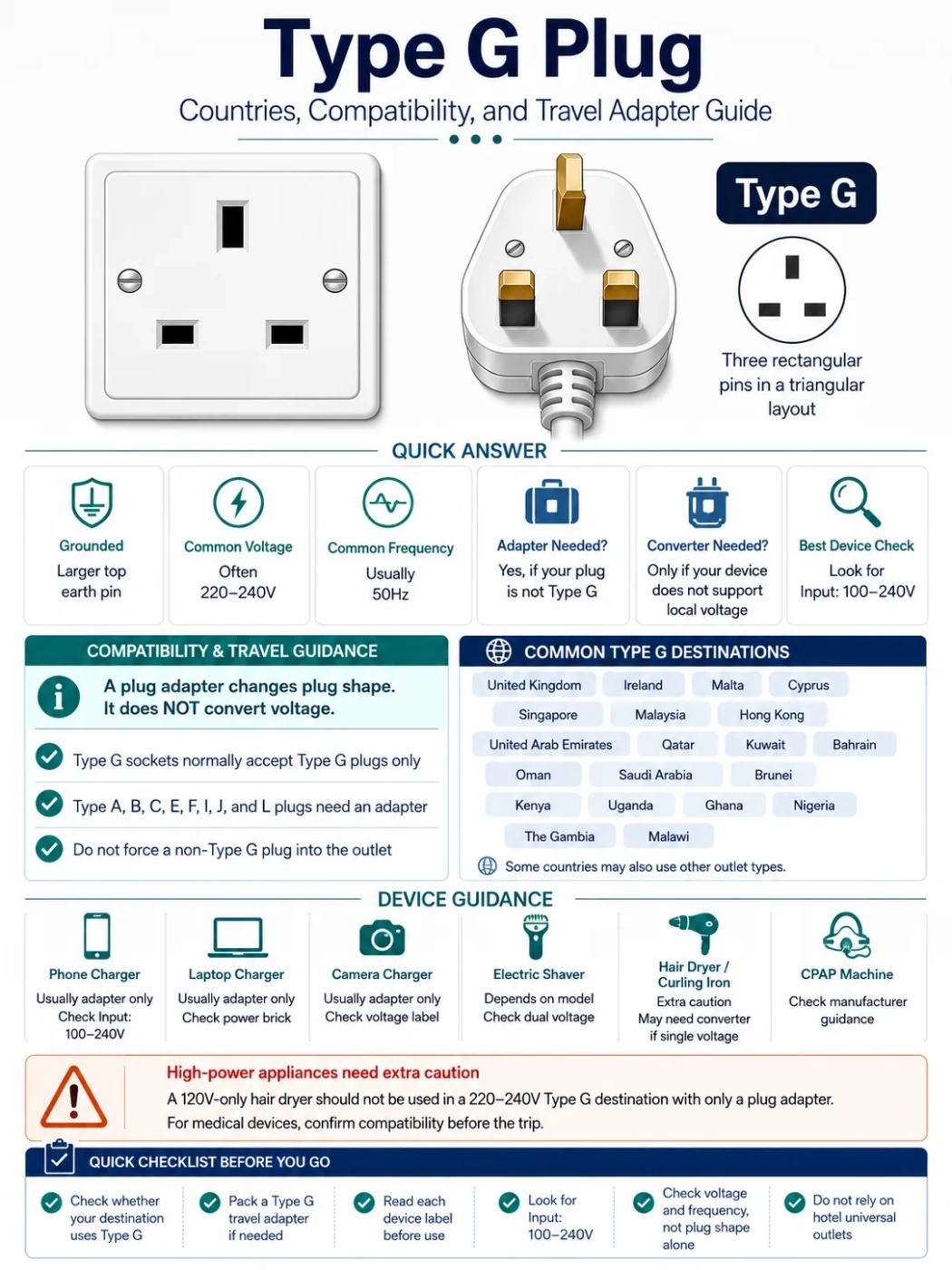
Type G is the large three-pin plug type used in the United Kingdom, Ireland, Malta, Cyprus, Singapore, Malaysia, Hong Kong, and several other destinations. If your device plug is not Type G, you will usually need a Type G travel adapter to fit the local power outlet. You may also need a voltage converter if your device is not compatible with the destination voltage.
| Item | What travelers need to know |
|---|---|
| Plug shape | Three rectangular pins in a triangular layout |
| Grounding | Grounded design with a larger top earth pin |
| Common voltage range | Often 220–240V in many Type G countries, but this is not guaranteed everywhere |
| Common frequency | Usually 50Hz in many Type G destinations, though travelers should still check country-specific information |
| Adapter needed? | Needed if your plug is Type A, B, C, E, F, I, J, L, or another non-Type G plug |
| Converter needed? | Only if your device does not support the local voltage |
| Best device advice | Check for Input: 100–240V on chargers before use |
What a Type G Plug and Outlet Look Like
This is a simplified front view. Real Type G wall sockets can look different depending on the building, socket manufacturer, hotel, or age of installation. The top rectangular slot is for the grounding pin, while the two lower rectangular slots are for the live and neutral pins. Plug shape and voltage are separate issues, so a plug that fits physically is not automatically safe for every device.
What Is a Type G Plug?
A Type G plug is a three-pin power plug with rectangular pins. It is strongly associated with the British-style outlet system and is widely recognized by its large, solid shape. The plug is designed for grounded connections and is commonly used with appliances, laptop chargers, phone chargers, hotel room outlets, and household sockets in Type G destinations.
Many Type G plugs include a fuse inside the plug body. This is one of the design features that makes Type G different from many smaller plug types. For travelers, the practical point is simple: a Type G socket normally expects a Type G plug. If your device uses a different plug shape, you need a plug adapter for Type G outlets.
What Does a Type G Plug Look Like?
A Type G plug has three rectangular pins arranged in a triangle. The grounding pin is the larger top pin. The live and neutral pins sit below it, usually side by side. Compared with Type C or Type A plugs, Type G looks larger, heavier, and more angular.
Travelers often notice Type G outlets in hotels because the socket face usually has three rectangular openings. Some hotels may provide multi-standard sockets or USB charging points, but you should not rely on that. A compact Type G travel adapter is often the safest item to pack when your home plug is not Type G.
Where Is Type G Used?
Type G is commonly used in the United Kingdom, Ireland, Malta, Cyprus, Singapore, Malaysia, Hong Kong, and several countries in the Middle East, Africa, Asia, and island destinations. It is also often seen in places such as the United Arab Emirates, Qatar, Kuwait, Bahrain, Oman, Saudi Arabia, Brunei, Kenya, Uganda, Ghana, Nigeria, The Gambia, Malawi, and some other destinations.
This list should be treated as practical travel guidance, not a promise that every building in every country uses only Type G. Some countries use Type G alongside other socket types. Older buildings, airports, hotels, serviced apartments, and imported appliances may create mixed outlet situations. When planning a trip, check the destination country page as well as your device label.
Common Type G Travel Destinations
- United Kingdom
- Ireland
- Malta
- Cyprus
- Singapore
- Malaysia
- Hong Kong
- United Arab Emirates
- Qatar, Kuwait, Bahrain, and Oman
- Kenya, Uganda, Ghana, Nigeria, and The Gambia
Is Type G Grounded?
Yes, Type G is a grounded plug type. The large top rectangular pin is the earth pin. In many Type G socket designs, this top pin also helps open internal shutters before the live and neutral pins can make contact. This is one reason Type G sockets look and feel more substantial than smaller two-pin sockets.
However, grounding only helps if the full connection is properly maintained through the plug, adapter, socket, and device. Some cheap travel adapters may not preserve grounding properly. If you are using a device with a three-prong grounded plug, choose an adapter that supports grounding instead of a very basic two-pin adapter.
Is Type G Compatible With Other Plug Types?
A standard Type G socket is normally compatible with Type G plugs. It does not naturally accept Type A, Type B, Type C, Type E, Type F, Type I, Type J, or Type L plugs without an adapter. A European Type C plug, for example, should not be forced into a Type G outlet. A North American Type A or Type B plug also needs a Type G adapter.
Some travel sockets in hotels may accept multiple plug shapes, but those are not the same as standard Type G wall sockets. Treat multi-standard outlets as a convenience, not a guarantee. If you are traveling to a Type G country, the safest assumption is: bring a Type G plug adapter if your plug is not Type G.
Do Travelers Need an Adapter for Type G Outlets?
You need a travel adapter if your device plug does not physically match the Type G outlet. For example, travelers from the United States, Canada, Mexico, Japan, most of mainland Europe, Australia, New Zealand, Switzerland, Italy, Brazil, and many other regions usually need an adapter for Type G destinations.
A travel adapter changes the plug shape so your device can fit into the wall outlet. A plug adapter does not convert voltage. This is the most important point on the page. If your device is made only for 110–120V and you plug it into a 230V country using only an adapter, the device may overheat, fail, or become unsafe.
Voltage Is Separate From Plug Shape
Many Type G countries use around 220–240V and 50Hz power, but you should not assume voltage from plug shape alone. The same plug type can appear in places with different electrical situations, and some countries use more than one outlet type. Always check the destination voltage and frequency before using anything more sensitive than a normal phone or laptop charger.
The key label to look for is Input: 100–240V. This means the device is designed to accept a wide voltage range and can usually be used in both 120V and 230V countries. Many phone chargers, USB chargers, laptop power bricks, camera chargers, and tablet chargers are dual voltage. They usually need only the correct plug adapter.
If the label says only “Input: 120V” or “Input: 110V,” it is not a universal-voltage device. In a 220–240V destination, that device may require a suitable voltage converter, or it may be better to leave it at home and use a travel-ready alternative.
Phone, Laptop, and Everyday Charger Guidance
Modern phone and laptop chargers are usually the easiest devices to use in Type G countries. Check the charger body, power brick, or tiny printed label. If it says Input: 100–240V, 50/60Hz, the charger is generally suitable for international voltage. You still need a Type G plug adapter if the plug shape does not match.
USB charging can also make travel simpler, especially for phones, earbuds, smartwatches, cameras, and tablets. Still, the wall charger itself must support the local voltage. Do not judge by the USB cable; check the charger label.
| Device | Adapter needed? | Converter needed? | What to check |
|---|---|---|---|
| Phone charger | Usually yes, if your plug is not Type G | Usually no, if dual voltage | Look for Input: 100–240V |
| Laptop charger | Usually yes, if your plug is not Type G | Usually no, if dual voltage | Check the power brick label |
| Camera charger | Usually yes, if your plug is not Type G | Usually no, if dual voltage | Check voltage and frequency on the charger |
| Electric shaver | Often yes | Depends on the model | Check whether it is dual voltage |
| Hair dryer or curling iron | Usually yes | May be needed if single voltage | Always check the device label before using high-power appliances abroad. |
| CPAP machine | Usually yes, if the plug is not Type G | Depends on the power supply | Check the medical device power label and manufacturer guidance |
High-Power Appliances Need Extra Caution
Hair dryers, curling irons, straighteners, kettles, travel irons, and heating devices draw much more power than phone chargers. These are the devices most likely to cause problems when voltage is wrong. Even if the plug fits through an adapter, that does not mean the appliance is safe to use.
If a high-power appliance says only 110–120V, do not use it in a 220–240V Type G destination with only a plug adapter. You would need a properly rated voltage converter, and even then, many high-power appliances are not ideal for travel converters. In many cases, using a local appliance or a dual-voltage travel appliance is safer and simpler.
What About 50Hz and 60Hz?
Frequency matters less for many modern electronic chargers because they often support 50/60Hz. If your charger says Input: 100–240V, 50/60Hz, it is usually designed for both common travel frequencies.
Frequency can matter more for some motor-based, clock-based, or heat-and-motor appliances. Electric shavers, fans, older clocks, and some medical or specialty equipment may behave differently if the frequency does not match. For important devices, especially a CPAP machine or medical equipment, check the full power label and manufacturer instructions before travel.
Common Mistakes With Type G Outlets
- Assuming a Type G adapter also changes voltage.
- Forcing a non-Type G plug into a Type G socket.
- Using a basic adapter with a grounded appliance that needs a proper earth connection.
- Using a 120V-only hair dryer in a 230V country.
- Checking the cable but not the charger or device label.
- Assuming every hotel room has universal outlets.
Travel Checklist for Type G Destinations
- Check whether your destination commonly uses Type G outlets.
- Pack a Type G travel adapter if your plug is not Type G.
- Read the label on each charger or appliance before plugging it in.
- Look for Input: 100–240V on phone, laptop, and camera chargers.
- Be extra careful with high-power appliances such as hair dryers and curling irons.
- Do not rely only on plug shape; check voltage and frequency too.
- For medical devices, confirm compatibility before the trip.
FAQ
What countries use Type G plugs?
Type G is commonly used in the United Kingdom, Ireland, Malta, Cyprus, Singapore, Malaysia, Hong Kong, the United Arab Emirates, Qatar, Bahrain, Kuwait, Oman, and several countries in Africa and Asia. Some countries use Type G alongside other plug types.
Can I plug a Type C plug into a Type G socket?
Not normally. A standard Type G socket is made for Type G plugs. If your device has a Type C plug, use a proper Type C to Type G travel adapter instead of forcing the plug into the outlet.
Does a Type G adapter convert voltage?
No. A plug adapter does not convert voltage. It only changes the plug shape. You must check your device label to see whether it supports the local voltage.
Will my phone charger work in a Type G country?
Usually yes, if the charger label says Input: 100–240V, 50/60Hz. You will still need a Type G plug adapter if your charger plug does not match the outlet.
Can I use a hair dryer with a Type G adapter?
Only if the hair dryer supports the local voltage or you have a properly rated converter. Many hair dryers are high-power, single-voltage appliances, so they need extra caution when used abroad.
Is Type G the same as a UK plug?
In travel language, Type G is often called the UK plug or British three-pin plug. It is also used in many places outside the United Kingdom, so the safer term is “Type G.”