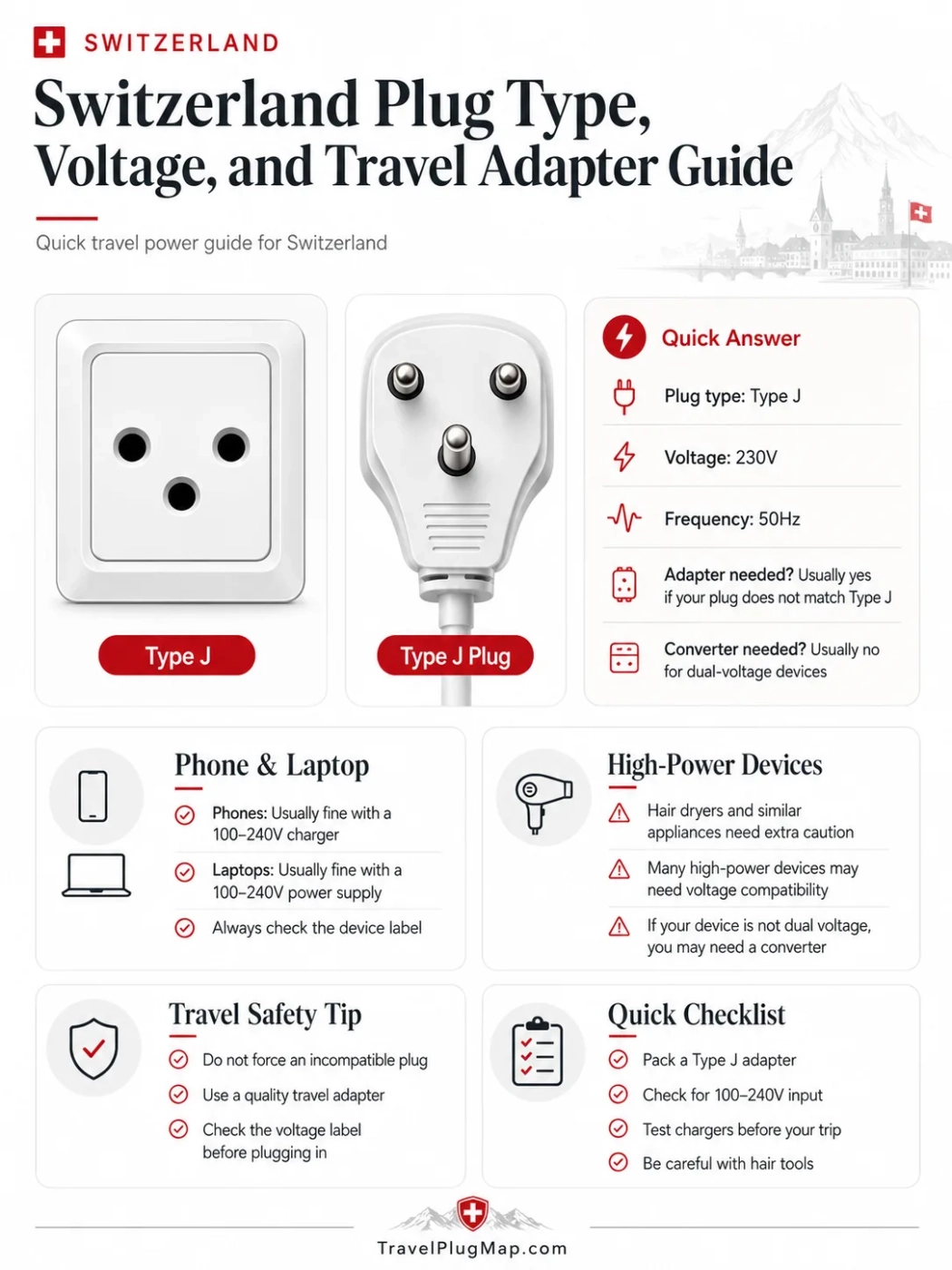
Switzerland uses Type J power outlets with a standard electricity supply of 230V at 50Hz. A slim two-pin Type C Europlug usually fits a Swiss socket, while larger grounded Type E and Type F plugs generally require a Switzerland-compatible adapter. Travelers from the United States, Canada, the United Kingdom, Australia, Japan and many other countries normally need a plug adapter. A voltage converter is relevant only when a device cannot accept 230V.
Switzerland Power Supply Basics
| Electrical detail | Switzerland |
|---|---|
| Main plug and socket type | Type J |
| Compatible two-pin plug | Type C Europlug usually fits |
| Standard voltage | 230V |
| Frequency | 50Hz |
| Grounding | Provided through the third pin of a grounded Type J connection |
| Plug adapter needed? | Yes, when your plug is not Type J or a compatible Type C Europlug |
| Voltage converter needed? | Usually only for devices rated exclusively for 110–120V |
| Best device check | Read the input voltage and frequency on the charger or appliance |
Plug compatibility and voltage compatibility are separate. A device can support Switzerland's 230V supply while still needing an adapter because its plug does not fit the socket.
What the Power Outlets Look Like
Real Swiss sockets vary in faceplate shape and installation style, but the Type J pin arrangement remains the useful feature for travelers to recognize. Hotels may also provide USB ports or multi-standard sockets in some rooms.
Type J, Type C and Grounded European Plugs
The Swiss Type J system uses two round power pins and an offset grounding pin. Switzerland's domestic plug system is therefore different from the larger Type E and Type F grounded systems found in several neighboring countries.
Type C Europlugs
A slim, ungrounded Type C Europlug has two narrow round pins and usually fits a Swiss Type J socket. This plug is common on phone chargers, compact camera chargers, electric toothbrush chargers and other small double-insulated devices.
Type C carries no protective earth connection. Equipment supplied with a grounded plug should retain grounding through a suitable Type J adapter rather than being converted to a basic two-pin connection.
Type E and Type F Plugs
Grounded Type E and Type F plugs use larger pins and larger plug bodies than a Type C Europlug. They are common in countries such as Germany, Austria, France, Belgium and the Netherlands, but they are not the same physical system as Swiss Type J.
Travelers carrying Schuko-style Type F equipment or other grounded continental European plugs should use an adapter specifically intended for Switzerland or Type J. A slim Type C charger and a grounded Type F appliance can therefore require different solutions on the same trip.
Voltage and Frequency in Switzerland
Switzerland supplies household electricity at 230V and 50Hz. This is close to the electrical supply used across much of Europe. It differs from the 120V, 60Hz system common in the United States and Canada and from Japan's lower-voltage supply.
A plug adapter does not convert voltage. It changes the physical connection between a plug and the wall socket. A device designed only for 110–120V can be damaged if it is connected directly to 230V.
Frequency is less troublesome for most modern electronic chargers because many accept both 50Hz and 60Hz. Motors, mechanical timers, clocks and some specialized equipment can be frequency-sensitive. A basic voltage converter usually changes voltage rather than frequency.
Do You Need a Travel Adapter?
| Traveling from | Common home plug | Adapter for Switzerland? | Voltage note |
|---|---|---|---|
| United States or Canada | Type A or Type B | Yes | Check carefully for 110–120V-only devices |
| United Kingdom or Ireland | Type G | Yes | Supply voltage is already close to Switzerland's 230V system |
| Australia or New Zealand | Type I | Yes | Most equipment designed for 220–240V does not need conversion |
| Germany or Austria | Type C or Type F | Type C often fits; Type F generally needs an adapter | Voltage and frequency are normally compatible |
| France or Belgium | Type C or Type E | Type C often fits; grounded Type E equipment generally needs an adapter | Voltage and frequency are normally compatible |
| Italy | Type C, Type F or Type L | Type C often fits; Type F and Type L generally need an adapter | Voltage and frequency are normally compatible |
| Japan | Type A or Type B | Yes | Check the voltage range because some equipment is designed around 100V |
Travelers from the United States and Canada need an adapter for Type A or Type B plugs and should pay close attention to voltage. Phone, tablet and laptop chargers often accept a wide input range, while hair dryers, styling tools and other appliances may be 120V-only.
Travelers from the United Kingdom and Ireland need a Type G-to-Type J adapter, but the similar 230V, 50Hz supply means voltage conversion is uncommon for ordinary equipment. Australian and New Zealand Type I plugs also need an adapter, while their usual appliance voltage is already close to the Swiss supply.
For visitors arriving from continental Europe, the exact plug matters more than the broad label “European plug.” A narrow Type C Europlug often connects directly. Grounded Type E, Type F and Type L equipment generally needs a Swiss adapter.
When a Voltage Converter Is Needed
The device label gives the most useful answer. Look for the word Input on the charger, power brick, appliance body or charging base.
| Device label | Meaning in Switzerland | Typical requirement |
|---|---|---|
| Input: 100–240V, 50/60Hz | Compatible with Switzerland's 230V, 50Hz supply | Plug adapter only when the plug does not fit |
| Input: 220–240V, 50Hz | Compatible with the local supply | Plug adapter when required |
| Input: 110–120V, 60Hz | Not suitable for direct connection to 230V | A properly rated converter or a different appliance may be required |
| Dual voltage: 110/120V and 220/240V | Can operate on either voltage range | Select 220–240V if the device uses a manual switch, then use the required adapter |
| No readable electrical label | Compatibility cannot be confirmed from the device | Check the manufacturer information before use |
A charger marked Input: 100–240V ~ 50/60Hz can normally accept Swiss electricity without a voltage converter. The output line, such as 5V, 9V or 20V DC, describes the electricity supplied by the charger to the connected device rather than the wall supply it can receive.
Some travel hair dryers and similar appliances have a manual 110/120V and 220/240V selector. Set a manually switched device to the 220–240V position before connecting it in Switzerland.
Phones, Laptops and Everyday Charging
Most modern phone, tablet and laptop chargers are straightforward to use in Switzerland when the label shows 100–240V, 50/60Hz. A Type C charger may fit directly. US Type A, UK Type G and Australian Type I charger plugs require an adapter.
Laptop power supplies deserve an additional grounding check. Some use a small ungrounded two-pin input; others use a three-conductor grounded cable. A grounded charger should be paired with an adapter that preserves the earth connection through the Swiss outlet.
USB-C charging can simplify a multi-device setup, but power output still matters. A phone charger may use the same USB-C connector as a laptop while providing far less wattage. Check the charger's USB Power Delivery rating when charging notebooks, tablets or several devices at once.
Switzerland USB-C Requirements in 2026
Swiss rules require covered wired-charge devices placed on the market to use a USB-C charging interface. The requirement has applied to covered phones, tablets, digital cameras and several other device categories since 28 December 2024. Covered laptops have been subject to the USB-C requirement since 28 April 2026.
This rule concerns the charging interface on covered products sold on the Swiss market. It does not change the country's Type J wall outlets or its 230V, 50Hz electricity supply. A traveler can therefore have a USB-C laptop and still need a Type J plug adapter for the wall charger.
Hair Dryers, Styling Tools and Other High-Power Appliances
Hair dryers, curling irons, straighteners, heated styling brushes, kettles and travel irons often draw far more power than phone or laptop chargers. Their voltage range and wattage should be checked before the trip.
A 110–120V-only hair dryer is unsuitable for direct connection to Switzerland's 230V supply. A suitable high-power converter would need to support the appliance's full wattage, which can make carrying the appliance impractical. Using a locally supplied hair dryer or another 220–240V appliance is often simpler.
Dual-voltage hair appliances marked for both 110–120V and 220–240V can be used when configured correctly. Some switch automatically; others have a manual selector. Always check the device label and selector position before using a high-power appliance.
Other Devices Travelers Commonly Bring
Electric shavers and toothbrush chargers vary by model. Their charging bases may have different input ratings from the handheld device, so the base or power adapter is the useful place to check. Bathroom shaver outlets, where provided, are intended for limited loads and are not general-purpose outlets for hair dryers or kettles.
Camera battery chargers commonly accept 100–240V. Drone hubs, multi-battery chargers and e-bike chargers may draw more power, so check their continuous input requirements along with the travel adapter's current rating. Using the charger supplied locally with a rented e-bike avoids unnecessary compatibility questions.
Many CPAP power supplies also accept 100–240V, but medical equipment should be checked individually for input voltage, frequency, grounding and power consumption. Travelers relying on powered medical equipment should carry the correct adapter and follow the device manufacturer's power instructions.
Grounding and Adapter Ratings
Swiss Type J provides grounding through its third pin. A two-pin Type C connection is suitable for equipment designed to operate without protective earth, such as many double-insulated phone chargers. Grounded laptops, desktop equipment, professional audio gear, larger battery chargers and metal-bodied appliances should retain their intended grounding path.
Travel adapters also have maximum current and power ratings. A compact adapter that is comfortable carrying a small charger may be unsuitable for a 1,500W hair dryer, kettle or iron. Check both the appliance wattage and the adapter rating.
Loose connections are another practical concern. Large power bricks can pull an adapter downward and create poor contact. Stop using an adapter that becomes hot, discolored, cracked, unstable or produces sparking.
Cross-Border Trips: France, Germany, Austria and Italy
Switzerland is often combined with neighboring countries on one itinerary. The voltage and frequency remain broadly similar across these routes, but the grounded plug systems differ.
| Starting country | Common plugs | What changes in Switzerland |
|---|---|---|
| Germany or Austria | Type C and Type F | Type C usually remains usable; grounded Type F equipment generally needs Type J adaptation |
| France or Belgium | Type C and Type E | Type C usually remains usable; grounded Type E equipment generally needs Type J adaptation |
| Italy | Type C, Type F and Type L | Type C usually remains usable; Type F and Type L generally need adaptation |
For a multi-country trip, look for adapter specifications that name the actual socket systems rather than relying on a broad “Europe” label. A two-pin Europlug solution can cover many low-power chargers, while grounded equipment may require country-specific support.
Hotels, Apartments and Mountain Accommodation
Swiss hotels and apartments normally provide Type J wall sockets. Some newer rooms also include USB-A, USB-C or multi-standard charging points. These features vary by property and room, so travelers carrying essential work or medical equipment should bring their own adapter.
Holiday apartments and chalets use the same national electrical system, although kitchens may expose travelers to high-power appliances. A foreign kettle, coffee maker or iron still needs the correct voltage rating even when a physical adapter is available.
Mountain huts and remote accommodation can have fewer charging points than urban hotels. Shared sockets, common-area charging or restricted charging times may occur. A compact multi-port charger and a charged power bank are useful for phones, cameras and navigation devices when socket access is limited.
Power outlets can also be available on some trains, in lounges and at public charging points, but availability varies by service and location. Essential ticket, navigation or communication devices are better kept charged before a long travel day.
Choosing a Switzerland Travel Adapter
A useful adapter should explicitly list Switzerland, Swiss or Type J compatibility. For grounded devices, choose a design that carries the earth connection. For high-power equipment, compare the adapter's current and wattage limits with the appliance.
| Adapter format | Best suited to | Main limitation |
|---|---|---|
| Compact Type J adapter | Trips mainly within Switzerland | Limited usefulness in countries with other socket systems |
| Grounded Type J adapter | Laptops and other equipment supplied with grounded plugs | Larger than a basic two-pin adapter |
| Universal travel adapter with Type J support | Multi-country itineraries | Can be bulky with heavy chargers |
| Multi-port USB-C charger with a Swiss-compatible wall connection | Phones, tablets, cameras and compatible laptops | Does not power appliances that require an AC outlet |
One adapter may be enough for a traveler carrying only a phone. A phone and laptop can be easier to manage with two adapters or one appropriately rated multi-port charger. Families, photographers and travelers carrying medical equipment should count the devices that need simultaneous charging before deciding how many connections to pack.
Practical Checks Before the Trip
- Identify the plug fitted to each charger and appliance.
- Pack an adapter explicitly compatible with Swiss Type J outlets when needed.
- Use a grounded adapter for equipment supplied with a grounded plug.
- Read the input voltage on every charger and appliance.
- Look for Input: 100–240V, 50/60Hz on universal-voltage chargers.
- Check 50Hz compatibility for motors, timers and older equipment.
- Review wattage before using hair dryers, kettles, irons or large battery chargers.
- Set manually switched dual-voltage appliances to 220–240V.
- Avoid loose, damaged or overheating adapters.
- Carry a backup charging option for medical, work or navigation equipment when losing access to power would cause a problem.
Frequently Asked Questions
What plug type is used in Switzerland?
Switzerland mainly uses Type J sockets. The system has round pins with an offset grounding connection.
Can I use a Type C plug in Switzerland?
Usually, yes. A slim two-pin Type C Europlug normally fits a Swiss Type J socket. Type C is ungrounded, so equipment supplied with a grounded plug should use a grounded Type J adapter.
Do I need a voltage converter for Switzerland?
Not when the device label shows Input: 100–240V, 50/60Hz. A converter may be required for equipment rated only for 110–120V.
Will a German Type F plug work in Switzerland?
A grounded Type F Schuko plug is generally not the same physical fit as Swiss Type J. Use an adapter that explicitly supports Switzerland or Type J.
Can I charge an iPhone or Android phone in Switzerland?
Most modern phone chargers accept 100–240V. They need only the correct physical connection to the Swiss socket when their existing plug does not fit.
Can I use a US hair dryer in Switzerland?
A US hair dryer rated only for 120V is unsuitable for direct use on Switzerland's 230V supply. A dual-voltage model set to 220–240V can usually be used with the correct plug adapter.