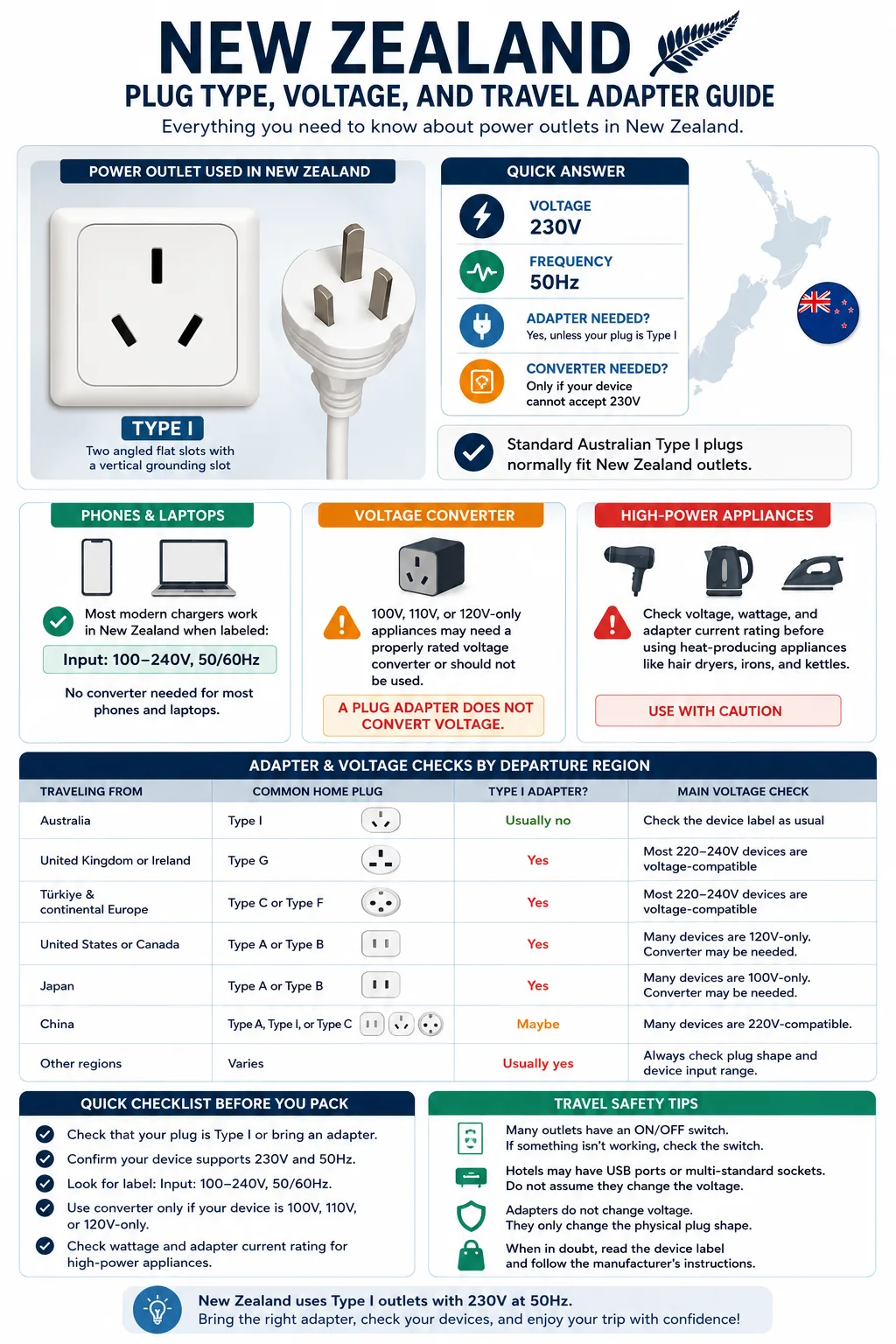
New Zealand uses Type I power outlets with a nominal supply of 230V at 50Hz. Travelers whose plugs are not Type I will need a plug adapter. Most modern phone and laptop chargers work when the label says Input: 100–240V, 50/60Hz, but 100V, 110V, or 120V-only appliances may need a properly rated voltage converter or should not be used.
A plug adapter does not convert voltage. It only changes the physical connection between the device plug and the New Zealand socket. Check plug shape, input voltage, frequency, grounding, and appliance wattage as separate issues.
| Electrical detail | What travelers need to know |
|---|---|
| Common plug and socket type | Type I |
| Outlet shape | Two angled flat slots with a vertical grounding slot |
| Nominal voltage | 230V |
| Frequency | 50Hz |
| Plug adapter | Needed when the device plug is not Type I |
| Voltage converter | Only when the device cannot accept New Zealand’s voltage |
| Shared plug system | Standard Australian Type I plugs normally fit New Zealand outlets |
| High-power warning | Check voltage, wattage, and adapter current rating before using heat-producing appliances |
What the Power Outlets Look Like
Type I plugs have two flat power pins set at an angle. Grounded versions add a third flat pin. Double-insulated appliances may use a two-pin Type I plug, while equipment that requires an earth connection normally uses the three-pin version.
Real wall plates can differ in shape, color, switch placement, and age. Many New Zealand outlets have a small on/off switch beside the socket, so check the switch if a charger appears not to work. Hotels may also install USB ports or multi-standard sockets. Do not assume that a hotel’s universal-looking socket changes the voltage.
Why New Zealand May Be Listed as 230V or 240V
New Zealand’s nominal electricity supply is 230V at 50Hz. Travel information and older appliance labels may still describe the supply as 230/240V or simply 240V. These descriptions do not indicate two separate household systems. For a traveler, the safe approach is to treat New Zealand as a 230V country and read the full input range on each device.
A 2025 electrical safety update set the standard low-voltage tolerance at 230V ±10%. That corresponds to an allowed range around the nominal value rather than a promise that every outlet will measure exactly 230V. A charger marked 100–240V is intended for a broad international range. A device marked only 220V, 230V, or 240V should be checked against its manufacturer instructions rather than judged from one number alone.
The frequency is 50Hz throughout the normal New Zealand supply. Chargers marked 50/60Hz are commonly suitable. Equipment marked only 60Hz may need closer review, especially when it contains a timing circuit, AC motor, pump, fan, or other frequency-dependent component.
Will Your Plug Fit?
The Type I plug family is shared with Australia, which makes travel across the Tasman Sea simple for most ordinary chargers. Visitors arriving from Europe, the United Kingdom, North America, Japan, and many other regions usually need an adapter even when their devices already support 230V.
| Traveling from | Common home plug | Type I adapter? | Main voltage check |
|---|---|---|---|
| Australia | Type I | Usually no | Check the device label as usual |
| United Kingdom or Ireland | Type G | Yes | Most 220–240V devices are voltage-compatible |
| Türkiye and continental Europe | Type C or Type F | Yes | Most 220–240V devices are voltage-compatible |
| United States or Canada | Type A or Type B | Yes | 120V-only appliances are not compatible with 230V |
| Japan | Type A or Type B | Yes | 100V-only appliances need special attention |
| Singapore, Malaysia, or Hong Kong | Usually Type G | Yes | Many modern devices already support 220–240V |
| India | Type C, Type D, or Type M | Usually yes | Check both the exact plug and the device input range |
Visitors from Australia
Standard Australian Type I appliance plugs normally connect directly to New Zealand wall outlets. A separate travel adapter is generally unnecessary. Check unusual plugs, industrial connectors, large appliance plugs, and campervan connection equipment separately because they are not interchangeable with an ordinary household Type I travel connection.
Visitors from the UK, Ireland, Türkiye, and Most of Europe
The home voltage is already close to New Zealand’s supply, so the main difference is usually the plug shape. Type G, Type C, and Type F plugs do not fit a New Zealand Type I outlet without an adapter. For grounded European or British equipment, choose an adapter that continues the earth connection rather than reducing the device to an ungrounded two-pin connection.
Visitors from the United States, Canada, and Japan
The plug and voltage both require attention. A mechanical Type I adapter can make a 120V or 100V appliance fit the wall, but it cannot make that appliance safe on 230V power. Phone chargers and laptop power supplies often support international voltage. Hair dryers, curling irons, kettles, clothes irons, and older shavers are more likely to be single voltage.
Read the Input Label Before Connecting a Device
The decisive information is usually printed after the word Input on the charger, power brick, appliance body, or detachable power supply. The output line describes what the charger sends to the device and does not determine whether the charger can accept New Zealand mains electricity.
| Label example | Meaning | New Zealand use |
|---|---|---|
| Input: 100–240V, 50/60Hz | Wide-range international power supply | Usually needs only a Type I plug adapter |
| Input: 220–240V, 50Hz | Designed for the local voltage and frequency range | Use an adapter only when the plug shape differs |
| Input: 220–240V, 50/60Hz | Voltage-compatible and accepts both common frequencies | Use an adapter only when required |
| Input: 120V, 60Hz | Single-voltage appliance for a lower-voltage supply | Do not use with only a plug adapter |
| Input: 100V, 50/60Hz | Single-voltage appliance despite accepting both frequencies | Not suitable for direct use on 230V |
| 110–120V / 220–240V selector | Manual dual-voltage appliance | Set the switch to 220–240V before plugging in |
| No readable input rating | Compatibility cannot be confirmed | Check the manual or avoid using the device |
Input: 100–240V means the power supply can normally accept both lower-voltage and higher-voltage mains systems. The matching 50/60Hz marking shows that it can accept either common frequency. You still need the correct Type I connection when the original plug does not fit.
Manual dual-voltage appliances need one more step. Set the selector to the 220–240V position before connecting the appliance. A selector left at 110–120V can expose the device to roughly twice the voltage it expects.
Plug Shape and Earthing Are Separate Questions
A two-pin adapter may be acceptable for a double-insulated charger that was designed without an earth connection. It is not the right substitute for a three-prong device that depends on grounding.
For a grounded laptop power supply, metal-bodied appliance, medical device, or other earthed equipment, the travel adapter should carry the earth connection from the original plug to the Type I outlet. Physical fit does not prove earth continuity. Avoid adapters that accept a three-prong plug but provide only two active pins on the New Zealand side.
New Zealand household plugs may have insulated sections on the active and neutral pins to reduce the amount of exposed metal during insertion and removal. A travel adapter should fit firmly, sit fully in the outlet, and show no cracking, scorching, loose parts, or bent pins. Do not force round European pins into a Type I socket or alter a plug to make it fit.
Chargers, Medical Equipment, and High-Power Appliances
Device size is not a reliable guide to voltage compatibility. A compact hair tool can be more difficult to use safely than a large laptop charger because heating appliances often draw high power and may be built for one voltage only.
| Device | Plug adapter | Voltage converter | What to check |
|---|---|---|---|
| Phone or tablet charger | Usually, unless already Type I | Usually no when marked 100–240V | Input voltage, frequency, and charger wattage |
| Laptop charger | Usually, unless already Type I | Usually no when marked 100–240V | Power brick input and grounding |
| Camera battery charger | Usually | Usually no when marked 100–240V | Input rating on the charger, not the battery |
| Electric toothbrush or shaver | Usually | Depends on the charging base | Voltage and frequency on the base or power supply |
| CPAP machine | Usually | Depends on the supplied power unit | Input range, manufacturer instructions, and backup power plan |
| Hair dryer | Yes when the plug differs | Often impractical if the appliance is 120V-only | Voltage, wattage, and manual selector position |
| Curling iron or straightener | Yes when the plug differs | Depends on whether it is dual voltage | Full voltage range and temperature-control compatibility |
| Kettle, clothes iron, or steamer | Yes when the plug differs | Often unsuitable for a small travel converter | Voltage, wattage, current rating, and earth connection |
Modern USB Chargers and Laptop Power Supplies
Many phone, tablet, camera, and laptop chargers are designed for 100–240V and 50/60Hz. When that exact range appears on the power supply, a Type I adapter is normally enough. USB-C describes the connector and charging method; it does not prove that a wall charger supports international mains voltage or enough output power for a laptop.
A laptop with a detachable wall cord may accept a New Zealand Type I power cord connected to the original power brick. This can provide a neater connection than placing a heavy universal adapter between the wall and the charger. The replacement cord still needs the correct connector, current rating, and earth arrangement.
CPAP Machines and Other Medical Devices
Many CPAP power supplies accept 100–240V, but the label and manufacturer instructions remain the deciding information. Check the machine, external power supply, humidifier, and any separate accessories. Pack the correct Type I adapter before departure and consider a manufacturer-approved battery option when the itinerary includes remote accommodation or campsites.
Do not rely on a generic converter for medical equipment unless the device manufacturer allows that setup. A compatible plug does not provide a safety guarantee, and an ungrounded adapter may be unsuitable for equipment designed with an earth connection.
Hair Tools and Other Heat-Producing Appliances
Hair dryers, curling irons, straighteners, kettles, travel irons, garment steamers, and portable heaters need separate checks. These appliances can draw far more power than a phone charger. A 120V-only hair dryer should not be connected to New Zealand’s 230V supply through a simple adapter.
Some travel hair dryers have a manual 110–120V / 220–240V switch. Set it before use and confirm that the appliance supports 50Hz where a motor is involved. A small voltage converter that works for a low-wattage device may not be rated for a hair dryer or kettle.
The 10-Amp Limit Is Easy to Miss
A common New Zealand household Type I plug is rated at 10A. At a nominal 230V supply, that is about 2300W. The printed limit on the adapter, power board, converter, and appliance always takes priority, and the lowest rating in the chain controls the safe load.
A four-outlet travel adapter does not create four times the available power. Add the wattage of devices used at the same time. A laptop charger, phone charger, and camera charger may remain well below the limit, while a hair dryer and travel kettle together can exceed it quickly.
Use extra care with a power strip brought from a 100–120V country. The strip itself, its switch, its surge-protection parts, and its insulation must be rated for 230V operation. A 120V surge protector should not be treated as a passive plug extension on New Zealand power.
- Check the adapter’s maximum voltage, amperage, and wattage.
- Do not cover an adapter or converter while it is operating.
- Stop using equipment that becomes unusually hot, smells burnt, buzzes, or loses contact.
- Avoid stacking several adapters or connecting one multi-board to another.
- Keep high-power appliances on a direct, correctly rated connection.
Charging in Hotels, Campervans, and Remote Areas
Hotel Rooms and Holiday Rentals
Standard accommodation normally uses Type I wall outlets, but the number and position of sockets vary. A switched outlet can appear inactive until the wall switch is turned on. USB-A or USB-C ports built into furniture may provide less power than the original charger, so they may charge a phone slowly and may not support a laptop.
Some rooms provide multi-standard sockets for international plugs. Use them only after confirming that the device accepts 230V. A universal socket changes plug access, not the electricity supplied by the building. A compact Type I adapter remains useful when the room’s special socket is missing, loose, or already occupied.
Powered Campsites and Campervan Connections
A powered campsite does not always mean that a public kitchen or common room has outlets for personal devices. Some campsites provide powered vehicle sites while other areas have no charging points. Check the facilities for the exact site and carry enough battery capacity for nights without accessible mains power.
Campervan and caravan mains connections use dedicated camping equipment, not an ordinary travel adapter. Some powered sites require a current Electrical Warrant of Fitness for the vehicle. Use the vehicle’s approved connection lead and follow the campsite and rental operator instructions.
Backcountry Huts and Isolated Routes
Do not plan around wall charging on remote hikes. A hut may have no mains power, and a campsite kitchen may have lighting without visitor charging outlets. A power bank, spare camera batteries, low-power settings, and an offline navigation plan are more useful than an extra plug adapter when there is no socket.
Electric Vehicle Charging
Do not place a household travel adapter, multi-box, double plug, or ordinary extension arrangement between EV charging equipment and a wall socket. Use charging equipment intended for the vehicle and approved for the connection being used. EV charging has different current, protection, and connection requirements from charging a phone or laptop.
Choosing a Type I Adapter for New Zealand
A dedicated Australia/New Zealand Type I adapter is often the simplest choice for a single-country trip. A universal adapter can be useful on a multi-country itinerary, but it needs the same voltage, current, grounding, and fit checks.
| Feature | Dedicated Type I adapter | Universal adapter |
|---|---|---|
| Best use | New Zealand and Australia trips | Trips crossing several plug regions |
| Wall fit | Usually smaller and more stable | May be heavier or project farther from the wall |
| Grounding | Available on suitable three-pin models | Varies by design and mode |
| USB charging | May have no USB ports | Often includes shared USB outputs |
| Voltage conversion | Not provided | Not provided unless explicitly designed and rated as a converter |
| High-power use | Depends on printed current and wattage rating | Depends on printed current and wattage rating |
Look for a firm Type I connection, insulated pin sections, clear electrical ratings, heat-resistant construction, and earth continuity when grounding is required. For adapters purchased for use in New Zealand or Australia, the Regulatory Compliance Mark may be one indication that applicable product requirements have been addressed. The mark does not replace checking the product’s ratings or using it within its intended purpose.
Port count can be misleading on USB-equipped adapters. Check the total shared USB output and the maximum output of each port. Four ports may share one power budget, so connecting several devices can reduce charging speed.
Pack for the Devices and the Route
Phone-Only or Light Electronics Trip
- One Type I plug adapter if the home plug is different
- The original 100–240V phone charger
- A suitable charging cable
- A small power bank for travel days
Laptop, Camera, and Multiple-Device Trip
- A grounded Type I adapter when the laptop supply uses earth
- The original laptop and camera power supplies
- A charger with enough total USB-C output for the devices
- A second Type I adapter rather than an overloaded adapter stack
- Spare camera batteries for remote days
Hair Tools or High-Wattage Appliances
- The full voltage and wattage rating for each appliance
- The correct 220–240V selector setting when present
- An adapter rated for the appliance load
- A locally rated or genuine dual-voltage alternative when the appliance is 120V-only
Campervan, Hiking, or Medical-Device Travel
- A normal Type I adapter for personal electronics
- Approved vehicle or campsite connection equipment where required
- A battery plan for nights without charging access
- Original medical-device power supplies and manufacturer-approved backup options
- Offline copies of any operating instructions needed during the trip
FAQ
What plug type is used in New Zealand?
New Zealand uses Type I plugs and outlets. The standard grounded socket has two angled flat slots and one vertical earth slot.
Is the New Zealand plug the same as the Australian plug?
Yes. Standard household Type I plugs used in Australia normally fit New Zealand Type I outlets, and both countries use 230V, 50Hz supplies.
Is New Zealand 230V or 240V?
The nominal supply is 230V at 50Hz. Older labels and some travel material may say 240V or 230/240V. Check the full accepted voltage range on the device rather than relying on a single printed country value.
Will a US phone charger work in New Zealand?
Usually, when the charger says Input: 100–240V, 50/60Hz. It will still need a Type I plug adapter. A charger marked only 120V should not be connected with only an adapter.
Can I use a European plug in a New Zealand outlet?
Type C and Type F plugs do not fit Type I outlets directly. Most European 220–240V devices are voltage-compatible, but they need a Type I adapter. Grounded devices need an adapter that preserves the earth connection.
Can I use a 120V hair dryer in New Zealand?
Not with only a plug adapter. A 120V-only hair dryer is not designed for New Zealand’s 230V supply. A genuine dual-voltage model set to 220–240V or a locally rated appliance is usually the simpler option.