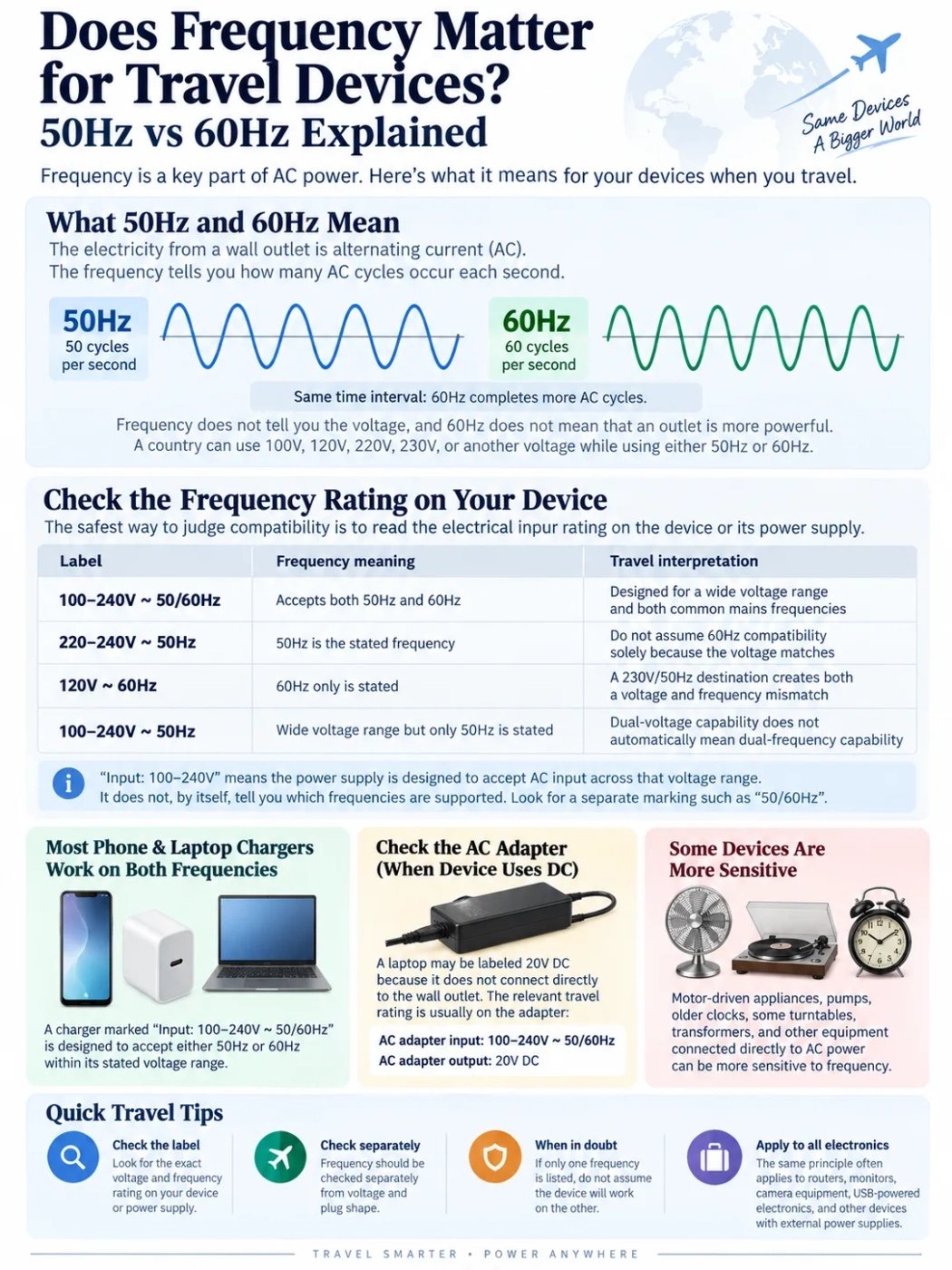
For most modern travel electronics, the difference between 50Hz and 60Hz is not a problem if the power supply is rated for both frequencies. A phone or laptop charger marked Input: 100–240V ~ 50/60Hz is designed to accept either frequency within its stated voltage range. Motor-driven appliances, pumps, older clocks, some turntables, transformers, and other equipment connected directly to AC power can be more sensitive.
Frequency should be checked separately from voltage and plug shape. A device can have the correct plug and voltage but still carry a frequency rating that does not match the destination.
What 50Hz and 60Hz Mean to a Travel Device
The electricity supplied by a wall outlet is alternating current, or AC. The frequency tells you how many AC cycles occur each second:
- 50Hz: 50 cycles per second
- 60Hz: 60 cycles per second
Frequency does not tell you the voltage, and 60Hz does not mean that an outlet is more powerful than a 50Hz outlet. A country can use 100V, 120V, 220V, 230V, or another nominal voltage while using either 50Hz or 60Hz.
The Frequency Rating on the Device Label Matters Most
The safest way to judge frequency compatibility is to read the electrical input rating printed on the device or its power supply. The frequency is normally shown beside the input voltage.
| Label | Frequency meaning | Travel interpretation |
|---|---|---|
| 100–240V ~ 50/60Hz | Accepts both 50Hz and 60Hz | Designed for a wide voltage range and both common mains frequencies |
| 220–240V ~ 50Hz | 50Hz is the stated frequency | Do not assume 60Hz compatibility solely because the voltage matches |
| 120V ~ 60Hz | 60Hz only is stated | A 230V/50Hz destination creates both a voltage and frequency mismatch |
| 100–240V ~ 50Hz | Wide voltage range but only 50Hz is stated | Dual-voltage capability does not automatically mean dual-frequency capability |
Input: 100–240V means the power supply is designed to accept AC input across that voltage range. It does not, by itself, tell you which frequencies are supported. Look for a separate marking such as 50/60Hz.
Check the AC adapter when the device itself uses DC
A laptop may be labeled for an input such as 20V DC because the laptop does not connect directly to the wall outlet. The relevant travel rating is usually printed on the external power brick:
AC adapter input: 100–240V ~ 50/60Hz
AC adapter output: 20V DC
In that arrangement, the adapter receives the 50Hz or 60Hz AC supply and converts it to DC before the electricity reaches the laptop.
The same principle often applies to routers, monitors, camera equipment, USB-powered electronics, and other devices with external AC-to-DC power supplies.
Why Most Phone and Laptop Chargers Handle Both Frequencies
Modern phone, tablet, camera, and laptop chargers commonly use switching power supplies. Instead of operating the device directly from the mains frequency, the charger converts incoming AC power into regulated DC power.
Many are therefore labeled 100–240V ~ 50/60Hz. When that rating appears on the charger, both 50Hz and 60Hz are within its stated input specification.
You may still need a plug adapter if the destination uses a different plug type or socket type. A plug adapter does not convert voltage. It also does not change 50Hz into 60Hz or 60Hz into 50Hz.
USB-C does not automatically mean international mains compatibility. USB-C describes the connection used on the charging side of the system. The AC input rating printed on the wall charger still determines which voltage and frequency it can accept.
Which Travel Devices Are More Sensitive to Frequency?
Whether 50Hz versus 60Hz matters depends heavily on what happens inside the device. Electronics powered through a wide-input AC/DC charger behave very differently from equipment whose motor or timing mechanism operates directly from AC mains power.
| Device | Frequency concern | What to check |
|---|---|---|
| Phone charger | Usually low when marked 50/60Hz | AC input voltage and frequency on the charger |
| Laptop charger | Usually low when marked 50/60Hz | Power brick input rating |
| Tablet charger | Usually low when marked 50/60Hz | Wall charger input rating |
| Camera battery charger | Often low with a wide-input supply | Input voltage and 50/60Hz marking |
| Power bank | The power bank itself normally charges from DC | Rating of the wall charger used with it |
| Electric shaver | Model-dependent | Whether the charger or shaver is rated for both frequencies and voltages |
| Electric toothbrush base | Model-dependent | Charging base input rating |
| Hair dryer | Can matter because a motor is present | Voltage, frequency, power rating, and any dual-voltage setting |
| Curling iron or hair straightener | Frequency is often secondary to voltage | Full input rating, especially voltage |
| Kettle or clothes iron | Frequency often has little direct effect on the heating element | Voltage and wattage are usually the main concerns |
| Portable mains-powered fan | Can matter | Motor nameplate and supported frequency |
| Pump | Can matter substantially on line-powered motor designs | Rated voltage, frequency, motor type, and manufacturer specification |
| Older electric clock | Can matter substantially | Whether timing depends on mains frequency |
| Turntable | Model-dependent | Motor type and 50Hz/60Hz rating |
| CPAP machine | Depends on the exact power supply | Power supply label and manufacturer instructions |
| Other medical equipment | Exact model must be checked | Approved operating range and power supply specification |
What a Frequency Mismatch Can Do
A device marked only for 50Hz or only for 60Hz should not automatically be treated as compatible with the other frequency. The effect depends on the electrical design.
Using a 60Hz motor on 50Hz
For motors whose speed is tied closely to mains frequency, reducing the supply from 60Hz to 50Hz reduces the theoretical synchronous speed.
For the same motor pole count:
- A 4-pole motor has a theoretical synchronous speed of 1,800 rpm at 60Hz.
- The same pole count corresponds to 1,500 rpm at 50Hz.
That is about a 16.7% decrease when moving from 60Hz to 50Hz.
Speed is not the only concern. If the voltage stays the same while the frequency decreases, the voltage-per-hertz ratio rises. In some magnetic motor and transformer designs, that can increase magnetic flux, current, heating, or operating stress.
Do not use the 16.7% speed difference as a safety rule. The exact response depends on the motor design, load, cooling, electronics, and manufacturer rating.
Using a 50Hz motor on 60Hz
Moving from 50Hz to 60Hz raises frequency by 20%. A motor whose synchronous speed follows line frequency may therefore have a higher theoretical speed at 60Hz.
That still does not mean every 50Hz motor simply runs 20% faster. Universal motors, electronically controlled motors, brushless systems, and inverter-driven motors can behave differently. Some equipment is deliberately designed and labeled for both frequencies.
If a motor-driven device says 50/60Hz, both frequencies are part of its stated operating range. If it lists only one frequency, check the exact model specification rather than assuming the change is harmless.
Clocks and Turntables Can Reveal the Difference Very Clearly
Some older AC-powered clocks use mains frequency as part of their timing system. A mechanism designed around 50Hz may keep incorrect time if operated from 60Hz unless the clock has a suitable adjustment, gearing arrangement, or dual-frequency design.
An uncompensated frequency-dependent mechanism designed for 50Hz would tend to run faster on 60Hz. A comparable 60Hz mechanism supplied with 50Hz would tend to run slower.
Some older turntables also use AC synchronous motors whose rotational speed is tied to mains frequency. Depending on the model, 50Hz and 60Hz versions may use different motor arrangements, pulleys, or selectable configurations to maintain the correct platter speed.
Modern quartz clocks, battery-powered clocks, electronically controlled turntables, and DC-motor equipment should not automatically be grouped with these older frequency-dependent designs.
Heating Appliances: Voltage Is Often the Bigger Issue
A simple resistive heating element does not respond to 50Hz versus 60Hz in the same way as a synchronous motor. For a resistive appliance operating at its intended voltage, the small change in mains frequency usually has little direct effect on heat production.
This matters when judging devices such as:
- kettles,
- clothes irons,
- curling irons,
- hair straighteners,
- simple electric heaters.
For these appliances, voltage is usually the first electrical rating to check. A 120V heating appliance should not be treated as suitable for a 230V outlet merely because both locations use a compatible plug adapter or because the frequency happens to match.
A hair dryer requires more care because it combines a high-power heating element with a fan motor. Its motor, heating circuit, selector switch, and control electronics all need to be considered together.
Always check the complete device label before using a high-power appliance on a different electrical system.
50Hz vs 60Hz Is Separate from 120V vs 230V
Travel power compatibility involves several separate questions:
| Property | What it tells you | Typical question |
|---|---|---|
| Plug type | Physical shape of the plug and socket | Will my plug fit? |
| Voltage | Electrical potential supplied to the device | Can the device accept 120V or 230V? |
| Frequency | Number of AC cycles per second | Does the device accept 50Hz, 60Hz, or both? |
| Power rating | How much electrical power the device or accessory is designed to handle | Can the converter or accessory support the appliance wattage? |
A matching plug does not prove that the voltage or frequency is suitable. A compatible voltage range does not prove that the frequency is suitable either.
For example, a device marked 100–240V ~ 50Hz accepts a wide range of voltages, but its label still states only 50Hz. The voltage rating should not be used to infer 60Hz support.
Does a Travel Adapter Change 50Hz to 60Hz?
No. A normal travel plug adapter changes only the physical connection between a plug and an outlet.
A plug adapter does not convert voltage. It also does not convert frequency.
| Accessory | Changes plug shape | Changes voltage | Changes frequency |
|---|---|---|---|
| Plug adapter | Yes | No | No |
| Voltage transformer | Not its main purpose | Yes | No |
| Typical voltage converter | Depends on the product | Yes | Usually no |
| Wide-input USB charger | May require a plug adapter | Converts AC input to DC output | Accepts only the input frequencies shown on its label |
| Frequency converter | Not necessarily | Design-dependent | Yes |
A Voltage Converter Usually Leaves the Frequency Unchanged
This is an easy point to miss when traveling between a 230V/50Hz country and a 120V/60Hz country.
A step-down transformer or typical voltage converter may reduce 230V to approximately 120V while the supply remains 50Hz. The output is therefore not automatically equivalent to a native 120V/60Hz outlet.
If the appliance is labeled 120V ~ 60Hz only, reducing the voltage from 230V to 120V solves only one of the two mismatches.
Frequency Converters Are Different from Normal Travel Converters
Changing mains frequency requires equipment specifically designed to generate a different AC frequency. A true frequency converter can produce a 50Hz or 60Hz output as required by its design, but it is not the same accessory as a basic plug adapter, step-down transformer, or typical travel voltage converter.
Frequency conversion becomes more complicated as power demand rises, especially with motors and other loads that have high starting current or unusual electrical characteristics.
For a phone or laptop charger already labeled 50/60Hz, there is normally no reason to add frequency conversion. For a single-frequency appliance, the practical choice depends on the exact device rather than frequency alone.
Japan Shows Why Voltage and Frequency Must Be Checked Separately
Japan is a useful real-world example because the nominal household voltage remains 100V while mains frequency differs by region.
- Eastern Japan, including Tokyo: generally 50Hz
- Western Japan, including Osaka and Kyoto: generally 60Hz
There are transition and boundary areas, so the exact local supply should be checked when frequency-sensitive equipment is involved.
A traveler going from Tokyo to Kyoto can therefore move from a 50Hz region to a 60Hz region without changing countries and without the nominal voltage changing from 100V.
A laptop charger marked 100–240V ~ 50/60Hz is designed for both frequencies and would not normally care about that regional frequency change. A mains-powered device labeled for only one frequency deserves closer attention.
Travel Routes Where the Frequency Changes
Frequency differences appear on many common international routes. The presence of a difference does not mean every traveler needs special equipment; it means the device label should be checked.
| Travel route | Typical home frequency | Typical destination frequency | What deserves attention |
|---|---|---|---|
| United States to France | 60Hz | 50Hz | Voltage and frequency rating |
| Canada to Germany | 60Hz | 50Hz | Voltage is often the larger difference, but frequency still belongs on the label check |
| United Kingdom to United States | 50Hz | 60Hz | Voltage, plug type, and frequency |
| Australia to Canada | 50Hz | 60Hz | Voltage and frequency compatibility |
| Tokyo to Kyoto | 50Hz | 60Hz | Frequency can change while nominal voltage remains 100V |
Five Labels and the Correct Frequency Decision
1. Input: 100–240V ~ 50/60Hz
Frequency result: compatible with both 50Hz and 60Hz.
The device or power supply also accepts a broad voltage range. A plug adapter may still be required when the destination socket type differs.
2. Input: 220–240V ~ 50Hz
Frequency result: only 50Hz is stated.
A 230V/60Hz outlet may match the voltage range, but the frequency is outside the printed rating. Do not assume compatibility from voltage alone.
3. Input: 120V ~ 60Hz
Frequency result: 60Hz is the stated frequency.
Using this appliance in a typical 230V/50Hz destination creates two separate issues. A mechanical plug adapter solves neither one.
4. Input: 100–240V ~ 50Hz
Frequency result: wide voltage range does not equal wide frequency support.
This is a useful example of why the voltage and frequency portions of the label should be read independently.
5. Device: 20V DC — Power adapter: 100–240V ~ 50/60Hz
Frequency result: check the AC power adapter.
The device receives DC from its adapter. The adapter is the component connected to the wall supply and its 50/60Hz input rating determines mains-frequency compatibility.
Older Equipment Is More Likely to Need a Closer Frequency Check
Older electrical equipment is more likely to contain components that interact directly with mains frequency, including:
- synchronous AC motors,
- line-frequency timing systems,
- traditional transformers,
- mechanically compensated motor-speed systems.
Modern electronics more often place a switching power supply or electronic control stage between the wall outlet and the part of the device doing the actual work. That makes 50/60Hz support common in many chargers and consumer electronics.
Age alone is not enough to decide compatibility. Some older devices were built for both frequencies, and some newer specialized equipment still has a single-frequency rating. The nameplate or input label takes priority over assumptions based on age.
Common 50Hz and 60Hz Travel Mistakes
“If the plug fits, the frequency must be compatible.”
Plug shape only tells you whether the physical connection fits. It does not identify the voltage or guarantee frequency compatibility.
“100–240V means the device works on every mains system.”
Not necessarily. A 100–240V rating covers voltage. The frequency line must still be checked for 50Hz, 60Hz, or 50/60Hz support.
“A voltage converter also converts 50Hz to 60Hz.”
Typical travel voltage converters and transformers change voltage while leaving the frequency unchanged.
“Every motor changes speed by exactly 20%.”
No. The 50Hz-to-60Hz ratio describes the theoretical synchronous-speed relationship for frequency-dependent AC motors. It is not a universal rule for every motor or appliance.
“All heating appliances are frequency-sensitive.”
Pure resistive heating elements are usually much more sensitive to voltage than to the difference between 50Hz and 60Hz. Appliances that also contain motors or electronic control circuits need to be evaluated as complete devices.
“USB-C means the charger is ready for any country.”
USB-C does not define the mains input range of the wall charger. Look for a rating such as 100–240V ~ 50/60Hz on the charger itself.
A Practical Frequency Check Before Plugging In
Start with the part connected to the wall
If the device uses an external AC adapter, read the adapter’s INPUT specification. If the device plugs directly into the outlet, read the device nameplate.
Compare both voltage and frequency
A 50/60Hz rating solves the frequency question but not automatically the voltage question. A 100–240V rating solves a broad voltage question but does not automatically prove 50/60Hz support.
Look more carefully at single-frequency motor equipment
Fans, pumps, older clocks, synchronous-motor turntables, compressors, and other mains-driven equipment deserve extra checking when their label lists only 50Hz or only 60Hz.
Treat high-power appliances separately from chargers
Phone and laptop chargers commonly accept a wide input range. Hair dryers, kettles, irons, curling irons, and other high-power appliances often have more restrictive voltage requirements even when frequency is not their main limitation.
Use exact specifications for medical equipment
For a CPAP machine or other medical device, check the operating range printed on the power supply and follow the manufacturer’s instructions for the exact model. Do not rely on the behavior of a different charger or a similar-looking device.
If the label lists only one frequency and the destination uses the other, do not assume that a plug adapter or voltage converter makes the device compatible.
Frequently Asked Questions
Can I use a 60Hz device on 50Hz?
Only when the device is rated for 50Hz as well, or its manufacturer specifically allows 50Hz operation. Some equipment may work differently or run hotter on the lower frequency, especially certain motors and magnetic devices. Check the exact label rather than assuming compatibility.
Can I use a 50Hz device on 60Hz?
A device marked 50/60Hz is designed for both. If it says only 50Hz, compatibility depends on the device design. Frequency-dependent motors and timing mechanisms may operate at a different speed.
Does 100–240V automatically mean 50/60Hz?
No. 100–240V describes the accepted voltage range. Frequency is a separate rating. Look for 50Hz, 60Hz, or 50/60Hz on the same input label.
Does a travel plug adapter change frequency?
No. A plug adapter changes the physical plug connection only. It does not change voltage or frequency.
Does a voltage converter change 50Hz to 60Hz?
Typical travel voltage converters and transformers do not. They change voltage while the mains frequency normally remains the same. Actual frequency conversion requires equipment specifically designed for that purpose.
Will my phone or laptop charger work on both 50Hz and 60Hz?
Many modern chargers are marked 100–240V ~ 50/60Hz. When your charger carries that rating, both frequencies are within its stated input range. You may still need a plug adapter for the destination socket.