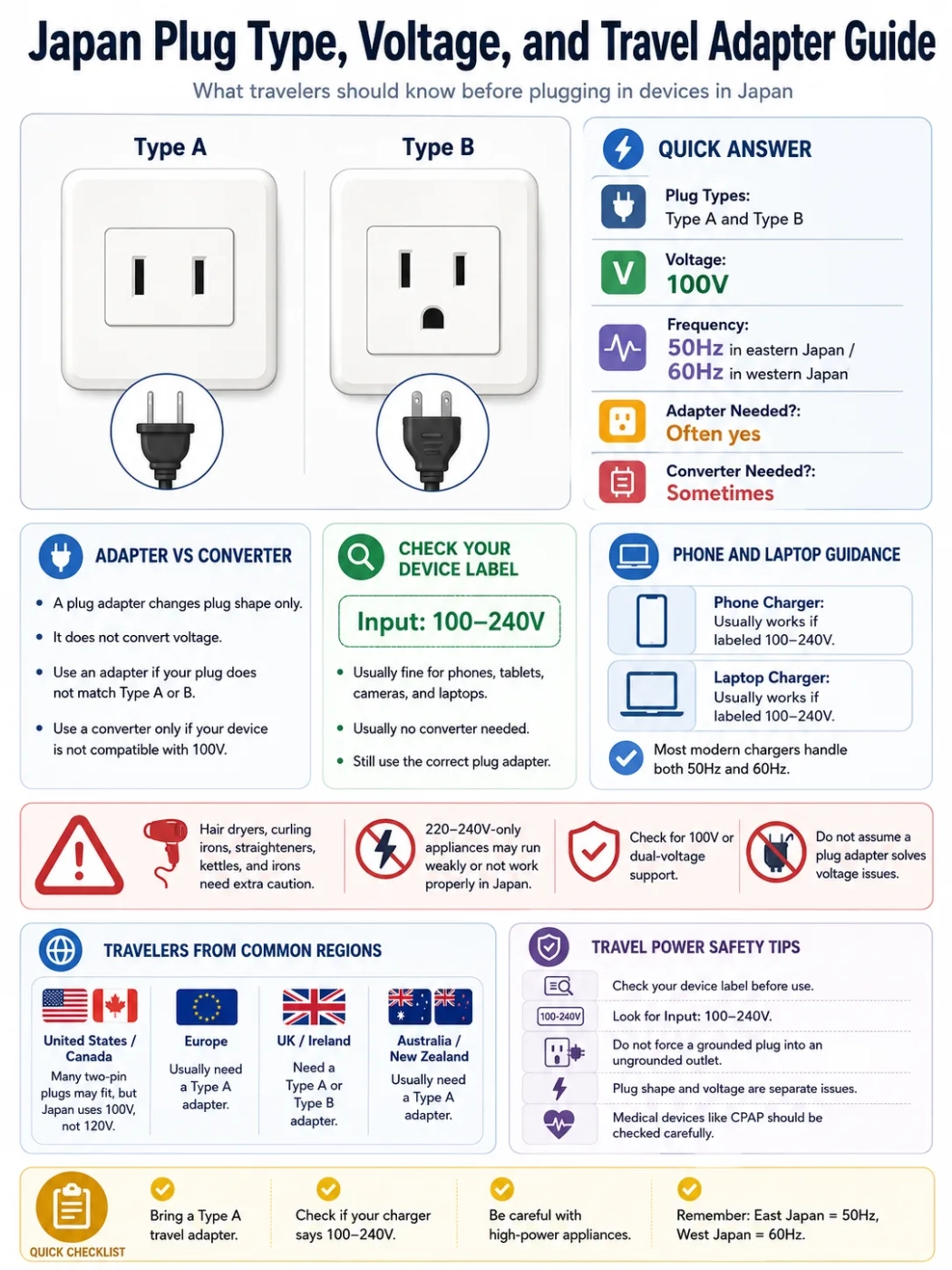
Japan uses Type A and Type B power outlets, with a standard voltage of 100V. Most travelers need to check two things before packing: whether their plug fits the outlet shape, and whether their device can safely run on Japan’s lower voltage.
| Item | Japan Information | What Travelers Should Do |
|---|---|---|
| Plug type | Type A and Type B | Use a plug adapter if your device has a different plug shape. |
| Voltage | 100V | Check the device label before plugging in appliances. |
| Frequency | 50Hz in eastern Japan, 60Hz in western Japan | Most phone and laptop chargers are fine; some motor-based appliances may care. |
| Adapter needed? | Often yes for travelers from Europe, the UK, Australia, and many other regions | Bring a Type A or Type B travel adapter if your plug does not match. |
| Converter needed? | Sometimes | Usually not for dual-voltage chargers, but may be needed for 220–240V-only appliances. |
| Best device advice | Phones, tablets, cameras, and laptops are usually low-risk if labeled 100–240V | Always check “Input: 100–240V” on the charger. |
A plug adapter does not convert voltage. It only changes the physical plug shape so your device can fit into the wall outlet.
What the Power Outlets Look Like
These illustrations are simplified front views of outlet types travelers may see in Japan. Real wall sockets can look slightly different depending on the building, socket manufacturer, and age of installation. Hotels may also provide multi-standard sockets in some rooms. Plug shape and voltage are separate issues, so always check both before using a device.
What Plug Type Does Japan Use?
Japan mainly uses Type A and Type B plugs and outlets.
- Type A has two flat parallel pins and is usually ungrounded.
- Type B has two flat parallel pins plus a round grounding pin.
Type A outlets are very common in Japan. Type B grounded outlets may appear in newer buildings, hotels, offices, and places where grounded appliances are expected. However, many everyday wall outlets may still be ungrounded Type A style.
If you are traveling from the United States or Canada, many of your two-pin plugs may physically fit Japanese Type A outlets. However, Japan’s voltage is not the same as North America. The plug may fit, but you still need to check voltage compatibility.
Voltage and Frequency in Japan
Japan’s standard voltage is 100V. This is lower than the 120V used in the United States and Canada, and much lower than the 220–240V used in many parts of Europe, Asia, Africa, Australia, and the Middle East.
Japan also has a split frequency system:
- 50Hz is used in much of eastern Japan, including the Tokyo area.
- 60Hz is used in much of western Japan, including the Osaka, Kyoto, Hiroshima, and Fukuoka areas.
For most modern travel electronics, frequency is not a problem. Phone chargers, laptop chargers, camera chargers, and USB power adapters usually accept both 50Hz and 60Hz. Some older appliances, clocks, fans, and motor-based devices may behave differently if they are designed for only one frequency.
Do You Need a Travel Adapter for Japan?
You need a travel adapter for Japan if your plug does not match Type A or Type B outlets.
Travelers from the UK, Ireland, most of Europe, Australia, New Zealand, Singapore, India, and many other countries usually need a Type A travel adapter for Japan. Travelers from the United States and Canada may not need a plug adapter for many two-pin devices, but grounded three-pin plugs may not fit every outlet.
If your device has a three-pin Type B plug, bring a compact adapter or extension solution only if you know your hotel or accommodation may not have grounded outlets. Do not force a grounded plug into an ungrounded outlet.
Do You Need a Voltage Converter in Japan?
You need a voltage converter only if your device is not compatible with Japan’s 100V electricity.
Look for the input label on the charger, power brick, or device body. If it says Input: 100–240V, the device is usually designed for international voltage and should work in Japan with the correct plug adapter.
If the label says only 220–240V, the device may not work properly in Japan because the voltage is too low. A 230V appliance plugged into Japan’s 100V supply may run weakly, heat poorly, charge slowly, or not work at all. This is especially relevant for high-power appliances.
Always check the device label before using high-power appliances abroad.
What “Input: 100–240V” Means
Input: 100–240V means the device can usually accept any voltage within that range. This is common on modern phone chargers, laptop chargers, tablet chargers, camera battery chargers, and many USB-C power adapters.
You may also see something like:
- Input: 100–240V~ 50/60Hz
- Input: 100-240V AC
- Input: 100–240V, 50Hz/60Hz
If your charger shows this range, you usually need only the correct plug adapter for Japan. You normally do not need a voltage converter for that charger.
Can You Charge Your Phone in Japan?
In most cases, yes. Modern phone chargers are usually dual voltage and commonly support Input: 100–240V. That means they can work with Japan’s 100V supply.
You may still need a Type A plug adapter if your charger uses a European, UK, Australian, or other non-Japanese plug. If you charge through USB at a hotel, airport, train station, or power bank, the plug shape may matter less, but it is still safer to bring your own adapter.
Can You Use a Laptop Charger in Japan?
Most laptop chargers work in Japan because they are usually designed for global voltage. Check the power brick for Input: 100–240V and 50/60Hz. If you see that, your laptop charger should usually work with only a plug adapter.
If your laptop charger has a grounded plug, remember that not every Japanese outlet may accept a three-pin plug. Some travelers bring a grounded-compatible adapter, but the safest choice depends on the device and the outlet available. Never remove or defeat grounding from a plug for a device that requires it.
Can You Use a Hair Dryer or Curling Iron in Japan?
Hair dryers, curling irons, hair straighteners, kettles, steamers, and irons need more caution. These are high-power appliances, and voltage matters much more than it does for a phone charger.
If your hair dryer or curling iron says Input: 100–240V or has a clear dual-voltage switch that includes 100V, it may work in Japan with the right plug adapter. If it says only 220–240V, it is not ideal for Japan’s 100V system. It may heat weakly or fail to work correctly.
If your device says only 110–120V, it may run in Japan, but performance can be weaker because Japan uses 100V. This is often less risky than plugging a 120V device into 230V, but you should still check the device instructions.
A plug adapter does not convert voltage. For high-power appliances, a simple adapter is not the same as a transformer or voltage converter.
Device-by-Device Advice for Japan
| Device | Usually Needs Plug Adapter? | Usually Needs Voltage Converter? | What to Check |
|---|---|---|---|
| Phone charger | Yes, if plug is not Type A or B | Usually no | Look for Input: 100–240V |
| Laptop charger | Often yes | Usually no | Check the power brick input label |
| Camera battery charger | Often yes | Usually no | Check for 100–240V and 50/60Hz |
| Electric shaver | Often yes | Maybe | Some shavers are dual voltage, some are not |
| Hair dryer | Yes, unless plug already fits | Maybe | Check voltage carefully; high-power device |
| Curling iron or straightener | Yes, unless plug already fits | Maybe | Use only if compatible with 100V |
| CPAP machine | Often yes | Usually no if dual voltage | Check the power supply label and bring the correct adapter |
Travelers From Common Regions
Traveling From the United States or Canada to Japan
Your plug shape is often similar to Japan’s Type A and Type B system. Many two-pin plugs may fit. However, Japan uses 100V, while the US and Canada commonly use 120V. Most chargers are fine, but some appliances may run slightly weaker.
Traveling From Europe to Japan
Most European plugs do not fit Japanese outlets. You usually need a Type A travel adapter. Many European phone and laptop chargers are dual voltage, but high-power 230V appliances may not work well on Japan’s 100V supply.
Traveling From the UK or Ireland to Japan
UK and Irish Type G plugs do not fit Japanese outlets. You need a Type A or Type B adapter. Check voltage carefully, especially for hair styling tools, kettles, and other high-power appliances designed only for 230V.
Traveling From Australia or New Zealand to Japan
Australian and New Zealand Type I plugs do not fit Japanese outlets. You usually need a Type A travel adapter. Many chargers are dual voltage, but high-power appliances should be checked before use.
Travel Power Safety Tips for Japan
- Check your device label before plugging it in.
- Look for Input: 100–240V on chargers and power bricks.
- Use a plug adapter only for plug shape, not for voltage conversion.
- Be extra careful with hair dryers, curling irons, kettles, irons, and steamers.
- Do not force a grounded plug into an ungrounded outlet.
- Remember that eastern and western Japan use different frequencies, although most modern chargers handle both.
- For medical devices such as CPAP machines, check the official device label and bring the correct adapter before travel.
What to Pack for Japan
Most travelers should pack a Type A travel adapter for Japan. If you are carrying several devices, a small multi-port USB charger that clearly supports Input: 100–240V can reduce the number of wall adapters you need.
If you plan to bring high-power appliances, check the voltage label before packing. In many cases, it is easier and safer to use hotel-provided appliances or travel devices that clearly support 100V.
FAQ
What plug adapter do I need for Japan?
Most travelers need a Type A plug adapter for Japan. Japan uses Type A and Type B outlets, with Type A being very common.
Does Japan use the same plug as the US?
Japan uses Type A and Type B plugs, which are similar to the US system. However, Japan uses 100V, while the US commonly uses 120V, so you should still check device voltage.
Can I charge my iPhone or Android phone in Japan?
Usually yes. Most modern phone chargers support Input: 100–240V. You may still need a plug adapter if your charger plug does not fit Type A or Type B outlets.
Do I need a voltage converter for Japan?
You usually do not need a voltage converter for dual-voltage chargers. You may need one for devices that do not support Japan’s 100V supply, especially high-power appliances.
Will my laptop charger work in Japan?
Most laptop chargers work in Japan if the power brick says Input: 100–240V. You may need a plug adapter depending on your plug shape.
Can I use a European hair dryer in Japan?
Only if it supports 100V or has a dual-voltage setting that includes 100V. A 220–240V-only hair dryer may not work properly in Japan, even with a plug adapter.