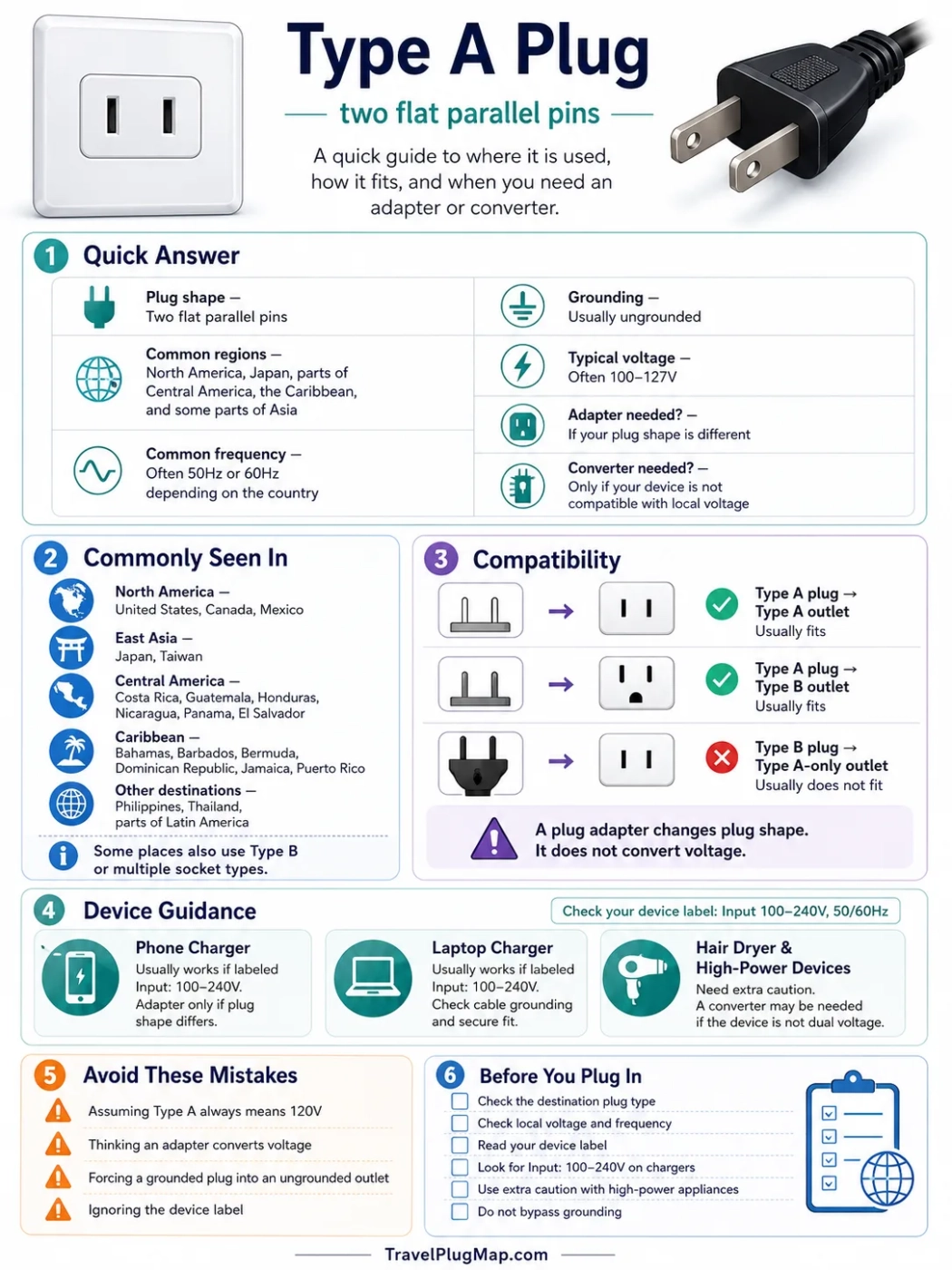
Type A plugs have two flat parallel pins and are commonly used in countries such as the United States, Canada, Mexico, and Japan. They are usually found in 100–127V electrical systems, but plug shape and voltage are separate issues, so travelers should always check the destination voltage and the device label before plugging in.
Quick Answer
| Feature | Type A Plug Guide |
|---|---|
| Plug shape | Two flat parallel pins |
| Grounding | Usually ungrounded |
| Common regions | North America, Japan, parts of Central America, the Caribbean, and some parts of Asia |
| Typical voltage | Often 100–127V, but not guaranteed everywhere Type A appears |
| Common frequency | Often 50Hz or 60Hz depending on the country |
| Adapter needed? | You need a plug adapter if your device has a different plug shape |
| Converter needed? | Only if your device is not compatible with the local voltage |
What a Type A Plug and Outlet Look Like
A Type A outlet is usually shown with two flat vertical slots. A Type A plug has two matching flat blades. This is a simplified travel illustration, not an engineering drawing. Some real outlets may be polarized, recessed, combined with Type B, or built into multi-standard hotel sockets.
What Is a Type A Plug?
A Type A plug is an electrical plug with two flat parallel pins. It is one of the most recognizable plug types for travelers because it is widely associated with North America and Japan.
The key detail is that Type A is usually ungrounded. It does not have the round grounding pin found on a Type B plug. That means Type A is most common on smaller, lower-power, double-insulated devices such as phone chargers, camera chargers, simple lamps, and some small electronics.
For travel, Type A mainly answers the question: Will my plug physically fit the wall outlet? It does not answer whether the voltage is safe for your device.
A plug adapter does not convert voltage. It only changes the shape of the plug so it can fit a different socket type.
Type A Plug Countries
Type A is commonly used in the United States, Canada, Mexico, Japan, and several countries or territories in the Caribbean, Central America, and parts of Asia. In many places, Type A appears alongside Type B, which has the same two flat slots plus a grounding hole.
| Region | Examples | Traveler note |
|---|---|---|
| North America | United States, Canada, Mexico | Type A and Type B are common. Many modern outlets accept both Type A and Type B plugs. |
| East Asia | Japan, Taiwan | Type A is common, but voltage and plug details can differ from North America. |
| Central America | Costa Rica, Guatemala, Honduras, Nicaragua, Panama, El Salvador | Type A and Type B are often seen, but always confirm local voltage before using appliances. |
| Caribbean | Bahamas, Barbados, Bermuda, Dominican Republic, Jamaica, Puerto Rico | Type A and Type B may appear, sometimes with local variation in voltage or frequency. |
| Other destinations | Philippines, Thailand, parts of Latin America | Type A may appear with other socket types, so a universal travel adapter may be useful. |
This is not a promise that every wall outlet in these places will be Type A. Some destinations use more than one socket type, and hotels sometimes install multi-standard outlets for travelers. Always check the exact destination and your accommodation if you rely on a specific device.
What Does a Type A Plug Look Like?
A Type A plug has two flat blades. On many plugs, the blades are the same size. In some systems, one blade may be wider than the other; this is called polarization. A polarized plug is designed to fit a matching polarized outlet in one direction only.
For travelers, the important points are simple:
- Type A has two flat parallel pins.
- Type A usually does not include a grounding pin.
- Type A plugs often fit into Type B outlets.
- Type B plugs usually do not fit into Type A-only outlets because Type B has a round grounding pin.
Is Type A Grounded?
No, Type A is usually an ungrounded plug type. It has only two pins and no separate earth or grounding connection.
This matters most for devices that are designed to use a grounded plug. If your appliance has a three-prong plug, do not treat a simple two-prong adapter as a safety upgrade. It may let the plug fit, but it does not create a proper grounding connection.
Do not remove, bypass, or defeat a grounding pin to make a plug fit into a Type A outlet. For grounded devices, use a suitable outlet and adapter system for the country you are visiting.
Is Type A Compatible With Type B?
Type A and Type B are closely related, but they are not the same.
| Plug or Outlet | Compatibility | Important Note |
|---|---|---|
| Type A plug into Type A outlet | Usually fits | Check voltage before use. |
| Type A plug into Type B outlet | Usually fits | Type B outlets include the two flat slots used by Type A plugs. |
| Type B plug into Type A outlet | Usually does not fit | The Type B grounding pin has nowhere to go. |
| Type A plug into multi-standard outlet | May fit | Hotel and airport outlets vary. Voltage still matters. |
In practical terms, a two-pin Type A phone charger will often fit into a North American Type B wall outlet. A three-prong laptop power cable or grounded appliance plug may need a grounded-compatible adapter and a suitable outlet.
Do Travelers Need an Adapter for Type A Outlets?
You need a plug adapter for Type A outlets if your device uses a different plug shape. For example, travelers from Europe, the United Kingdom, Australia, India, or many other regions will usually need an adapter to plug into a Type A socket.
You may not need a plug adapter if your device already has a Type A plug. This is common for travelers from the United States, Canada, Mexico, Japan, and some nearby regions.
However, physical fit is only half of the decision. The other half is voltage.
Voltage Is Separate From Plug Shape
Type A is often used in countries with 100–127V mains electricity, especially in North America and Japan. But travelers should not assume that every Type A outlet means the same voltage.
Plug shape does not tell you everything about voltage. Some countries have mixed electrical systems, older installations, hotel-specific outlets, or more than one socket type. A Type A-looking outlet may still require careful voltage checking.
The safest habit is to check three things before using a device abroad:
- The plug type used at the destination
- The local voltage, such as 100V, 110V, 120V, 127V, 220V, or 230V
- The device label, especially the input voltage range
What “Input: 100–240V” Means
Many modern chargers say Input: 100–240V on the label. This usually means the charger is dual voltage or multi-voltage and can work in most countries without a voltage converter.
You may see a label like this:
If your phone charger, laptop charger, camera charger, or tablet charger says Input: 100–240V, 50/60Hz, you will usually only need the correct plug adapter for a Type A outlet. The adapter changes the plug shape; the charger itself handles the voltage range.
If the label says only 220–240V, a Type A adapter alone may not be enough in a 100–127V country. If the label says only 100–120V, a Type A adapter alone may not be enough in a 220–240V country.
Phone Chargers and Type A Outlets
Most modern phone chargers are designed for international voltage ranges. If your charger label says Input: 100–240V, it can usually be used with Type A outlets when the plug shape fits or when you use a suitable adapter.
For travelers from countries that already use Type A or Type B, phone charging in Type A destinations is often straightforward. For travelers from Type C, Type G, Type I, Type D, Type F, or Type L regions, a plug adapter may be needed.
Still, check the small print on the charger. Do not rely only on the country you bought the phone in.
Laptop Chargers and Type A Outlets
Most laptop power bricks are also multi-voltage. Many say Input: 100–240V and 50–60Hz. In that case, a Type A plug adapter is usually enough for travel charging.
The main issue with laptops is the plug at the wall end of the power cable. Some laptop chargers use a grounded three-prong cable. If your cable has a grounded plug, use an adapter that respects the grounding design where possible, especially for longer use.
A laptop may charge normally through a Type A adapter, but the adapter should fit securely. Loose adapters can overheat, disconnect, or create an unreliable connection.
Hair Dryers, Curling Irons, and High-Power Appliances
Hair dryers, curling irons, straighteners, kettles, clothes irons, and other heat-producing appliances need extra caution. These are high-power appliances, and they are much more sensitive to voltage mismatch than phone or laptop chargers.
Always check the device label before using high-power appliances abroad.
| Device | Adapter Needed? | Converter Needed? | What to Check |
|---|---|---|---|
| Phone charger | Only if the plug shape is not Type A | Usually no, if labeled 100–240V | Input voltage and plug shape |
| Laptop charger | Only if the plug shape is not Type A | Usually no, if labeled 100–240V | Input voltage, frequency, and grounding |
| Camera charger | Often yes for non-Type A plugs | Usually no, if labeled 100–240V | Input label on the charger |
| Electric shaver | Depends on plug shape | Depends on voltage rating | Whether it is dual voltage |
| Hair dryer | Often yes for non-Type A plugs | May be needed if not dual voltage | Voltage, wattage, and dual-voltage setting |
| Curling iron or straightener | Often yes for non-Type A plugs | May be needed if not dual voltage | Voltage range and heat appliance warnings |
| CPAP machine | Depends on plug shape | Usually no if the power supply says 100–240V | Medical device power label and manufacturer guidance |
For high-power devices, a small travel adapter is not a voltage solution. If the appliance is not rated for the local voltage, you may need a proper voltage converter or a travel version of the appliance designed for that destination.
Type A and Frequency: 50Hz vs 60Hz
Frequency is measured in hertz, usually written as Hz. Many Type A destinations use 60Hz, but not all. Japan is especially notable because parts of the country use 50Hz and other parts use 60Hz.
For most modern phone chargers and laptop chargers, frequency is usually not a problem if the label says 50/60Hz. For appliances with motors, timers, pumps, or heating controls, frequency may matter more.
If a device label says only 60Hz, be careful using it in a 50Hz country. If it says 50/60Hz, it is usually designed for both common frequencies.
Common Type A Travel Mistakes
Assuming Type A Always Means 120V
Type A is often linked with 100–127V systems, but travelers should not treat that as a universal rule. Some countries have mixed standards, and some hotels use multi-standard sockets. Check the actual destination voltage.
Using a Plug Adapter as a Voltage Converter
A plug adapter does not convert voltage. If your appliance is not compatible with the local voltage, changing the plug shape will not make it safe.
Forcing a Grounded Plug Into an Ungrounded Outlet
Type A is usually ungrounded. Do not remove a grounding pin or force a Type B plug into a Type A-only socket. This can create a safety risk.
Ignoring the Device Label
The device label is the most useful travel power clue. Look for input voltage, frequency, wattage, and any dual-voltage switch.
What Adapter Should You Pack for Type A Outlets?
For a Type A destination, pack a plug adapter that accepts your home plug and outputs a Type A plug shape. For example, travelers from the UK need a Type G to Type A adapter, while travelers from much of Europe may need a Type C or Type F to Type A adapter.
If your trip includes several countries, a simple universal travel adapter may be practical. Choose one that supports the plug shapes you will actually use. Remember that even a universal adapter still does not convert voltage unless it specifically includes voltage conversion, which most simple adapters do not.
Type A Travel Checklist
- Check whether your destination uses Type A, Type B, or multiple socket types.
- Check the local voltage and frequency.
- Read your device label before travel.
- Look for Input: 100–240V on chargers.
- Use a plug adapter only for plug shape compatibility.
- Use extra caution with hair dryers, curling irons, kettles, irons, and other high-power appliances.
- Do not bypass grounding on three-prong devices.
- For medical devices such as CPAP machines, confirm the power supply rating before departure.
FAQ
What countries use Type A plugs?
Type A plugs are commonly used in the United States, Canada, Mexico, Japan, and several destinations in Central America, the Caribbean, and parts of Asia. Many of these places also use Type B outlets.
Can a Type A plug fit into a Type B outlet?
Usually, yes. A Type B outlet has the two flat slots needed for a Type A plug, plus a grounding hole. A Type B plug, however, usually cannot fit into a Type A-only outlet.
Is a Type A plug grounded?
No. Type A is usually ungrounded because it has only two flat pins. Devices that require grounding should not be forced into ungrounded Type A outlets.
Do I need a voltage converter for Type A countries?
You only need a voltage converter if your device is not compatible with the local voltage. If your charger says Input: 100–240V, you usually only need the correct plug adapter.
Will my phone charger work with Type A outlets?
Usually yes, if the charger label says Input: 100–240V and you have the correct plug shape or adapter. Always check the charger label before use.
Can I use a hair dryer with a Type A adapter?
Only if the hair dryer is compatible with the local voltage. A Type A adapter changes the plug shape, but it does not convert voltage. High-power appliances need extra caution.