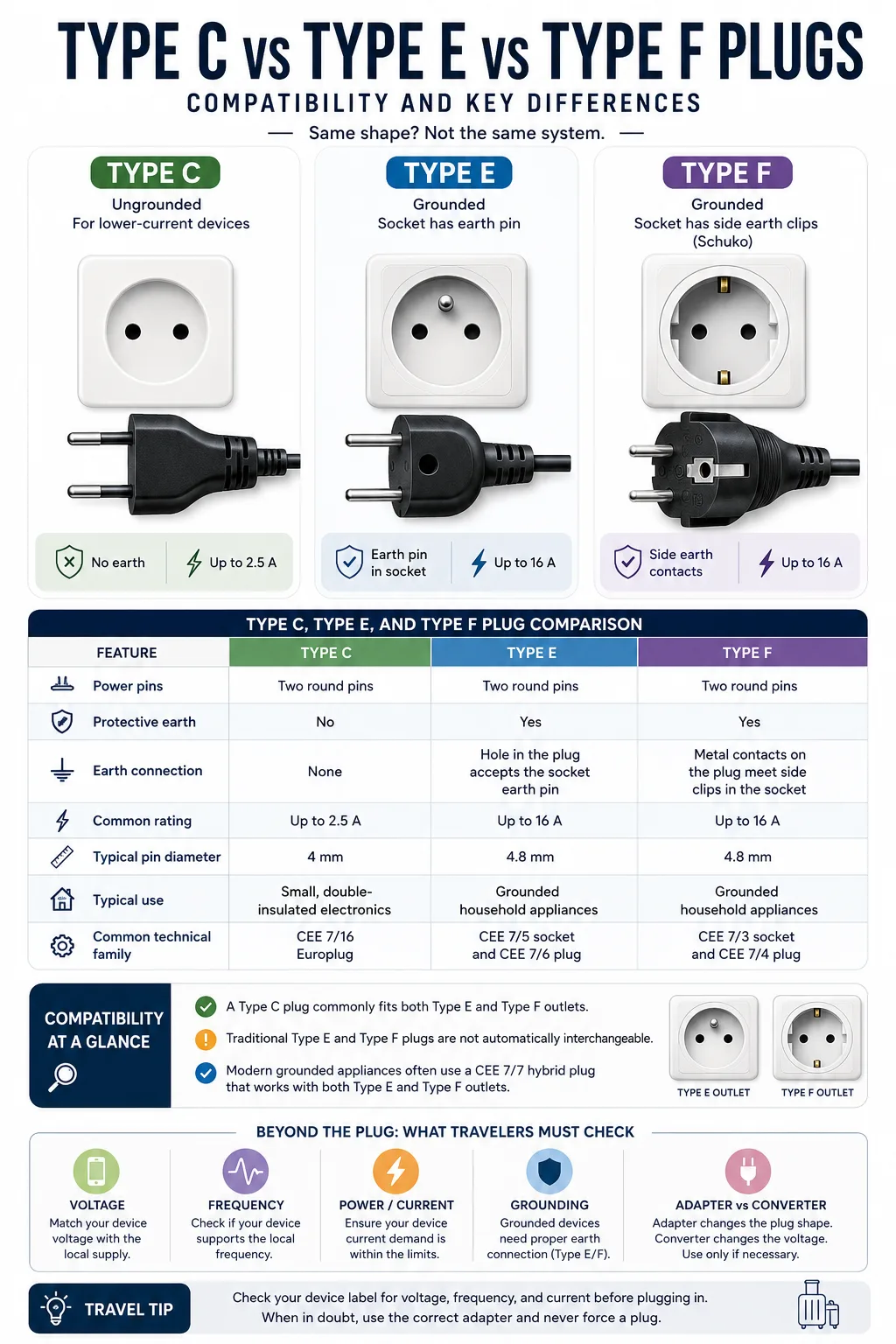
Type C, Type E, and Type F plugs all use two round power pins, but they are not the same system. Type C is ungrounded and intended for lower-current devices, while Type E and Type F support protective earth through different contact designs. A Type C plug commonly fits both Type E and Type F outlets, but traditional Type E and Type F plugs are not automatically interchangeable. Modern grounded appliances often use a CEE 7/7 hybrid plug that works with both.
For travelers, physical fit is only one check. The device voltage, frequency, current demand, and grounding requirement must also match the available power supply.
The Practical Difference Between Type C, Type E, and Type F
| Feature | Type C | Type E | Type F |
|---|---|---|---|
| Power pins | Two round pins | Two round pins | Two round pins |
| Protective earth | No | Yes | Yes |
| Earth connection | None | Hole in the plug accepts the socket earth pin | Metal contacts on the plug meet side clips in the socket |
| Common rating | Up to 2.5 A | Up to 16 A | Up to 16 A |
| Typical pin diameter | 4 mm | 4.8 mm | 4.8 mm |
| Typical use | Small, double-insulated electronics | Grounded household appliances | Grounded household appliances |
| Common technical family | CEE 7/16 Europlug | CEE 7/5 socket and CEE 7/6 plug | CEE 7/3 socket and CEE 7/4 plug |
The most useful visual clue is the earth contact. Type C has none. Type E relies on a metal pin that projects from the wall socket. Type F, often called Schuko, uses spring contacts at the sides of the recessed socket.
What Type C, Type E, and Type F Plugs and Outlets Look Like
These are simplified illustrations rather than engineering drawings. Real products can differ in body shape, recess depth, shutters, finish, and contact placement. The grounding method is the most dependable feature for distinguishing Type E from Type F.
Type C: The Ungrounded Europlug
Type C commonly refers to the CEE 7/16 Europlug. It has two thin round pins, no protective-earth contact, and a flat body that can enter many recessed European socket designs.
Its common rating is limited to 2.5 A. That makes it suitable for many small, double-insulated devices, including phone chargers, compact USB power supplies, electric toothbrush chargers, camera battery chargers, shavers, and some laptop power supplies.
Why Type C Fits More Than One Outlet Type
The slender pins and narrow plug body allow a Type C plug to enter compatible Type E and Type F sockets. It does not connect to the earth pin in a Type E outlet or the side earth clips in a Type F outlet because the plug itself has no protective-earth conductor.
This is normal only when the appliance was designed to operate without protective earth. Many such devices carry the double-insulated symbol, shown as one square inside another.
Type C Does Not Mean Any Plug with Two Round Pins
A larger two-pin plug may be a CEE 7/17 contour plug rather than Type C. CEE 7/17 uses thicker pins and can serve higher-current Class II appliances that do not need protective earth. A hair dryer or vacuum cleaner with two round pins should not be identified as Type C from pin count alone.
Type E: Grounding Through a Pin in the Socket
A Type E outlet has two round power openings and a metal earth pin projecting from the socket face. The matching traditional CEE 7/6 plug has an opening that receives this pin.
The third connection is therefore easy to misread. It is not a third power pin attached to the appliance plug. It is a protective-earth pin built into the wall outlet.
What the Earth-Pin Opening Does
When a compatible grounded plug is inserted, the socket pin enters the contact opening in the plug and connects the appliance earth conductor. This protective path is intended to carry fault current if an internal failure energizes exposed conductive parts.
A two-pin Type C plug can enter a Type E socket around the earth pin, but it remains ungrounded by design. A travel adapter that merely avoids the pin does not create an earth connection.
Type E Orientation and Polarity
The projecting earth pin normally forces a Type E plug to enter in one orientation. That physical orientation should not be treated as a universal promise that line and neutral will always appear on a particular side. Travelers should not rely on assumed polarity as a substitute for a correctly wired, grounded connection.
Type F: Schuko Side-Contact Grounding
Type F is the Schuko system. The name comes from the German term Schutzkontakt, referring to a protective contact. Its socket has two round power openings and metal earth clips along the sides of the recessed face.
A traditional CEE 7/4 Type F plug has matching metal strips on its body. When inserted, these surfaces meet the socket clips and provide protective earth without a central grounding pin.
Why Type F Can Usually Be Reversed
The Type F layout is symmetrical, so the plug can usually be inserted in either direction. Protective earth is available in both positions because contacts are provided on both sides. Line and neutral are therefore not fixed to one plug orientation.
Why Type F and Type E Look Almost Identical in Photos
Front-facing product images often show only the two round power pins. The Type F earth strips are located on the plug body, while the Type E earth connection is an opening near the face. A side view or angled view is often needed to identify the design correctly.
Which Plugs Fit Type E and Type F Outlets?
| Plug design | Type E socket | Type F socket | Protective earth |
|---|---|---|---|
| Type C / CEE 7/16 Europlug | Commonly fits | Commonly fits | No earth by design |
| Traditional Type E / CEE 7/6 | Fits | Not designed for the Type F earth system | Preserved in Type E |
| Traditional Type F / CEE 7/4 | Does not fit around the Type E earth pin | Fits | Preserved in Type F |
| CEE 7/7 hybrid E/F plug | Fits | Fits | Preserved in both |
| CEE 7/17 contour plug | Commonly fits | Commonly fits | No earth by design |
The compatibility answer changes when a product listing uses “Type F” as a loose name for a modern CEE 7/7 plug. A true traditional CEE 7/4 plug has side earth contacts but no opening for the Type E socket pin. A CEE 7/7 plug has both.
Type C Plug in a Type E Socket
This is a normal pairing for a device manufactured with a Type C Europlug. The plug enters the two power openings, while the socket earth pin remains unused. Voltage and frequency still need to match the device label.
Type C Plug in a Type F Socket
A Type C plug commonly fits a Type F socket directly. The side earth clips remain unused because Type C has no earth contact. The 16 A rating of the wall outlet does not raise the 2.5 A rating of the Europlug.
Traditional Type F Plug in a Type E Socket
The fixed earth pin in the Type E outlet blocks a traditional CEE 7/4 Type F plug that has no matching opening. The pin should never be cut, bent, removed, or forced against the plug body.
Traditional Type E Plug in a Type F Socket
A traditional CEE 7/6 Type E plug does not include the side earth strips used by a Type F socket. Even where a loose or nonstandard mechanical fit appears possible, the required earth path is not provided by the Type F contact system. A properly designed CEE 7/7 plug is the normal dual-compatible solution.
Why CEE 7/7 Is Often Mistaken for Type E or Type F
CEE 7/7 combines both grounding methods on one plug:
- An earth-contact opening accepts the projecting pin in a Type E socket.
- Metal strips on the plug body connect to the side clips in a Type F socket.
- Two 4.8 mm power pins serve the line and neutral contacts in either system.
This hybrid design is widely used on grounded appliances sold for several continental European markets. Product descriptions may call it Type E/F, Schuko-compatible, European grounded, or simply Type F. The label is less reliable than the physical contacts.
To identify it, look for both a round earth-pin opening and metal side contact strips. If only one feature is present, the plug may be a traditional Type E or traditional Type F design.
CEE 7/17: The Larger Two-Pin Plug That Is Not Type C
CEE 7/17 helps explain why two ungrounded plugs can have very different bodies and current capacities. It has two thicker 4.8 mm pins and a rounded contour that fits recessed Type E and Type F sockets, but it has no connected protective-earth contact.
It is used for Class II appliances that draw more current than a 2.5 A Europlug is intended to carry. Examples can include some hair dryers, vacuum cleaners, kitchen appliances, and other double-insulated equipment.
| Feature | Type C / CEE 7/16 | CEE 7/17 |
|---|---|---|
| Protective earth | No | No |
| Pin diameter | About 4 mm | About 4.8 mm |
| Body shape | Thin and compact | Larger rounded contour |
| Current class | Up to 2.5 A | Commonly 10 A or 16 A, depending on the plug |
| Typical device profile | Small electronics and chargers | Higher-power double-insulated appliances |
Do not choose an adapter or extension socket by counting pins alone. The plug rating, body shape, device insulation class, and required current all matter.
Plug Fit, Voltage, Frequency, and Grounding Are Separate Checks
A plug can fit a socket while the device remains electrically unsuitable. Before connecting equipment abroad, separate the decision into four questions:
- Will the plug physically fit?
- Does the device accept the local voltage?
- Can the device operate on the local frequency?
- Will any required protective-earth connection remain intact?
A plug adapter does not convert voltage. It changes the mechanical connection between the device plug and the wall outlet. It does not turn a 230V supply into 120V, and it does not automatically preserve grounding.
What “Input: 100–240V” Means
A charger marked Input: 100–240V, 50/60Hz is designed to accept mains voltage across that stated range and either listed frequency. In many trips, such a charger needs only a suitable plug adapter when its existing plug does not fit the destination socket.
The full input line should be checked. Similar-looking chargers can have different ratings, and the output information does not replace the input voltage information.
When a Voltage Converter May Be Needed
A device marked only for 110V, 115V, or 120V should not be connected directly to a 220–240V supply unless the manufacturer specifically permits it or a suitable voltage converter is used. A device marked only for 220–240V may not operate correctly on a 100–120V supply.
Always check the device label before using high-power appliances on a different voltage system.
Why 50Hz and 60Hz Still Matter
Many modern electronic power supplies accept both 50Hz and 60Hz. Some motor-driven devices, clocks, pumps, and older appliances may behave differently when the frequency changes. A voltage converter does not necessarily change frequency.
Phone and Laptop Chargers vs High-Power Appliances
Modern chargers and heating appliances should not be treated as one category. Their power demand, voltage tolerance, and grounding needs can be very different.
| Device | Common plug situation | What to check | Typical concern |
|---|---|---|---|
| Phone charger | Often Type C or a detachable regional head | Input voltage and frequency | Usually low current; adapter may be enough |
| Laptop charger | Type C, CEE 7/17, CEE 7/7, or detachable power cord | Input range, wattage, cord earth connection | High-wattage models may use grounded cords |
| Camera battery charger | Often Type C or detachable plug | Input: 100–240V and 50/60Hz | Usually similar to other small chargers |
| Electric shaver | Type C is common on travel-friendly models | Single-voltage or dual-voltage label | Motor or charging base may have limits |
| CPAP machine | Varies by power supply | Power brick input, grounding, manufacturer instructions | Medical use requires careful planning |
| Hair dryer or curling iron | May use CEE 7/17 or a grounded plug | Voltage setting, wattage, plug and adapter rating | High heat and high current |
| Kettle or clothes iron | Often CEE 7/7 on E/F systems | Voltage, wattage, earth continuity | Unsuitable for many compact travel adapters |
| Desktop computer | Usually a grounded detachable cord | Power-supply input range and correct grounded cord | Do not remove earth through a two-pin adapter |
Modern Chargers Are Often Easier to Use Abroad
Phone, tablet, camera, and many laptop chargers commonly accept 100–240V at 50/60Hz. When that exact input range appears on the label, the remaining issue is usually plug fit and, for grounded equipment, earth continuity.
A small Type C charger can normally be used in a compatible Type E or Type F socket without a separate E/F adapter. Travelers arriving from countries that use flat-blade or rectangular-pin plugs will still need an appropriate plug adapter.
Heat-Producing Appliances Need More Care
Hair dryers, curling irons, straighteners, kettles, and clothes irons can draw much more current than a phone charger. A compact adapter may accept the plug shape yet have an insufficient rating for the appliance.
Dual-voltage hair tools should be placed on the correct voltage setting before connection. Single-voltage 120V heating appliances should not be used directly on 220–240V power. Local appliances or manufacturer-approved travel models are often the simpler choice.
Choosing an Adapter for Type E and Type F Outlets
For a low-power, dual-voltage charger, the adapter decision is mainly about plug shape. For a grounded or high-power device, it also involves earth continuity and current capacity.
- Confirm that the adapter output accepts the exact device plug.
- Confirm that the adapter input is designed for the destination outlet.
- Read the maximum current, voltage, and wattage markings.
- For a grounded device, verify that protective earth passes through the adapter.
- Do not assume a universal-looking socket changes voltage.
- Avoid loose stacking of multiple plug adapters.
Why a Two-Pin Adapter Can Be Wrong for a Grounded Appliance
A small two-pin adapter may allow the line and neutral contacts of a CEE 7/7 appliance plug to receive power while leaving the earth connection unused. The appliance may turn on, but normal operation does not prove that fault protection remains available.
Mechanical compatibility does not guarantee grounding compatibility. Equipment supplied with a grounded plug should normally remain grounded throughout the connection.
The Lowest-Rated Part Sets the Practical Limit
The wall socket, travel adapter, power strip, extension lead, detachable cord, and appliance form one connection chain. The lowest-rated part limits what can be used safely. A 16 A Type E or Type F outlet does not make a 2.5 A Europlug, a low-rated adapter, or a light extension lead suitable for a high-power load.
Where Type C, Type E, and Type F Are Commonly Seen
Type C plugs are used with small appliances across many countries because they fit several round-pin socket systems. Type E outlets are commonly associated with France, Belgium, Poland, Czechia, and Slovakia. Type F outlets are common in Germany, Austria, Spain, Portugal, the Netherlands, Türkiye, and much of northern and eastern Europe.
Country labels should not replace an outlet check. Some destinations use more than one socket type, and accommodation may contain renovated outlets, older installations, or multi-standard sockets. Plug shape and supply voltage remain separate issues.
How to Identify the Plug in Your Hand
Look at the Pin Thickness
Thin 4 mm pins and a flat body point toward a Type C Europlug. Thicker 4.8 mm pins suggest Type E, Type F, CEE 7/7, or CEE 7/17.
Look for an Earth-Pin Opening
A round contact opening near the face indicates compatibility with the projecting earth pin in a Type E socket. On a true grounded plug, that opening contains a metal contact connected to the earth conductor.
Look for Side Metal Strips
Metal contact strips on the sides of the plug body indicate Type F socket compatibility. If the plug also has a Type E earth opening, it is likely a CEE 7/7 hybrid.
Check Whether the Plug Is Large but Ungrounded
A larger rounded plug with thick pins but no connected side earth strips may be CEE 7/17. Some CEE 7/17 bodies include a clearance opening for a Type E socket pin, but that opening should not be assumed to provide protective earth.
Read the Printed Rating
Look for current and voltage markings such as 2.5A 250V, 10A 250V, or 16A 250V. Also check the appliance label for the double-insulated symbol or a protective-earth requirement.
Common Compatibility Errors
“Two Round Pins Means Type C”
Type E, Type F, CEE 7/7, and CEE 7/17 also use two round power pins. Ground contacts, pin thickness, and body shape separate them.
“Type E and Type F Are the Same Plug”
The wall sockets use different earth mechanisms. Modern CEE 7/7 plugs work with both, but that does not make traditional CEE 7/6 and CEE 7/4 plugs identical.
“If It Fits, the Voltage Must Be Correct”
A Type C charger may fit a Type F outlet in a 230V country, while another two-pin appliance designed only for 120V may be damaged on the same supply. The device label decides voltage compatibility.
“An Adapter Also Converts Voltage”
An ordinary plug adapter changes the connector shape. A voltage converter is a separate device with its own input, output, power, and usage limits.
“Grounding Is Unnecessary if the Appliance Works”
Protective earth is mainly intended for fault conditions. Removing it may not stop normal operation, which is why turning on successfully is not a valid grounding test.
“A 16 A Outlet Makes Every Connected Plug 16 A”
Each plug, adapter, cable, and accessory retains its own rating. The connection must stay within the lowest marked limit.
Frequently Asked Questions
Can a Type C plug be used in a Type E outlet?
Yes, a standard Type C Europlug commonly fits a Type E outlet. It does not use the outlet earth pin because Type C is ungrounded. Check the device input voltage and frequency before use.
Can a Type C plug be used in a Type F outlet?
Yes, Type C commonly fits Type F sockets. The Type F side earth contacts remain unused. The device must still stay within the Type C plug rating and accept the local voltage.
Are Type E and Type F plugs interchangeable?
Traditional Type E and Type F plugs use different grounding contacts and are not fully interchangeable. A CEE 7/7 hybrid plug is designed to work safely with both Type E and Type F sockets.
How can I recognize a CEE 7/7 plug?
Look for a round opening that accepts the Type E socket earth pin and metal contact strips that connect to Type F side clips. Both features must be present.
Is every large two-pin European plug Type C?
No. A large ungrounded two-pin plug may be CEE 7/17. It uses thicker pins and can support higher-current Class II appliances than the 2.5 A Type C Europlug.
Do I need a voltage converter for Type C, Type E, or Type F?
The plug type does not determine the answer. Check the device input label. Equipment marked Input: 100–240V, 50/60Hz commonly needs only a suitable plug adapter. Single-voltage equipment may require a converter when the destination voltage differs.