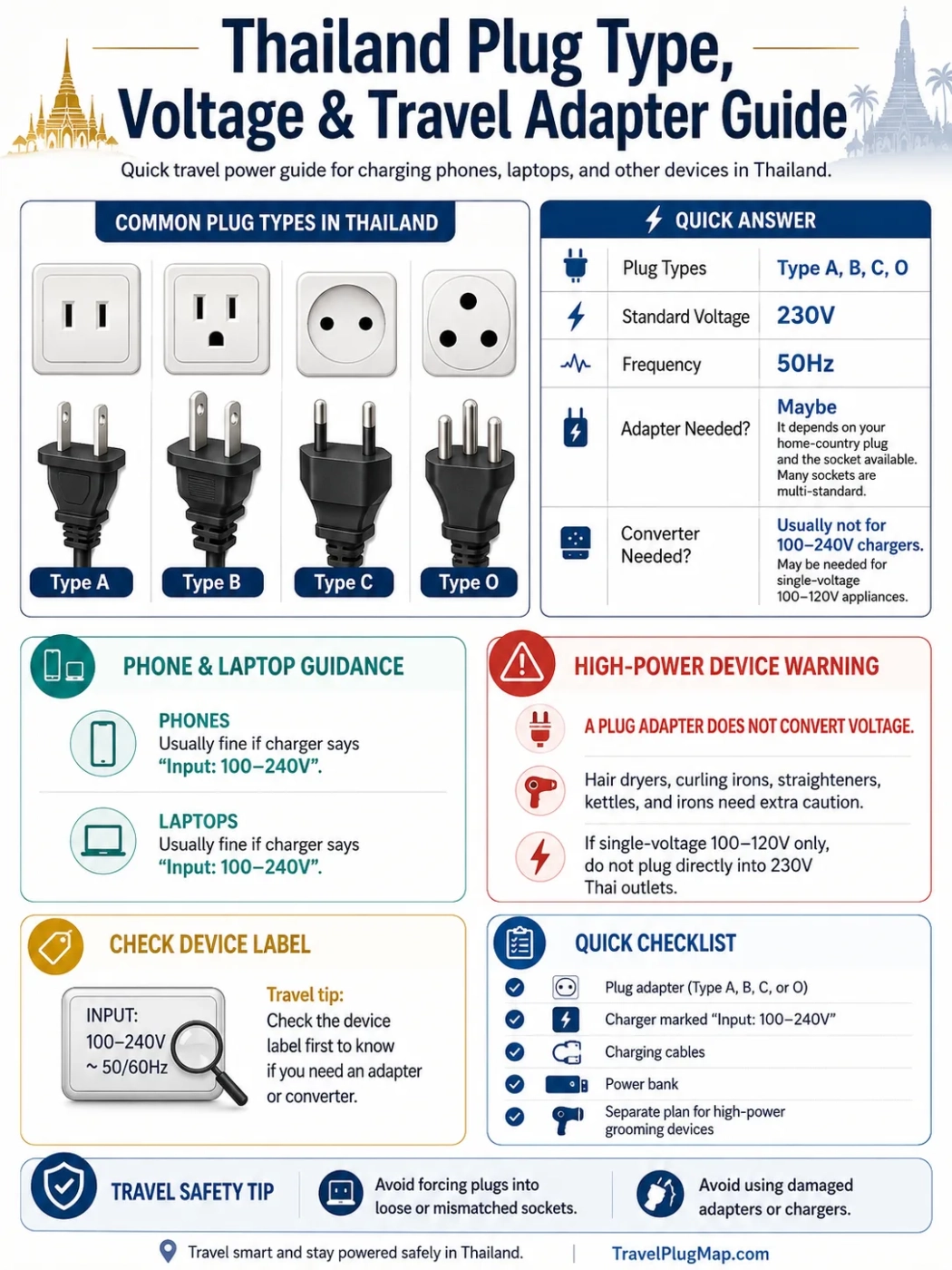
Thailand uses several plug shapes, most commonly Type A, Type B, Type C, and Type O outlets, with electricity commonly supplied at 230V and 50Hz. Many modern phone chargers and laptop chargers work if the label says Input: 100–240V, but travelers from 100–120V countries should be careful with hair dryers, curling irons, kettles, and other high-power appliances.
| Travel Power Topic | Thailand Guidance |
|---|---|
| Common plug types | Type A, Type B, Type C, and Type O are commonly associated with Thailand. Some sockets are multi-standard and may accept more than one plug shape. |
| Standard voltage | 230V is commonly listed for Thailand. Some local travel materials may describe it as 220V, but travelers should treat Thailand as a high-voltage destination compared with 100–120V countries. |
| Frequency | 50Hz |
| Plug adapter needed? | Maybe. It depends on your home-country plug and the socket available in your hotel, apartment, airport, or café. |
| Voltage converter needed? | Usually not for modern phone and laptop chargers marked Input: 100–240V. May be needed for single-voltage 100–120V appliances. |
| Best device advice | Check the device label first. A plug adapter does not convert voltage. |
What the Power Outlets Look Like
These illustrations are simplified front views of outlet types travelers may see in Thailand. Real wall sockets can look slightly different depending on the building, socket manufacturer, and age of installation. Hotels may also provide multi-standard sockets. Plug shape and voltage are separate issues, so always check both before using a device.
What Plug Type Does Thailand Use?
Thailand is a little more mixed than some destinations. Travelers may see sockets that accept Type A plugs with two flat parallel pins, Type B plugs with two flat pins and a grounding pin, Type C Europlug-style plugs with two round pins, and Type O, a Thai-style grounded plug with three round pins.
In practical travel terms, many hotels, apartments, airports, coworking spaces, and cafés use hybrid outlets that can accept more than one plug shape. That can be convenient, but it can also create confusion. A plug may physically fit into the outlet, yet the device may still need to be checked for voltage compatibility.
Type F-style round-pin plugs may also fit some sockets or appear in certain situations, but travelers should not rely on every socket accepting every European or grounded plug. If your device has a bulky grounded plug, a travel adapter may still be useful.
Voltage and Frequency in Thailand
Thailand commonly uses 230V electricity at 50Hz. You may also see Thailand described as 220V in some travel materials. For most travelers, the practical point is the same: Thailand is a higher-voltage destination than countries such as the United States, Canada, Japan, and parts of the Caribbean that commonly use around 100–120V.
The frequency is 50Hz. Most modern USB phone chargers, camera chargers, and laptop power bricks are designed to handle both 50Hz and 60Hz, but some appliances with motors, heating elements, timers, or older power supplies may be more sensitive.
Always check the device label before using high-power appliances abroad. Do not assume that a device is safe just because the plug fits into a Thai outlet.
Do You Need a Travel Adapter for Thailand?
You may need a travel adapter for Thailand if your plug does not match the outlet available where you are staying. Because Thailand uses mixed and hybrid socket types, the answer depends on your home-country plug and the specific outlet in the room.
Travelers from the United States, Canada, Mexico, or Japan
Two-pin Type A plugs often fit many Thai sockets, but not always securely. Three-pin Type B plugs may fit some outlets, but older or simpler sockets may not accept the grounding pin. If your charger has a grounded Type B plug, carrying a suitable adapter is still a sensible choice.
The bigger issue for North American and Japanese travelers is usually voltage. Thailand’s supply is around 230V, while many home appliances from these countries are designed for 100–120V only.
Travelers from the United Kingdom, Ireland, Singapore, or Hong Kong
Type G plugs do not normally match Thai outlets. You will usually need a plug adapter for Thailand. If your device is dual voltage, the adapter is usually enough for charging. If the device is single-voltage, you may also need a voltage converter or a different travel-safe device.
Travelers from Europe
Two-round-pin Type C plugs often work in many Thai sockets. Larger grounded European plugs may be less predictable, especially if the socket is older or multi-standard. A compact adapter can be useful if you rely on grounded plugs or bulky chargers.
Travelers from Australia or New Zealand
Type I plugs are not the standard plug shape in Thailand, so travelers from Australia or New Zealand will usually need a plug adapter. Many modern chargers are dual voltage, but the label should still be checked.
Do You Need a Voltage Converter in Thailand?
You need a voltage converter only if your device is not compatible with Thailand’s voltage. The key is the label on the charger, plug, or appliance body.
If the label says Input: 100–240V, the device is designed to work across the common global voltage range. In that case, you usually only need a plug adapter if the plug shape does not fit.
If the label says something like Input: 120V only or 100V only, do not plug it directly into a Thai outlet. That device is not designed for Thailand’s voltage without the correct voltage converter or transformer.
A plug adapter does not convert voltage. It only changes the physical plug shape so your device can connect to a different outlet. Voltage conversion is a separate function.
Can You Charge Your Phone in Thailand?
In most cases, yes. Most modern phone chargers are designed for international travel and show a rating such as Input: 100–240V, 50/60Hz. That means the charger can usually handle Thailand’s voltage and frequency.
You may still need a plug adapter if your charger plug does not fit the outlet. USB wall chargers with Type A, Type C, or multi-country pins may work in many places, but socket fit can vary.
Before charging, check the tiny printed label on the charger. Look for “Input,” not “Output.” The output line describes what the charger sends to the phone; the input line tells you whether the charger can safely accept the wall voltage.
Can You Use a Laptop Charger in Thailand?
Usually, yes. Most laptop chargers are dual voltage and support Input: 100–240V and 50/60Hz. If your laptop power brick has that rating, you normally need only a plug adapter for the physical outlet shape.
Be more careful if the laptop charger is old, damaged, unofficial, or missing its label. If the label is unreadable, do not guess. Use a confirmed compatible charger instead.
Grounding can also matter. Some laptop chargers use a three-prong grounded plug. If you use an adapter that removes the ground connection, it may not be ideal for long-term use. For short travel charging, many people use compact adapters, but grounded equipment should be matched with an adapter designed for grounded plugs whenever possible.
Can You Use a Hair Dryer or Curling Iron in Thailand?
This is where travelers need the most caution. Hair dryers, curling irons, straighteners, kettles, clothes irons, and some heating appliances draw much more power than a phone charger or laptop charger.
If your hair dryer or curling iron is marked 100–240V or has a proper dual-voltage switch, it may be usable in Thailand with the right plug adapter. If it is marked only for 110V, 120V, or 100V, do not plug it directly into a Thai outlet.
Some voltage converters are not suitable for high-wattage heat appliances. Even when a converter is available, it must be rated for the appliance’s wattage. A small travel converter that works for a low-power device may not safely run a hair dryer.
For high-power appliances, the safest travel choice is usually a dual-voltage travel model or using equipment provided locally.
Device-by-Device Travel Advice
| Device | Adapter Needed? | Converter Needed? | What to Check |
|---|---|---|---|
| Phone charger | Maybe, depending on plug shape | Usually no if marked 100–240V | Look for Input: 100–240V and 50/60Hz |
| Laptop charger | Maybe | Usually no if dual voltage | Check the power brick input label |
| Camera battery charger | Maybe | Usually no if dual voltage | Check the charger label, not the battery label |
| Electric shaver | Maybe | Depends on voltage rating | Many are dual voltage, but not all |
| Hair dryer | Usually yes if plug differs | May be needed if single-voltage | Check voltage and wattage carefully |
| Curling iron or straightener | Usually yes if plug differs | May be needed if single-voltage | Check for dual voltage or a voltage selector |
| CPAP machine | Maybe | Often no if the power supply is 100–240V, but confirm | Check the medical device power supply and bring the correct adapter |
What “Input: 100–240V” Means
Input: 100–240V means the device power supply can accept electricity from roughly 100 volts up to 240 volts. This is common on modern phone chargers, laptop chargers, tablet chargers, USB-C chargers, and many camera chargers.
If your charger also says 50/60Hz, it is usually designed to work with both major electrical frequencies used around the world. Thailand uses 50Hz, so a charger marked 50/60Hz is normally fine from a frequency point of view.
Do not confuse input and output. A phone charger might say “Output: 5V,” “9V,” or “20V.” That is what the charger sends to the device. For wall power compatibility in Thailand, the important line is the Input rating.
120V vs 230V: Why Thailand Can Be Risky for Some Devices
If you are traveling from a 100–120V country, Thailand’s 230V supply can damage a single-voltage appliance. In some cases, the device may overheat, fail, blow a fuse, or create a safety risk.
This matters most for older appliances and high-power devices. A basic 120V hair dryer, 120V curling iron, or 120V clothes iron should not be used directly in Thailand. A simple plug adapter will not make it safe.
For modern electronics, the risk is usually lower because many chargers are built for international voltage. Still, the label is the final check.
Travel Power Safety Tips for Thailand
- Check every device label before plugging it in, especially appliances from 100–120V countries.
- Look for Input: 100–240V on phone, laptop, tablet, camera, and CPAP power supplies.
- Use a plug adapter only for plug shape. A plug adapter does not convert voltage.
- Be cautious with high-power appliances such as hair dryers, curling irons, kettles, and irons.
- Do not force a plug into a loose or mismatched socket.
- Avoid using damaged adapters, cracked chargers, or overloaded power strips.
- For medical devices, confirm compatibility before travel and pack a suitable adapter in your carry-on bag.
- Remember that hotel sockets may vary from room to room, especially in older buildings.
What to Pack for Thailand
For most travelers, a compact universal travel adapter or a Thailand-compatible plug adapter is enough for phones, laptops, tablets, and camera chargers, as long as those chargers are marked Input: 100–240V.
If you are bringing high-power appliances from a 100–120V country, think carefully before packing them. A voltage converter can be bulky, may not support the required wattage, and may not be ideal for heat appliances. A dual-voltage travel appliance or local option is often simpler.
For a short trip, the safest basic checklist is:
- One plug adapter that fits Thai outlets and your home-country plug
- USB charger or laptop charger marked 100–240V
- Charging cable for each device
- Power bank for buses, trains, and long travel days; flights have separate lithium-battery rules
- Separate plan for high-power grooming devices if needed
FAQ
What plug type is used in Thailand?
Thailand commonly uses Type A, Type B, Type C, and Type O plug/socket arrangements. Many sockets are hybrid designs, so the exact outlet shape can vary by building and location.
Do I need a plug adapter for Thailand?
Maybe. If your plug does not fit Type A, Type B, Type C, or Thai-style multi-standard sockets, you will need a plug adapter. Travelers with UK Type G or Australia/New Zealand Type I plugs usually need one.
Do I need a voltage converter in Thailand?
You usually do not need a voltage converter for modern chargers marked Input: 100–240V. You may need one for single-voltage 100–120V appliances, especially high-power devices.
Can I charge my phone in Thailand?
Usually yes. Most modern phone chargers support 100–240V and 50/60Hz. Check the charger label and use a plug adapter if the plug shape does not fit the socket.
Can I use a US hair dryer in Thailand?
Only if it is dual voltage or specifically rated for 230V. A 120V-only hair dryer should not be plugged directly into a Thai outlet. A plug adapter does not convert voltage.
Is Thailand 50Hz or 60Hz?
Thailand uses 50Hz electricity. Most modern electronic chargers marked 50/60Hz are usually fine, but some motorized, timing, or heating appliances may be affected by frequency differences.