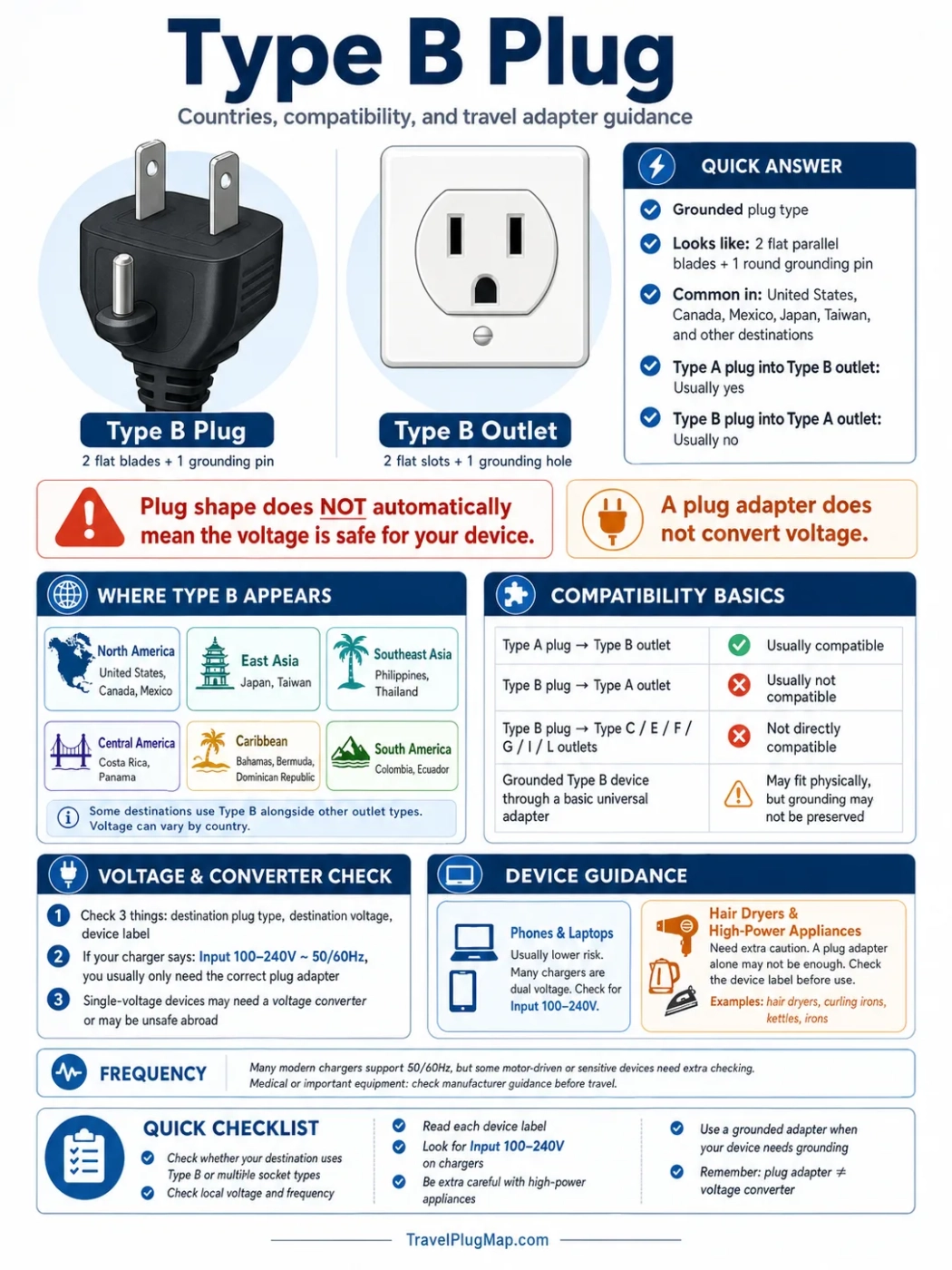
Type B is the grounded North American-style plug with two flat parallel blades and one round grounding pin. It is commonly linked with destinations such as the United States, Canada, Mexico, Japan, Taiwan, and several countries in the Americas and Asia, but voltage still changes by country. A Type B plug shape does not automatically mean the voltage is safe for your device.
| Question | Practical Answer |
|---|---|
| What does Type B look like? | Two flat parallel blades plus one round grounding pin. |
| Is Type B grounded? | Yes. Type B is the grounded version of the Type A plug family. |
| Where is Type B common? | It is mainly associated with North America and also appears in parts of Central America, the Caribbean, South America, and Asia. |
| Can a Type A plug fit a Type B outlet? | Usually yes. A two-blade Type A plug can normally fit into a Type B outlet. |
| Can a Type B plug fit a Type A outlet? | Usually no. The round grounding pin prevents a Type B plug from fitting into a two-slot Type A outlet. |
| Do travelers need a voltage converter? | It depends on the destination voltage and the device label. A plug adapter does not convert voltage. |
What a Type B Plug and Outlet Look Like
This is a basic visual guide, not an engineering drawing. Real wall outlets can look slightly different depending on the country, building age, socket manufacturer, and installation style. Plug shape and voltage are separate issues, so always check both before using a device abroad.
What Is a Type B Plug?
A Type B plug is a three-pin plug used for grounded electrical connections. It has two flat parallel blades for power and one round or U-shaped grounding pin below them. The grounding pin is the key difference between Type A and Type B.
In travel language, Type B is often described as the grounded plug used in the United States, Canada, Mexico, and nearby regions. That is mostly helpful, but it is not the full story. Some countries use Type B together with Type A. Some use Type B alongside other socket types. Some hotels also install multi-standard outlets that accept several plug shapes.
For travelers, the important point is simple: Type B tells you the plug shape, not the voltage. A Type B outlet in one country may be part of a 100–127V system, while another destination with Type B-style outlets may use a different voltage.
What Does a Type B Plug Look Like?
A Type B plug has three visible parts:
- Two flat parallel blades
- One round grounding pin below the blades
- A wider plug body than a simple two-pin Type A plug in many designs
The two flat blades make it look similar to Type A, but the grounding pin changes compatibility. A Type A plug usually fits into a Type B outlet because it only needs the two flat slots. A Type B plug usually cannot fit into a Type A outlet because the Type A socket has no place for the grounding pin.
Where Is Type B Used?
Type B is most strongly associated with North America, but it can also appear in several other regions. Country-by-country power systems can change, and some destinations use more than one outlet type, so treat this as a practical travel overview rather than a complete electrical standard list.
| Region | Examples | Traveler Note |
|---|---|---|
| North America | United States, Canada, Mexico | Type A and Type B outlets are common. Many devices are designed around 120V / 60Hz use. |
| East Asia | Japan, Taiwan | Type A is very common, and Type B grounded outlets may also appear. Voltage can differ from North America. |
| Southeast Asia | Philippines, Thailand and some mixed-standard destinations | Multiple plug types may be present, so a destination-specific adapter check is useful. |
| Central America | Costa Rica, Panama and nearby destinations | Type A and Type B are commonly seen, but always check local voltage before using appliances. |
| Caribbean | Bahamas, Bermuda, Dominican Republic and some island destinations | Socket types and voltage can vary between islands and accommodations. |
| South America | Colombia, Ecuador and some locations with Type A/B systems | Type B may appear, but countries in South America are not all the same electrically. |
Some countries use Type B as one of several outlet types, not the only outlet type. Older buildings, rural areas, hotels, airports, and apartments may not always match the most common national pattern.
Is Type B Grounded?
Yes. Type B is a grounded plug type. The round pin provides a grounding path when the outlet, plug, adapter, and building wiring all support it.
This matters for some three-prong devices, especially equipment with metal bodies or devices that are designed to rely on grounding. However, not every travel adapter preserves grounding. Many compact universal adapters physically let your plug fit, but they may not provide a true ground connection.
If your device has a three-prong grounded plug, use a travel adapter that clearly supports grounded Type B use. For sensitive or high-value equipment, check the device instructions before relying on a simple adapter.
Is Type B Compatible With Other Plug Types?
Type B compatibility is easiest to understand by comparing it with Type A.
| Plug or Outlet Situation | Usually Compatible? | Why It Matters |
|---|---|---|
| Type A plug into Type B outlet | Usually yes | The Type A plug only needs the two flat slots. |
| Type B plug into Type A outlet | Usually no | The Type A outlet has no grounding hole. |
| Type B plug into Type C, E, F, G, I, L, or other outlets | No, not directly | You need a plug adapter for the destination socket shape. |
| Grounded Type B device through a basic universal adapter | Physically possible in some cases | The adapter may not preserve grounding. Check the adapter design carefully. |
Compatibility only answers the shape question. It does not answer whether the device can safely handle the local voltage or frequency.
Do Travelers Need an Adapter for Type B Outlets?
You need a plug adapter if your device plug does not physically match Type B or Type A/B outlets. Travelers from the United Kingdom, most of Europe, Australia, New Zealand, India, Singapore, and many other regions usually need an adapter when visiting a Type B destination.
Travelers from the United States, Canada, Mexico, or another country that already uses Type A/B plugs may not need a plug adapter for shape compatibility, but they still need to check voltage when traveling internationally.
A plug adapter does not convert voltage. It only changes the physical plug shape so your device can connect to the wall outlet.
Voltage Is Separate From Plug Shape
Type B is often found in countries using around 100–127V, especially in North America and Japan-style systems. But travelers should not rely on plug shape alone. Some destinations have mixed systems, multiple outlet types, or local variations.
The safe habit is to check three things before plugging in:
- The destination plug type
- The destination voltage
- The device label on your charger or appliance
If the label says Input: 100–240V, the device is usually designed for worldwide voltage ranges. This is common on many phone chargers, laptop chargers, camera battery chargers, tablet chargers, and USB-C power adapters.
If the label says only 110V, 120V, 125V, 220V, or 230V, the device may be single-voltage. In that case, you may need a voltage converter, or you may need to avoid using that device in a country with a different voltage.
What “Input: 100–240V” Means
Input: 100–240V means the power supply is usually designed to accept voltage from low-voltage systems such as 100–120V and higher-voltage systems such as 220–240V. For most travelers, this is the most reassuring label to find.
You may also see frequency information such as 50/60Hz. That means the charger is designed for both common electrical frequencies. Many modern chargers list something like:
Input: 100–240V ~ 50/60Hz
When you see that kind of label, you usually only need the correct plug adapter for the outlet shape. Still, the plug adapter must match the destination socket and must be suitable for the device’s plug.
Phone and Laptop Chargers With Type B Outlets
Phones and laptops are usually lower-risk travel devices because their chargers are commonly dual voltage. If your charger says Input: 100–240V, it should normally work in Type B destinations with the correct plug fit or adapter.
For example, a traveler from Europe visiting the United States usually needs a plug adapter for the Type A/B outlet shape. A modern USB phone charger that says Input: 100–240V usually does not need a voltage converter.
Laptop chargers are similar. Most modern laptop power bricks support a wide input range, but check the printed label on the charger itself, not only the laptop body.
Hair Dryers, Curling Irons, Kettles, and Irons Need More Caution
High-power heat appliances are the biggest travel power risk. Hair dryers, curling irons, straighteners, travel kettles, clothes irons, and similar devices often draw much more power than phone or laptop chargers.
Always check the device label before using high-power appliances abroad.
If your hair dryer or curling iron is single-voltage and the destination voltage is different, a plug adapter alone is not enough. Using a 120V-only hair dryer in a 230V country can damage the appliance and may create a safety risk. Using a 230V-only appliance in a 120V country may result in poor performance or failure to heat properly.
Some travel hair tools have a dual-voltage switch or label. If they do, make sure the voltage setting is correct before plugging them in. If the device is not clearly dual voltage, it is usually safer to use a locally compatible appliance or hotel-provided option.
What About 50Hz and 60Hz?
Frequency is measured in hertz, usually 50Hz or 60Hz. Many modern electronic chargers are marked 50/60Hz and can handle both. For phones, laptops, tablets, cameras, and USB chargers, frequency is usually not a problem when the charger label supports both.
Frequency can matter more for some motor-driven appliances, clocks, pumps, shavers, or medical equipment. If you travel with a CPAP machine or another important health-related device, check the power label and manufacturer guidance before departure. You may need the correct plug adapter, voltage support, and sometimes a grounded connection.
Travel Adapter Guide for Type B Destinations
Choose your adapter based on where you are traveling from and where you are going.
| Your Device Plug | Destination Outlet | Adapter Needed? | Voltage Check Needed? |
|---|---|---|---|
| Type A | Type B | Usually no | Yes, especially when traveling internationally |
| Type B | Type B | No for plug shape | Yes, if the country voltage differs from your home country |
| Type C, E, or F | Type B | Yes | Yes |
| Type G | Type B | Yes | Yes, especially for UK-style 230V appliances |
| Type I | Type B | Yes | Yes, especially for Australian or New Zealand appliances |
If your device has a grounded plug, look for an adapter that supports grounding. If your device is a simple two-pin charger, grounding is usually less relevant, but voltage still matters.
Common Mistakes With Type B Plugs
- Assuming every Type B country uses the same voltage.
- Using a plug adapter as if it were a voltage converter.
- Trying to force a Type B plug into a Type A outlet.
- Ignoring the grounding pin on three-prong devices.
- Using a single-voltage hair dryer or curling iron without checking the label.
- Assuming hotel multi-standard sockets always support every device safely.
Simple Type B Travel Checklist
- Check whether your destination uses Type B, Type A/B, or multiple socket types.
- Check the destination voltage and frequency.
- Read the label on each charger or appliance.
- Look for Input: 100–240V on phones, laptops, tablets, and camera chargers.
- Be extra careful with high-power appliances such as hair dryers, curling irons, kettles, and irons.
- Use a grounded adapter if your device has a grounded plug and needs grounding.
- Remember: a plug adapter does not convert voltage.
FAQ
Is Type B the same as Type A?
No. Type A has two flat blades and is usually ungrounded. Type B has two flat blades plus a round grounding pin. A Type A plug usually fits a Type B outlet, but a Type B plug usually does not fit a Type A outlet.
Do I need a travel adapter for a Type B outlet?
You need a travel adapter if your plug does not match Type B or Type A/B outlets. Travelers from Europe, the UK, Australia, and many other regions usually need an adapter for Type B destinations.
Does a Type B adapter convert voltage?
No. A plug adapter does not convert voltage. It only changes the plug shape. If your device is not compatible with the local voltage, you may need a voltage converter or a different device.
Can I charge my phone in a Type B outlet?
Usually yes, if your charger fits the outlet or you have the correct adapter. Check the charger label. If it says Input: 100–240V, it is usually suitable for international voltage ranges.
Can I use a European hair dryer in a Type B country?
Only if the hair dryer supports the local voltage. Many European hair dryers are 220–240V only, while many Type B destinations use around 100–127V. A plug adapter alone may not make the hair dryer work correctly.
Are Type B outlets always grounded?
Type B is designed as a grounded outlet type, but grounding depends on the outlet, building wiring, plug, and adapter. Some travel adapters do not preserve a true ground connection, even if they accept a three-prong plug.