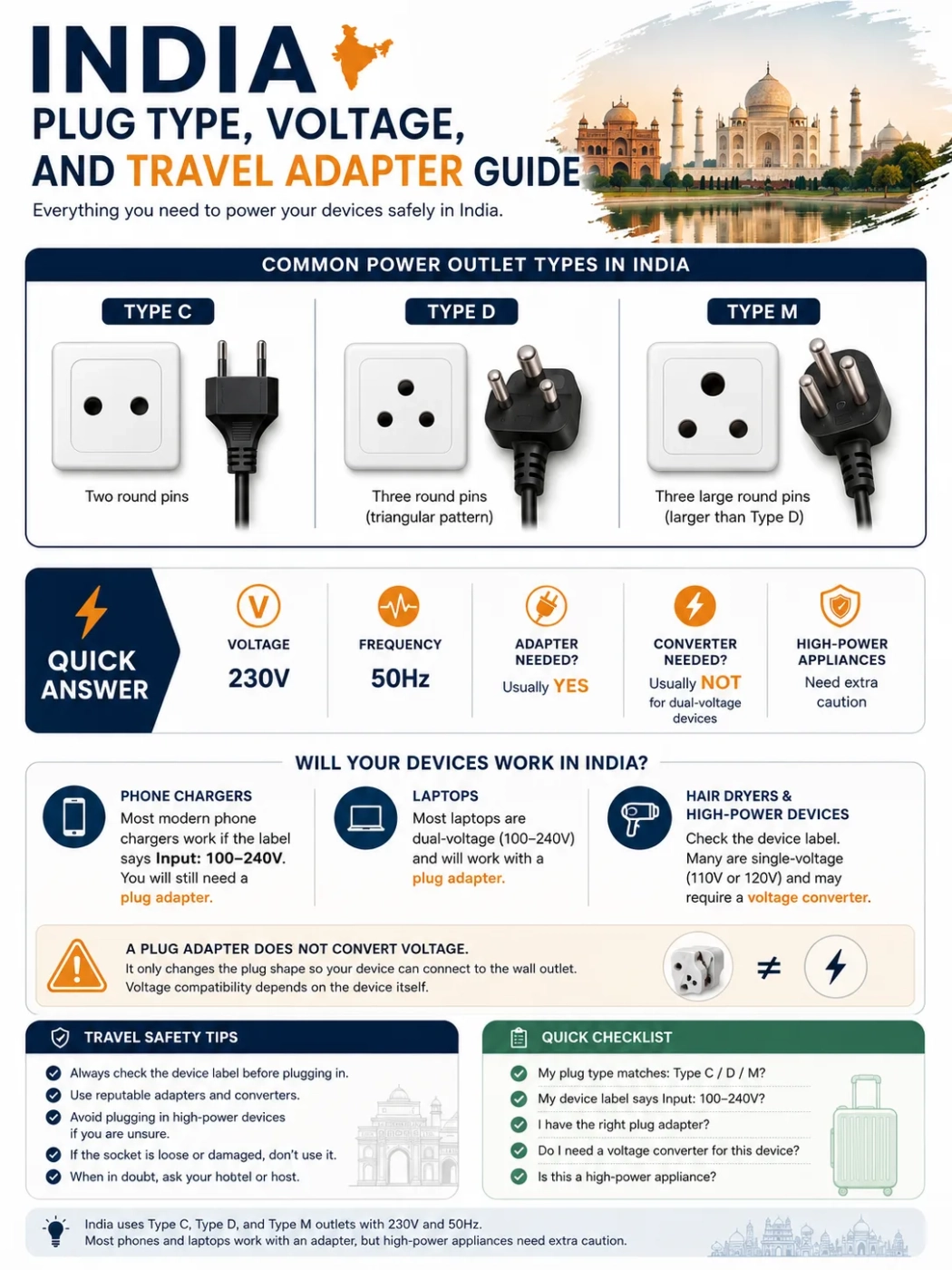
India commonly uses Type C, Type D, and Type M power outlets, with a standard supply of 230V and 50Hz. Most modern phone and laptop chargers work in India if the label says Input: 100–240V, but many travelers will still need a plug adapter. High-power appliances need more caution.
| Travel Power Question | India Answer |
|---|---|
| Common plug types | Type C, Type D, and Type M |
| Standard voltage | 230V |
| Standard frequency | 50Hz |
| Plug adapter needed? | Usually yes, unless your plug already fits the socket safely. |
| Voltage converter needed? | Usually not for dual-voltage chargers. May be needed for single-voltage 110V or 120V appliances. |
| Best device advice | Check the device label before plugging in anything, especially hair dryers, curling irons, kettles, irons, and other high-power appliances. |
A plug adapter does not convert voltage. It only changes the plug shape so your device can physically connect to the wall outlet. Voltage compatibility depends on the device itself.
What the Power Outlets Look Like
These illustrations are simplified front views of outlet types travelers may see in India. Real wall sockets can look slightly different depending on the building, socket manufacturer, and age of installation. Hotels may also provide multi-standard sockets. Plug shape and voltage are separate issues, so always check both before using a device.
What Plug Type Does India Use?
India commonly uses Type C, Type D, and Type M sockets. Type D is especially important for travelers because it is widely associated with Indian wall outlets and has three round pins in a triangular pattern. Type M looks similar but uses larger round pins and is more commonly linked with heavier appliances or higher-current circuits.
Type C may appear in some places, especially for small two-pin plugs and travel-friendly outlets. However, travelers should not assume that every Indian socket will accept every European-style plug safely. Some sockets are older, some are loose, and some multi-standard sockets vary in quality.
If your plug is from the United States, Canada, the United Kingdom, Australia, New Zealand, or many other regions, you will usually need a travel plug adapter for India. The exact adapter depends on your home plug shape and the outlet available where you stay.
Voltage and Frequency in India
India uses a standard voltage of 230V and a standard frequency of 50Hz. This matters because the plug shape is only one part of compatibility. Your device also needs to handle the local electrical supply.
If you are traveling from a country that also uses around 220V to 240V, many appliances may be voltage-compatible, although the plug may still not fit. If you are traveling from a 100V to 127V country, such as the United States, Canada, Japan, or parts of Latin America, you need to check each device more carefully.
The frequency difference can matter for some devices with motors, timers, heating controls, or clocks. Most modern chargers for phones, laptops, tablets, cameras, and USB devices are designed for both 50Hz and 60Hz, but you should still check the label.
Do You Need a Travel Adapter for India?
You usually need a plug adapter for India if your device plug does not physically match Type C, Type D, or Type M outlets. A travel adapter helps your plug fit the socket, but it does not change the electricity going into your device.
A plug adapter does not convert voltage. This is one of the most common travel power mistakes. If your hair dryer is made only for 120V, using only a plug adapter in India’s 230V outlet can damage the appliance and may create a safety risk.
For most travelers, the safest approach is simple: pack a suitable India plug adapter, then check every device label before use. If the device says Input: 100–240V, it is usually designed to handle India’s 230V supply.
Do You Need a Voltage Converter in India?
You may need a voltage converter in India if your device is single-voltage and not rated for 230V. This is especially common with high-power personal appliances from 110V or 120V countries.
Look at the small print on the charger, power brick, or appliance body. If it says Input: 100–240V, 50/60Hz, the device is usually dual voltage or multi-voltage. In that case, you normally need only the correct plug adapter.
If the label says only 110V, 120V, or a narrow range such as 120V 60Hz, do not plug it directly into an Indian outlet with only a travel adapter. Always check the device label before using high-power appliances abroad.
Can You Charge Your Phone in India?
In most cases, yes. Modern phone chargers are commonly rated for Input: 100–240V and 50/60Hz, which means they can usually handle India’s 230V, 50Hz electricity. You will normally need only a plug adapter so the charger can fit the wall outlet.
Do not rely only on the phone brand or the USB cable. Check the actual wall charger or charging brick. The important information is printed on the charger label, not on the cable.
Can You Use a Laptop Charger in India?
Most modern laptop chargers are designed for international voltage. If the power brick says Input: 100–240V, it should usually work in India with the right plug adapter or a compatible power cord.
Laptop chargers can draw more power than phone chargers, so use a stable outlet and avoid loose wall sockets. If your laptop charger uses a grounded plug, choose an adapter that supports grounding when possible. This is especially helpful for larger laptop power bricks and work equipment.
Can You Use a Hair Dryer or Curling Iron in India?
Hair dryers, curling irons, straighteners, kettles, irons, and similar appliances need extra caution. These are high-power appliances, and many are made for only one voltage range.
If your hair dryer is marked only 120V, do not use it in India with a simple plug adapter. It may overheat, burn out, or become unsafe. A voltage converter may be required, but high-wattage converters can be bulky and must be matched carefully to the appliance wattage.
For many travelers, the easier option is to use a locally provided appliance at the hotel or bring a travel appliance that clearly supports 220–240V or dual voltage. If the device has a voltage switch, make sure it is set correctly before plugging it in.
Device-by-Device Travel Power Guide for India
| Device | Adapter Needed? | Converter Needed? | What to Check |
|---|---|---|---|
| Phone charger | Usually yes | Usually no | Look for Input: 100–240V, 50/60Hz |
| Laptop charger | Usually yes | Usually no | Check the power brick label |
| Camera battery charger | Usually yes | Usually no if dual voltage | Check the charger input range |
| Electric shaver | Usually yes | Depends on voltage rating | Check whether it supports 230V and 50Hz |
| Hair dryer or curling iron | Usually yes | Often needed if from a 120V country | Check voltage, wattage, and any dual-voltage switch |
| CPAP machine | Usually yes | Usually no if the power supply is 100–240V | Check the power supply label and bring a reliable adapter |
What “Input: 100–240V” Means
Input: 100–240V means the device is designed to accept a wide voltage range. This is common on USB phone chargers, laptop power bricks, camera chargers, and many tablet chargers. If the label also says 50/60Hz, it is usually suitable for both major frequency systems used around the world.
This does not mean the plug will fit the wall. It only means the electrical input range is broad enough. You may still need a travel adapter for India’s socket types.
If you cannot find the label or the printed information is unclear, do not guess. Use a different charger, ask the manufacturer, or avoid using the device until you can confirm its rating.
Travel Power Safety Tips for India
- Check the device label before plugging anything into the wall.
- Use a plug adapter that fits securely and does not wobble in the outlet.
- Do not overload one outlet with several high-power appliances.
- Be careful with old, loose, or damaged sockets.
- Keep chargers away from beds, curtains, and wet surfaces.
- Unplug high-power appliances when not in use.
- For medical devices such as CPAP machines, bring the correct adapter and confirm the power supply rating before travel.
What to Pack for India
For a typical trip to India, most travelers should pack a suitable India travel adapter, USB chargers that support Input: 100–240V, and the original charger for important electronics. If you rely on medical equipment, bring a backup plan and check compatibility before departure.
If you are traveling from a 120V country and plan to bring a hair dryer, curling iron, electric kettle, or iron, check the label carefully. A small plug adapter is not enough if the appliance cannot handle 230V.
FAQ
What plug adapter do I need for India?
You usually need an adapter that can connect your home plug to India’s common Type C, Type D, or Type M outlets. Type D is especially common, but hotels and buildings may vary.
Is India 110V or 220V?
India uses 230V electricity, which is closer to 220V–240V systems than to 110V–120V systems. Travelers from 120V countries should check device labels carefully.
Will my US phone charger work in India?
Usually yes, if the charger says Input: 100–240V and 50/60Hz. You will still need a plug adapter because US plugs do not normally fit Indian outlets directly.
Can I use a European plug in India?
Some two-pin Type C plugs may fit certain sockets, but fit and safety can vary. Larger grounded European plugs may not fit properly. A suitable travel adapter is safer.
Do I need a voltage converter for my laptop in India?
Usually no, because most laptop chargers support Input: 100–240V. Check the power brick label to confirm before plugging it in.
Can I use my hair dryer in India?
Only if it is rated for 230V or clearly marked dual voltage and set correctly. If it is only 110V or 120V, do not use it in India with only a plug adapter.