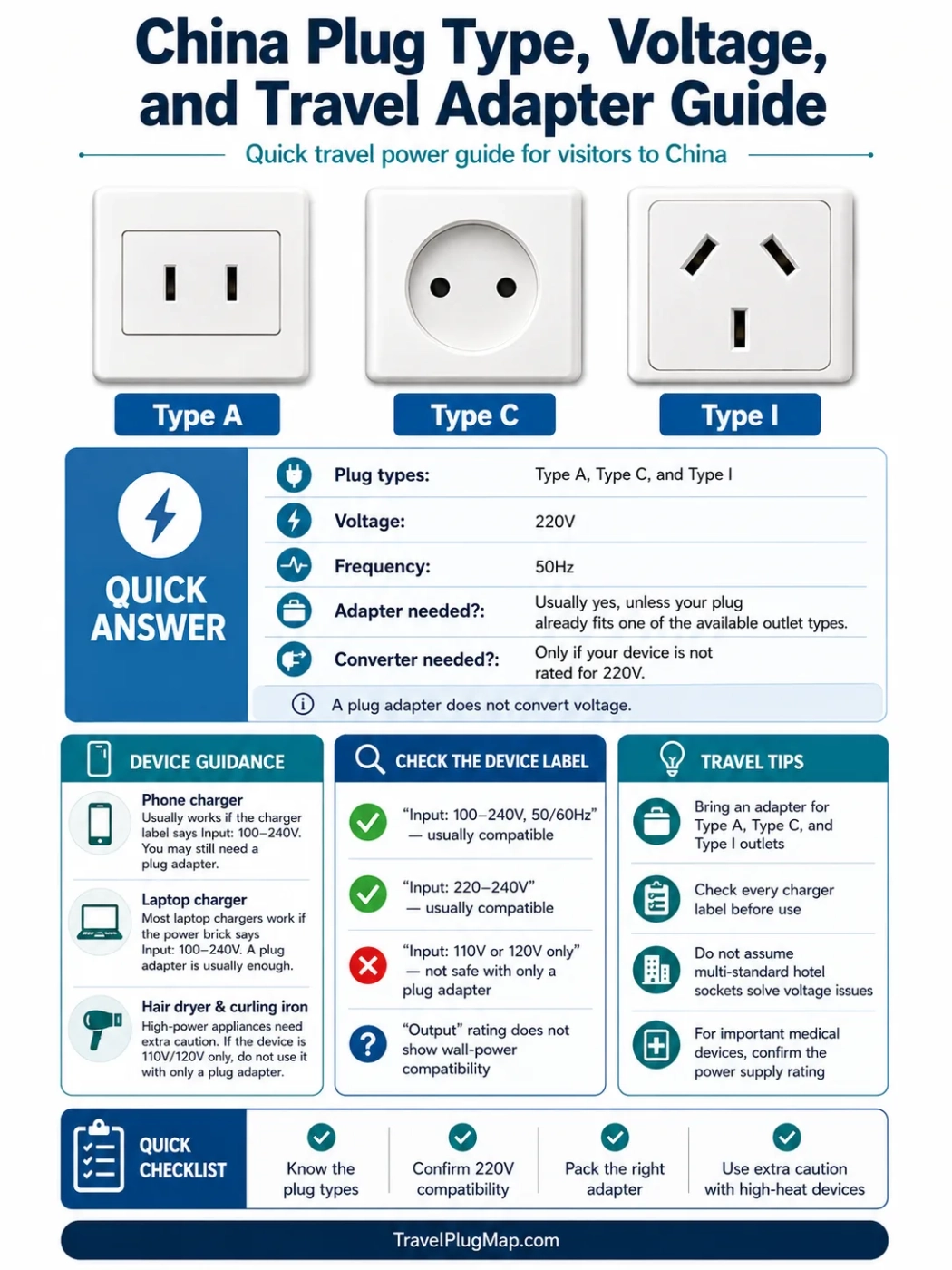
China’s current standardized household socket system is commonly described for travelers as a Type A + Type I hybrid socket, with a nominal supply of 220V at 50Hz under the Chinese voltage standard used here. Type C-compatible outlets and older multi-standard sockets can still appear in some hotels, apartments, and older installations, but Type C is not part of the current standardized A + I socket system. Many phone chargers and laptop chargers will work if the label says Input: 100–240V, but travelers may still need a plug adapter. High-power appliances such as hair dryers and curling irons need extra caution.
| Item | China Travel Power Details |
|---|---|
| Current standardized socket | Type A + Type I hybrid socket |
| Legacy and accommodation sockets | Type C-compatible and older multi-standard sockets may still be encountered |
| Nominal voltage used here | 220V |
| Frequency | 50Hz |
| Plug adapter needed? | Usually yes, unless your plug fits the socket available. |
| Voltage converter needed? | Only if your device is not rated for 220V. Check the device label first. |
| Best device advice | Phone and laptop chargers are often dual voltage. Hair dryers, curling irons, kettles, and irons are higher risk. |
A plug adapter does not convert voltage. It only changes the plug shape so your device can physically fit into the wall outlet.
What the Power Outlets Look Like
These illustrations are simplified front views of socket arrangements travelers may encounter in mainland China. Current standardized outlets center on Type A and Type I compatibility. Older buildings and accommodation may still have Type C-compatible or other multi-standard sockets. Real wall sockets can also look different depending on the manufacturer and age of installation. Plug shape and voltage are separate issues, so always check both before using a device.
What Plug Type Does China Use?
For current traveler-facing classification, mainland China uses a Type A + Type I hybrid socket. The Type A portion accepts two flat parallel pins, while the Type I portion is designed for two angled flat pins and, on grounded plugs, an additional grounding pin.
Type C should be treated as a legacy or accommodation-related possibility rather than part of the current official socket classification. Two-round-pin Type C-compatible outlets and older multi-standard sockets can still be found in some hotels, apartments, offices, and older buildings. Travelers should therefore avoid assuming that every socket will have exactly the same layout.
A travel adapter that supports the current A/I arrangement is the main requirement for many visitors. A broader travel adapter can also be useful when staying in older accommodation where legacy socket designs remain in service.
Do not judge electrical compatibility by plug shape alone. A plug may physically fit, but the device still needs to match the local voltage and frequency.
Current Chinese Plug and Socket Standard: GB 1002-2024
China’s current mandatory national standard for the types, basic parameters, and dimensions of single-phase plugs and socket-outlets for household and similar purposes is GB 1002-2024. It was published on 24 July 2024, took effect on 1 August 2025, and replaced GB/T 1002-2021.
The standardized Chinese arrangement is commonly described in international plug classifications as an A + I hybrid socket. The socket accommodates Type A and Type I plugs; Type I provides the grounded connection for equipment that requires protective earth. Other universal and legacy socket arrangements that may still exist in buildings should not be confused with the current national system.
For comparison, World Standards also identifies mainland China’s standardized outlet as the Type A/I hybrid system and distinguishes it from older universal socket arrangements.
Voltage and Frequency in China
For this page, China’s nominal household electricity supply is listed as 220V at 50Hz. China’s national standard GB/T 156-2017, Standard Voltages, remains current. It was reviewed on 27 March 2025 and the review concluded that the standard should remain in force.
GB/T 156-2017 adapts the IEC voltage series to Chinese conditions and uses the 220/380V series rather than the IEC 230/400V series. For that reason, this page retains 220V as the nominal value. Some international travel references, including World Standards, list China as 230V. Travelers do not normally need to resolve that reporting difference when using modern equipment rated for 220–240V or 100–240V; the device input label remains the practical compatibility check.
The frequency is 50Hz. For many modern electronic chargers, frequency is usually not a major issue because the charger is designed to handle both 50Hz and 60Hz. For some appliances with motors, heating elements, clocks, or older power supplies, frequency and voltage can matter more.
Do You Need a Travel Adapter for China?
You may need a travel adapter for China if your plug does not fit the standardized Type A/I socket arrangement. A travel adapter changes the physical plug shape. It lets your device plug into the wall, but it does not make the electricity safe for equipment that cannot handle China’s voltage.
Travelers from the United States and Canada may find that some two-flat-pin plugs physically fit the Type A portion of a Chinese socket, but that does not mean every device is safe to use. The local voltage is much higher than the standard voltage in North America. Always check the device label before plugging in a 120V-only device in China.
Travelers from the United Kingdom usually need a plug adapter because UK Type G plugs do not fit the standardized mainland Chinese socket directly. Travelers from much of mainland Europe should not assume that a Type C Europlug will fit every current socket. Type C-compatible and multi-standard outlets can still appear in some older buildings and hotels, but availability varies. Travelers from Australia and New Zealand may already use Type I plugs, although socket orientation and physical fit can differ by installation.
Do You Need a Voltage Converter in China?
You need a voltage converter only when your device is not compatible with China’s 220V supply. The safest first step is to read the label on the charger, power brick, or device body.
Look for wording such as Input: 100–240V. This means the device is designed to accept power across a wide voltage range, including China’s supply. Many modern phone chargers, laptop chargers, camera battery chargers, tablet chargers, and USB-C power adapters are built this way.
If the label says only Input: 120V, 100V, or another single low-voltage rating, do not plug it directly into a Chinese outlet using only a plug adapter. In that case, a voltage converter may be needed, or it may be safer to leave the device at home and use a locally compatible option.
A plug adapter does not convert voltage. This is the most important difference to remember when traveling with electrical devices.
Can You Charge Your Phone in China?
In most cases, yes. Most modern phone chargers are dual voltage and can work on 100–240V, 50/60Hz. Check the tiny print on the charger before use. If it says Input: 100–240V, you usually only need the correct plug adapter for the socket available.
If you charge through USB from a compatible power adapter, the phone itself is not usually the voltage concern. The wall charger is the part that connects to the local electricity supply, so that is the label you need to check.
Can You Use a Laptop Charger in China?
Most laptop chargers are designed for international use and commonly list Input: 100–240V on the power brick. If your laptop charger has that rating, it should usually work with China’s electrical supply when used with the correct plug adapter.
Still, inspect the charger label rather than assuming. Some older or unusual power supplies may have narrower input ratings. Also make sure the plug adapter can hold the charger securely, especially if the power brick is heavy.
Can You Use a Hair Dryer or Curling Iron in China?
Hair dryers, curling irons, hair straighteners, kettles, travel irons, and similar heating appliances need more caution. These are high-power appliances, and they are more likely to be voltage-sensitive than phone or laptop chargers.
If your hair dryer or curling iron says only 110V or 120V, do not use it directly in China with only a plug adapter. It may overheat, fail, trip protection, or become unsafe. A voltage converter for high-wattage appliances must be correctly rated, and even then it can be bulky and inconvenient.
Some travel hair tools are dual voltage. If the label says something like Input: 100–240V or includes a switch for 110V/220V operation, it may be suitable, but follow the device instructions carefully. For high-heat devices, the label matters more than the plug shape.
Device Advice for China
| Device | Adapter Needed? | Converter Needed? | What to Check |
|---|---|---|---|
| Phone charger | Usually, depending on plug shape | Usually no if rated 100–240V | Charger label: Input: 100–240V |
| Laptop charger | Usually, depending on plug shape | Usually no if rated 100–240V | Power brick input rating |
| Camera battery charger | Often yes | Usually no if dual voltage | Input voltage and frequency |
| Electric shaver | Often yes | Depends on model | Whether it supports 220V |
| Hair dryer | Usually yes | Often yes if not dual voltage | Voltage rating and wattage |
| Curling iron or straightener | Usually yes | Often yes if not dual voltage | Voltage rating and heat tool instructions |
| CPAP machine | Usually, depending on plug shape | Often no if power supply says 100–240V | Medical device power supply label and manufacturer guidance |
How to Check Your Device Label
Before packing, look at the charger, adapter, or device label. You are looking for the input rating, not the output rating.
- Input: 100–240V, 50/60Hz usually means the charger can handle China’s electrical supply.
- Input: 220–240V usually means the device is compatible with China’s voltage range, but you may still need a plug adapter.
- Input: 110V or 120V only means the device should not be plugged directly into a Chinese outlet with only a plug adapter.
- Output information, such as 5V USB output, does not tell you whether the charger itself can accept the local mains voltage.
If the label is missing, damaged, or unclear, do not guess. Use a safer alternative or check the manufacturer’s instructions before travel.
Travel Power Safety Tips for China
- Choose an adapter that supports China’s current Type A + Type I socket arrangement.
- If you will stay in older accommodation, a broader travel adapter may also be useful because legacy or multi-standard sockets can still appear.
- Check every charger label before use, especially for devices bought in 100–120V countries.
- Do not use a 120V-only hair dryer, curling iron, kettle, or iron directly in China.
- Remember that a travel adapter only changes plug shape.
- For important medical devices such as CPAP machines, confirm the power supply rating before travel and consider carrying a backup plan.
- Do not overload cheap multi-plug adapters with several high-power appliances.
- In hotels, multi-standard sockets can be helpful, but they do not guarantee voltage conversion.
Common Mistakes to Avoid
Assuming a Plug Adapter Makes Everything Safe
A plug adapter only helps your plug fit the wall socket. It does not reduce 220V to 120V, and it does not change 50Hz to 60Hz.
Checking the Phone Instead of the Charger
For phones, tablets, cameras, and laptops, the wall charger or power brick is usually the part that matters. Check that label for Input: 100–240V.
Packing High-Power Heat Appliances Without Checking Voltage
Hair tools are among the most common travel power problems. If the device is not dual voltage, a simple plug adapter is not enough.
Expecting Every Outlet to Look the Same
Current Chinese standardization centers on the Type A/I hybrid socket, but older electrical installations have not disappeared. A hotel room or older apartment may still contain Type C-compatible or multi-standard sockets, so travelers should not treat those legacy designs as the present national standard.
FAQ
What plug adapter do I need for China?
Mainland China’s current standardized socket is a Type A + Type I hybrid. Travelers whose plugs do not fit this arrangement should bring an appropriate adapter. Type C-compatible or multi-standard sockets may still appear in older accommodation, but they should not be relied on as the current standard.
Does China use Type C plugs?
Type C is not part of China’s current standardized A + I hybrid socket system. However, travelers can still encounter Type C-compatible outlets or older multi-standard sockets in some hotels, apartments, and older buildings.
Is China 220V or 230V?
This page uses 220V because China’s current GB/T 156-2017 voltage standard retains the Chinese 220/380V series. Some international travel references report China as 230V. For modern chargers rated 100–240V or equipment rated across the 220–240V range, this reporting difference normally does not change device compatibility. Always check the equipment label.
Can I use my US phone charger in China?
Usually yes, if the charger label says Input: 100–240V. You will still need a plug adapter if the charger plug does not fit the socket available.
Do I need a voltage converter for China?
You only need a voltage converter if your device is not rated for China’s supply voltage. Many modern chargers are dual voltage, but high-power appliances often need extra caution.
Will my laptop charger work in China?
Most laptop chargers work internationally if the power brick says Input: 100–240V, 50/60Hz. If it does, a plug adapter is usually enough.
Can I use a hair dryer in China?
Only if the hair dryer is rated for 220V or is clearly dual voltage. If it is 110V or 120V only, do not use it in China with only a plug adapter.