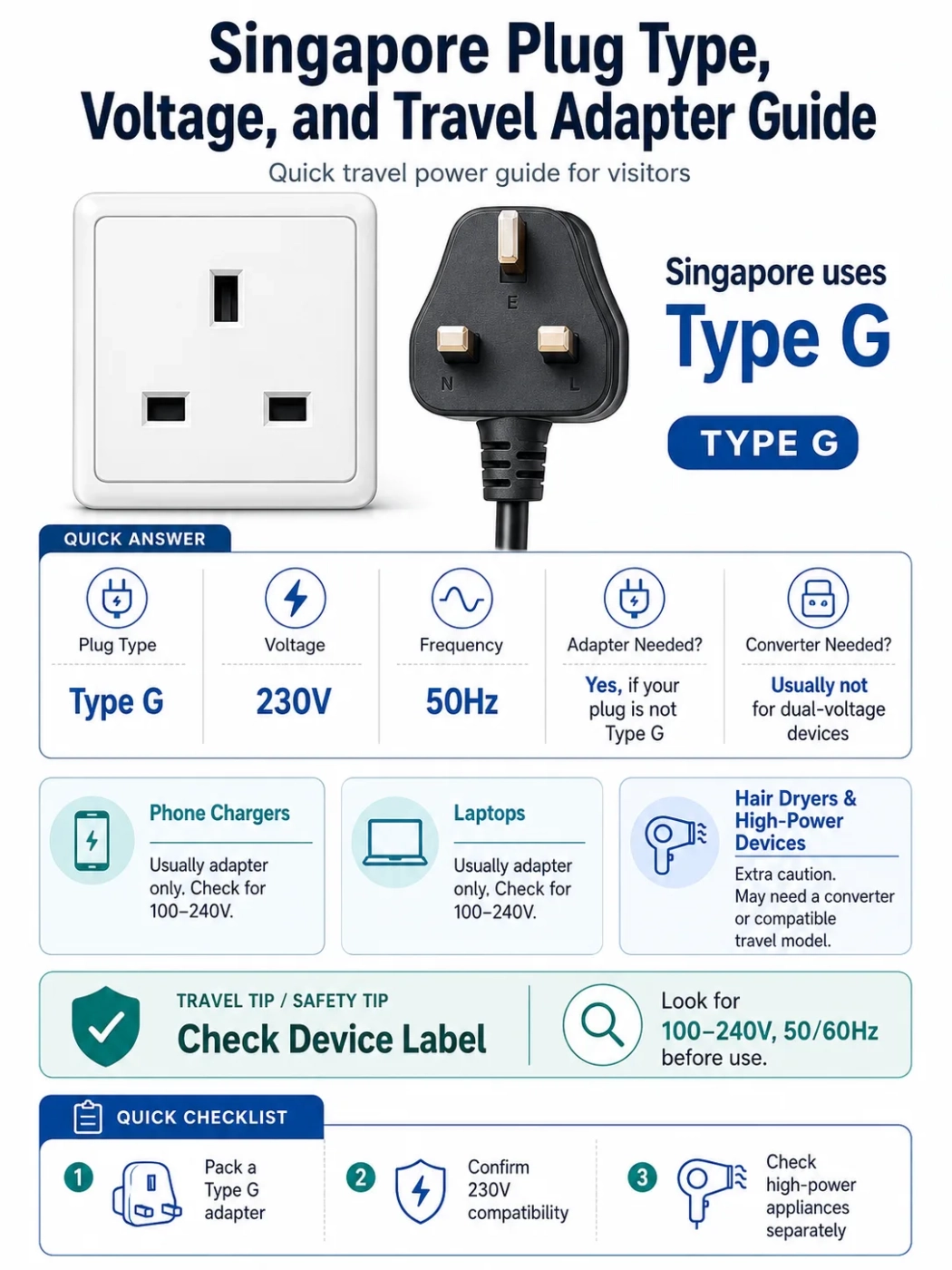
Singapore uses Type G power outlets with a standard supply of 230V at 50Hz. Travelers whose devices have Type A, B, C, E, F, I, or other plug shapes will normally need a Type G travel adapter. Most modern phone and laptop chargers marked Input: 100–240V, 50/60Hz can work without a voltage converter. However, single-voltage hair dryers, curling irons, kettles, and similar high-power appliances require extra caution.
A plug adapter does not convert voltage. It only allows one plug shape to fit another socket type. Before connecting any device in Singapore, check both the plug shape and the electrical input rating printed on the device or its power supply.
Singapore Plug and Power Summary
| Electrical detail | Singapore standard | What travelers should know |
|---|---|---|
| Main plug type | Type G | Three rectangular pins in a triangular arrangement |
| Standard voltage | 230V | Check devices designed only for 100V, 110V, or 120V |
| Frequency | 50Hz | Usually accepted by modern chargers marked 50/60Hz |
| Grounding | Available through Type G | A grounded device requires an adapter that preserves the earth connection |
| Travel adapter | Depends on your home plug | Usually unnecessary for travelers already using Type G plugs |
| Voltage converter | Device-dependent | Usually unnecessary for devices marked 100–240V |
| Best device check | Read the input label | Confirm voltage, frequency, and maximum power before use |
What the Power Outlets Look Like
Real wall outlets may look slightly different depending on the building, socket manufacturer, and age of the installation. Some hotels also provide multi-standard sockets or built-in USB charging ports. These features should be treated as a convenience rather than something guaranteed in every room.
Plug shape and voltage are separate issues. A plug may physically fit a Singapore outlet while the connected device is still electrically incompatible with the 230V supply.
What Plug Type Does Singapore Use?
The standard power outlet travelers should expect in Singapore is Type G. This is the same basic plug and socket system used in the United Kingdom, Ireland, Malaysia, Hong Kong, and several other destinations.
How to Identify a Type G Plug
A Type G plug has three rectangular metal pins arranged in a triangular pattern:
- One larger vertical grounding pin at the top
- One rectangular live pin at the lower right
- One rectangular neutral pin at the lower left
The upper pin provides the protective earth connection on grounded appliances. Standard Type G plugs are also commonly fused. This built-in fuse is part of the plug’s electrical protection system, but it does not change the voltage supplied to the device.
UK Plug Compatibility in Singapore
Yes. A normal UK Type G plug can generally fit directly into a Singapore Type G socket without a travel adapter. The same is usually true for standard Type G plugs from Ireland, Malaysia, and Hong Kong.
You should still check the device label. Sharing the same plug shape does not automatically prove that every appliance has the correct voltage or frequency rating.
Switched Wall Outlets in Singapore
Many Type G wall outlets in Singapore have an individual on-and-off switch beside the socket. If a charger is correctly connected but does not begin charging, check whether the wall outlet is switched on.
Insert the plug or adapter fully before turning on the socket. Turn the socket off before removing a high-power appliance. Never use tools, spare pins, or another object to force open the socket shutters.
Will Travelers See Round-Pin Outlets?
Larger round-pin outlets may occasionally appear in specialized, older, or high-load installations. They are not the ordinary traveler socket to plan around. Hotel rooms, offices, homes, and public charging areas primarily use Type G outlets for normal portable equipment.
For travel preparation, choose your adapter based on Type G compatibility, not on uncommon outlets intended for specific appliances or installations.
Voltage and Frequency in Singapore
Singapore Uses 230 Volts
Singapore’s standard electricity supply is 230V alternating current. This is broadly compatible with many devices designed for 220V, 230V, or 240V systems, provided the device manufacturer includes the relevant voltage range on the label.
Devices designed only for 100V, 110V, or 120V should not be connected directly to a Singapore outlet. Supplying 230V to a device that accepts only 120V can cause immediate damage, excessive heat, smoke, or an electrical fire.
Singapore Uses 50Hz
The electrical frequency is 50Hz. Most modern electronic power supplies accept both 50Hz and 60Hz, but this should be confirmed on the input label.
Frequency can be more important for:
- Older electric motors
- Analog clocks and timers
- Some turntables and audio equipment
- Specialized pumps or mechanical devices
- Appliances marked only for 60Hz operation
A voltage converter normally changes voltage, not frequency. A device marked only “60Hz” may therefore remain unsuitable even when a voltage converter is used.
Three Compatibility Checks
Travel power compatibility involves three separate questions:
| Compatibility check | Question | Singapore requirement |
|---|---|---|
| Plug compatibility | Does the plug physically fit? | Type G connection |
| Voltage compatibility | Can the device accept the supply voltage? | 230V must be within the printed input range |
| Frequency compatibility | Can the device operate at the local frequency? | 50Hz must be supported |
A device is ready for normal use only when all relevant checks are satisfied.
Do You Need a Travel Adapter for Singapore?
You need a travel adapter when your plug does not match Singapore’s Type G socket. The required adapter should accept your original plug and provide a Type G connection on the Singapore side.
| Your usual plug | Common source regions | Direct fit in Singapore? | Likely requirement |
|---|---|---|---|
| Type G | United Kingdom, Ireland, Malaysia, Hong Kong | Yes | Usually no plug adapter |
| Type A or B | United States, Canada, Japan | No | Type G adapter and careful voltage check |
| Type C | Continental Europe and some international devices | No safe direct fit | Type C to Type G adapter |
| Type E or F | Europe and Türkiye | No | Grounded Type G adapter where required |
| Type I | Australia, New Zealand, China | No | Type I to Type G adapter |
| Type D | India and nearby markets | No | Suitable Type G adapter |
| Type M or N | Parts of Southern Africa and Brazil | No | Suitable Type G adapter |
Countries may use more than one plug type, and individual devices may have imported or replacement plugs. Confirm the plug actually attached to your device rather than relying only on the country where it was purchased.
Travelers from the United States and Canada
Standard Type A and Type B plugs do not fit Singapore’s Type G sockets, so a plug adapter is normally required.
Voltage is the more important concern. Many North American phone chargers, laptop power supplies, camera chargers, and USB adapters are marked 100–240V and can accept Singapore’s supply. Appliances marked only 120V cannot be safely used with a simple plug adapter.
Never connect a 120V-only heating appliance directly to a 230V Singapore outlet.
Travelers from Europe and Türkiye
Type C, Type E, and Type F plugs require a Type G travel adapter. Voltage is commonly less problematic because many European appliances are designed for the 220–240V range, but the device label must still be checked.
A two-pin Type C Europlug should not be forced into a Type G socket. A Type F Schuko plug also requires an adapter that properly accommodates its thicker round pins and preserves grounding when the appliance depends on it.
Travelers from Australia and New Zealand
Type I plugs do not fit Type G sockets, so a plug adapter is normally required. Many Australian and New Zealand devices are already designed for a voltage close to Singapore’s 230V supply, which often means a voltage converter is unnecessary.
Check the exact input range, especially for imported equipment, older appliances, and products with replacement power supplies.
Travelers from the UK, Ireland, Malaysia, or Hong Kong
Travelers bringing standard Type G equipment will usually not need a plug adapter. A compact USB charger or power strip may still be useful when several devices need charging, but it must be rated for 230V operation and used within its stated electrical limits.
Do You Need a Voltage Converter in Singapore?
A voltage converter may be needed when a device cannot accept Singapore’s 230V supply. The answer is determined by the input label, not by the shape of the plug.
Travel Adapter vs Voltage Converter
| Equipment | What it changes | What it does not change |
|---|---|---|
| Plug adapter | The physical plug connection | Voltage and frequency |
| Voltage converter | The voltage supplied to the device | Usually the electrical frequency |
| Transformer | Voltage for compatible continuous loads | Plug shape unless an adapter is included |
A plug adapter does not convert voltage. A Type G adapter can allow a 120V appliance to connect physically, but it cannot prevent that appliance from receiving Singapore’s 230V supply.
Use the Device Label to Decide
| Device label | Likely compatibility | What you may need |
|---|---|---|
| Input: 100–240V, 50/60Hz | Compatible with Singapore’s voltage and frequency | Only a Type G plug adapter if the plug shape differs |
| Input: 220–240V, 50Hz | Normally compatible | Only a plug adapter if required |
| Input: 230V, 50Hz | Designed for the local supply | Only a plug adapter if required |
| Input: 110–120V, 60Hz | Not directly compatible | Appropriate converter or a different appliance |
| Input: 60Hz only | Frequency compatibility is uncertain | Manufacturer confirmation may be required |
| No readable input label | Compatibility cannot be confirmed | Do not connect until verified |
When a Converter May Not Be Practical
Small travel converters are not suitable for every appliance. High-power devices can draw far more electricity than phone chargers or laptop adapters. A converter must support the appliance’s wattage, operating duration, and device type.
For a high-power 120V-only hair dryer, kettle, iron, or heating appliance, using locally compatible equipment is often safer and more practical than carrying a large converter.
How to Check Your Device’s Power Label
The most important information is normally printed near the word Input. Depending on the device, the label may be located on:
- The back or side of a wall charger
- The laptop power brick
- The handle of a hair dryer
- The underside of an electric shaver
- The base of a toothbrush charger
- The rear panel of a monitor or game console
- The power supply for a CPAP machine
What “Input: 100–240V” Means
A label such as:
Input: 100–240V ~ 50/60Hz 1.5A
means the power supply is designed to accept a wide range of international voltages and both common electrical frequencies. In Singapore, this device normally needs only a Type G plug adapter when its existing plug has a different shape.
The voltage printed after “Output” is not the wall voltage. For example, a USB charger may accept 230V from the wall and then provide 5V, 9V, 12V, or 20V to the connected device.
What “120V, 60Hz Only” Means
A device marked only for 120V and 60Hz is not designed for direct use on Singapore’s 230V, 50Hz supply. A simple travel adapter is not enough.
Before considering a converter, check:
- The appliance’s wattage
- Whether it uses a heating element
- Whether it contains a motor
- How long it will operate continuously
- Whether the manufacturer permits converter use
- Whether 50Hz operation is supported
Manual Dual-Voltage Switches
Some older travel appliances have a manual switch marked 110/120V and 220/240V. Set the switch to the correct voltage before connecting the appliance.
A manually switched appliance is different from an automatic 100–240V power supply. If the switch is left in the 120V position, connecting it to a Singapore outlet may seriously damage the appliance.
Device Compatibility in Singapore
| Device | Main check | Adapter likely? | Converter concern |
|---|---|---|---|
| Phone charger | Look for 100–240V, 50/60Hz | Depends on plug shape | Usually low |
| Tablet charger | Input voltage and USB output | Depends on plug shape | Usually low |
| Laptop charger | Input range and required wattage | Depends on plug shape | Usually low if universal voltage |
| Camera battery charger | Input range on the charger | Usually, if not Type G | Usually low if marked 100–240V |
| Hair dryer | Voltage setting and wattage | Often | High |
| Curling iron or straightener | Dual-voltage rating | Often | Medium to high |
| Electric shaver | Charger input label | Often | Model-dependent |
| CPAP machine | Power supply and humidifier rating | Plug-dependent | Manufacturer guidance may be needed |
| Travel kettle or iron | Voltage and high wattage | Often | High |
Can You Charge a Phone in Singapore?
Most modern phone chargers can be used in Singapore because they commonly accept 100–240V and 50/60Hz. Check the small print on the wall charger rather than the phone itself.
If the charger has a Type G plug, it can normally connect directly. Type A, B, C, E, F, I, and other plug shapes require an appropriate Type G adapter.
A built-in hotel USB port may charge a phone, but charging speed can vary. A low-power USB port may be slower than your own wall charger.
Can You Use a Laptop Charger in Singapore?
Most modern laptop power supplies are designed for international voltage ranges. Look for an input such as 100–240V, 50/60Hz on the charger block.
For USB-C laptops, also check the charger’s output wattage. A small phone charger may be electrically safe but may not provide enough power to charge the laptop normally.
For example, a laptop designed for a 65W or 100W USB-C power supply may charge slowly, display a low-power warning, or continue losing battery while in use when connected to a lower-powered charger.
Camera and Drone Battery Chargers
Camera and drone chargers often accept universal voltage, but third-party chargers and multi-battery charging hubs should be checked individually. Confirm both the AC input and the total power requirement.
A compact multi-port adapter may share its available USB output across several ports. Connecting multiple batteries, a laptop, and a phone at the same time can reduce charging speed or exceed the adapter’s intended load.
Hair Dryers, Curling Irons, and Hair Straighteners
Hair-care appliances require more attention because they often contain high-power heating elements. Some are dual voltage, while others are designed only for the voltage of the country where they were sold.
Check for markings such as:
- 110–120V only
- 220–240V only
- 120/240V with a manual switch
- 100–240V automatic dual voltage
The word “travel” in a product name does not guarantee international voltage compatibility. A travel-sized hair dryer can still be a 120V-only appliance.
Always check the device label before using high-power appliances abroad. A low-capacity universal travel adapter should not be used simply because the appliance plug fits into it.
Electric Shavers and Toothbrush Chargers
Many shaver and toothbrush chargers accept international voltage, but not all models do. Check the charging base, cable adapter, or detachable power supply.
Bathroom outlets marked “shavers only” should not be treated as normal general-purpose sockets. They may have limited output and are intended only for compatible low-power grooming equipment.
CPAP Machines and Medical Equipment
Many modern CPAP power supplies accept 100–240V, but the exact machine, power supply, and heated humidifier configuration must be checked. Humidifier modules can increase power consumption.
Use an adapter that holds the plug securely and preserves grounding when the medical equipment requires it. Do not rely on an unknown low-cost converter for essential medical equipment without manufacturer confirmation.
Battery backup planning, airline battery rules, and medical equipment availability are separate from plug and voltage compatibility.
Travel Kettles, Irons, and Heating Appliances
Kettles, irons, portable cookers, and immersion heaters can draw a large amount of power. Even when the appliance voltage is compatible, the travel adapter must be rated for the full load.
Do not use a high-power appliance when:
- The adapter has no clear current or wattage rating
- The plug feels loose in the adapter
- The adapter becomes hot
- The socket shows discoloration or damage
- The appliance exceeds the hotel’s permitted equipment policy
Using European Plugs in Singapore
Can a Type C Europlug Be Inserted Directly?
A Type C Europlug has two thin round pins. It should be connected through a proper Type C-to-Type G adapter rather than forced into the rectangular openings of a Singapore socket.
Some hotel multi-standard sockets may accept two-pin plugs, but availability and connection quality vary. Travelers should not assume that every hotel room will provide this feature.
Why Type F Schuko Plugs Need Special Attention
A Type F Schuko plug uses two round pins and side grounding contacts. Those side contacts do not automatically connect to the protective earth of a Type G outlet.
If the appliance requires grounding, choose an adapter specifically designed to accept a grounded Type E or Type F plug and continue the earth connection to the Type G side.
An adapter that only accepts the two round pins but ignores the grounding contacts may allow the device to receive power without preserving its intended electrical protection.
Do Not Force Round Pins into Type G Slots
Forcing an incompatible plug into a Type G socket can damage the internal contacts, create a loose connection, or defeat the safety shutters. Loose electrical contact can cause arcing and overheating.
Use an adapter that accepts the original plug fully and securely. The weight of the device cable should not pull the adapter partially out of the wall.
How to Choose a Type G Travel Adapter
Check the Maximum Current and Wattage
The adapter’s printed rating is the maximum limit you should follow. Do not assume that every Type G adapter can handle the full capacity of a Singapore wall outlet.
Electrical power can be estimated with:
Watts = Volts × Amps
At 230V, a 5A rating represents approximately 1,150W. However, the product’s own stated wattage, current limit, operating instructions, and device restrictions take priority over a simple calculation.
Grounded vs Ungrounded Adapters
Two-pin, double-insulated chargers may not require a protective earth connection. Three-pin devices and some metal-bodied appliances may rely on grounding for safety.
A grounded plug should be used with an adapter that preserves grounding. A plastic pin that only opens the socket shutter is not the same as a functioning electrical earth connection.
Fused Type G Adapters
Type G plug systems commonly use a fuse within the plug or adapter. The fuse helps protect the cable and connected equipment from excessive current.
The fuse:
- Does not reduce 230V to 120V
- Does not correct a frequency mismatch
- Should not be replaced with a randomly higher rating
- Does not make an incompatible high-power appliance safe
Universal Travel Adapters
A universal adapter can be convenient when visiting several countries, but its limitations must be understood.
Before using one in Singapore, check:
- Whether it provides a stable Type G connection
- Its maximum AC current and wattage
- Whether protective grounding is supported
- The USB-A and USB-C output ratings
- Whether power is shared across USB ports
- Whether high-power appliances are prohibited
Most universal travel adapters change plug shape only. They are not voltage converters unless the product specifically includes a converter function.
Buying an Adapter in Singapore
When purchasing locally, choose equipment clearly intended for Singapore’s electrical system. Check for a legible voltage, current, and safety rating. Regulated electrical products may carry Singapore’s local SAFETY Mark where applicable.
Avoid products with loose pins, damaged housings, exposed metal, missing ratings, or unclear instructions.
Hotel, Airport, and Public Charging Outlets
Hotel Room Sockets
Type G should be your default expectation. Some hotels provide international sockets, bedside USB ports, or USB-C charging points, but these are not guaranteed.
Check whether the wall outlet has its own switch. If the plug is secure but the device is not receiving power, the socket may simply be switched off.
Built-In USB Ports
Built-in USB ports avoid the need for a plug adapter when charging a compatible USB device. They do not all provide the same speed or power.
A basic USB-A port may be suitable for overnight phone charging but inadequate for a tablet or laptop. A USB-C connector also does not guarantee high-power USB Power Delivery.
Bathroom Shaver Outlets
Use bathroom outlets only for the equipment and power range indicated on the outlet. Do not connect hair dryers, kettles, irons, or multi-device power strips to an outlet marked for shavers only.
Public Charging Areas
At airports, coworking spaces, cafés, and public areas:
- Check the outlet for physical damage
- Insert the adapter fully
- Do not leave devices unattended
- Stop using an outlet that sparks, smells unusual, or feels loose
- Avoid hanging heavy chargers directly from a weak adapter connection
Using Power Strips and Multiple Devices
Can You Use a Power Strip with a Travel Adapter?
A power strip may be used only when it is rated for Singapore’s 230V supply and the adapter can safely carry the combined load.
Check:
- The power strip’s voltage rating
- The adapter’s maximum current
- The total wattage of all connected devices
- Whether grounding is preserved
- Whether the hotel permits personal extension leads
Calculate the Combined Load
A group of low-power electronics may include:
- Laptop charger: 100W
- Phone charger: 30W
- Camera charger: 20W
- Watch charger: 5W
The approximate combined load would be 155W. This is very different from adding a hair dryer or kettle, which may use well over 1,000W on its own.
Avoid Daisy-Chaining Adapters
Do not connect several travel adapters, universal adapters, extension leads, or power strips in a chain. Each additional connection can introduce:
- Loose electrical contact
- Mechanical strain
- Grounding loss
- Overheating
- Unclear load limits
Use one properly rated Type G connection wherever possible.
Common Electrical Mistakes in Singapore
- Assuming a plug adapter also converts voltage
- Connecting a 120V-only appliance to the 230V supply
- Forcing a Type C plug into a Type G outlet
- Using a Schuko plug without preserving its grounding connection
- Choosing an adapter without checking its current or wattage rating
- Using a phone-focused universal adapter with a high-power hair dryer
- Leaving a manual dual-voltage device in the 120V position
- Ignoring a 60Hz-only label
- Assuming every Singapore hotel has universal sockets
- Connecting multiple power strips and adapters together
- Continuing to use an adapter that becomes unusually hot
- Reading the charger output voltage instead of the AC input voltage
Singapore Travel Power Checklist
- Confirm that your destination socket is Type G
- Inspect the actual plug attached to every device
- Find the input voltage on each charger or appliance
- Look for Input: 100–240V, 50/60Hz
- Separate low-power electronics from high-power heating appliances
- Check manual 110/220V or 120/240V selector switches
- Choose a Type G adapter that accepts your plug securely
- Preserve grounding for devices that require it
- Check the adapter’s maximum current and wattage
- Verify USB-C output power for laptops and larger tablets
- Avoid relying entirely on hotel universal sockets
- Do not use damaged, loose, or overheating adapters
Frequently Asked Questions
Is the Singapore plug the same as the UK plug?
Yes. Singapore and the United Kingdom use Type G plugs and sockets. A standard UK plug will usually fit directly, although the device’s voltage and frequency label should still be checked.
Do I need a voltage converter in Singapore?
You usually do not need one for devices marked 100–240V, 50/60Hz. A converter may be required for equipment designed only for 100V, 110V, or 120V, provided the converter is suitable for the device.
Can I charge my phone in Singapore?
Usually, yes. Most modern phone chargers support 100–240V and 50/60Hz. You need a Type G plug adapter when the charger’s plug does not match the Singapore socket.
Can I use a US hair dryer in Singapore?
Only if the hair dryer supports 220–240V or has a correctly set dual-voltage mode. A 120V-only hair dryer must not be connected directly to Singapore’s 230V supply.
Can I use a European plug in Singapore?
European Type C, E, and F plugs normally require a Type G adapter. Grounded Type E and F appliances should use an adapter that preserves the protective earth connection.
Do universal travel adapters convert voltage?
Most do not. They normally change only the plug shape. Check the product specification carefully and assume that voltage is unchanged unless a converter function is explicitly stated.