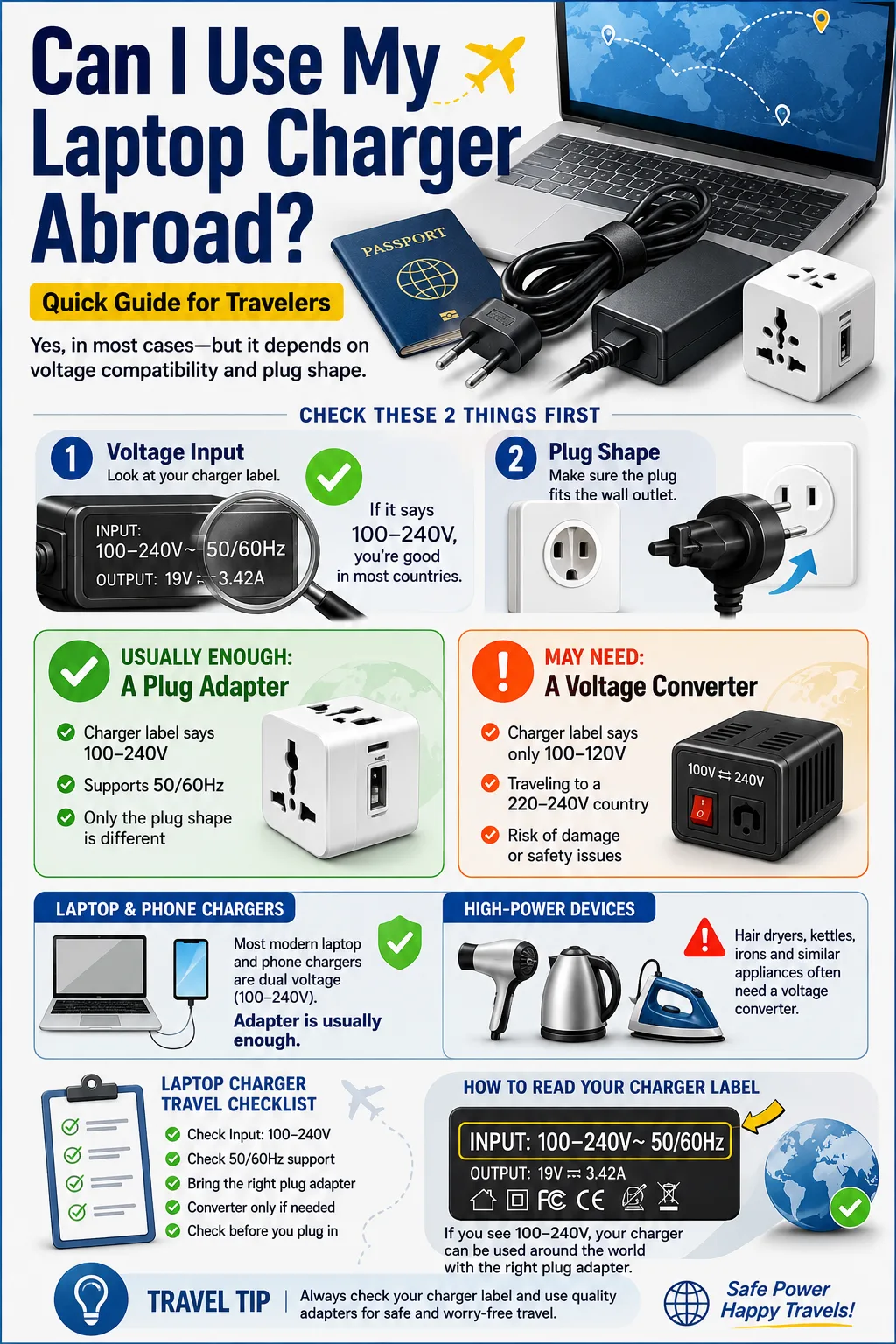
Yes, you can usually use your laptop charger abroad, but you need to check two things first: the charger’s voltage input and the plug shape used in your destination. Most modern laptop chargers are dual voltage and support Input: 100–240V, which means they can work in many countries with only a plug adapter. The plug adapter changes the shape of the plug, not the electricity.
The Short Answer for Travelers
| What to Check | What It Means | What You May Need |
|---|---|---|
| Charger label says Input: 100–240V | Your laptop charger is designed for both 120V and 230V power systems. | Usually only a plug adapter |
| Charger label says only 100–120V | It may not be safe in 220–240V countries. | A suitable voltage converter or a different charger |
| Plug shape does not match the wall outlet | Your charger may be electrically compatible but physically cannot plug in. | A travel plug adapter |
| Frequency is 50Hz or 60Hz | Most laptop chargers handle both, but the label should be checked. | Usually no separate action |
How to Check Your Laptop Charger Label
Look at the small printed label on the charger brick, not the laptop itself. You may need good lighting because the text is often small. The key line usually starts with Input.
If the label says something like Input: 100–240V, 50/60Hz, your charger is built to accept the common voltage and frequency ranges used around the world. In most cases, that means you do not need a voltage converter for the charger.
If the label says only Input: 100–120V, the charger is intended for lower-voltage systems. Using it directly in a 220–240V country can damage the charger, trip protection, or create a safety risk. In that case, do not rely on a simple plug adapter.
What “Input: 100–240V” Means
Input: 100–240V means the charger can accept electricity within that voltage range. This covers the common power systems travelers encounter, including countries that use around 110–120V and countries that use around 220–240V.
This is why laptop chargers are usually easier to travel with than hair dryers, curling irons, kettles, or clothes irons. A laptop charger converts wall power into the lower-voltage power your laptop needs, and many modern chargers are designed for international use.
Still, the label matters. Do not assume every charger is universal just because it belongs to a laptop. Older chargers, replacement chargers, low-quality chargers, or unusual power supplies may have different limits.
Plug Adapter vs Voltage Converter
A travel plug adapter and a voltage converter solve different problems.
- A plug adapter changes the physical plug shape so your charger can fit into a foreign wall outlet.
- A voltage converter changes the electrical voltage from the wall outlet.
A plug adapter does not convert voltage. If your laptop charger already supports Input: 100–240V, a plug adapter is usually enough. If the charger supports only one voltage range, a plug adapter alone may not protect it.
When a Plug Adapter Is Usually Enough
A plug adapter is usually enough for a laptop charger when all of these are true:
- The charger label says Input: 100–240V.
- The charger label supports 50/60Hz or a compatible frequency range.
- The only problem is that the plug shape does not match the outlet.
- The adapter is suitable for the destination’s plug type.
For example, if you travel from a country that uses Type A or Type B plugs to a country that uses Type C, Type E, Type F, or Type G outlets, your laptop charger may work electrically but still need a plug adapter to fit the socket.
When a Voltage Converter May Be Needed
A voltage converter may be needed if your laptop charger is not dual voltage. This is less common with modern laptop chargers, but it is still possible.
Be extra careful if the charger label says only 100–120V and you are traveling to a country that uses 220–240V. In that situation, the charger is not designed for the local voltage. You may need a properly rated voltage converter, or it may be safer to use a manufacturer-approved charger designed for that country’s voltage.
Always check the device label before plugging a charger into a foreign outlet. If the label is damaged, missing, or unclear, do not guess.
Does 50Hz or 60Hz Matter for Laptop Chargers?
Many countries use either 50Hz or 60Hz frequency. Most modern laptop chargers are designed to work with both and will show something like 50/60Hz on the label.
For laptop chargers, frequency is usually less of a problem than voltage and plug shape. However, it is still part of the input rating. If the charger label clearly lists 50/60Hz, it is normally suitable for both common frequency systems.
Can USB-C Laptop Chargers Be Used Abroad?
USB-C laptop chargers are commonly designed for international voltage ranges, but the same rule applies: check the charger label. Many USB-C power adapters say Input: 100–240V, which usually makes them suitable for travel with the right plug adapter.
Do not judge compatibility only by the USB-C port. The wall-side power adapter is the part that connects to local electricity. That adapter must support the destination’s voltage.
EU Common Charger Rules for Laptops
Since 28 April 2026, the EU Common Charger requirements also apply to covered laptops that can be recharged by wired charging. The rules require a USB-C charging receptacle on the device side. Where covered equipment can be charged at voltages above 5V, currents above 3A, or power above 15W, the charging system must incorporate USB Power Delivery (USB PD). Manufacturers must also provide information about charging requirements and compatible charging power.
The EU rule concerns the connection between the laptop and its compatible charger. It does not standardize the wall sockets used across Europe and does not remove the need to check the charger’s AC input rating.
A laptop with USB-C charging may therefore still need a travel plug adapter. Germany commonly uses Type F outlets, France uses Type E alongside compatible socket arrangements, and the United Kingdom uses Type G. Great Britain is outside the EU Common Charger regime, while Northern Ireland has separate UK regulations applying common-charger requirements, including to covered laptops placed on the Northern Ireland market from 28 April 2026. In Northern Ireland, the rules also require USB Power Delivery in the relevant charging conditions above 5V, 3A, or 15W. USB-C describes the charging connection at the laptop, while the wall plug must still fit the local socket.
A traveler with a compliant USB-C laptop and a 100–240V USB-C power adapter may be able to use the same charger across several countries, but the wall-side plug or plug adapter must still match each destination.
Saudi Arabia USB-C Rules for Laptops
Saudi Arabia has a separate CST and SASO USB Type-C requirement for devices placed on the Saudi market. The first mandatory phase began on 1 January 2025 for covered products including mobile phones, tablets, digital cameras and other listed electronics, while the second phase began on 1 April 2026 and includes laptops.
This is a device-side charging rule and does not replace Saudi Arabia’s wall-power requirements. Saudi Arabia uses Type G outlets and a 230V, 60Hz supply for travel purposes, so a laptop with USB-C charging may still need a Type G-compatible plug adapter; the charger’s AC input rating should also be checked before use.
What About Phone Chargers, Tablets, and Camera Chargers?
Phone chargers, tablet chargers, camera battery chargers, and laptop chargers are often low-risk travel devices because many are dual voltage. In most cases, if the charger label says Input: 100–240V, you only need the correct plug adapter for the destination.
This is different from high-power appliances. A phone charger and a hair dryer are not the same kind of travel power risk.
| Device | Common Travel Risk | What to Check |
|---|---|---|
| Laptop charger | Usually low if dual voltage | Input: 100–240V and plug type |
| Phone charger | Usually low if dual voltage | Input rating and plug type |
| Camera battery charger | Usually low if dual voltage | Input rating and plug type |
| Hair dryer | Higher risk | Voltage, wattage, and dual-voltage setting |
| Curling iron or straightener | Higher risk | Voltage rating and heat appliance instructions |
| Travel kettle or iron | Higher risk | Voltage and wattage rating |
Why High-Power Appliances Are Different
High-power appliances such as hair dryers, curling irons, clothes irons, and kettles draw much more power than a laptop charger. They also create heat, which increases the risk if the voltage is wrong.
A simple plug adapter should not be treated as a safe solution for these appliances unless the appliance is clearly rated for the local voltage. Some travel hair dryers have a manual voltage switch, but it must be set correctly before use.
For laptop chargers, a dual-voltage input label is usually the main check. For heat appliances, you also need to consider wattage, safety instructions, and whether the appliance is actually designed for international travel.
How to Choose the Right Plug Adapter
To choose the right plug adapter, check the plug type used in your destination country. Different countries use different outlet shapes, such as Type A, Type B, Type C, Type E, Type F, Type G, Type I, or other types.
The adapter must match the wall outlet in the country you are visiting. It must also accept the plug attached to your laptop charger. If you visit multiple countries on the same trip, a multi-region travel adapter may be more practical, but it still does not convert voltage.
Before packing, check whether your charger has a removable power cord. Some laptop chargers allow you to replace only the wall-side cable with a cable made for the destination’s plug type. That can be cleaner than using a bulky adapter, as long as the cable is suitable and the charger itself supports the voltage.
Airport, Hotel, and Train Outlet Tips
Hotels and airports sometimes provide multi-standard outlets or USB charging ports. These can be convenient, but you should still check your charger label and avoid assuming that every outlet is suitable for every device.
Some hotel sockets are loose, worn, or controlled by a wall switch. If your charger does not seem to work, the issue may be the outlet, the room power switch, or the adapter fit rather than the charger itself.
For travel days, keep your laptop charger and plug adapter in your carry-on bag. If you need to work during a layover, a checked bag adapter will not help.
Laptop Charger Safety Tips Abroad
- Check the charger brick for Input: 100–240V before travel.
- Confirm the destination’s plug type and pack the correct plug adapter.
- Remember that a plug adapter does not convert voltage.
- Do not assume that a USB-C laptop eliminates the need for a wall plug adapter.
- Avoid using damaged adapters, loose sockets, or chargers with frayed cables.
- Do not overload one wall outlet with too many devices.
- Keep chargers uncovered while charging so heat can escape.
- Use extra caution with replacement or third-party chargers.