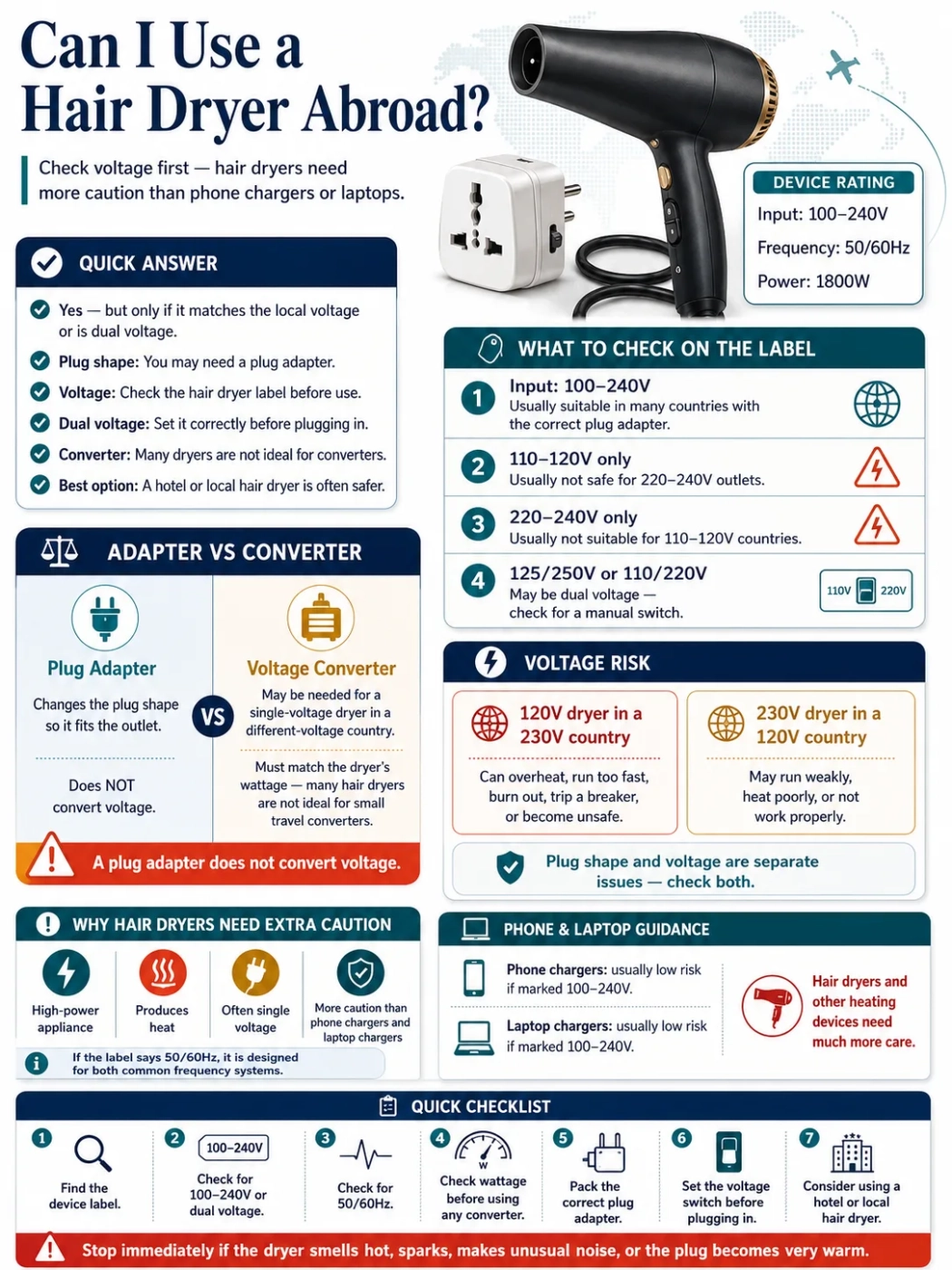
You can use a hair dryer abroad only if it matches the local voltage or is clearly labeled as dual voltage. Many hair dryers are high-power appliances, so they need more caution than a phone charger or laptop charger. Before packing one, check the label on the handle, plug, or power cord for voltage information such as Input: 100–240V or a dual-voltage setting.
Quick Travel Answer
| What to Check | What It Means | Travel Advice |
|---|---|---|
| Plug shape | Your hair dryer plug may not fit the wall outlet abroad. | You may need a plug adapter. |
| Voltage | Many countries use either around 120V or around 230V. | Check the hair dryer label before use. |
| Dual voltage | A dual-voltage dryer can work in more than one voltage range. | Set it correctly before plugging it in. |
| Converter need | A single-voltage dryer may not be safe abroad. | A voltage converter may be needed, but many dryers are not ideal for converters. |
| Best option | Hotel or local hair dryers are already matched to local power. | Often safer and easier than carrying one from home. |
Can You Use a Hair Dryer Abroad?
Yes, but only under the right conditions. A hair dryer is not like a phone charger. It draws a lot of power and produces heat, which makes voltage compatibility much more important.
There are two separate issues:
- Plug compatibility: whether the plug physically fits the power outlet.
- Voltage compatibility: whether the hair dryer can safely handle the local electrical voltage.
A plug adapter does not convert voltage. It only changes the plug shape so your device can fit into a different socket type. If your hair dryer is not designed for the local voltage, a simple travel adapter is not enough.
How to Check the Hair Dryer Label
Look for a small printed label on the hair dryer body, handle, plug, or power cord. It may be called a rating label, device label, or electrical rating plate.
The most important line is the voltage line. It may look like one of these examples:
- Input: 100–240V — usually suitable for use in many countries, with the correct plug adapter.
- 110–120V only — usually not safe to plug directly into 220–240V outlets.
- 220–240V only — usually not suitable for 110–120V countries unless designed for that range.
- 125/250V or 110/220V — may be dual voltage, but you must check whether it has a manual switch.
Always check the device label before using high-power appliances abroad. Do not rely only on the plug shape, brand, or where the dryer was purchased.
What “Input: 100–240V” Means
Input: 100–240V means the device is designed to accept a wide range of voltage. Many phone chargers, laptop chargers, camera chargers, and some electric shavers have this rating.
Hair dryers are different. Some travel hair dryers are dual voltage, but many full-size home hair dryers are not. A dryer labeled Input: 100–240V or similar is generally easier to use abroad, but you still need a plug adapter if the plug does not match the local outlet.
If the label says only one voltage range, such as 120V or 230V, treat the dryer as single voltage unless the manufacturer clearly states otherwise.
When a Plug Adapter Is Enough
A plug adapter may be enough when your hair dryer is already compatible with the local voltage. This usually means one of the following is true:
- The hair dryer label says Input: 100–240V.
- The dryer is marked dual voltage and set to the correct voltage range.
- The destination country uses the same voltage range as your home country.
In these cases, the adapter only solves the physical plug problem. For example, if your plug has flat pins but the destination uses round sockets, the adapter lets the plug fit. It does not make the appliance safer electrically.
When a Voltage Converter May Be Needed
A voltage converter may be needed if your hair dryer is single voltage and the destination uses a different voltage. For example, a 120V-only hair dryer used in a 230V country can overheat, run too fast, burn out, trip a breaker, or become unsafe.
However, hair dryers are high-wattage heating devices. Many small travel converters are not suitable for them, even if the plug fits. If a converter is used, it must be rated for the dryer’s wattage, and even then, performance may be poor or unreliable.
For most travelers, the safer choice is usually to use a hotel hair dryer, buy a local dryer at the destination, or carry a properly rated dual-voltage travel hair dryer.
120V vs 230V Travel Risk
The biggest risk comes from taking a hair dryer from a lower-voltage country to a higher-voltage country. A 120V-only dryer plugged into a 230V outlet can be damaged very quickly.
The opposite situation can also be a problem. A 230V-only dryer used in a 120V country may run weakly, heat poorly, or not work properly. It may not be dangerous in the same way, but it usually will not perform as expected.
This is why the voltage line matters more than the plug shape. Plug shape and voltage are separate issues, and both must be checked before using a hair dryer abroad.
Do Hair Dryers Work on 50Hz and 60Hz?
Frequency is usually shown as 50Hz or 60Hz. Many simple heating appliances are less sensitive to frequency than voltage, but hair dryers often include a motor, so frequency can still matter.
If your dryer label says 50/60Hz, it is designed for both common frequency systems. If it lists only one frequency, be more cautious. Voltage remains the main issue, but frequency should not be ignored, especially for motorized appliances.
Phone Chargers and Laptop Chargers Are Different
Modern phone chargers and laptop chargers are usually easier to use abroad because many are designed for worldwide input. Their labels commonly say Input: 100–240V, 50/60Hz. In that case, travelers usually need only the correct plug adapter.
Hair dryers, curling irons, travel kettles, clothes irons, and similar heat-producing appliances are different. They use much more power and are more likely to be single voltage. These devices should always be checked carefully before travel.
| Device | Typical Travel Risk | What to Check |
|---|---|---|
| Phone charger | Usually low if marked 100–240V | Input voltage and plug adapter |
| Laptop charger | Usually low if marked 100–240V | Power brick label |
| Camera charger | Usually low if marked 100–240V | Input rating |
| Electric shaver | Varies by model | Voltage and charging base label |
| Hair dryer | High caution | Voltage, wattage, dual-voltage setting |
| Curling iron | High caution | Voltage and heat appliance rating |
Using a Dual-Voltage Hair Dryer Abroad
A dual-voltage hair dryer may have a small switch or dial marked with voltage options such as 110V and 220V. Some models adjust automatically, but many require manual switching.
If your dryer has a voltage selector, set it before plugging it into the wall. Use a coin or small tool if the switch is recessed. Do not change the voltage setting while the dryer is plugged in or running.
After setting the correct voltage, you may still need a travel adapter for the local socket type. Again, the adapter only changes the plug shape.
Should You Pack a Hair Dryer for International Travel?
It depends on your destination, accommodation, and hair care needs. Many hotels, apartments, and guesthouses provide hair dryers, but quality and availability can vary. If a hair dryer is essential for your trip, check with your accommodation before you travel.
If you prefer to bring your own, a compact dual-voltage travel hair dryer is usually more practical than a full-size home dryer. It should clearly list its voltage range and wattage. Avoid assuming that “travel size” automatically means dual voltage.
Safety Tips Before Using a Hair Dryer Abroad
- Check the voltage on the hair dryer label before every international trip.
- Confirm whether your destination uses a different plug type, voltage, or frequency.
- Use a plug adapter only when the dryer is voltage-compatible.
- Do not use a damaged adapter, loose socket, or overheated plug.
- Avoid using a hair dryer near sinks, bathtubs, or wet surfaces.
- Do not force a plug into an outlet.
- Stop using the dryer immediately if it smells hot, sparks, makes unusual noise, or the plug becomes very warm.
Travel Checklist for Hair Dryers
- Find the device label.
- Check whether it says Input: 100–240V or dual voltage.
- Check whether it says 50/60Hz if frequency may matter.
- Check the wattage before considering any converter.
- Pack the correct plug adapter for your destination.
- Set the voltage switch correctly if the dryer has one.
- Consider using a hotel or local hair dryer instead of a converter.
FAQ
Can I use my regular hair dryer in another country?
You can use it only if it matches the local voltage or is clearly dual voltage. If it is single voltage and the destination uses a different voltage, do not plug it in directly.
Do I need a plug adapter or a voltage converter for a hair dryer?
You may need a plug adapter if the plug shape is different. You may need a voltage converter if the dryer is not compatible with the local voltage. A plug adapter does not convert voltage.
Is a dual-voltage hair dryer safe for travel?
A dual-voltage hair dryer is usually better for travel, but you must set it to the correct voltage if it has a manual switch. You may still need a plug adapter for the outlet shape.
Can I use a 120V hair dryer in a 230V country?
Not directly. A 120V-only hair dryer can overheat or fail in a 230V outlet. Use a properly rated dual-voltage dryer, a suitable high-wattage converter, or a local hair dryer.
Can I use a 230V hair dryer in a 120V country?
It may run weakly or not heat properly unless it is designed for 120V use. Check the label before plugging it in.
Are hotel hair dryers safer than bringing my own?
Often, yes. A hotel hair dryer is usually already matched to the local voltage and outlet system. If you rely on one, confirm availability with your accommodation before travel.