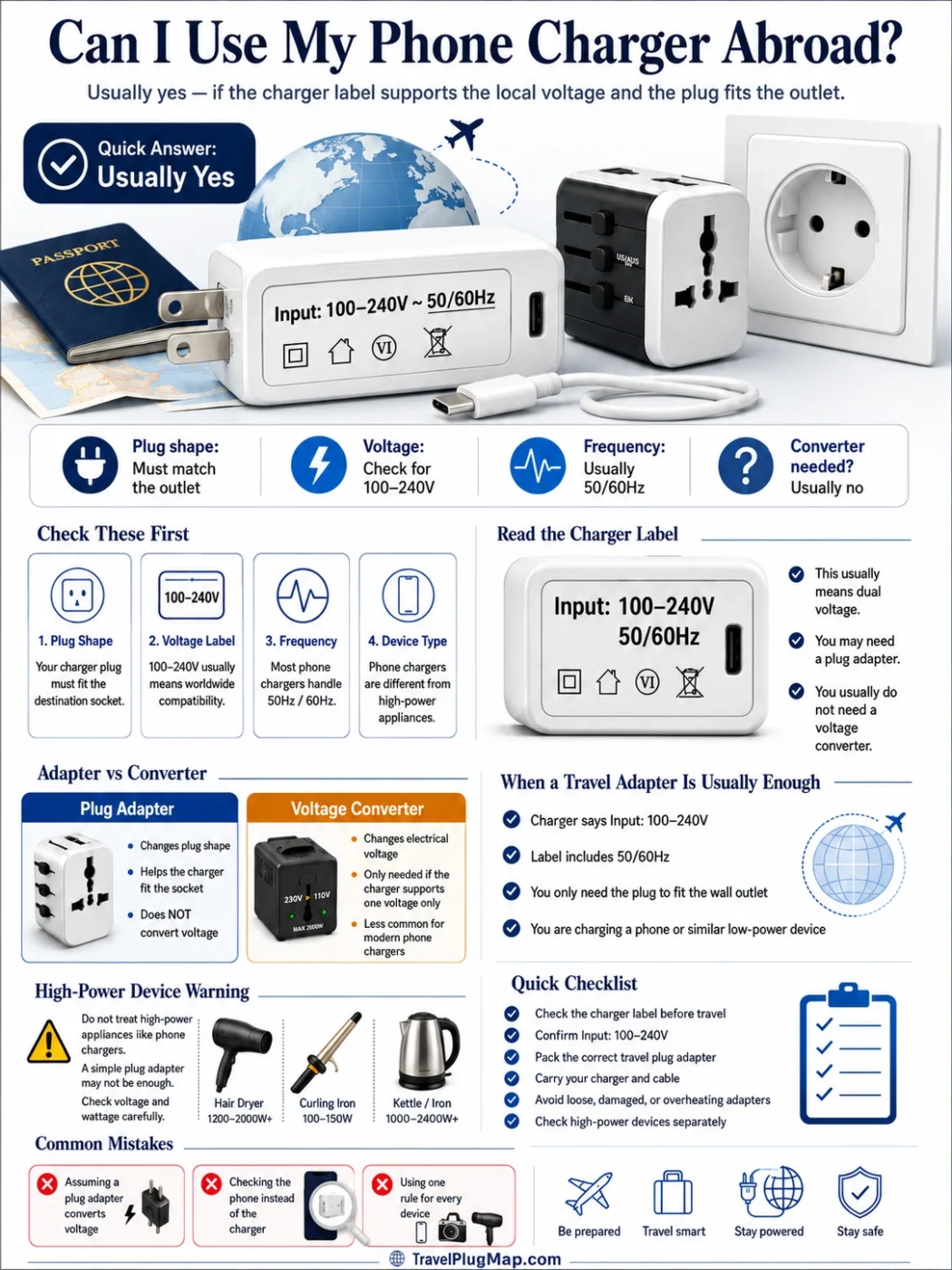
Yes, you can usually use your phone charger abroad, but you need to check two things before you plug it in: the plug shape used in the country you are visiting and the charger’s voltage input label. Most modern phone chargers are dual voltage and show Input: 100–240V, which means they can normally handle common power systems around the world. In many cases, you only need a travel plug adapter so the charger physically fits the wall outlet.
| What to Check | What It Means | What You May Need |
|---|---|---|
| Plug shape | Your charger plug must match the outlet socket type in the destination. | Plug adapter or travel adapter |
| Voltage label | Input: 100–240V means the charger is usually suitable for both 120V and 230V countries. | Usually no voltage converter |
| Frequency | Phone chargers usually work with both 50Hz / 60Hz if the label says so. | Usually no special action |
| High-power appliances | Hair dryers, curling irons, kettles, and irons are different from phone chargers. | Check carefully; converter may be needed |
Look at the Charger Label First
The safest way to know whether your phone charger will work abroad is to read the small print on the charger body. Look for a line that says something like:
Input: 100–240V ~ 50/60Hz
This means the charger is designed to accept voltage from 100 volts up to 240 volts and can usually work on both 50Hz and 60Hz electrical systems. That covers most travel destinations. You may still need a plug adapter, but you usually do not need a voltage converter for that charger.
What “Input: 100–240V” Means
Input: 100–240V means the charger can normally accept electricity from low-voltage countries, such as places using around 100–120V, and higher-voltage countries, such as places using around 220–240V. This is common on modern USB phone chargers, USB-C chargers, and many laptop chargers.
If your charger says only Input: 120V or only Input: 230V, it may not be suitable for every country. In that case, you should not assume it is safe to use abroad without checking the destination voltage and the charger specifications.
The label may also show 50/60Hz. This refers to electrical frequency. Most phone chargers are designed to work with both frequencies when the label includes both numbers. For phone charging, frequency is usually less of a concern than voltage and plug shape, but it is still worth checking the label.
Do You Need a Plug Adapter for Your Phone Charger?
You need a plug adapter when your charger plug does not physically fit the power outlet in the country you are visiting. For example, a charger with a flat two-pin plug may not fit round-pin outlets, and a charger made for Type G outlets will not fit Type A or Type C outlets without an adapter.
A plug adapter changes the shape of the plug connection. A plug adapter does not convert voltage. This is the most important difference to understand before using any device abroad.
For most phone chargers marked Input: 100–240V, a plug adapter is usually enough. The adapter lets the charger fit the wall socket, while the charger itself handles the voltage.
Do You Need a Voltage Converter for a Phone Charger?
In most cases, no. A modern phone charger with Input: 100–240V is usually dual voltage, so it does not need a voltage converter when traveling internationally.
You may need a voltage converter only if your charger is designed for one voltage range and the country you are visiting uses a different voltage. This is less common with phone chargers, but it can happen with older chargers, low-cost replacement chargers, or chargers made for a limited market.
Always check the device label before using any charger abroad. Do not rely only on the plug shape, the country name, or the fact that the charger fits into an adapter.
Phone Chargers Are Different From Hair Dryers and Curling Irons
Phone chargers are usually low-power electronic devices. Hair dryers, curling irons, travel kettles, clothes irons, and some electric shavers are different because they may draw much more power or produce heat.
| Device | Usually Dual Voltage? | Main Travel Concern | Typical Advice |
|---|---|---|---|
| Phone charger | Often yes | Plug shape | Check for Input: 100–240V; use a plug adapter if needed. |
| Laptop charger | Often yes | Plug shape and charger rating | Check the power brick label before travel. |
| Camera charger | Often yes | Plug shape and voltage label | Check the charger label, not just the camera model. |
| Hair dryer | Not always | Voltage and wattage | High-power appliance; use only if clearly compatible. |
| Curling iron | Not always | Voltage and heat control | Check carefully; a simple adapter may not be enough. |
| Travel kettle or iron | Not always | Very high power draw | Avoid using unless rated for the destination voltage. |
A phone charger that works worldwide does not mean every device in your bag will work worldwide. High-power appliances need more caution because using the wrong voltage can damage the device, overheat it, or create a safety risk.
How to Check Your Phone Charger Before Travel
Before packing, look at the charger itself, not only the phone. The important electrical information is usually printed on the charging plug or power brick.
- Find the word Input on the charger label.
- Look for 100–240V. This usually means worldwide voltage support.
- Check whether the label includes 50/60Hz.
- Compare your plug shape with the outlet type used in your destination.
- Pack a suitable plug adapter if the shapes are different.
- Do not use a damaged charger, loose adapter, or overloaded power strip.
When a Travel Adapter Is Enough
A travel adapter is usually enough for your phone charger when all of the following are true:
- Your charger label says Input: 100–240V.
- The charger supports the local frequency, usually shown as 50/60Hz.
- You only need to make the plug fit the wall outlet.
- You are charging a normal phone, tablet, earbuds, camera battery, or similar low-power device.
In this situation, the travel adapter only solves the physical plug problem. The charger does the electrical conversion needed to charge your phone safely.
When You Should Be More Careful
You should be more careful if the charger is old, unbranded, damaged, or missing a readable input label. You should also be careful if you are using a charger bought for a very specific voltage system.
A universal-looking plug adapter does not make an unsafe charger safe. A plug adapter does not convert voltage, reduce wattage, or repair poor-quality electronics. It only changes the plug shape.
If the label is unreadable or does not clearly show a suitable input range, the safer choice is to use a charger that clearly supports the destination voltage.
Can You Use a USB Port Instead?
Many hotels, airports, trains, and newer wall outlets provide USB-A or USB-C charging ports. These can be convenient, but charging speed and reliability can vary. A direct wall charger is often more predictable, especially if you need faster charging.
If you use a USB port, you may not need a plug adapter for that specific charging session. However, it is still smart to carry the correct travel adapter so you can use your own charger when USB ports are not available.
What About Fast Chargers and USB-C Chargers?
Fast chargers and USB-C chargers can usually be used abroad if their input label supports the local voltage. The charging speed technology is separate from the wall outlet shape. A USB-C charger still needs the correct plug adapter if its plug does not fit the local socket.
Check the label on the charger body. Many USB-C chargers show Input: 100–240V, but you should confirm this before travel rather than assume.
Saudi Arabia USB-C Charging Rules
Saudi Arabia requires USB Type-C for covered devices placed on the Saudi market under a phased CST and SASO rule. The first mandatory phase took effect on 1 January 2025 for mobile phones, tablets, digital cameras, e-readers, portable game consoles, headphones, earphones and other listed electronic devices. The second phase took effect on 1 April 2026 and covers laptops.
The rule concerns the charging connection on covered devices; it does not change Saudi Arabia’s wall-socket requirements. Saudi Arabia uses Type G outlets, so a USB-C phone charger with a different wall plug may still need a Type G-compatible travel adapter. Travelers should also continue checking the charger’s input voltage and frequency rating before use.
Travel Power Checklist for Phone Chargers
- Check the charger label before your trip.
- Confirm it says Input: 100–240V.
- Check whether your destination uses 50Hz or 60Hz power, especially if the charger label is unusual.
- Find the plug type used in your destination.
- Pack the correct travel plug adapter.
- Keep one charger and cable in your carry-on bag.
- Avoid using loose, damaged, or overheating adapters.
- Do not treat high-power appliances the same way as phone chargers.
Common Mistakes to Avoid
Assuming the Plug Adapter Converts Voltage
This is the most common mistake. A plug adapter does not convert voltage. It only helps your plug fit into a different socket type.
Checking the Phone Instead of the Charger
Your phone battery charges through the charger. The charger’s input label is what tells you whether it can accept the destination voltage.
Using One Rule for Every Device
A phone charger may be dual voltage, but a hair dryer or curling iron may not be. Treat high-power appliances separately.
Ignoring Loose or Poor-Fitting Adapters
If an adapter feels loose in the socket, does not hold the charger securely, or becomes hot, stop using it. A good fit matters for safe charging.
FAQ
Can I charge my phone in another country?
Usually yes. Most modern phone chargers support Input: 100–240V, so they can work in many countries. You may still need a plug adapter for the local outlet type.
Do I need a voltage converter for my phone charger?
Usually no, if the charger label says Input: 100–240V. If the charger only lists one voltage, check the destination voltage before using it.
Is a travel adapter the same as a voltage converter?
No. A travel adapter changes the plug shape. A plug adapter does not convert voltage. A voltage converter changes electrical voltage for devices that need it.
Will my USB-C phone charger work abroad?
Most USB-C phone chargers work abroad if they show Input: 100–240V on the label. You may need a plug adapter if the charger plug does not match the wall outlet.
Can I use the same adapter for my phone and hair dryer?
You may be able to use the same plug adapter for the physical outlet shape, but that does not mean the hair dryer is electrically safe. Hair dryers are high-power appliances and must be checked for voltage compatibility separately.
What should I pack to charge my phone abroad?
Pack your phone charger, charging cable, and the correct travel plug adapter for your destination. A charger labeled Input: 100–240V is usually the best choice for international travel.