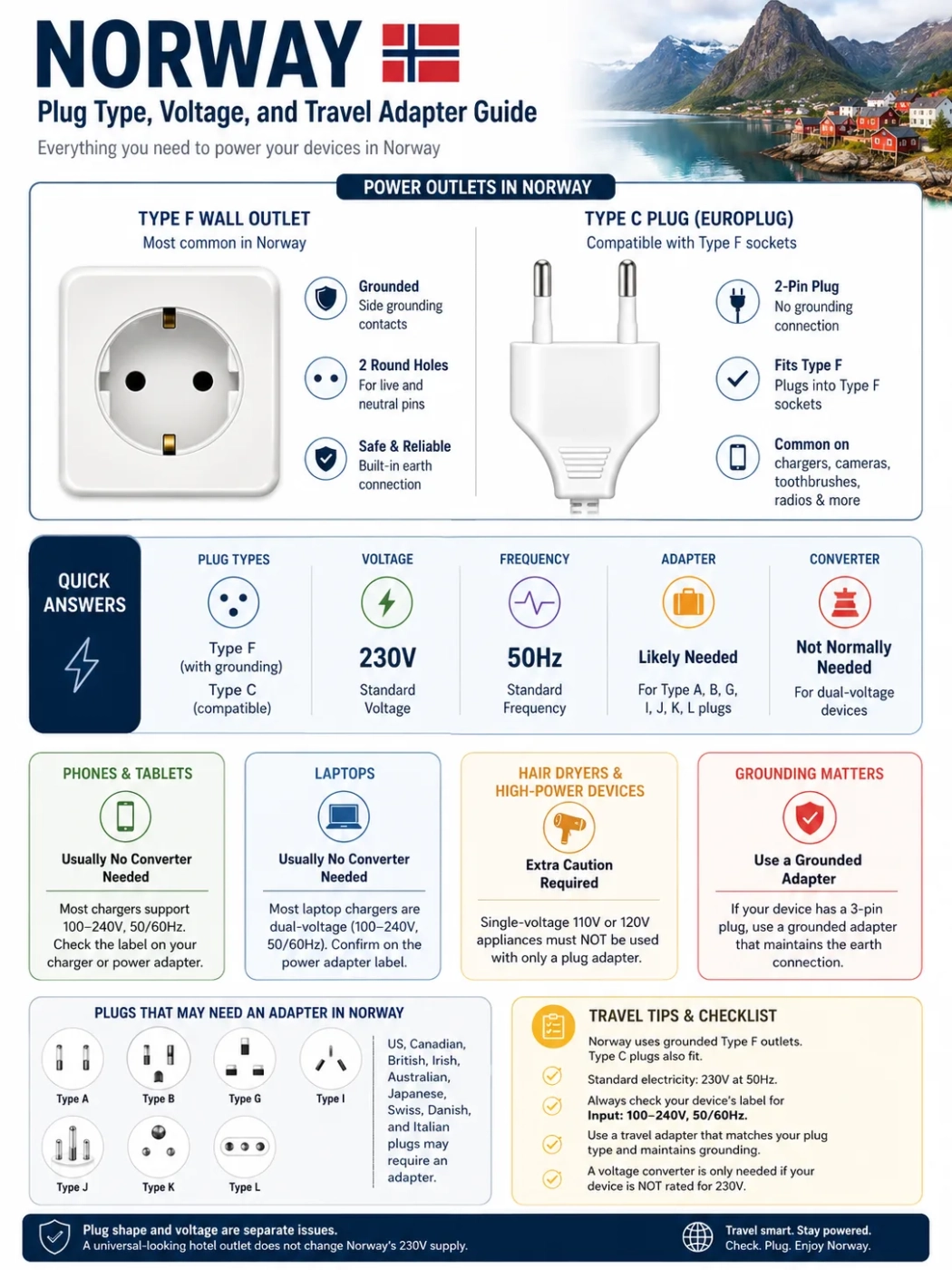
Norway mainly uses grounded Type F power outlets, while two-pin Type C Europlugs also fit these sockets. The standard electricity supply is 230V at 50Hz. Travelers using Type A, B, G, I, J, K, or L plugs will normally need a Norway travel adapter. A voltage converter is only relevant when a device is not designed for 230V.
| Travel power detail | Norway | What it means for travelers |
|---|---|---|
| Usual wall socket | Type F | Expect two round openings with side grounding contacts. |
| Compatible two-pin plug | Type C Europlug | Common small two-pin chargers can usually connect to a Type F socket. |
| Standard voltage | 230V | Single-voltage 110V or 120V appliances must not be connected with only a plug adapter. |
| Frequency | 50Hz | Modern chargers commonly support 50/60Hz, but frequency-sensitive equipment needs checking. |
| Grounding | Side contacts on Type F sockets | A grounded appliance needs an adapter that maintains the earth connection. |
| Plug adapter | Depends on the plug attached to the device | US, Canadian, British, Irish, Australian, Japanese, Swiss, Danish, and Italian plugs may require an adapter. |
| Voltage converter | Not normally needed for dual-voltage electronics | Look for Input: 100–240V, 50/60Hz on the charger or power supply. |
What the Power Outlets Look Like
Real outlets may differ slightly in color, depth, faceplate shape, or shutter design. Some hotels may also provide USB ports or multi-standard sockets. Plug shape and voltage are separate issues, and a universal-looking hotel outlet does not change Norway’s 230V supply.
Why Norway Is Listed With Both Type C and Type F
Type F is the socket travelers are most likely to see in Norwegian homes, hotels, apartments, offices, restaurants, and public buildings. It is the round Schuko-style design with two pin openings and grounding contacts positioned around the recessed socket.
Type C usually describes the slim two-pin Europlug attached to small ungrounded equipment. It is common on phone chargers, camera chargers, electric toothbrush adapters, radios, and other low-power devices. The Type C plug fits inside a Type F socket, which is why Norway is often listed as using both Type C and Type F.
This does not mean that every Norwegian wall outlet is a separate ungrounded Type C socket. For a traveler, the practical distinction is:
- Type F is the normal grounded wall socket.
- Type C is a compatible two-pin plug used by many small appliances.
- A Type C plug does not provide a protective earth connection.
- A grounded appliance should remain grounded through the travel adapter.
Norwegian household plugs and socket-outlets are covered by the national NEK 502 standard, which is based on IEC requirements with Norwegian additions and deviations. The standard covers several household plug and socket arrangements, including 16A, 250V connections used in Norway.
Will Your Existing Plug Fit?
The adapter decision depends on the plug physically attached to the charger or appliance. Nationality alone is not enough. A device bought in another country may have a different plug from the one normally used where its owner lives.
| Plug carried by the traveler | Will it normally fit? | Grounding result | Likely requirement |
|---|---|---|---|
| Type C | Yes | Type C is ungrounded | No plug adapter for shape |
| Type F | Yes | Grounding is supported | No plug adapter |
| Modern Type E/F hybrid plug | Usually | Usually supports Type F side grounding | Often no adapter |
| Type A or Type B | No | Type B needs a grounded adapter to retain earth continuity | Adapter needed |
| Type G | No | Grounding must be transferred by the adapter | Adapter needed |
| Type I | No | Grounded Type I equipment needs a grounded adapter | Adapter needed |
| Type J | No for a three-pin Type J plug | Grounding arrangement differs | Adapter needed |
| Type K | No for a grounded Type K plug | Grounding arrangement differs | Adapter needed |
| Type L | No for a true three-pin Type L plug | Grounding arrangement differs | Adapter needed |
Travelers from continental Europe
Travelers carrying Type C, Type F, or modern Type E/F hybrid plugs can often use Norwegian outlets without an adapter. This covers many devices sold in Germany, Spain, Portugal, the Netherlands, France, Belgium, Sweden, Finland, and several other European countries.
Check the actual plug before departure. A British laptop charger purchased while living in continental Europe still has a Type G plug unless the cord or plug head has been replaced.
Travelers from the United Kingdom and Ireland
Type G plugs do not fit Norwegian sockets, so a plug adapter is required. The voltage and frequency difference is usually less troublesome because the UK, Ireland, and Norway all use nominal 230V, 50Hz supplies.
A British phone charger, laptop charger, or hair appliance may therefore be electrically compatible even though its plug does not fit. The device label and the adapter’s power rating still need to be checked.
Travelers from the United States and Canada
Type A and Type B plugs need an adapter. Voltage requires a separate decision because Norway uses 230V while the United States and Canada commonly use 120V.
Phones and laptops are often straightforward because their power supplies frequently accept a wide input range. A single-voltage 120V hair dryer, curling iron, heating pad, shaver, or kitchen appliance is a different case.
Do not connect a 120V-only appliance to a Norwegian outlet with only a plug adapter.
Travelers from Australia and New Zealand
Type I plugs need an adapter for Norway. The standard voltage and frequency are normally similar, so a voltage converter is usually unnecessary for equipment already designed for 220–240V, 50Hz operation.
Travelers from Switzerland, Denmark, or Italy
The result depends on the exact plug:
- A slim Type C Europlug normally fits.
- A Type F or compatible Type E/F plug normally fits.
- A three-pin Swiss Type J plug needs an adapter.
- A grounded Danish Type K plug needs an adapter.
- A true Italian Type L plug needs an adapter.
Adapter Only or Voltage Converter?
A plug adapter changes the physical connection between a foreign plug and a Norwegian Type F socket. A plug adapter does not convert voltage.
A voltage converter or transformer changes the electrical voltage supplied to the device. It may be needed when an appliance was designed only for a lower voltage such as 110V or 120V.
Read the input label on the charger, power brick, appliance body, or cable tag before deciding what equipment to pack.
If the label says “Input: 100–240V, 50/60Hz”
This wide input range includes Norway’s 230V, 50Hz supply. The device normally does not need a voltage converter. A plug adapter may still be necessary if the attached plug is not Type C, Type F, or another Type F-compatible design.
This label is common on:
- Phone chargers
- Tablet chargers
- Laptop power supplies
- USB-C and GaN chargers
- Camera battery chargers
- Portable game console chargers
- Some electric shaver and toothbrush chargers
- Many CPAP power supplies
If the label says “Input: 220–240V, 50Hz”
The device is normally suited to the Norwegian supply. Only plug-shape compatibility and the adapter’s current or watt rating need to be checked.
If the label says only “120V, 60Hz”
The device is not designed for Norway’s 230V supply. A mechanical adapter is not enough. Using it directly may cause overheating, immediate failure, damaged heating elements, damaged motors, or an electrical hazard.
A converter must be designed for the appliance type and must have enough continuous watt capacity. Small electronic converters are not automatically suitable for high-wattage heaters or motor-driven equipment.
If the device has a 110/220V or 120/240V switch
Some older travel appliances have a manual voltage selector. It must be placed in the 220V or 240V position before the appliance is connected in Norway. The plug adapter does not operate this switch automatically.
Grounding Is Part of the Adapter Decision
Type F sockets provide protective grounding through metal contacts at the edge of the recessed outlet. A matching grounded plug touches these contacts when inserted.
Some inexpensive adapters accept a three-prong plug but produce only two round pins on the Norwegian side. The appliance may turn on, but its protective earth connection may be lost.
For grounded equipment, check that the adapter:
- Is described as grounded or earthed
- Has contacts designed to connect with a Type F socket
- Accepts the original plug without removing its ground pin
- Is rated for 230V operation
- Can carry the appliance’s current and wattage
A two-pin adapter cannot create grounding that is not physically carried through its design.
How to identify double-insulated equipment
A device marked with a square inside another square is normally Class II or double-insulated equipment. It does not rely on a protective earth conductor in the same way as a grounded metal appliance.
Double insulation does not remove the need to check voltage, frequency, wattage, or manufacturer instructions.
Modern Chargers and High-Power Appliances Need Different Checks
| Device | Plug adapter | Voltage converter | What to inspect |
|---|---|---|---|
| Phone charger | Needed if the plug does not fit Type F | Usually no | Look for Input: 100–240V, 50/60Hz |
| Laptop charger | Depends on the wall plug or detachable cord | Usually no | Input range, USB-C wattage, cable rating |
| Camera battery charger | Depends on plug shape | Usually no if dual voltage | Input voltage and frequency |
| Electric shaver | Depends on plug shape | Model-dependent | Check the charger base and power supply, not only the shaver |
| Hair dryer | Normally needed for non-European plugs | May be needed for a 120V-only model | Voltage setting and high wattage |
| Curling iron or straightener | Depends on plug shape | May be needed | Voltage range and watt rating |
| Travel kettle or clothes iron | Depends on plug shape | Often impractical for the wrong voltage | High wattage and adapter limit |
| CPAP machine | Needed if the plug does not fit | Depends on the power supply | Power brick label, humidifier load, manufacturer travel instructions |
Phones, tablets, cameras, and USB devices
Modern low-power chargers commonly accept 100–240V and 50/60Hz. When that range appears on the label, the main issue is normally the plug shape.
A USB cable does not connect directly to a Norwegian wall socket unless the building provides a suitable USB port. The wall charger still needs either a compatible European plug or a travel adapter.
Laptop and GaN chargers
Most laptop power supplies are designed for international voltage, but the input label remains the deciding information. For USB-C charging, also check whether the charger supplies enough power for the laptop.
A USB-C port does not guarantee the same charging performance across every charger. A small charger intended for a phone may charge a laptop slowly, only while it is sleeping, or not at all under heavy use.
Check:
- The laptop’s recommended wattage
- The charger’s USB Power Delivery output
- The maximum power supported by the USB-C cable
- How output is divided when several ports are used together
- Whether a heavy charger will sit securely in a recessed Type F socket
GaN describes the charger’s internal semiconductor technology. It does not determine plug compatibility or voltage support.
Hair dryers and styling tools
Hair dryers, curling irons, straighteners, hot brushes, steamers, and similar appliances deserve more caution because they produce heat and may draw far more power than a phone charger.
A 120V-only hair dryer from North America should not be used on 230V with a basic adapter. Even when a suitable high-wattage converter exists, its size, rating, operating limits, and compatibility with the appliance must be checked carefully.
For a dual-voltage hair tool:
- Set the voltage selector to 220V or 240V before plugging it in.
- Confirm that the selected setting supports 50Hz if frequency is listed.
- Check that the adapter is rated above the appliance wattage.
- Do not exceed the adapter’s current limit.
- Do not use an adapter that feels loose in the socket.
Always check the device label before using high-power appliances abroad.
Electric toothbrushes and shavers
The low operating voltage of a toothbrush or shaver does not prove that its charging base accepts 230V. Check the base, wall adapter, or removable power supply.
Some bathroom shaver outlets have limited output and are not replacements for a normal wall socket. Do not use them for hair dryers, kettles, irons, or other high-load equipment.
CPAP machines and medical equipment
Many modern CPAP power supplies accept 100–240V, but this cannot be assumed for every machine, heated hose, humidifier, battery charger, or accessory.
Before travel, confirm:
- The input voltage and frequency printed on the power supply
- The plug adapter required for Type F sockets
- Whether the equipment needs protective grounding
- The power draw when the humidifier or heated hose is active
- Manufacturer instructions for travel and battery use
A medical device should not be tested for the first time after arrival.
USB-C Rules in Norway in 2026
Norway introduced common charging-interface requirements for covered equipment placed on the market from December 7, 2024. Covered laptop computers followed from April 7, 2026. The requirements apply to the charging interface used by covered products and are intended to support USB Type-C charging where the regulation applies.
This change does not replace Norway’s Type F wall outlets. Three separate connections are involved:
- Wall connection: The charger connects to a Type F socket.
- Charger connection: The charger may have a Type C, Type F, Type G, Type A, or another wall plug.
- Device connection: The cable may use USB-C or another connector.
A traveler can own a USB-C phone and still need a plug adapter because the wall charger has a British, American, Australian, or other non-European plug.
When replacing a charger in Norway, check more than the connector:
- USB Power Delivery support
- Required wattage
- PPS support when the device uses it
- Whether a cable is included
- The cable’s power capacity
- Power sharing across multiple ports
- The charger’s Type C or Type F wall connection
Charging During a Norway Trip
Hotels and city apartments
Standard Type F wall sockets should be expected rather than universal travel sockets. USB-A or USB-C charging ports may be available in some rooms, but their presence, location, and output cannot be assumed.
Do not assume that a hotel’s universal-looking socket changes the voltage. It may accept several plug shapes while still supplying 230V, 50Hz.
A compact charger with several suitable ports can reduce the number of wall outlets required, but its total output may be shared when several devices are connected.
Cabins and mountain accommodation
Norway itineraries often include cabins, mountain lodges, camping facilities, and remote accommodation. Electrical access can differ from a city hotel, so the property description should be checked before arrival.
Useful questions include:
- Does the accommodation have continuous electricity?
- Are sockets available inside the room or only in a shared area?
- Are high-wattage appliances permitted?
- Is charging available overnight?
- Does the property use limited generator, battery, or solar capacity?
A plug adapter cannot solve limited access to electricity. Travelers carrying camera equipment, navigation devices, medical equipment, or several phones may need a charging schedule or suitable backup battery.
Trains, ferries, and long-distance buses
Power availability can depend on the operator, vehicle, vessel, route, cabin, and seating class. Do not treat a booking photo or a previous journey as a guarantee that the next vehicle will provide the same outlet.
Before relying on transport charging, check whether the service provides:
- A Type F mains socket
- USB-A only
- USB-C charging
- A shared socket rather than one per seat
- Enough output for a laptop rather than only a phone
Campervans and motorhomes
A socket inside a vehicle may not operate like a normal building outlet. Identify the available power source:
- 12V vehicle socket
- Built-in USB charging port
- 230V outlet supplied by an inverter
- 230V outlet available only when connected to campsite shore power
An inverter has a continuous watt limit and may also have a separate short-duration peak rating. High-power hair appliances, kettles, heaters, and cooking devices can exceed the system’s capacity even when the plug fits.
Cold-weather charging
Cold conditions can reduce the available performance of phone, camera, drone, and power-bank batteries. Keep spare batteries protected from prolonged exposure, charge equipment when power is available, and avoid relying on one battery for navigation, communication, photography, and tickets.
A power bank also needs to be recharged. Its capacity does not replace the need to confirm electricity access at remote accommodation.
Choosing a Norway Travel Adapter
A dedicated European adapter is often smaller and sits more securely in a recessed Type F socket than a large universal adapter. A universal design may be useful on a multi-country trip, but it should be checked for fit, grounding, and load capacity.
Adapter details worth checking
- Type F socket compatibility
- 230V rating
- Maximum current in amps
- Maximum permitted wattage
- Grounded output for grounded appliances
- Secure fit inside a recessed round socket
- USB-C output wattage, if included
- Power distribution when several ports are active
Do not judge an adapter only by the number of plug shapes it accepts. A universal input face does not prove that grounding is maintained or that the adapter can support a high-wattage appliance.
Avoid loose or layered connections
Large chargers and stacked adapter combinations can place mechanical strain on the outlet. Avoid connecting one adapter to another adapter and then adding a heavy charger or power strip.
Stop using the setup if:
- The plug does not remain firmly seated
- The adapter becomes unusually hot
- There is visible damage, discoloration, or exposed metal
- The connection crackles, sparks repeatedly, or loses power when touched
- The appliance exceeds the adapter’s rating
Five Packing Decisions for Common Norway Trips
US traveler carrying a phone and laptop
Pack a Type A/B-to-Type F adapter. Check both chargers for Input: 100–240V, 50/60Hz. A voltage converter is normally unnecessary when both power supplies show that range.
US traveler carrying a 120V hair dryer
The phone and laptop may work with an adapter, while the hair dryer may not. Each device must be evaluated separately. A working laptop charger does not prove that the hair dryer is safe on 230V.
UK traveler carrying electronics and a straightener
A Type G-to-Type F adapter is needed. Most British electronics are already intended for 230V, but the straightener’s voltage range and the adapter’s watt rating still need checking.
Traveler from Germany or Spain
Type C and Type F plugs normally fit without an adapter. Check any extension lead, detachable laptop cable, or charger purchased outside continental Europe because it may use another plug type.
Campervan journey through northern Norway
Plan for more than a wall adapter. Confirm whether the vehicle provides 12V, USB, inverter-supplied 230V, or shore-power-only sockets. Carry suitable charging cables and avoid assuming that high-wattage appliances can run from the vehicle system.
Common Norway Power Mistakes
Treating Type C as the main grounded wall socket
Type C is commonly listed because the Europlug fits Norwegian outlets. The normal grounded socket is Type F, and its side contacts matter when using grounded equipment.
Assuming that a fitting plug proves electrical compatibility
A plug can fit while the appliance voltage is wrong. Check the plug, voltage, frequency, grounding requirement, and wattage separately.
Expecting a travel adapter to reduce 230V to 120V
A plug adapter does not convert voltage. A single-voltage 120V device remains a 120V device after an adapter is attached.
Using an ungrounded adapter for grounded equipment
The appliance may operate while its protective earth connection is missing. Use a grounded adapter designed to transfer grounding to the Type F socket.
Assuming every USB-C charger can power a laptop
USB-C describes the connector. Charging performance depends on Power Delivery support, output profiles, charger wattage, cable capacity, and the laptop’s requirements.
Depending on transport or cabin charging without checking
Outlet access can vary. Confirm the charging arrangement before relying on it for medical equipment, navigation devices, cameras, or a multi-day remote itinerary.
Before Packing Your Devices
- Identify the plug attached to every charger and appliance.
- Bring a Type F-compatible adapter when the plug will not fit.
- Read the input voltage on each charger or power supply.
- Treat Input: 100–240V, 50/60Hz as separate from plug compatibility.
- Do not connect a 110V or 120V-only appliance directly to Norway’s 230V supply.
- Use a grounded adapter for equipment that requires grounding.
- Check adapter amperage and wattage before using heat-producing appliances.
- Confirm USB-C charger and cable wattage for laptops.
- Check electricity access for remote cabins, transport, and campervan stays.
- Test the full charging setup before departure rather than after arrival.
FAQ
Does Norway use Type C or Type F outlets?
Norway mainly uses grounded Type F wall sockets. Type C Europlugs are also listed because their two slim round pins normally fit Type F sockets.
Do I need a plug adapter for Norway?
You need an adapter if your plug does not fit a Type F socket. Travelers using Type A, B, G, I, J, K, or L plugs will normally need one. Type C and Type F plugs usually fit directly.
What voltage and frequency does Norway use?
Norway uses 230V electricity at 50Hz. Check that the device label includes 230V and, where relevant, 50Hz operation.
Will my phone or laptop charger work in Norway?
It will normally work without a voltage converter when the charger says Input: 100–240V, 50/60Hz. A plug adapter may still be required.
Can I use a US hair dryer in Norway?
Only when the hair dryer is clearly rated for 220–240V or has a correctly selected dual-voltage setting. A 120V-only hair dryer must not be used with only a plug adapter.
Does USB-C mean I no longer need a Norway adapter?
No. USB-C describes the connection between the cable, charger, and device. The charger still needs a plug that fits Norway’s Type F wall socket.