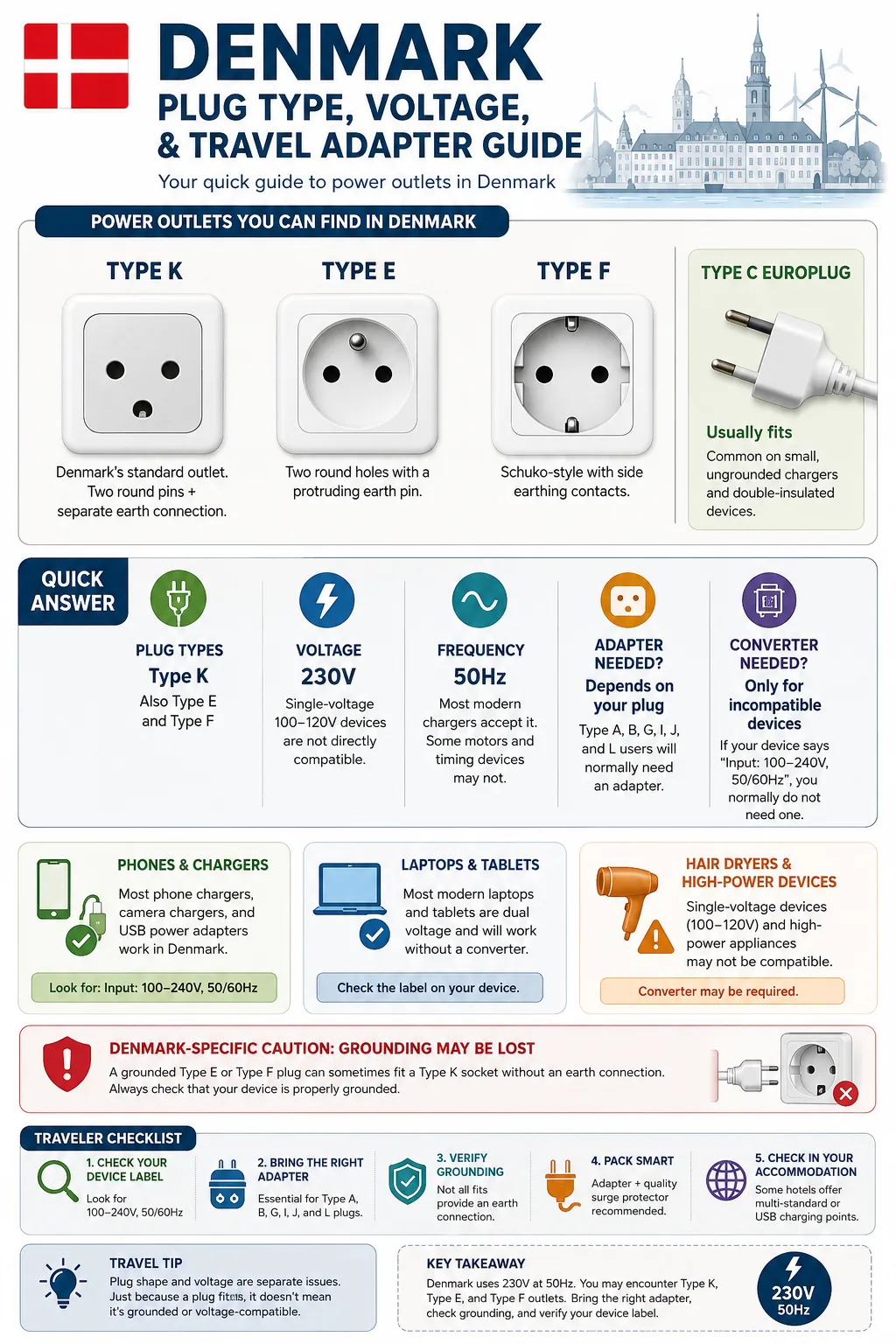
Denmark uses 230V electricity at 50Hz. The Danish Type K socket remains the country’s distinctive outlet design, while Type E and Type F sockets may also appear. A two-pin Type C Europlug often fits, but a grounded European plug may not always provide a proper earth connection. Travelers should check both plug fit and grounding before use.
| Travel power detail | Denmark | What it means for a traveler |
|---|---|---|
| Main local plug system | Type K | The Danish grounded design uses two round power pins and a separate earth connection. |
| Other sockets you may see | Type E and Type F | Socket availability can depend on the building and installation. |
| Type C Europlug | Usually fits | Common on small, ungrounded chargers and double-insulated devices. |
| Standard voltage | 230V | Single-voltage 100–120V appliances are not directly compatible. |
| Frequency | 50Hz | Most modern chargers accept it; some motors, clocks, and timing devices may not. |
| Plug adapter | Depends on the source plug | Type A, B, G, I, J, and L users will normally need an adapter. |
| Voltage converter | Only for incompatible devices | A device marked Input: 100–240V, 50/60Hz normally does not need one. |
| Denmark-specific caution | Grounding may be lost | A grounded Type E or Type F plug can sometimes fit a Type K socket without an earth connection. |
What the Power Outlets Look Like
These are simplified front views of outlet systems travelers may encounter in Denmark. Wall plates, shutters, switches, recess depth, and socket combinations can vary by building and product design. Some hotels provide multi-standard or USB charging points. Plug shape and voltage are separate issues, and a plug that enters a socket is not automatically grounded.
Why Denmark Is Not Simply a “Standard European Plug” Destination
Many European countries use two round power pins, so Denmark can look familiar at first. The difference is the earth connection. The local Type K system places the grounding contact in a different position from the French Type E and German-style Type F systems.
A Type K plug has two round live and neutral pins plus a separate Danish earth pin. A Type E socket provides a projecting earth pin. A Type F socket uses metal grounding contacts at the sides. The power-pin spacing is similar enough for partial physical compatibility, but the grounding methods are not interchangeable in every combination.
Type C Europlugs Are the Simple Case
The slim two-pin Type C Europlug is ungrounded and commonly used on phone chargers, camera chargers, small USB power supplies, and other double-insulated equipment. It usually fits Danish Type K outlets as well as Type E and Type F outlets.
Because Type C does not carry protective earth, there is no earth contact to preserve. This does not make every two-pin device suitable for travel; the charger still has to support Denmark’s 230V, 50Hz supply.
Grounded Type E and Type F Plugs Need More Attention
A grounded Type F plug may enter a pure Type K socket because the two round power pins line up. Its side earth contacts, however, do not connect to the Danish earth opening. Some Type E and combined E/F plugs can create the same problem when used without a suitable connection.
The device may switch on while its protective earth remains disconnected. Normal operation does not prove that grounding is present. This matters most for Class I equipment, three-core power cords, metal-cased appliances, desktop equipment, larger power supplies, and devices whose safety design depends on protective earth.
Will Your Plug Fit and Remain Safely Connected?
| Plug brought to Denmark | Likely physical fit | Main decision |
|---|---|---|
| Type C | Usually yes | Check 230V compatibility. The plug itself is ungrounded. |
| Type E | May fit some outlets | Use a connection that preserves earth when the device requires grounding. |
| Type F | May fit Type K and fits Type F outlets | Do not assume the side earth contacts work in a pure Type K outlet. |
| Type A or B | No | Use a Denmark-compatible adapter and check for 230V support. |
| Type G | No | Use an adapter. Most UK and Irish devices already match 230V and 50Hz. |
| Type I | No | Use an adapter. Many Australian and New Zealand devices match the supply voltage. |
| Type J or L | Do not rely on direct fit | Use a suitable adapter, especially for grounded plugs. |
Travelers from the United States and Canada
Type A and Type B plugs do not fit Danish outlets, so a plug adapter is normally required. The larger issue is voltage: Denmark supplies 230V, while many North American household appliances are designed only for about 120V.
Phone, tablet, camera, and laptop chargers often accept worldwide voltage. Check the charger body for Input: 100–240V, 50/60Hz. A label that says only 120V or 110–120V does not support direct use on Denmark’s supply.
Travelers from the United Kingdom and Ireland
Type G plugs require an adapter. Voltage conversion is usually unnecessary because the UK, Ireland, and Denmark use 230V and 50Hz. The adapter still needs to suit the device’s power draw and preserve grounding when the original plug is earthed.
Travelers from Continental Europe and Türkiye
A slim Type C charger often connects directly. Grounded Type F plugs need a closer look. They work normally in a Type F outlet, but a pure Type K outlet may accept the power pins without connecting the side grounding contacts.
Travelers carrying a grounded laptop cord, monitor, desktop power supply, kitchen appliance, or other Class I device should use a solution that explicitly supports the Danish Type K earth connection rather than relying on physical fit alone.
Travelers from Australia, New Zealand, China, and Japan
Type I and Type A plugs need an adapter. Many Australian, New Zealand, and Chinese devices are designed for a voltage near Denmark’s 230V supply, but the device label remains the deciding information. Japan uses a lower household voltage, so Japanese single-voltage appliances need especially careful checking.
230V and 50Hz: Read the Input Label Before Packing
The electrical label is usually printed on the wall charger, laptop power brick, appliance base, cable entry area, or battery charging cradle. Read the input line rather than the USB output line.
If the Label Says “Input: 100–240V, 50/60Hz”
The charger or power supply is designed for both common voltage ranges and both main frequencies. It can normally accept Denmark’s 230V, 50Hz electricity. You may still need a plug adapter, and a grounded device still needs a grounded connection.
If the Label Says “Input: 220–240V, 50Hz”
The device is electrically matched to Denmark. Only plug shape, grounding, adapter rating, and the condition of the equipment remain to be checked.
If the Label Says Only “110V,” “120V,” or “110–120V, 60Hz”
Do not connect it directly to a Danish outlet. A suitable voltage converter or a locally compatible replacement may be required. The converter must support the appliance type and its wattage; a low-power electronics converter is not automatically suitable for a heating appliance or motor.
A plug adapter does not convert voltage. It changes the mechanical connection only. It also does not normally change 50Hz into 60Hz.
When Frequency Can Matter
Most switching power supplies used for phones and laptops accept 50/60Hz. Frequency deserves more attention with mains-powered clocks, turntables, older motor-driven appliances, timers, pumps, and equipment marked for 60Hz only. A voltage converter that changes 230V to 120V may still leave the output at 50Hz.
Modern Chargers and High-Power Appliances Need Different Decisions
| Device | Usual travel pattern | What to check |
|---|---|---|
| Phone or tablet charger | Often works without a converter | Look for Input: 100–240V and check the plug shape. |
| USB-C laptop charger | Often works without a converter | Check input voltage, required USB Power Delivery wattage, cable rating, and grounding. |
| Camera battery charger | Often dual voltage | Read the charger base or power brick, not only the camera manual. |
| Electric toothbrush or shaver | Varies by model | Check the charging base, cord set, voltage, and frequency marking. |
| CPAP machine | Many power supplies are wide-voltage, but not all | Check the power supply label, humidifier load, grounding needs, and manufacturer travel instructions. |
| Hair dryer or hot-air styler | Often problematic when brought from a 120V country | Check voltage selector, wattage, and converter suitability. |
| Curling iron or hair straightener | Some models are dual voltage | Confirm the printed range includes 230V; do not infer this from size or price. |
| Kettle, clothes iron, or steamer | High load | Use only equipment rated for 230V and within the adapter or extension rating. |
Phones, Tablets, Cameras, and USB Chargers
These devices are commonly powered through compact switch-mode chargers. When the charger says Input: 100–240V, 50/60Hz, Denmark’s supply is normally acceptable. The wall plug still has to fit correctly, and a crowded multi-port charger must stay within its stated total output.
A USB cable does not determine wall-voltage compatibility. The input rating belongs to the wall charger or power brick. A cable also has its own current or USB Power Delivery limit, which can affect charging speed.
Laptops, USB-C Power Delivery, and Grounded Cords
Two separate checks apply to a laptop. First, the charger input must support 230V and 50Hz. Second, the charger must provide enough output power for the computer. A 30W USB-C phone charger may charge a small laptop slowly, but it may not support a machine designed for 65W, 100W, 140W, or more.
Grounding depends on the charger design. Some laptop chargers use an ungrounded two-pin input and are double insulated. Others use a three-core grounded cord. For the second group, choose an adapter that keeps the protective earth connection through to a Type K, Type E, or Type F socket as applicable.
EU USB-C Rules Do Not Remove the Wall-Adapter Question
USB-C charging requirements cover many categories of portable electronics sold in the European Union, and the requirements extended to covered laptops on April 28, 2026. This can make device-side cable compatibility easier when buying newer electronics in Denmark.
The rule does not change Danish wall outlets. A USB-C cable connects the charger to the device; the charger still needs a plug that fits the available Type K, E, or F socket. It also needs enough USB Power Delivery output for the device.
Hair Dryers, Curling Irons, Kettles, and Clothes Irons
Heat-producing appliances draw far more power than a phone charger. A 120V-only hair dryer connected to 230V through a mechanical adapter is not a workable setup. It can overheat, fail, trip protection, or create a fire and shock hazard.
Some travel hair tools have a manual 120/240V selector. Set it to the correct position before connecting the appliance. Dual-voltage wording must appear on the appliance itself; a familiar plug or detachable cable is not proof.
Always check the device label before using high-power appliances abroad. A converter must be rated above the device’s wattage and suitable for its heating element, electronics, or motor. In many cases, using an appliance supplied by the accommodation is simpler than carrying a large converter.
The Grounding Check That Matters in Denmark
Protective earth is a fault path, not a feature that can be judged by whether the device powers on. A grounded appliance may operate normally for months without earth and reveal the missing protection only when insulation or internal wiring fails.
Devices More Likely to Depend on Earth
- Three-core laptop and monitor power cords
- Desktop computers and larger external power supplies
- Metal-cased kitchen or workshop equipment
- Professional lighting and audiovisual equipment
- Some medical and accessibility devices
- Power strips designed with protective-earth contacts
How to Select a Denmark Adapter for a Grounded Device
- Check that the destination side is made for the socket you will use, including a true Type K earth connection when required.
- Check that the source side accepts the original plug without defeating its grounding contacts.
- Do not treat a two-pin adapter as grounded because it accepts a three-pin plug on the front.
- Check the maximum current and wattage on the adapter.
- Avoid loose stacks of adapters that place weight and leverage on the wall socket.
- Do not use an ungrounded travel adapter to feed a grounded power strip.
The word grounded on a universal adapter is not enough by itself. The product has to carry earth continuously for the exact input-plug and output-socket combination being used.
Hotels, Apartments, Trains, and Shared Charging Areas
Danish accommodation may have Type K outlets, Type E or Type F outlets, mixed wall plates, or sockets combined with USB-A or USB-C ports. An international-looking socket may be convenient, but its presence is not guaranteed and it does not change the room’s 230V supply.
Do not assume that a hotel’s universal-looking socket changes the voltage. Read the device label even when the plug fits without an adapter.
On trains, at airports, and in shared work areas, charging options depend on the vehicle, terminal, seat, and installation. A USB port may provide enough power for a phone but too little for a laptop. Carrying a suitable wall adapter and the original charging cable avoids depending on low-power public USB ports.
Bathroom shaver outlets, where provided, may have restricted output and are not substitutes for general room sockets. Do not use them for hair dryers, kettles, laptop chargers, or multi-device power strips unless the outlet is clearly marked for that use.
Denmark’s 2026 Plug and Socket Standard Update
From January 1, 2026, plugs and household socket-outlets placed on the Danish market must follow DS 60884-2-D1:2023 after the main transition period ended. The revision addresses product safety and construction details, including child-protection shutters, removal of certain blind-hole designs, revised ingress-protection tests, and requirements for crimped connections.
A separate transition for specified blind-hole socket designs continues through December 31, 2027. Products already placed on the market before a transition deadline may continue to be sold under the applicable rules.
For visitors, this update does not introduce a new travel plug letter and does not make old outlets disappear overnight. Existing buildings can still contain earlier socket designs. The practical checks remain the same: identify the socket, preserve grounding when required, confirm 230V and 50Hz compatibility, and stay within the adapter’s electrical rating.
What to Pack for Denmark
For a Phone, Tablet, Camera, and Laptop
- A plug adapter that matches your home plug and the Danish outlets you expect to use
- A charger marked Input: 100–240V, 50/60Hz
- A USB-C charger with enough single-port and total output for the devices
- Cables rated for the required charging power
- A grounded Type K-capable solution if a laptop or other device uses a three-core cord
For a Trip Starting in Another European Country
- Check whether your chargers use slim Type C plugs or grounded Type E/F plugs.
- Do not pack only on the assumption that all two-round-pin systems share the same earth connection.
- Use a Type K grounding adapter for grounded equipment when the available outlet is Danish Type K.
For High-Power or Medical Equipment
- Photograph the input label before departure.
- Check voltage, frequency, wattage, grounding, and connector type separately.
- For CPAP machines and other medical equipment, verify the power supply and accessory instructions supplied for the exact model.
- Carry required adapters rather than depending on availability after arrival.
Power Mistakes to Avoid in Denmark
Assuming “It Fits” Means “It Is Grounded”
This is the Denmark-specific error most likely to be overlooked. Type E or Type F power pins may line up with a Type K outlet while their earth system does not. Check the complete grounding path for Class I equipment.
Treating Type C and Type K as the Same System
Type C describes an ungrounded two-pin plug commonly used by small devices. Type K is the Danish system with a dedicated earth arrangement for grounded equipment. A Type C plug may fit a Type K socket, but the terms are not interchangeable.
Using a Universal Adapter as a Voltage Converter
A plug adapter does not convert voltage. A 120V-only appliance remains a 120V-only appliance after its plug shape has been changed.
Ignoring Total Load on a Multi-Port Adapter or Power Strip
The wattage of every connected device contributes to the load. A compact travel adapter intended for chargers should not be assumed suitable for a kettle, hair dryer, iron, or several high-power devices at once.
Assuming a USB-C Port Delivers Laptop Power
USB-C describes the connector. A port can provide anything from basic charging to high-power USB Power Delivery. Check the marked output and the laptop’s required wattage.
Frequently Asked Questions
What plug type is used in Denmark?
Type K is the distinctive Danish plug and socket system. Type E and Type F sockets may also be encountered, while slim Type C Europlugs usually fit compatible round-pin outlets.
Can I use a Type C plug in Denmark?
Usually, yes. The ungrounded two-pin Europlug commonly fits Type K, Type E, and Type F outlets. The attached charger or device must still support 230V and 50Hz.
Can a Type F plug be used in a Danish Type K outlet?
It may physically enter, but its side grounding contacts do not connect to a pure Type K earth opening. Use a suitable grounded adapter when the device requires protective earth.
Do travelers from Türkiye need an adapter in Denmark?
A small Type C charger often fits directly. A grounded Type F device may need a Type K grounding adapter to preserve earth when connected to a pure Danish Type K socket.
Will a US phone charger work in Denmark?
It normally works when the charger says Input: 100–240V, 50/60Hz. A Type A or Type B plug still needs an adapter for the Danish outlet.
Do I need a voltage converter for Denmark?
Not for a device whose input range includes 230V. A converter may be needed for single-voltage 100–120V equipment, especially high-power appliances.