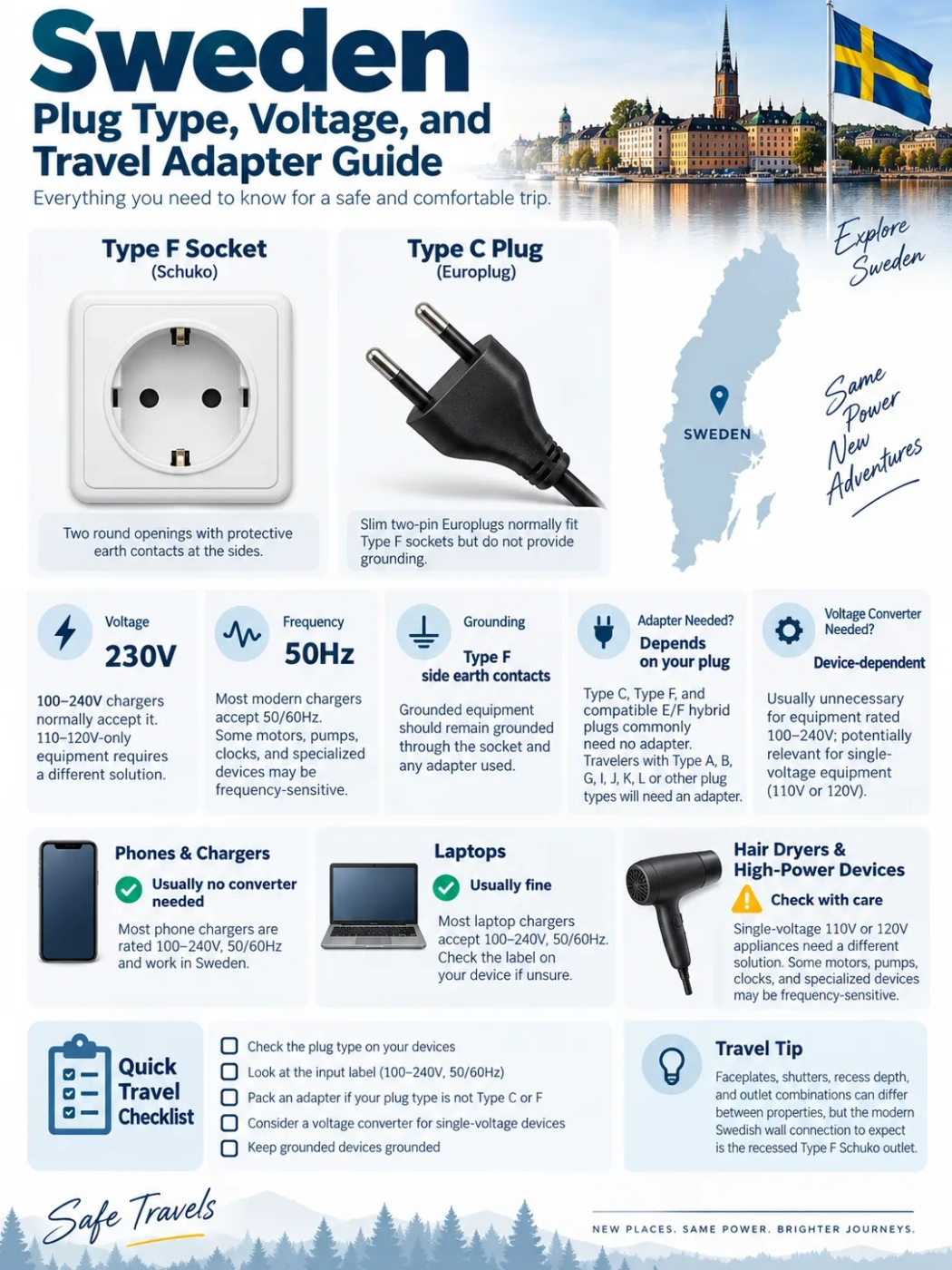
Sweden uses 230V electricity at 50Hz, and the wall socket travelers should plan for is the grounded Type F Schuko socket. A slim two-pin Type C Europlug normally fits a Type F outlet, which is why Sweden is often described in travel references as using Type C and Type F. Travelers carrying Type A, B, G, I, J, K, L, or another incompatible plug shape will need an adapter.
For voltage, the deciding information is printed on the charger or appliance. A device marked Input: 100–240V, 50/60Hz can normally use Sweden’s electrical supply without voltage conversion. Single-voltage 110V or 120V appliances need much more care.
| Power detail | Sweden | What it means for travelers |
|---|---|---|
| Standard wall socket | Type F (Schuko) | Two round openings with protective earth contacts at the sides. |
| Common compatible plug | Type C Europlug | Slim two-pin Europlugs normally fit Type F sockets but do not provide grounding. |
| Voltage | 230V | 100–240V chargers normally accept it; 110–120V-only equipment requires a different solution. |
| Frequency | 50Hz | Most modern chargers accept 50/60Hz. Some motors, pumps, clocks, and specialized devices may be frequency-sensitive. |
| Grounding | Type F side earth contacts | Grounded equipment should remain grounded through the socket and any adapter used. |
| Adapter requirement | Depends on your plug | Type C, Type F, and compatible E/F hybrid plugs commonly need no adapter. |
| Voltage converter | Device-dependent | Usually unnecessary for equipment rated 100–240V; potentially relevant for single-voltage equipment. |
What the Power Outlets Look Like
The second drawing shows a plug rather than a separate Swedish socket standard. For packing purposes, the modern Swedish wall connection to expect is the recessed Type F Schuko outlet. Faceplates, shutters, recess depth, and outlet combinations can differ between properties.
Why Sweden Is Often Listed as Type C and Type F
Travel plug charts frequently place Sweden in the Type C/F group. That description is useful for compatibility, but it needs a little context. Sweden’s standard household socket system is the grounded Type F Schuko design. Type C matters because the CEE 7/16 Europlug used on many compact European chargers can connect to that socket.
A Type C Europlug uses two thin round pins and has no protective earth contact. It is common on double-insulated phone chargers, USB power supplies, camera chargers, and other relatively small devices. A Type F plug is larger and includes side contacts that connect protective earth through the Schuko socket.
This distinction becomes important when a device was designed to be grounded. A two-pin adapter may make the live connections fit while leaving the protective earth disconnected. For a three-prong or otherwise grounded appliance, use an adapter designed to preserve that earth path.
Will Your Plug Fit in Sweden?
| Plug carried by traveler | Direct fit? | Sweden travel requirement |
|---|---|---|
| Type A | No | Plug adapter required |
| Type B | No | Grounded adapter required when the device uses earth |
| Type C Europlug | Yes | Normally no adapter |
| Type F | Yes | No adapter |
| Modern Type E/F hybrid plug | Yes | Normally no adapter |
| Type G | No | Plug adapter required |
| Type I | No | Plug adapter required |
| Type J | No | Plug adapter required |
| Type K | No for a grounded Type K connection | Use an adapter suitable for Type F |
| Type L | No for a true three-pin Type L plug | Plug adapter required |
Travelers from the United States and Canada normally carry Type A or B plugs, so an adapter is needed. Their bigger concern is often voltage: many North American appliances are designed only for about 120V, while Sweden supplies 230V.
UK and Irish Type G plugs also need an adapter. The electrical transition is easier for many devices because the UK, Ireland, and Sweden all use nominal 230V, 50Hz supplies. A British charger may therefore be voltage-compatible even though its wall plug cannot enter the Swedish socket.
Travelers from Türkiye, Germany, the Netherlands, Spain, Portugal, and several other continental European countries can often connect Type C or Type F equipment directly. French travelers frequently carry either a Type C Europlug or a modern E/F hybrid plug; a pure grounded Type E connection should not be treated as equivalent to an E/F hybrid without checking how its earth connection will be maintained.
Australian and New Zealand Type I plugs need an adapter. Japanese Type A plugs also need one, and Japanese single-voltage equipment deserves particular attention because Japan uses a much lower household voltage than Sweden.
Sweden’s 230V Supply: Read the Input Line Once
The most useful electrical information on a travel device is usually the line beginning with Input. It may appear on the charger body, laptop power brick, underside of an appliance, or power supply.
| Label example | What it means in Sweden |
|---|---|
| Input: 100–240V, 50/60Hz | Designed for the usual international voltage and frequency ranges. Only plug compatibility needs to be solved. |
| Input: 220–240V, 50Hz | Compatible with Sweden’s household supply if the plug connection is suitable. |
| Input: 220–240V, 50/60Hz | Compatible with Sweden’s voltage and frequency. |
| Input: 110–120V, 60Hz | Not suitable for direct connection to Sweden’s 230V supply. |
| 120/240V selectable | The device must be placed in its 220/240V setting before connection. |
An adapter changes the physical connection between the plug and the socket; Sweden’s 230V supply remains 230V. A traveler with a 120V-only appliance therefore has an electrical compatibility problem, not merely a plug-shape problem.
Sweden operates at 50Hz. Chargers marked 50/60Hz are designed for both common frequencies. Frequency deserves closer checking on equipment containing AC motors, pumps, mechanical timers, or other components whose speed or operation may depend on the supply frequency.
Phone, Laptop, Camera, and USB Charging in Sweden
Modern charging equipment is usually the easiest category to travel with. Phone chargers, laptop power supplies, tablet chargers, camera battery chargers, and many USB-C power adapters are commonly built with a wide input range. When the power supply states 100–240V, 50/60Hz, Sweden’s 230V, 50Hz electricity is within that range.
| Device | Main Sweden check | Typical travel situation |
|---|---|---|
| Phone charger | Input voltage and plug shape | Often 100–240V; adapter depends on the wall plug |
| Laptop charger | Input range, plug, and grounding | Many accept 100–240V and 50/60Hz |
| USB-C charger | AC input and required USB power output | USB-C solves the cable connection, not the Swedish wall connection |
| Camera battery charger | Charger input rating | Frequently multi-voltage |
| Electric toothbrush or shaver | Charging base or power supply rating | Varies more by model than phone chargers |
| CPAP machine | Exact power supply specification | Many external power supplies are multi-voltage, but the exact model must be confirmed |
| Hair dryer or straightener | Voltage, wattage, and any voltage selector | High-power device; 120V-only versions are unsuitable for direct use |
USB-C is now common across portable electronics sold in the European Union, and EU common-charger requirements also apply to laptops covered by the rules from 2026. That can make cable and charger sharing easier during a Swedish trip, but the AC charger still needs a plug that connects correctly to a Type F wall outlet.
For a CPAP machine or another medical device, use the specifications for the exact power supply and follow the manufacturer’s operating instructions. Voltage range, frequency range, grounding, and any required accessories should all match the intended setup.
Hair Dryers and Other High-Power Appliances
Hair dryers, curling irons, hair straighteners, kettles, clothes irons, garment steamers, and other heating appliances deserve a separate check because they can draw far more power than a phone or laptop charger.
A 120V-only hair dryer should not be connected to a Swedish 230V outlet through a simple plug adapter. The adapter may make the pins fit, but it leaves the appliance exposed to a supply far above its rated voltage.
A dual-voltage hair tool may show 120/240V, 125/250V, or a similar range. Some models select voltage automatically, while others have a manual switch. Where a selector is fitted, it must be placed in the setting specified for a 230V supply before the appliance is connected.
Using a voltage converter with a high-wattage heating appliance is more demanding than converting power for small electronics. The converter has to support the appliance type, voltage, wattage, and operating duration. For a device drawing well over 1,000 watts, a compact travel converter should never be chosen merely because its plug fits.
Grounded and Ungrounded Outlets in Swedish Buildings
Modern Swedish Type F sockets use metal side contacts for protective grounding. This is relevant for equipment designed as Class I, including some computer power cords, larger appliances, monitors, and other devices whose safety design relies on an earth connection.
Sweden also has a building-age detail worth knowing. In homes built before 1994, older unearthed outlets can still be permitted in certain dry residential rooms. Homes built in 1994 or later are expected to have earthed outlets. A traveler staying in an older apartment, cottage, or historic property may therefore encounter an outlet arrangement that differs from a recently built hotel or apartment.
Legacy unearthed sockets are not a reason to pack for a different national plug standard. Plan around Type F, and if a grounded plug or adapter cannot make a proper grounded connection in the available outlet, use another suitable outlet rather than forcing or modifying the connection.
Some equipment carries the double-square symbol used for Class II, or double-insulated, equipment. Class II products are designed without reliance on a protective earth conductor. This is one reason small two-pin chargers can legitimately use an ungrounded Europlug while other appliances require an earthed connection.
Choosing the Right Adapter for Sweden
The adapter should match both ends of the connection: your existing plug on one side and Sweden’s Type F socket on the other. For a two-pin, double-insulated charger, the choice is relatively simple. Grounded equipment requires an adapter that carries protective earth through to the Schuko socket.
- Type A or B traveler: choose an adapter intended for connection to Type F; Type B equipment that uses grounding needs a grounded version.
- Type G traveler: use a Type G-to-Type F compatible adapter and retain earth for grounded equipment.
- Type I traveler: a Type I-to-Type F solution is required.
- Type C Europlug traveler: an adapter is normally unnecessary.
- Type F traveler: direct connection is normally possible.
Also check the adapter’s electrical rating when connecting anything more demanding than a small charger. The rating of an adapter limits what can safely pass through it; adding several high-power appliances through a travel adapter or power strip can create excessive load.
A Sweden–Norway–Denmark Trip Needs One Extra Check
Sweden and Norway are straightforward companions from a plug perspective because Type F Schuko sockets are central to both systems and both use 230V, 50Hz power. A setup that works correctly in Sweden will often remain suitable in Norway.
Denmark needs closer attention. Danish Type K grounding is different from Schuko grounding, even though some two-round-pin connections may appear familiar. A basic Type C Europlug is relatively easy to accommodate, but travelers carrying grounded equipment should make sure their adapter supports the actual Danish earth connection rather than planning an entire Nordic trip around pin shape alone.
FAQ
What plug type does Sweden use?
Sweden’s standard household wall socket is Type F, also called Schuko. Type C Europlugs are also relevant because their two slim round pins normally fit Type F sockets.
Does Sweden use Type C or Type F?
For travel compatibility, Sweden is commonly described as Type C/F. The more precise distinction is that Type F is the wall socket to plan for, while the ungrounded Type C Europlug is compatible with it for appropriate devices.
Do US and Canadian travelers need an adapter for Sweden?
Yes. Type A and Type B plugs do not fit a Swedish Type F socket directly. Travelers should also check voltage because Sweden supplies 230V, while many North American appliances are designed only for about 120V.
Do UK travelers need a plug adapter in Sweden?
Yes. A Type G plug requires an adapter for a Swedish Type F outlet. Voltage conversion is normally unnecessary for a UK device designed for 230V, 50Hz operation.
Can I charge my phone or laptop in Sweden?
Usually yes when the charger says Input: 100–240V, 50/60Hz. That rating includes Sweden’s 230V, 50Hz supply. A plug adapter is still required when the charger’s wall plug is not compatible with Type F.
Do I need a voltage converter for Sweden?
Not for a device that accepts 230V, including most chargers marked 100–240V. A converter may be relevant for a single-voltage 110V or 120V device, especially when traveling with appliances from North America or Japan. High-power heating appliances require particular care because both voltage and wattage must be suitable.