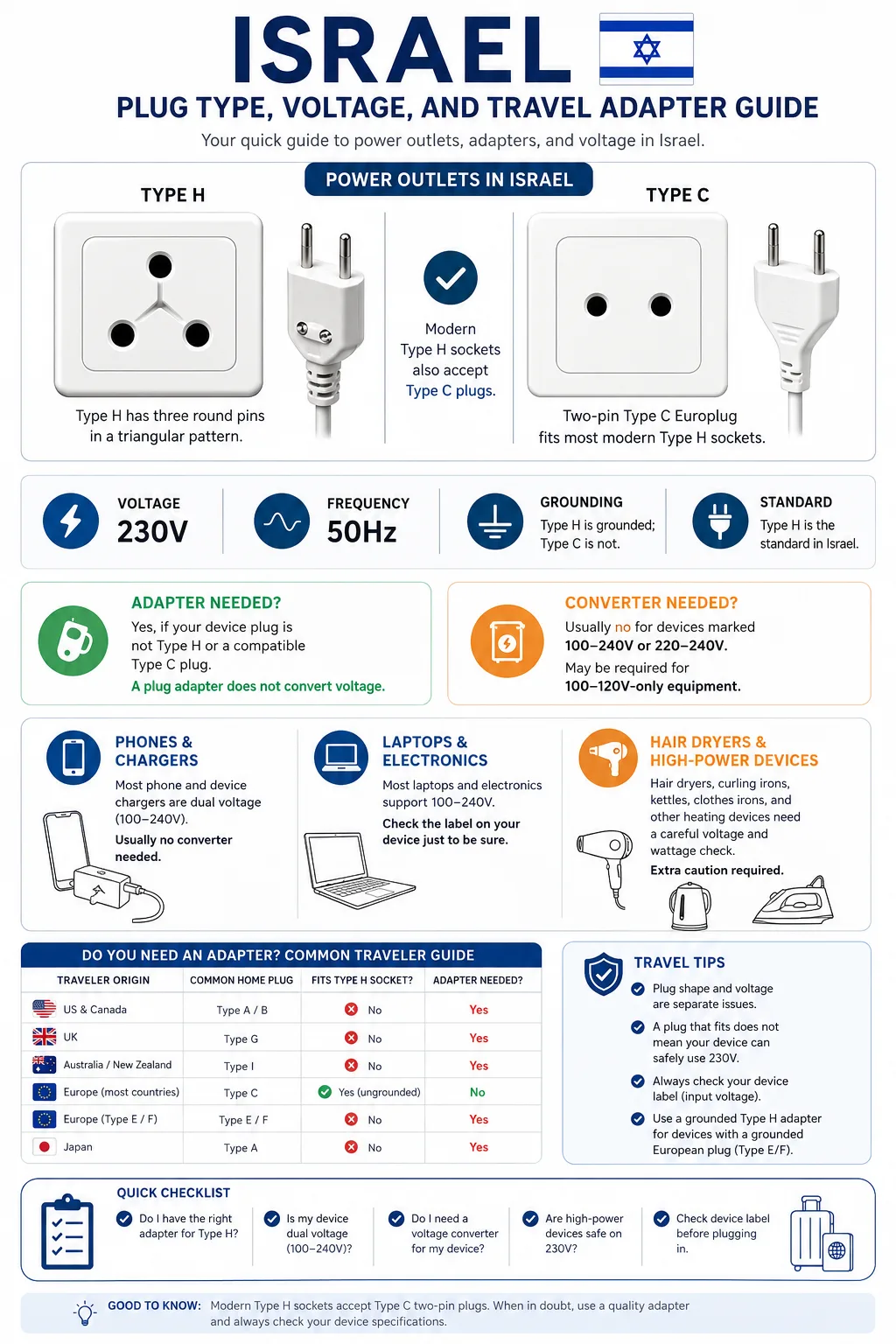
Israel uses Type H power outlets and a 230V, 50Hz electricity supply. Modern Type H sockets also accept the two-pin Type C Europlug. Travelers from the United States, Canada, the United Kingdom, Australia, New Zealand, Japan, and other countries with different plug shapes will normally need a plug adapter. A voltage converter is needed only when a device is not rated for 230V. A plug adapter does not convert voltage.
| Power detail | What travelers should know |
|---|---|
| Local plug standard | Type H, with three round pins on current plugs |
| Also commonly compatible | Type C two-pin Europlug in modern Type H sockets |
| Standard voltage | 230V |
| Frequency | 50Hz |
| Grounding | Three-pin Type H is grounded; two-pin Type C is not |
| Plug adapter | Needed when the device plug is not Type H or a compatible Type C plug |
| Voltage converter | Usually unnecessary for devices marked 100–240V or 220–240V; may be required for 100–120V-only equipment |
| Main appliance warning | Hair dryers, curling irons, kettles, clothes irons, and other heating devices need a careful voltage and wattage check |
What the Power Outlets Look Like
These illustrations show the basic socket faces travelers may encounter. Real outlets can differ in color, orientation, shutter design, and surrounding plate shape. Some hotels may provide multi-standard sockets or USB ports. Plug shape and voltage are separate issues, so a plug that physically fits is not proof that the device can safely use 230V.
Why Israel’s Type H Socket Needs a Closer Look
Type H is Israel’s local household plug and socket system. A current Type H plug has three round pins arranged in a triangle. The third pin provides protective grounding for equipment designed to use it. Israel’s SI 32 Part 1.1 standard covers household and similar plugs and socket-outlets rated up to 16A.
Older photographs may show an Israeli plug with flat pins. That was the earlier Type H design. The standard changed in 1989 to round pins, and post-1989 socket designs were made to accept the newer round Type H plug, the older flat-pin version, and the two-pin Type C Europlug. Travelers should select an adapter for the modern round-pin Type H socket rather than buying equipment based on a legacy illustration.
Current standards note
Israel’s published record for SI 32 Part 1.1 lists amendment sheet 3 from December 2025, effective February 8, 2026. The traveler-facing decision remains unchanged: ordinary outlets are identified as Type H, modern Type H sockets accept Type C plugs, and the supply is 230V, 50Hz. The amendment record should not be read as a change to a new travel plug type.
Type C compatibility has a limit
A slim two-pin Type C Europlug commonly used on phone chargers, camera chargers, and other low-power equipment will normally fit a modern Type H outlet. This does not make every European round-pin plug compatible.
Grounded Type E and Type F plugs use thicker pins and a different earthing arrangement. They should not be forced into a Type H socket. A forced connection may be difficult to remove and may leave the appliance without protective earth. Use a properly rated grounded Type H adapter when a device has a grounded European plug.
Who Needs a Plug Adapter?
| Traveler origin | Common home plug | Israel adapter decision | Voltage check |
|---|---|---|---|
| United States and Canada | Type A or B | Adapter needed | Check for 100–240V; 120V-only devices cannot use 230V directly |
| United Kingdom and Ireland | Type G | Adapter needed | Most devices are already designed for a 230V supply |
| Continental Europe | Type C, E, or F | Type C usually fits; grounded Type E/F equipment should use a suitable Type H adapter | Most devices are voltage-compatible with 230V |
| Türkiye | Type C or F | Two-pin Type C chargers usually fit; grounded Type F plugs need a suitable adapter | Türkiye and Israel both use 230V, 50Hz |
| Australia and New Zealand | Type I | Adapter needed | Most devices are designed for the same voltage range |
| Japan | Type A or B | Adapter needed | 100V-only devices may require a step-down converter |
| Switzerland | Type J | Adapter needed | Most devices are compatible with 230V |
| Italy | Type C, F, or L | Type C may fit; Type F and L require an appropriate adapter | Most devices are compatible with 230V |
An adapter should be chosen for the plug attached to the device, not only for the traveler’s home country. A person from Germany may have a two-pin phone charger that fits directly and a grounded laptop cable that needs a Type H adapter. The correct answer can therefore differ between devices in the same suitcase.
Adapter Only or Voltage Converter?
The device label settles the voltage question. Look for the line marked Input on the charger, power brick, appliance base, or rating plate.
If the label says Input: 100–240V, 50/60Hz
Input: 100–240V, 50/60Hz means the power supply is designed to accept Israel’s 230V, 50Hz electricity. A phone charger, laptop adapter, camera charger, or USB power supply with this label normally needs only a plug adapter when its plug does not fit.
If the label says 220–240V, 50Hz
The device matches the Israeli supply. Only physical plug compatibility needs to be solved. A voltage converter is normally unnecessary.
If the label says 100–120V or 120V only
The device must not be connected directly to a 230V outlet. It may need a correctly sized step-down voltage converter, or it may be better left at home. Using a 120V-only heating appliance on 230V can cause rapid overheating, equipment failure, fire, or electric shock.
If the appliance has a manual voltage switch
Some travel hair dryers, shavers, and styling tools have a switch marked 110/120V and 220/240V. The switch must be set to the 220/240V position before the appliance is connected in Israel. A dual-voltage label does not help when the selector is left in the wrong position.
The Output line on a charger describes what the charger sends to the connected device. For wall-supply compatibility, the Input line is the part that matters.
Modern Chargers, Medical Equipment, and High-Power Appliances
| Device | What usually happens | What to check |
|---|---|---|
| Phone or tablet charger | Usually works with an adapter or a compatible Type C plug | Look for 100–240V, 50/60Hz |
| Laptop charger | Usually voltage-compatible | Input range, required wattage, and whether grounding must be maintained |
| Camera or drone battery charger | Commonly works without a converter | Input range on the charging dock or power brick |
| USB-C PD charger | Usually works if rated 100–240V | Input voltage and enough USB-C wattage for the connected device |
| Electric toothbrush or shaver | Varies by charger design | Some bases are 100–240V; others are single-voltage |
| CPAP machine | Many external power supplies accept 100–240V | Power-brick input, humidifier requirements, grounding, and manufacturer instructions |
| Hair dryer | High risk when brought from a 100–120V country | Voltage setting, wattage, and adapter or converter rating |
| Curling iron or hair straightener | Dual-voltage models may work; single-voltage models may not | Exact input range and any manual selector |
| Travel kettle or clothes iron | Often draws more power than a small universal adapter can handle | 230V compatibility, wattage, grounding, and adapter current rating |
| Clock, turntable, pump, or motor-driven equipment | May be affected by the 50Hz supply even when voltage is correct | Whether the rating plate allows 50Hz or 50/60Hz |
Phones and laptops are usually the easy part
Modern switch-mode chargers commonly accept a wide input range. A phone or laptop charger marked 100–240V, 50/60Hz can normally use Israel’s electricity without a converter. The remaining questions are plug shape, charger wattage, and grounding.
A three-wire laptop cable should stay grounded when the original design provides an earth connection. Do not replace it with an ungrounded two-pin arrangement merely because the charger powers on. Voltage compatibility and grounding continuity are separate safety checks.
Heat-producing devices need a different decision
Hair dryers, curling irons, hair straighteners, kettles, and clothes irons draw far more power than most chargers. A compact universal adapter may be labeled for low-power electronics only, even when it accepts the plug shape. Check the adapter’s amp or watt rating and compare it with the appliance rating.
A voltage converter also has a maximum wattage. The appliance must remain below that limit, including any startup demand stated by the manufacturer. For a short trip, using a locally supplied hair dryer or kettle is often simpler than carrying a large converter for a single-voltage appliance.
CPAP and medical device planning
Check the external power supply rather than relying on the device name. Many CPAP power bricks accept 100–240V, but the humidifier, heated tubing, battery system, and replacement cable may have separate requirements. Keep the required adapter accessible in carry-on luggage and follow the equipment manufacturer’s instructions. No general country compatibility statement can guarantee safe operation of a medical device.
What 50Hz Means for Your Equipment
Israel uses 50Hz electricity. Chargers marked 50/60Hz are designed for either common mains frequency and normally operate without special action. The frequency deserves more attention when a device contains an AC motor, relies on mains timing, or is marked only 60Hz.
- Phone, tablet, laptop, camera, and USB chargers marked 50/60Hz are normally unaffected.
- Some clocks, turntables, pumps, fans, and older motor-driven devices may run at the wrong speed, overheat, or keep inaccurate time.
- A normal step-down voltage converter changes voltage but usually does not change frequency.
- When the label permits only 60Hz, check the manufacturer’s instructions before using the device on 50Hz.
Grounding Is the Part a Loose Adapter Can Hide
Type H provides a grounding path through its third pin. Type C is a two-wire, ungrounded connection intended for equipment designed without protective earth. An adapter that accepts a three-prong plug but sends only two pins into the wall may power the device while removing its grounding protection.
For grounded laptops, desktop equipment, metal-cased appliances, and other three-wire devices, choose an adapter that explicitly maintains grounding through a Type H plug. Avoid using a loose universal adapter that leans away from the wall, exposes part of the pins, or becomes warm during normal use.
A plug fitting into a socket does not prove that the connection is grounded, correctly rated, or voltage-compatible.
Hotel, Apartment, and Airport Charging
Standard Type H outlets should be the basis of the packing decision. A renovated hotel room may also provide Type C sockets, universal-looking outlets, USB-A ports, or USB-C ports, but these features are not guaranteed in every property.
Do not assume that a hotel’s universal-looking socket changes the voltage. It may accept several plug shapes while still supplying 230V, 50Hz. Built-in USB ports may also provide less power than a laptop or fast-charging phone expects.
- Carry at least one Type H-compatible adapter rather than relying on the room description.
- Use your own 100–240V USB charger when the room’s USB output is unknown or too slow.
- Check a travel power strip for a 230V rating before bringing it from a 120V country.
- Do not connect several heating appliances through one travel adapter.
- Keep one adapter in carry-on luggage so it remains available after arrival.
Why Type M Appears in Some Israel Plug Lists
Some plug charts also associate Type M with Israel. Type M is a much larger three-round-pin connection that may be used for dedicated high-current appliances, including certain air-conditioning or washing-machine installations. It is not the normal socket a traveler needs for a phone, laptop, camera, or bedside charger.
For ordinary accommodation and personal electronics, plan around Type H and the Type C compatibility of modern Type H sockets. A separate Type M travel adapter is normally unnecessary unless a specific appliance or installation requires it.
Choosing an Adapter for Israel
- Look for an output plug identified as Type H or as suitable for Israel.
- Match the adapter input to the plug attached to the device.
- Use a grounded adapter for equipment that has a grounded plug.
- Check the adapter’s current and wattage rating before connecting a heating appliance.
- Do not treat USB charging wattage as the same thing as the AC outlet rating.
- Choose a body that sits securely in the outlet without twisting under the weight of a charger.
- Remember that surge protection, fusing, grounding, and voltage conversion are separate features.
A small two-pin solution may be enough for a phone charger with a Type C plug and 100–240V input. A grounded laptop cable or high-wattage appliance calls for a different adapter decision. There is no single answer for every item packed by the same traveler.
Power Mistakes to Avoid in Israel
- Buying an adapter before checking the plug attached to each device.
- Assuming every European round-pin plug is safe in a Type H socket.
- Forcing a Type E or Type F plug into an Israeli outlet.
- Using a Type C connection for equipment that requires protective grounding.
- Connecting a 120V-only hair dryer to 230V through a mechanical adapter.
- Reading the charger’s Output line instead of its Input line.
- Assuming a universal hotel socket converts voltage.
- Using a 125V-only power strip on Israel’s 230V supply.
- Ignoring the wattage limit of an adapter or voltage converter.
- Buying a Type M adapter for ordinary hotel-room charging.
Before You Pack
- Identify every plug shape you plan to use.
- Check each device for 100–240V, 220–240V, or a single-voltage rating.
- Confirm 50Hz or 50/60Hz compatibility.
- Separate low-power chargers from heating and motor-driven appliances.
- Preserve grounding for three-prong equipment.
- Compare appliance wattage with the adapter or converter limit.
- Set any manual voltage selector to 220/240V before connection.
- Pack a Type H-compatible adapter even when the accommodation advertises USB or universal sockets.
Frequently Asked Questions
What plug type is used in Israel?
Israel mainly uses Type H outlets. Modern Type H sockets also accept two-pin Type C Europlugs. Type H is the grounded local standard for ordinary household use.
Will a European Type C plug work in Israel?
Usually, yes. A slim, ungrounded Type C Europlug normally fits a modern Type H socket. This does not mean that grounded Type E or Type F plugs are safely interchangeable with Type H.
Do US travelers need a voltage converter in Israel?
They need a plug adapter for Type A or B plugs. A converter is needed only for equipment that cannot accept 230V. Chargers marked 100–240V normally need an adapter but not a converter.
Can I use a Type F Schuko plug in an Israeli outlet?
Do not force it into the socket. Type F pins and grounding contacts differ from Type H. Use a grounded adapter designed to connect the Type F plug to a Type H outlet.
Will my phone or laptop charger work in Israel?
It normally will when the charger says Input: 100–240V, 50/60Hz. You may still need a plug adapter, and a grounded laptop cable should remain grounded.
Can I use a 120V hair dryer in Israel?
Not directly. Israel supplies 230V. A 120V-only hair dryer requires a suitable high-wattage step-down converter, while a dual-voltage model must be set to 220/240V. A simple plug adapter is not enough.