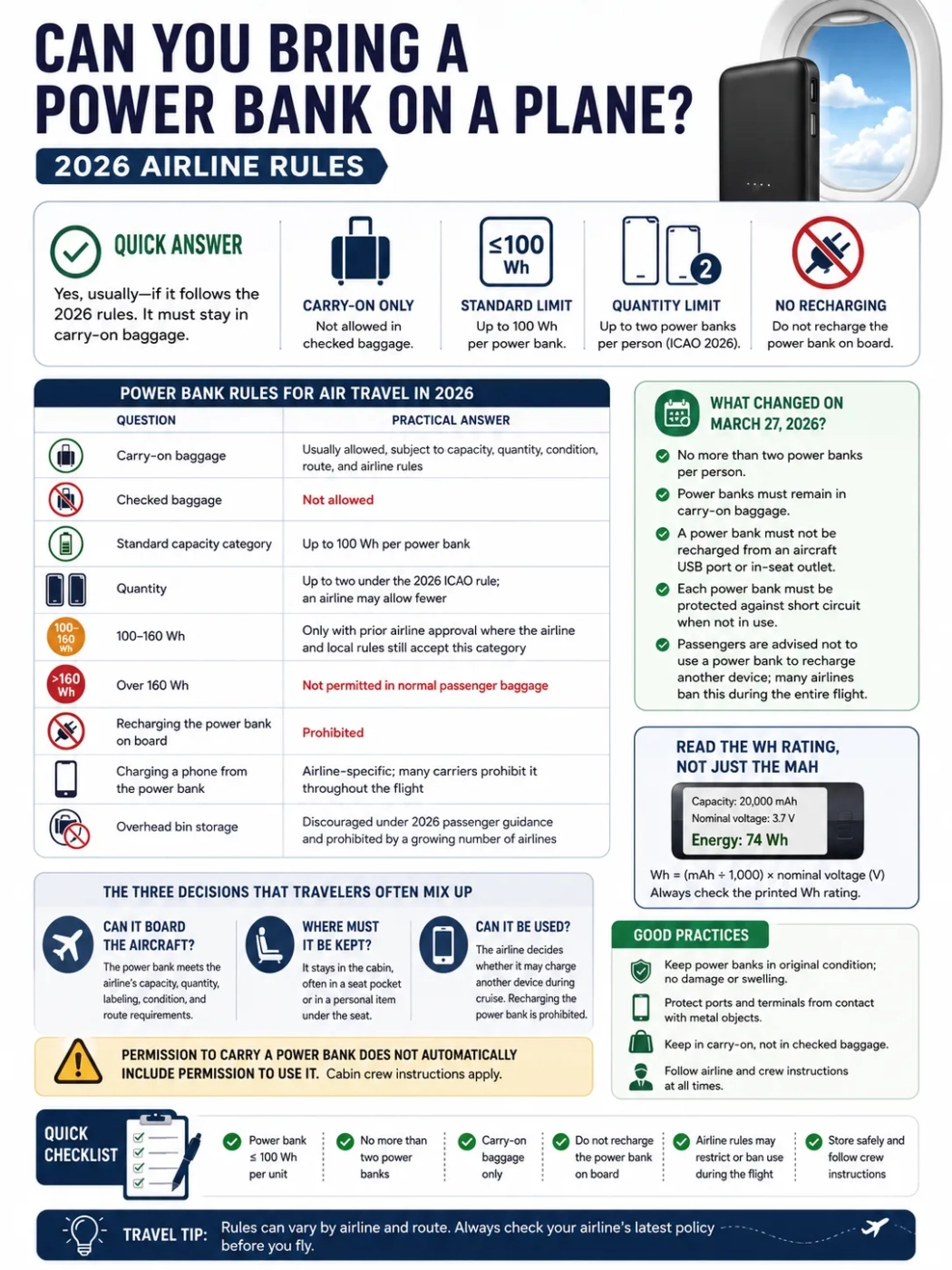
Yes, you can usually bring a power bank on a plane in 2026, but it must stay in carry-on baggage. The normal no-approval category is a power bank rated at no more than 100 watt-hours (Wh). ICAO’s Technical Instructions effective March 27, 2026 limit passengers to two power banks and prohibit recharging a power bank from the aircraft’s power supply. U.S. FAA passenger rules are different: rechargeable batteries at or below 100 Wh have no fixed quantity limit when they are for the passenger’s personal use, while 101–160 Wh spare lithium-ion batteries, including power banks, are limited to two per person and require airline approval. The operating airline may apply stricter limits than the ICAO or U.S. baseline.
| Question | Practical answer |
|---|---|
| Carry-on baggage | Usually allowed, subject to capacity, quantity, condition, route, and airline rules |
| Checked baggage | Not allowed |
| Standard capacity category | Up to 100 Wh per power bank |
| Quantity | ICAO: maximum two power banks per person. U.S. FAA: no fixed quantity limit for personal-use rechargeable batteries at or below 100 Wh; 101–160 Wh is limited to two with airline approval. Airline limits may be stricter. |
| 100–160 Wh | Only with prior airline approval where the airline and local rules still accept this category |
| Over 160 Wh | Not permitted in normal passenger baggage |
| Recharging the power bank on board | Prohibited under the 2026 ICAO specification; for U.S. travel, check the operating airline’s onboard-use policy in addition to FAA PackSafe baggage rules |
| Charging a phone from the power bank | Airline-specific; many carriers prohibit it throughout the flight |
| Overhead bin storage | Discouraged under 2026 passenger guidance and prohibited by a growing number of airlines |
What Changed Under ICAO on March 27, 2026?
Power banks were previously handled largely as spare lithium batteries. The 2026 ICAO change separates them more clearly and adds rules aimed specifically at portable chargers carried for personal use.
- No more than two power banks per person.
- Power banks must remain in carry-on baggage.
- A power bank must not be recharged from an aircraft USB port or in-seat power outlet.
- Each power bank must be protected against short circuit when it is not being used.
- Passengers are advised not to use a power bank to recharge another device during the flight, while airlines may turn that advice into a full onboard ban.
The ICAO changes do not produce identical passenger instructions on every route. Countries may adopt international changes through different legal processes, and airlines may apply tighter limits. A carrier may allow two 100 Wh units, restrict passengers to one, ban power bank use while still allowing carriage, or require the unit to remain under the seat rather than in an overhead bin.
How U.S. FAA Rules Differ
FAA PackSafe guidance for passenger baggage in the United States does not apply the ICAO two-power-bank limit to personal-use rechargeable batteries at or below 100 Wh. In that category, the FAA states that there is no fixed quantity limit when the batteries are for the passenger’s own use. For 101–160 Wh lithium-ion spare batteries, including power banks, the FAA allows no more than two per person and requires airline approval. Airlines may still set lower quantity limits or tighter Wh limits.
The Three Decisions That Travelers Often Mix Up
A power bank can be accepted for carriage while its use is restricted. Check these questions separately:
| Decision | What it means |
|---|---|
| Can it board the aircraft? | The power bank meets the airline’s capacity, quantity, labeling, condition, and route requirements. |
| Where must it be kept? | It stays in the cabin, often in a seat pocket or in a personal item under the seat. |
| Can it be used? | The airline decides whether it may charge another device during cruise. Under ICAO’s 2026 specification, the power bank itself must not be recharged on board. |
Permission to carry a power bank does not automatically include permission to use it. Cabin crew instructions apply even when the airline’s general baggage page appears less restrictive.
Read the Wh Rating, Not Just the mAh Number
Airline battery limits are based on watt-hours. The familiar milliamp-hour number tells only part of the story because the calculation also needs the battery’s nominal voltage.
Wh = (mAh ÷ 1,000) × nominal voltage
For a 20,000 mAh power bank rated at 3.7 V:
20,000 ÷ 1,000 × 3.7 = 74 Wh
| Printed capacity | Approximate energy | Likely flight category |
|---|---|---|
| 5,000 mAh | 18.5 Wh | Normally within the no-approval category |
| 10,000 mAh | 37 Wh | Normally within the no-approval category |
| 20,000 mAh | 74 Wh | Normally within the no-approval category |
| 26,800 mAh | About 99.2 Wh | Very close to the 100 Wh limit |
| 27,000 mAh | About 99.9 Wh | May remain within 100 Wh if the manufacturer’s printed rating confirms it |
| 30,000 mAh | About 111 Wh | Airline approval territory where accepted |
These are examples, not a substitute for the product label. Some cells use a nominal voltage of 3.6 V, 3.7 V, 3.85 V, or another value. Security staff may refuse a unit when the Wh rating cannot be confirmed from the casing or reliable product documentation.
Do Not Confuse Output Watts with Battery Watt-Hours
A label such as 65W USB-C PD, 100W output, or 140W output describes how quickly the power bank may deliver power. It does not state how much energy the battery stores.
A laptop power bank can provide 140W output and still contain less than 100Wh. Another model may advertise only 65W output but contain more than 100Wh. Airport rules look at Wh, not the maximum USB-C charging wattage.
Which Capacity Category Does Your Power Bank Enter?
Up to 100 Wh
This is the normal category for personal power banks carried without advance airline approval. It includes most 5,000 mAh, 10,000 mAh, and 20,000 mAh models. It also includes some units near 27,000 mAh when their printed Wh rating does not exceed 100.
The power bank must still meet the airline’s rules on quantity, condition, labeling, storage, and onboard use. Under the ICAO 2026 specification, no more than two power banks may be carried per person. Under U.S. FAA passenger rules, personal-use rechargeable batteries at or below 100 Wh have no fixed quantity limit, although the airline may set one. A capacity below 100 Wh is not a guarantee of acceptance.
More Than 100 Wh but No More Than 160 Wh
This is a transition category in 2026. ICAO’s 2026 specification permits a power bank above 100 Wh and up to 160 Wh with operator approval, while the U.S. FAA allows up to two 101–160 Wh spare lithium-ion batteries, including power banks, with airline approval. Some carriers do not accept any power bank above 100 Wh, even when the applicable baseline rule provides an approval route.
Do not arrive at the airport expecting a check-in agent to approve the unit automatically. Ask the operating airline before travel and keep any written approval available. The airline may request a clear photograph of the label, the model details, and proof that the battery meets applicable transport testing requirements.
IATA’s 2026 operator guidance states that the approval option for 100–160 Wh power banks is not planned to continue in the 2027 Dangerous Goods Regulations. For a trip in 2026, treat every power bank above 100 Wh as a possible refusal unless the operating carrier has approved that exact unit.
Over 160 Wh
Power banks above 160 Wh are not accepted in normal passenger carry-on or checked baggage. Many portable power stations, large backup batteries, and high-capacity solar generators fall into this category. Their small physical size or presence of USB ports does not change the limit.
Why Power Banks Must Stay Out of Checked Baggage
A damaged or defective lithium-ion cell can overheat and enter thermal runaway, producing heat, smoke, and fire. Cabin crew can detect and respond to an incident in the passenger cabin more quickly than an event hidden inside the baggage hold.
Never move a power bank into checked baggage to solve a cabin-bag weight or space problem. It must be removed before the bag is checked.
What If Your Carry-On Bag Is Taken at the Gate?
Small aircraft, full overhead bins, or cabin-bag limits can cause a carry-on suitcase to be tagged at the gate and loaded into the hold. Remove the power bank before handing over the bag. Keep it with you in the cabin, protected against damage and short circuit.
A useful packing method is to keep the power bank in a small pouch inside your personal item rather than deep inside a wheeled cabin case. This also makes it easier to follow an airline rule requiring the unit to remain under the seat.
Where Should a Power Bank Be Stored in the Cabin?
Current passenger guidance favors an accessible location rather than an overhead locker. Several airlines now prohibit overhead storage and require power banks to be placed in the seat pocket or in a bag under the seat in front.
- Keep the power bank where heat, swelling, smoke, or odor can be noticed.
- Do not wedge it inside the seat mechanism.
- Do not place it under heavy objects that may crush the casing.
- Protect exposed charging ports and terminals from metal items.
- Keep wireless power banks separated from the phone so charging cannot start accidentally.
- Follow the crew’s storage instruction even when it differs from your usual packing method.
If the airline allows overhead storage, keeping the unit in an accessible personal item under the seat is still the safer and more practical choice.
Can You Use a Power Bank During the Flight?
There is no single airline-wide answer for charging another device. ICAO’s 2026 specification prohibits recharging the power bank itself and advises passengers not to use a power bank to recharge portable electronics on board. Individual airlines may turn that recommendation into a full onboard-use ban.
| Action | 2026 position |
|---|---|
| Carry a compliant power bank in the cabin | Usually allowed |
| Recharge the power bank from an aircraft USB port or outlet | Prohibited under the 2026 ICAO specification; for U.S. travel, check the operating airline’s onboard-use policy in addition to FAA PackSafe baggage rules |
| Use the power bank to charge a phone or laptop | Depends on the airline; many carriers prohibit it for the full flight |
| Use it during taxi, takeoff, or landing | Do not use it; follow crew instructions and keep it disconnected |
Some carriers ban all power bank use from boarding until arrival. Others allow a power bank to charge a personal device during non-critical phases only when it remains visible and directly supervised. Never assume that a working in-seat USB port changes the power bank rule.
Wireless and Magnetic Power Banks
Wireless power banks follow the same flight rules as cable-connected models. Switch the unit off and keep it away from the back of the phone when it is not being used. A magnetic pack can begin charging after accidental activation without a cable making the connection obvious.
How Published Airline Policies Differ in 2026
The operating carrier’s rule matters more than the logo shown by the booking website. On a codeshare itinerary, check the airline that actually operates each flight segment.
| Airline | Carriage limit | Onboard use | Cabin storage |
|---|---|---|---|
| Emirates | One power bank under 100 Wh with a visible capacity rating | May not charge devices and may not be recharged | Not in the overhead bin; seat pocket or bag under the seat |
| Singapore Airlines | Maximum two; up to 100 Wh without approval, 100–160 Wh only with advance approval | Use and charging are prohibited throughout the flight | Accessible location; not in the overhead compartment |
| AirAsia | Up to 100 Wh; 100–160 Wh requires approval | Power bank use and charging other devices are prohibited | Seat pocket or under the seat; not in the overhead compartment |
| Qatar Airways | Maximum two, each no more than 100 Wh | The power bank may not be recharged; supervised device charging may be allowed during non-critical phases | Keep accessible and directly supervised while in use |
| Southwest Airlines | One power bank per passenger, maximum 100 Wh, effective April 20, 2026 | The power bank may not be recharged using in-seat power; when in use, it must remain visible and not be stored inside a bag | Cabin only; not in checked baggage or the overhead bin. It should be kept in a personal item under the seat in front |
Southwest is a current example of an airline applying a tighter quantity limit than the broader U.S. FAA rule. Its April 20, 2026 policy limits each passenger to one power bank of no more than 100 Wh and prohibits overhead-bin storage.
This comparison shows why “airline rules” cannot be reduced to one capacity number. A policy may change after a ticket is purchased, and a partner-operated segment may follow another carrier’s instructions. Check again close to departure.
China Domestic Flights: The CCC Mark Can Decide Acceptance
Power banks carried on domestic flights within mainland China face an extra product-marking rule. Since June 28, 2025, a power bank may be refused when it has no readable CCC mark, has an unclear CCC mark, or belongs to a recalled model or production batch.
The CCC logo is also commonly called the 3C mark. This requirement is separate from the watt-hour limit. A 20,000 mAh power bank can be below 100 Wh and still be rejected for a China domestic flight when the required mark is absent or unreadable.
Travelers connecting from an international arrival to a domestic Chinese flight should check the actual unit before departure. Passing security for the international sector does not prove that the same power bank will pass screening for the domestic connection.
When a Power Bank Below 100 Wh Can Still Be Refused
Capacity is only one part of the screening decision. Do not travel with a unit that shows any of these conditions:
- No visible Wh rating and no reliable way to confirm it
- A swollen or separating case
- Cracks, deep dents, punctures, or crushed corners
- Unusual heat while disconnected
- A burnt smell, discoloration, smoke, or melted plastic
- Water or liquid damage
- A damaged charging port or exposed conductive material
- A recalled model or affected production batch
- A modified, covered, or suspicious capacity label
Tell airport staff or cabin crew immediately if a power bank becomes hot, expands, smokes, hisses, or gives off an unusual odor. Do not place it in a bag, cover it, or attempt to move it to another part of the aircraft without crew direction.
How to Pack a Power Bank for Air Travel
- Choose a unit with a clear manufacturer label showing its Wh rating.
- Carry no more than the lowest quantity allowed across all flight segments.
- Place each power bank in a separate protective pouch or its original packaging.
- Prevent short circuits by covering exposed terminals where applicable.
- Keep keys, coins, loose adapters, and metal cable ends away from charging ports.
- Disconnect all cables before boarding.
- Switch off wireless charging and prevent accidental activation.
- Allow a recently charged unit to cool before packing it.
- Keep it in an accessible personal item rather than a gate-check-prone suitcase.
- Remove it immediately if the carry-on bag is sent to the aircraft hold.
Some safety guidance recommends avoiding a fully charged state for travel when practical. This is not a universal passenger percentage rule, and an airline may publish its own instruction. Do not invent a target charge level when the carrier does not specify one.
Products That Still Count as Power Banks
A different shape or marketing name does not remove the lithium battery rules. The following products may be treated as power banks or spare batteries:
- Magnetic and wireless phone battery packs
- Phone charging cases
- Solar power banks with an internal rechargeable battery
- USB-C laptop power banks
- Portable jump starters with USB charging outputs
- Removable smart-luggage battery packs
- Rechargeable hand warmers that can power another device
A portable power station is usually much larger in energy capacity than a phone power bank. Many are above 160 Wh and cannot travel as ordinary passenger baggage.
Smart Luggage
A smart suitcase with a removable lithium battery may be accepted when the battery is removed before the bag is checked and carried in the cabin under the applicable battery rules. A bag with a non-removable lithium battery may be prohibited, depending on the battery size and airline policy.
CPAP and Medical Device Batteries
A CPAP battery or another medical-device battery may have separate handling provisions from a general phone power bank. Check the Wh rating, the device maker’s instructions, and the airline’s medical-device policy before travel. Advance notice may be required, especially when the battery exceeds 100 Wh or must be used during the flight.
Phone, Laptop, and High-Power Device Differences
| Device | What matters | Common mistake |
|---|---|---|
| Phone, tablet, camera, or e-reader | The power bank’s Wh rating and the airline’s onboard-use policy | Assuming cabin carriage means charging is allowed during the flight |
| USB-C laptop | Wh for flight acceptance; USB-C PD output for charging performance | Confusing 100W output with 100Wh battery capacity |
| Hair dryer, curling iron, kettle, clothes iron, or single-voltage electric shaver | Destination voltage, appliance wattage, and dual-voltage support | Expecting a normal travel power bank to run a heat-producing appliance |
| CPAP or medical equipment | Battery rating, runtime, airline approval, and manufacturer instructions | Treating a medical battery as an ordinary phone charger |
Phone and laptop charging equipment often uses low-voltage USB output, but this does not make every power bank acceptable for flight. Heat-producing appliances normally draw far more power and should not be connected to a typical phone power bank.
Power Bank Rules Are Separate from Plug and Voltage Compatibility
The Wh limit controls whether the battery may travel on the aircraft. Plug type, power outlet shape, voltage, and frequency matter when charging the power bank from a wall socket before departure or after arrival.
Check the phone charger, laptop charger, or USB wall charger for wording such as Input: 100–240V, 50/60Hz. This usually identifies a dual-voltage power supply that can accept common 120V and 220–240V systems and both 50Hz and 60Hz frequencies. You may need only a travel adapter or plug adapter so the charger fits the destination’s socket type.
A plug adapter does not convert voltage. A charger marked only for 120V should not be connected to a 230V power outlet. Use a manufacturer-approved charger for the local supply or, when the equipment instructions allow it, a suitable voltage converter. A hotel’s universal-looking socket does not change the supplied voltage.
These electrical compatibility checks do not override onboard battery restrictions. Even when the charger accepts Input: 100–240V, a power bank must not be recharged from the aircraft’s power supply on flights applying the ICAO 2026 specification. On U.S. flights, check the operating airline’s onboard-use policy as well as the FAA baggage rules.
A Decision Path Before Leaving for the Airport
- Find the printed Wh rating on every power bank.
- If Wh is missing, calculate it from mAh and nominal voltage, then check whether the airline will accept calculated or documented proof.
- Keep the normal travel choice at or below 100 Wh.
- For travel subject to the ICAO 2026 specification, carry no more than two power banks. Under U.S. FAA passenger rules, personal-use rechargeable batteries at or below 100 Wh have no fixed quantity limit, but the airline may set one.
- Request advance approval for a 100–160 Wh unit and do not pack it without a clear acceptance.
- Leave every power bank over 160 Wh at home.
- Check for swelling, damage, heat, recalls, and a readable capacity label.
- Confirm whether the operating airline bans use, overhead storage, or both.
- Check every codeshare and connecting segment separately.
- For Southwest Airlines flights, carry no more than one power bank and keep it out of the overhead bin.
- For a mainland China domestic flight, confirm that the CCC mark is present and readable.
- Pack the unit in carry-on baggage where it can be removed if the bag is gate-checked.
- Do not recharge the power bank on board when the ICAO 2026 specification or the operating airline prohibits it.