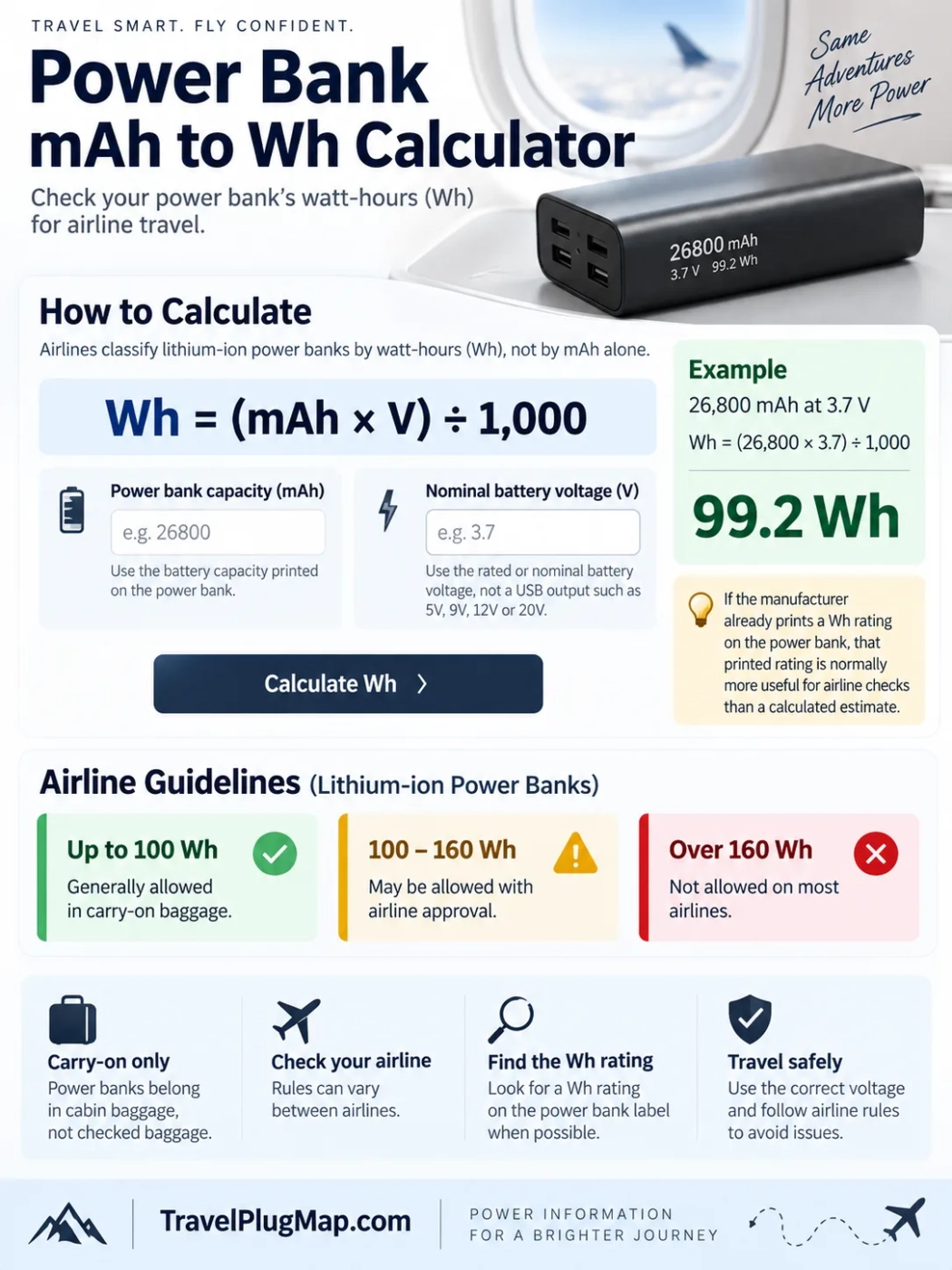
Airlines classify lithium-ion power banks by watt-hours (Wh), not by mAh alone. If your power bank does not show a clear Wh rating, enter its mAh capacity and nominal battery voltage below. The calculation is Wh = (mAh × V) ÷ 1,000.
Calculate Power Bank mAh to Wh
Use the Printed Wh Rating When It Is Available
A power bank may show several electrical numbers on the same label. For airline capacity, look first for a value followed by Wh. A label might show 20,000 mAh, 3.7 V and 74 Wh alongside USB output voltages and a maximum output such as 100W.
If the label clearly states 74 Wh, use that figure for the airline capacity check. Calculating 20,000 mAh × 3.7 V gives the same 74 Wh, but a manufacturer’s printed Wh value avoids mistakes caused by using the wrong voltage or a rounded capacity figure.
Some models also print more than one mAh figure. One may describe the internal cell capacity while another describes usable output capacity at a particular USB voltage. If a clear Wh rating is printed, it removes much of that ambiguity.
Why mAh Alone Cannot Tell You the Airline Battery Size
Milliamp-hours measure electric charge. Watt-hours measure stored energy. Airlines use Wh because the same mAh capacity can represent different amounts of energy at different battery voltages.
A 26,800 mAh power bank is a useful example. At 3.7 V it works out to 99.16 Wh. At 3.85 V it is 103.18 Wh. The mAh number is identical, but one calculation falls below 100 Wh and the other is above it.
| Capacity | At 3.7 V | At 3.85 V |
|---|---|---|
| 10,000 mAh | 37 Wh | 38.5 Wh |
| 20,000 mAh | 74 Wh | 77 Wh |
| 25,000 mAh | 92.5 Wh | 96.25 Wh |
| 26,000 mAh | 96.2 Wh | 100.1 Wh |
| 26,800 mAh | 99.16 Wh | 103.18 Wh |
| 27,000 mAh | 99.9 Wh | 103.95 Wh |
| 30,000 mAh | 111 Wh | 115.5 Wh |
| 40,000 mAh | 148 Wh | 154 Wh |
This is why a statement such as “27,000 mAh is below the airline limit” is incomplete unless the battery voltage or printed Wh rating is also known.
What mAh Equals 100 Wh?
There is no universal mAh value equal to 100 Wh. The conversion depends on voltage:
mAh = (Wh × 1,000) ÷ V
| Nominal voltage | 100 Wh | 160 Wh |
|---|---|---|
| 3.6 V | 27,778 mAh | 44,444 mAh |
| 3.7 V | 27,027 mAh | 43,243 mAh |
| 3.85 V | 25,974 mAh | 41,558 mAh |
| 7.4 V | 13,514 mAh | 21,622 mAh |
The 7.4 V row also shows why assuming every power bank uses 3.7 V is unsafe. Some battery packs use a higher nominal pack voltage. When the label supplies the correct pack voltage, use that figure rather than replacing it with a familiar cell voltage.
Do Not Use the USB Output Voltage in the Formula
A modern USB-C power bank may list outputs such as 5V, 9V, 12V, 15V or 20V. Those values describe the voltage delivered to another device. They are not automatically the voltage that should be multiplied by the internal battery’s mAh rating.
For example, using a 20V USB-C output figure with a 20,000 mAh battery would produce:
20,000 × 20 ÷ 1,000 = 400 Wh
If the same power bank’s battery label states 3.7 V nominal, the relevant calculation is:
20,000 × 3.7 ÷ 1,000 = 74 Wh
The first calculation combines two ratings that describe different parts of the power bank and produces a misleading result.
100W and 100Wh Are Not the Same Measurement
A marking such as 100W Max describes power: how quickly the power bank may be able to deliver energy. 100 Wh describes energy capacity. A 74 Wh power bank can still have a USB-C port rated for 100W output.
Airline battery limits are based on Wh, not the maximum charging wattage printed beside a USB port.
Common Power Bank mAh to Wh Calculations
| Capacity | Nominal voltage | Calculated energy | Capacity band |
|---|---|---|---|
| 10,000 mAh | 3.7 V | 37 Wh | ≤100 Wh |
| 20,000 mAh | 3.7 V | 74 Wh | ≤100 Wh |
| 20,000 mAh | 3.85 V | 77 Wh | ≤100 Wh |
| 26,800 mAh | 3.7 V | 99.16 Wh | ≤100 Wh |
| 26,800 mAh | 3.85 V | 103.18 Wh | >100 to ≤160 Wh |
| 30,000 mAh | 3.7 V | 111 Wh | >100 to ≤160 Wh |
| 40,000 mAh | 3.7 V | 148 Wh | >100 to ≤160 Wh |
These are mathematical conversions, not automatic permission to carry the power bank on a particular flight.
The 100 Wh Boundary Needs Exact Math
A calculator should classify the battery before rounding the displayed result. This matters when the real result is only slightly above or below 100 Wh.
For example, 27,028 mAh at 3.7 V equals 100.0036 Wh. Rounded to two decimal places, the screen may show 100.00 Wh, but the unrounded value is still greater than 100 Wh.
The calculator on this page uses the full calculated value for the capacity band and rounds only the number shown to the reader.
Exactly 100 Wh belongs to the ≤100 Wh mathematical category. That does not override an airline’s own battery policy, quantity limit, labeling requirement or route-specific restriction.
How to Interpret the Airline Capacity Bands
| Calculated rating | How to treat it |
|---|---|
| ≤100 Wh | Falls within the usual small lithium-ion power-bank capacity band. Carry-on and airline-specific rules still apply. |
| >100 Wh to ≤160 Wh | Restricted range. Do not assume the power bank is acceptable simply because it is below 160 Wh. Operator, national and current airline rules must be checked. |
| >160 Wh | Outside the normal passenger power-bank allowance and not treated as an ordinary carry-on power bank. |
The calculator deliberately does not display “airline approved.” Capacity is only one part of the decision.
Power Bank Rules That Wh Cannot Decide
Current international aviation rules treat power banks separately from batteries installed inside phones, laptops and other equipment. Power banks must travel in carry-on baggage and should be protected against damage and short circuits.
ICAO’s 2026 power-bank changes limit personal-use power banks to no more than two per person, prohibit recharging the power bank itself while on board, and recommend against using a power bank to recharge another portable electronic device during the flight. National implementation and airline policies can be stricter, so the operating carrier’s rule still matters.
Why a Result Above 100 Wh Needs Extra Checking
The >100 Wh to ≤160 Wh range is no longer a simple “ask the airline for approval” category for power banks. ICAO’s 2026 technical instructions contain an operator-approval route for this band, while IATA’s 2026 operator guidance treats power banks above 100 Wh more restrictively and indicates that the approval provision for power banks will not continue into the 2027 IATA Dangerous Goods Regulations.
For practical travel planning, treat any power bank above 100 Wh as a manual airline check. An orange calculator result means “restricted and verify,” not “permitted with approval.”
Remove a Power Bank Before a Carry-On Bag Is Gate-Checked
If cabin baggage is taken from you at the gate and placed in the aircraft hold, remove the power bank first and keep it in the cabin with you. A power bank is treated as a spare lithium battery rather than as a battery permanently installed in a device.
The Calculator Cannot Check Battery Condition or Label Acceptance
A Wh result does not tell you whether a particular power bank is suitable for travel. Airline or security decisions may also depend on matters such as:
- whether the Wh or battery rating is readable;
- whether the power bank is damaged, swollen, overheating or otherwise unsafe;
- whether the model or battery batch has been recalled;
- the airline’s own quantity and capacity limits;
- national aviation rules applying to the departure, destination or domestic sector;
- whether the terminals and ports are protected against short circuit or accidental damage.
A calculated result is most useful when a readable mAh and voltage rating exists but the Wh figure is missing.
Mainland China Domestic Flights: Wh Is Not the Only Check
For domestic flights within mainland China, capacity is only part of the screening process. Power banks without a required CCC/3C marking, with an unclear marking, or belonging to recalled models or batches may be refused even when their calculated Wh value is below 100 Wh.
A calculator therefore cannot turn a compliant capacity into an automatic boarding decision. The physical label and product status can matter as much as the Wh calculation on these flights.
Power Bank Capacity and Wall-Outlet Compatibility Are Separate Issues
The Wh calculation tells you how much battery energy a power bank stores. It does not tell you whether the wall charger used to recharge that power bank will work with the electricity supply at your destination.
A phone or laptop charger marked Input: 100–240V, 50/60Hz is designed to accept the common mains-voltage and frequency ranges shown on that label. You may still need a plug adapter if the charger’s plug does not fit the local power outlet.
A plug adapter does not convert voltage. It only changes the physical plug connection unless the product specifically includes separate electrical conversion electronics.
Modern phone chargers, laptop chargers, tablet chargers and USB power supplies commonly use wide-range input electronics. High-power wall appliances such as hair dryers, curling irons, kettles and clothes irons are a separate issue. A single-voltage appliance can require different planning when used on a foreign mains supply, regardless of the size of the power bank in your luggage.
The battery’s mAh, nominal voltage and Wh rating are used for the flight-capacity calculation. The charger’s Input: 100–240V, plug type and destination voltage are used for wall-power compatibility. They answer different travel questions.
Frequently Asked Questions
How many Wh is a 20,000 mAh power bank?
At 3.7 V, 20,000 mAh equals 74 Wh. At 3.85 V, it equals 77 Wh. Use the nominal voltage printed on the battery rather than assuming one voltage for every model.
Is a 26,800 mAh power bank under 100 Wh?
It depends on the nominal voltage. At 3.7 V it is 99.16 Wh, but at 3.85 V it is 103.18 Wh. The mAh figure alone cannot settle the question.
Can I use 5V to convert mAh to Wh?
Only if 5V is genuinely the rated battery or pack voltage associated with the stated mAh capacity. On most USB power banks, 5V is an output rating, so it should not automatically be used in the battery-energy calculation.
Does a 100W power bank equal 100 Wh?
No. Watts measure power output, while watt-hours measure stored energy. A power bank can support 100W USB-C charging while storing much less than 100 Wh.
Is exactly 100 Wh within the normal airline capacity band?
Mathematically, yes: 100 Wh falls within a ≤100 Wh category. Airline, quantity, labeling, route and battery-condition rules still apply.
Can a power bank go in checked baggage?
No. Power banks are treated as spare lithium batteries and belong in carry-on baggage. If a cabin bag is gate-checked, remove the power bank and keep it in the cabin.