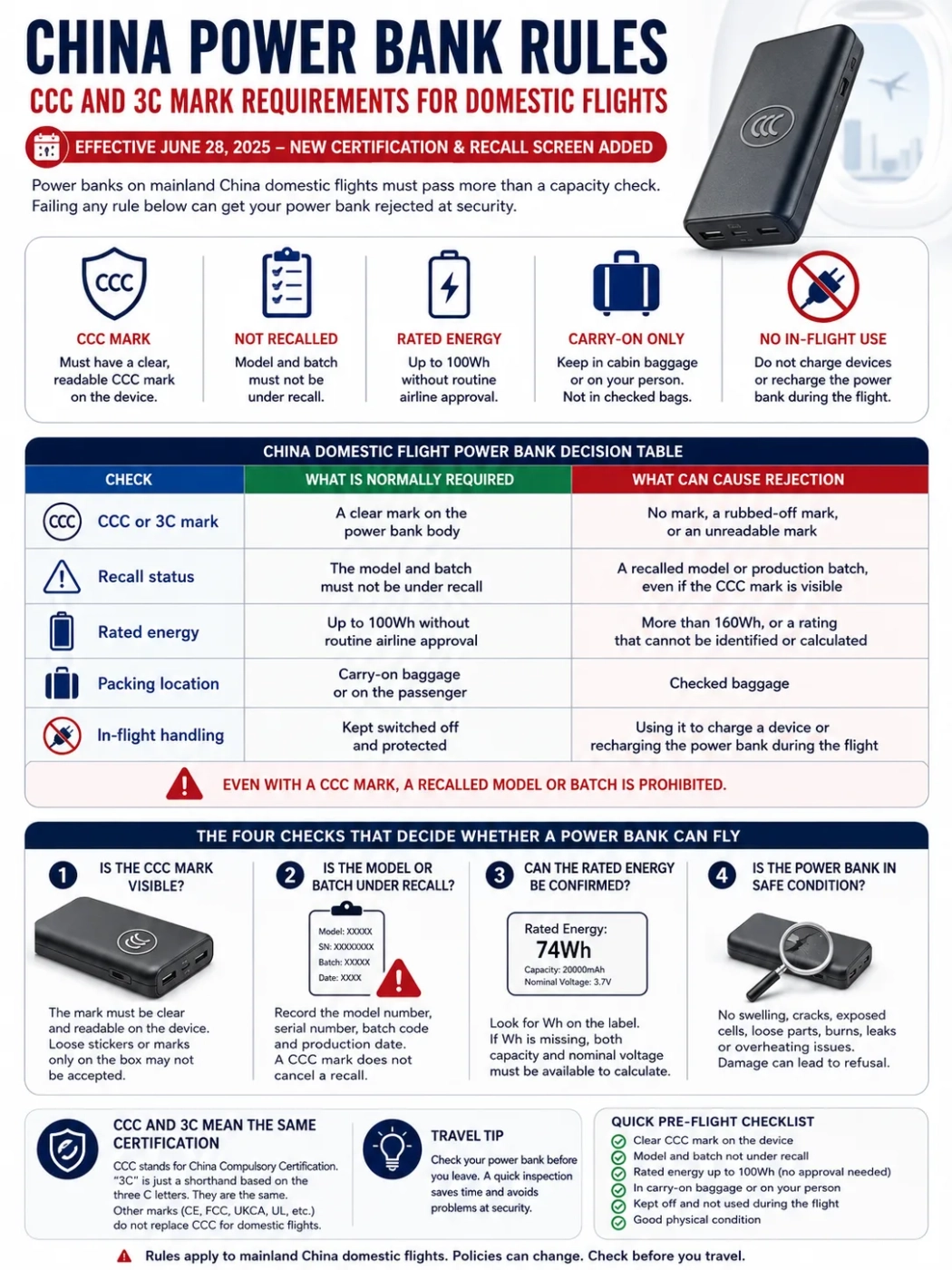
Power banks carried on mainland China domestic flights must pass more than a capacity check. Since June 28, 2025, passengers have been prohibited from bringing a power bank onto a domestic flight when it has no clear CCC mark, when the mark cannot be read, or when the model or production batch has been recalled. The battery must also stay within the usual watt-hour limits, remain in cabin baggage, and not be used during the flight.
| Check | What is normally required | What can cause rejection |
|---|---|---|
| CCC or 3C mark | A clear mark on the power bank body | No mark, a rubbed-off mark, or an unreadable mark |
| Recall status | The model and batch must not be under recall | A recalled model or production batch, even if the CCC mark is visible |
| Rated energy | Up to 100Wh without routine airline approval | More than 160Wh, or a rating that cannot be identified or calculated |
| Packing location | Carry-on baggage or on the passenger | Checked baggage |
| In-flight handling | Kept switched off and protected | Using it to charge a device or recharging the power bank during the flight |
CCC and 3C Mean the Same Certification
CCC stands for China Compulsory Certification. The term 3C is a common shorthand based on the three letter C characters. They are not two different approvals, and a traveler does not need both markings.
The aviation check is concerned with the CCC mark applied to the power bank itself. A mark printed only on a retail box, receipt, online listing, or product manual may not resolve a problem when airport staff cannot identify the required mark on the device being screened.
Other product marks do not automatically replace CCC for a mainland domestic flight. A CE, FCC, UKCA, UL, or similar marking may relate to another market or testing system, but it should not be treated as a substitute for the Chinese compulsory certification mark.
What Changed for Domestic Flights on June 28, 2025?
The newer domestic-flight measure added a certification and recall screen to the existing lithium-battery rules. Three categories became prohibited on covered mainland domestic flights:
- Power banks without a CCC mark
- Power banks with a CCC mark that is unclear or unreadable
- Power banks from recalled models or production batches
This did not remove the existing 100Wh and 160Wh thresholds. It created an additional test. A 74Wh power bank can still be refused if it has no readable CCC mark. A fully marked 111Wh model still needs airline approval because its rated energy is above 100Wh. A 37Wh model can still be refused when its exact model or batch is under recall.
The Four Checks That Decide Whether a Power Bank Can Fly
1. Is the CCC Mark Visible on the Device?
Remove any sleeve or case and inspect the body of the power bank. The mark should be clear enough to identify without guessing. Scratches, fading, a torn label, a printed skin, or adhesive residue can make a genuine product difficult to verify at security.
A loose CCC sticker added after purchase should not be relied on. The visible mark is only one part of the check, and airport staff may also examine the model, rating label, manufacturer details, physical condition, and recall status.
2. Is the Model or Batch Under Recall?
A recall may apply to selected models, serial-number ranges, production dates, or batches rather than every product sold under one brand. Two power banks with the same marketing name may have different outcomes when their model codes or batch numbers are different.
Before departure, record the model number, serial number, production date, and batch code shown on the device or its original packaging. A CCC mark does not cancel a recall. A marked product from a recalled model or batch remains prohibited under the domestic-flight rule.
3. Can the Rated Energy Be Confirmed?
The easiest label to inspect is one that states the rated energy directly in watt-hours, such as 74Wh or 99.9Wh. When Wh is not printed, the value may be calculated only when the battery capacity and nominal voltage are both available.
Labels that show only a marketing capacity, output wattage, or USB charging profile may not provide enough information. The 65W or 100W printed on a laptop power bank usually describes output power, not stored battery energy. It does not replace the Wh rating.
4. Is the Power Bank in Safe Physical Condition?
Certification and capacity do not make a damaged battery suitable for travel. Do not bring a power bank with a swollen case, cracked enclosure, exposed cell, loose port, burn mark, unusual smell, liquid contamination, or repeated overheating. Damage can also prevent couriers or airport storage services from accepting a rejected device.
Capacity Limits Still Apply After the CCC Check
| Rated energy | Domestic flight treatment | Airline approval |
|---|---|---|
| 100Wh or less | Normally allowed in the cabin when all other requirements are met | Normally not required |
| More than 100Wh and no more than 160Wh | May be carried in the cabin after approval | Required; no more than two such power banks per passenger |
| More than 160Wh | Not allowed as passenger baggage | Approval does not make it acceptable |
| Wh cannot be identified or calculated | Not allowed | Airline approval does not replace a usable rating |
The power bank must also be for the passenger's personal use. Carrying a large quantity of units that appears commercial may lead to a different screening outcome even when each unit is individually rated below 100Wh.
How to Convert mAh to Wh
Use the battery's nominal voltage, not the USB output voltage:
Wh = mAh × nominal voltage ÷ 1,000
A power bank may list several output modes such as 5V, 9V, 12V, or 20V. These are charging-output profiles. They are not normally the voltage used to calculate stored energy. The relevant nominal battery voltage is commonly 3.7V or 3.85V, but the value printed by the manufacturer should be used.
| Printed capacity | Calculation | Rated energy | Likely category |
|---|---|---|---|
| 10,000mAh | 10,000 × 3.7 ÷ 1,000 | 37Wh | Below 100Wh |
| 20,000mAh | 20,000 × 3.7 ÷ 1,000 | 74Wh | Below 100Wh |
| 26,800mAh | 26,800 × 3.7 ÷ 1,000 | 99.16Wh | Below 100Wh |
| 27,000mAh | 27,000 × 3.7 ÷ 1,000 | 99.9Wh | Below 100Wh |
| 30,000mAh | 30,000 × 3.7 ÷ 1,000 | 111Wh | Airline approval required |
Do not assume that every 20,000mAh or 30,000mAh product has the same Wh value. The nominal voltage can differ, and some multi-cell products use a label arrangement that requires careful reading. A directly printed Wh value is easier for both the passenger and the security officer to verify.
Domestic, International, and Connecting Flights Need Separate Checks
The CCC restriction announced for June 28, 2025 concerns domestic flights within mainland China. A power bank accepted on an international flight into China is not automatically accepted on a later mainland domestic sector.
For example, a passenger may travel from Istanbul to Shanghai with a foreign power bank and then continue from Shanghai to Chengdu. The Shanghai–Chengdu sector is a mainland domestic flight, so the CCC, recall, label, capacity, and cabin-baggage checks can apply at the domestic security point.
The result does not depend on whether the flights were bought on one ticket or separate tickets. The route being screened, the airport's procedures, and the applicable carrier conditions matter more than the booking structure.
Flights involving Hong Kong, Macao, or Taiwan should not be treated as ordinary mainland domestic sectors without checking the exact airport and airline instructions. Their security handling and route classification may differ.
Foreign-Made Power Banks Are Not Nationally Exempt
A foreign purchase receipt, foreign safety mark, or international brand name does not create a nationwide exemption from the mainland domestic-flight rule. Airport staff still need to identify the battery, determine its rated energy, inspect its condition, and apply the rules in force at that departure point.
A Shenzhen airport guide published in 2025 described separate handling for foreign-manufactured power banks under the airport's earlier inspection standards. Travelers should not rely on that older local notice as a permanent rule for Shenzhen or as permission that applies across China. Airport instructions can be revised, and a unit accepted at one departure point may still be questioned during a later mainland connection.
The lower-risk choice for an itinerary containing mainland domestic sectors is a power bank with a clear Wh rating, identifiable model and batch information, sound physical condition, and a readable CCC mark.
Where the Power Bank Must Be Packed
Power banks are treated as spare lithium batteries and must remain in the cabin. They may be carried in hand baggage or on the passenger, but they must not be placed in checked baggage.
| Location | Allowed? | What to do |
|---|---|---|
| Carry-on bag | Yes | Keep it accessible and protect the ports from short circuit |
| Personal item or coat pocket | Yes | Avoid contact with coins, keys, or exposed metal |
| Checked suitcase | No | Remove the power bank before check-in |
| Cabin bag taken at the gate | Only after removal | Take the power bank out before the bag is sent to the hold |
| Smart suitcase | Depends on battery design | Remove the battery when the bag is checked and carry it under the power bank rules |
Covering exposed contacts, using the original pouch, or placing each unit in a separate protective sleeve can reduce accidental contact. Do not pack a loose power bank beside metal tools, cables with exposed ends, keys, or coins.
Using a Power Bank During the Flight
Being allowed to carry the device does not mean it may be used in the cabin. Chinese civil aviation rules prohibit using a power bank to charge a phone, tablet, laptop, camera, or other device during the flight. A power bank with an on/off switch should remain switched off.
Do not connect the power bank to a seat outlet or USB port to recharge it. Wireless charging should also remain inactive. If the unit becomes hot, swells, smells unusual, leaks, smokes, or makes a hissing sound, do not hide it inside a bag. Inform the cabin crew immediately.
Recharging the Power Bank During Your China Trip
Mainland China generally uses a 220V, 50Hz electricity supply. Many modern USB wall chargers are marked Input: 100–240V, 50/60Hz. That label means the charger can normally accept both common voltage systems without a voltage converter, provided the plug can connect safely to the outlet.
A plug adapter does not convert voltage. It changes only the physical plug connection. If the charger's input label covers 100–240V and 50/60Hz, a plug adapter may be all that is needed. If the charger is marked only for 100–120V, it should not be connected directly to a 220V supply without equipment intended for that load.
The power bank's USB input values, such as 5V, 9V, or 20V DC, describe what the wall charger supplies to the power bank. The wall charger's AC input label is the part that determines whether the charger itself can be connected to China's electricity supply.
Phone chargers, laptop USB-C chargers, camera chargers, many tablet chargers, and some electric shaver chargers commonly use wide-range input. Heat-producing appliances such as hair dryers, curling irons, kettles, and clothes irons follow separate voltage and wattage rules. Their compatibility does not tell you anything about whether a power bank may pass airport screening.
A CPAP machine or other medical device should be checked against its own power supply label and manufacturer instructions. A power bank being permitted through security does not confirm that it is approved, suitable, or large enough to run a medical device.
What Happens When Security Rejects the Power Bank?
Available options depend on the airport and the condition of the device. Some airports provide temporary storage, courier handling, a recall-service desk, or a way to hand the unit to a non-traveling person. A passenger may also choose to surrender the device and continue without it.
These services are not identical across China. Storage periods, collection procedures, identity requirements, courier restrictions, and fees can vary. Swollen, leaking, cracked, recalled, or visibly damaged batteries may be refused by shipping services.
Moving the rejected unit into checked baggage is not an alternative. A power bank that cannot travel in the cabin cannot be made acceptable by placing it in the aircraft hold.
How the Certification and Flight Rules Developed
| Date | Change | Traveler relevance |
|---|---|---|
| August 1, 2023 | Certification bodies began accepting CCC applications for newly covered power banks and related products | This started the formal certification transition |
| August 1, 2024 | Covered products without CCC certification and marking could no longer be released from factories, sold, imported, or used in covered commercial activities | Newer units sold through normal Chinese channels were expected to carry the required certification |
| June 28, 2025 | Mainland domestic flights prohibited power banks with no clear CCC mark or from recalled models and batches | The product certification became a direct airport screening issue |
| March 31, 2026 | GB 47372-2026 was published | A new product safety and labeling standard entered its transition period |
| April 1, 2027 | GB 47372-2026 is scheduled to take effect | New-standard products will carry expanded safety, identification, and traceability information |
The 2026 Power Bank Standard and the April 2027 Change
China published GB 47372-2026, Safety Technical Specification for Power Bank, on March 31, 2026. The mandatory standard is scheduled to take effect on April 1, 2027.
The standard adds clearer product identification and safety requirements. New-standard products are expected to show rated energy, production information, a recommended safe service life, and a unique product code that can support traceability. It also adds stronger testing and control requirements for conditions such as high temperature, overcharge, crushing, internal short circuit, cell aging, and abnormal battery behavior.
The publication of the new standard does not instantly make every older CCC-certified power bank unusable or prohibited on aircraft. A previously purchased unit that already passed CCC certification may continue to be carried after the new standard takes effect when it still meets the civil aviation rules, remains outside any recall, has readable markings, falls within the capacity limits, and is physically safe.
Power Banks Most Likely to Cause Trouble at Security
Older Imported Units
An older power bank purchased outside China may have no CCC mark, a faded battery label, or incomplete model information. Even when it is under 100Wh, the domestic-flight certification check can remain unresolved.
Unbranded or Promotional Models
Free promotional devices and unbranded units often have limited technical labeling. A device showing only “20,000mAh” without nominal voltage, Wh, manufacturer, or model information may be difficult to identify and calculate.
Laptop Power Banks Near 100Wh
Laptop-oriented models are often designed close to the 100Wh boundary. Read the actual Wh figure instead of relying on capacity alone. A small difference in nominal voltage can move a product from the no-approval category into the 100–160Wh category.
Multi-Function Battery Products
A jump starter, heated hand warmer, flashlight, portable router, speaker, battery case, or other multi-function product may still be treated as a power bank when one of its main functions is supplying external power. The name used in an online shop does not decide the aviation category.
Modified or Repaired Power Banks
Replacing cells, rebuilding the pack, opening the enclosure, or mixing a certified outer case with different internal cells can make the original rating and certification difficult to trust. Do not travel with a unit that has been informally repaired or rebuilt.
Pre-Flight Inspection Before a China Domestic Sector
- Remove the case and find the CCC mark on the device.
- Confirm that the mark and technical label are readable.
- Find the rated energy in Wh.
- If Wh is absent, confirm both mAh and nominal voltage before calculating.
- Record the exact model, serial number, batch code, and production date.
- Check whether the model or batch has been recalled.
- Inspect the enclosure for swelling, cracks, dents, heat damage, or loose ports.
- Ask the airline for approval before travel when the rating is above 100Wh and no more than 160Wh.
- Move every power bank out of checked baggage.
- Protect the ports and keep the device switched off during the flight.
Examples of Likely Screening Outcomes
| Power bank situation | Likely result | Reason |
|---|---|---|
| 20,000mAh, 74Wh, clear CCC mark, no recall | Normally accepted in the cabin | Below 100Wh and identifiable |
| 26,800mAh, 99.16Wh, no CCC mark | Refused on a covered mainland domestic flight | The capacity is acceptable, but the certification mark is missing |
| 30,000mAh, 111Wh, clear CCC mark | Conditional | Airline approval is required because the rating exceeds 100Wh |
| 10,000mAh, 37Wh, clear CCC mark, recalled batch | Refused | The recall takes priority over the visible mark |
| 20,000mAh, CCC logo rubbed off | Likely refused | The required mark cannot be clearly identified |
| 74Wh foreign-made unit accepted on an international arrival | Not guaranteed for a later domestic sector | The domestic security point may apply the CCC rule |
| Compliant 74Wh unit packed in a checked suitcase | Refused in that packing location | Power banks must remain in the cabin |
Frequently Asked Questions
Is 3C different from CCC?
No. 3C is a common name for China Compulsory Certification, abbreviated CCC.
Is a power bank under 100Wh automatically allowed on a China domestic flight?
No. It must also have a clear CCC mark, remain outside any recall, have readable identification, be physically safe, and travel in the cabin.
Can a CE-certified power bank be used instead of one with a CCC mark?
CE does not automatically replace CCC for the mainland domestic-flight rule. Airport-specific handling of foreign-made units can vary, so acceptance should not be assumed.
Can two 20,000mAh power banks be carried?
They may normally fit within the energy rule when each unit is 100Wh or less, but both still need readable ratings, compliant markings, safe condition, cabin packing, and no applicable recall.
Can a power bank be used to charge a phone during the flight?
No. Chinese civil aviation rules prohibit using a power bank during the flight, and a unit with a switch should remain switched off.
Will an older CCC-certified power bank become illegal on April 1, 2027?
Not automatically. An older certified unit may still be carried when it continues to meet the aviation rules, has readable markings, is not recalled, stays within the energy limits, and remains in safe condition.