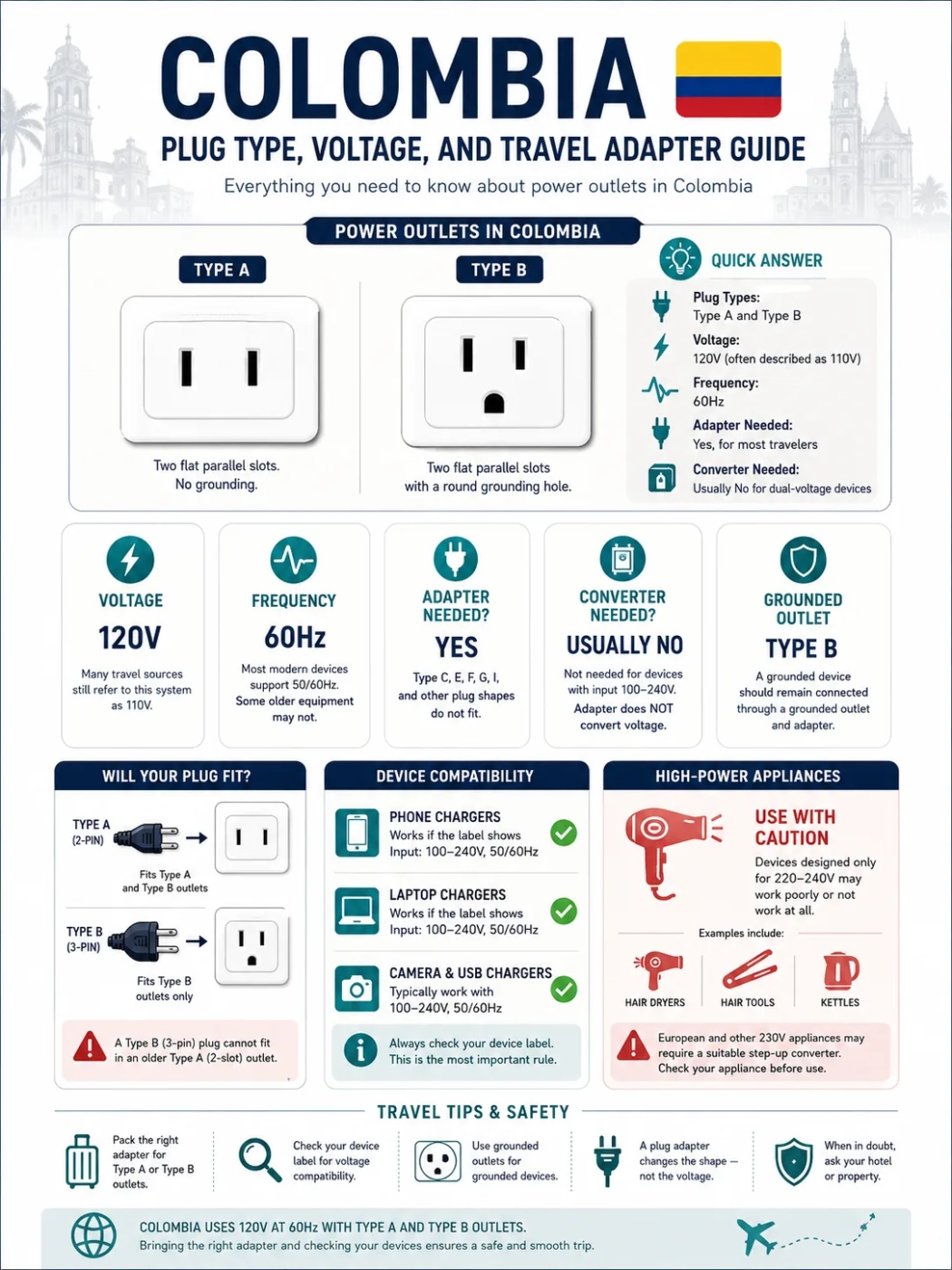
Colombia commonly uses Type A and Type B power outlets. The current Colombian electrical regulation defines normal low-voltage supplies around 120V at 60Hz, although hotels and travel references often describe the same system as 110V. Travelers whose plugs already have two flat pins or twoter. Visitors using Type C, E, F, G, I, or other plug shapes will need an adapter.
Most phone chargers, laptop chargers, camera chargers, and USB power supplies work when their label says Input: 100–240V, 50/60Hz. Appliances designed only for 220–240V, especcking. A plug adapter does not convert voltage.
| Travel power detail | Colombia | What it means for travelers |
|---|---|---|
| Common plug types | Type A and Type B | Expect two flat slots, with an additional round grounding hole on Type B outlets. |
| Nominal supply | 120V | Many travel listings still use the older 110V description. |
| Frequency | 60Hz | Most modern chargers accept 50/60Hz, but some motors, clocks, pumps, and older appliances may not. |
| Grounded outlet | Type B | A grounded device should remain connected through a grounded outlet and adapter. |
| Plug adapter | Depends on the plug attached to the device | Type C, E, F, G, I, J, K, L, and other plug shapes do not fit directly. |
| Voltage converter | Device-dependent | Usually unnecessary for 100–240V chargers, but it may be relevant for single-voltage appliances. |
| Main appliance concern | 220–240V-only heating devices | European and other 230V hair tools may work poorly or require a suitable step-up solution. |
What the Power Outlets Look Like
These are simplified front views of the socket types travelers may see in Colombia. Outlet plates, slot orientation, color, and overall shape can vary by building and manufacturer. Some hotels may also install multi-standard sockets. Plug shape and voltage are separate issues, so a plug that fits is not automatic proof that the appliance is electrically compatible.
Why Colombia Is Described as Both 110V and 120V
Colombia is often listed as a 110V country in hotel descriptions, travel information, and everyday conversation. The current RETIE electrical regulation uses 120V phase-to-ground as the nominal value for general low-voltage networks. It also confirms that the standard frequency of the Colombian electrical system is 60Hz.
For normal travel decisions, Colombia should therefore be treated as a 120V-class, 60Hz destination. The 110V wording is a familiar shorthand for the same lower-voltage supply family. It does not mean that travelers must choose a special “110V adapter” instead of a “120V adapter.” The device input range remains the deciding factor.
The Colombian regulation also mentions 208V and 240V configurations used between conductors in certain electrical systems. These values do not mean that an ordinary bedside or desk outlet in a hotel room normally supplies 208V or 240V. Travelers should base their device decision on the regular 120V wall supply unless the property or equipment connection is clearly marked otherwise.
Will Your Plug Fit in Colombia?
Type A has two flat parallel pins. Type B uses the same two flat pins plus a round grounding pin. A two-pin Type A plug can usually enter a Type B outlet, but a three-pin Type B plug cannot enter an older two-slot Type A outlet because there is no opening for the grounding pin.
| Traveler’s usual plug | Will it commonly fit? | What still needs checking? |
|---|---|---|
| Type A or Type B from the United States, Canada, or Mexico | Usually | A three-prong Type B device still needs a Type B outlet if grounding is required. |
| Type A or Type B from Japan | Often | Japan uses 100V, so 100V-only appliances require a voltage check before use on 120V. |
| Type C, E, or F from Türkiye and continental Europe | No | A Type A/B plug adapter is needed. Check 230V-only appliances separately. |
| Type G from the United Kingdom or Ireland | No | A plug adapter is needed, and grounded devices should use an adapter that preserves grounding. |
| Type I from Australia or New Zealand | No | A Type A/B adapter is needed. Single-voltage 230V appliances may not work as intended. |
| Type N or mixed plug systems from Brazil | Usually not | Check both the plug shape and the input voltage because Brazilian devices may come from different voltage environments. |
Travelers from the United States and Canada
Most North American Type A and Type B plugs are physically compatible with Colombian outlets. Common 120V, 60Hz devices are also normally close to the Colombian electrical supply. A plug adapter is therefore often unnecessary.
The remaining issue is grounding. A three-prong laptop cable, appliance, or power strip should not be forced into a two-slot Type A outlet. Removing the grounding pin or using a basic two-pin adapter can eliminate the protective earth connection designed for the device.
Travelers from Türkiye and 230V Europe
Type C and Type F plugs do not directly fit Colombian Type A or Type B outlets. A plug adapter is required even when the charger accepts international voltage.
Phones, tablets, laptops, cameras, and USB-C chargers commonly accept 100–240V and need only the correct plug adapter. Hair dryers, curling irons, straighteners, kettles, clothes irons, and some bathroom appliances are more likely to be designed only for 220–240V.
Travelers from Japan
Many Japanese plugs have the same flat-pin shape used by Type A outlets, but physical compatibility does not settle the voltage question. Japan uses 100V, while Colombian wall power should be treated as nominally 120V.
A charger marked 100–240V can normally accept the difference. A device marked only 100V, particularly a heating appliance or motor-driven product, should not be assumed safe on 120V without manufacturer confirmation.
Grounded and Ungrounded Outlets
The difference between Type A and Type B is not decorative. Type A provides the two current-carrying connections but has no grounding contact. Type B adds a round grounding connection below the flat slots.
A Type B connection can provide a protective grounding path only when every part of the connection supports it:
- The building outlet must be correctly wired.
- The device plug must include its grounding pin.
- The travel adapter must carry the grounding connection through.
- No two-pin converter or extension should interrupt that path.
Some existing properties may have a mixture of two-slot and grounded outlets. The age, renovation history, and electrical condition of a building can affect what is found in a room. A Type B socket face also does not prove that the building’s grounding conductor is working correctly.
Do not remove, bend, or defeat the grounding pin on a three-prong device simply to make it fit a two-slot outlet. Ask for another outlet or use a properly grounded solution intended for the device.
Adapter Only or Voltage Converter?
A plug adapter solves a mechanical mismatch. It changes the shape presented to the wall outlet. A voltage converter changes the electrical voltage supplied to the appliance. These functions should not be confused.
| Device label | Likely result in Colombia | What may be needed |
|---|---|---|
| Input: 100–240V, 50/60Hz | Usually compatible with Colombian voltage and frequency | Only a plug adapter if the attached plug does not fit Type A or Type B |
| Input: 110–120V, 60Hz | Normally compatible | An adapter only when the plug shape differs |
| Input: 100V only | Not automatically compatible with nominal 120V | Manufacturer guidance or a suitable voltage solution |
| Input: 220–240V, 50/60Hz | The device may receive too little voltage to work properly | A suitable step-up converter may be needed |
| Input: 220–240V, 50Hz only | Both voltage and frequency require attention | Device-specific confirmation; a basic adapter is not enough |
What “Input: 100–240V” means
The input line tells you which wall voltage the charger or power supply is designed to accept. A label showing Input: 100–240V, 50/60Hz covers Colombia’s nominal 120V and 60Hz supply.
The wording usually appears on the charger body, laptop power brick, camera battery charger, USB power supply, or underside of the device. Read the line marked “Input,” not the USB output line. A line such as “Output: 5V” describes the electricity sent from the charger to the device and does not confirm wall-voltage compatibility.
What a converter would need to do
A 220–240V-only device brought to Colombia may require a step-up converter that raises the local supply to the voltage expected by the appliance. The converter must support the appliance’s wattage and operating pattern.
This can become impractical with high-power heating devices. A small converter intended for chargers should not be used with a hair dryer, kettle, garment steamer, or clothes iron. Starting current also matters for appliances with motors or compressors.
Always check the device label and wattage before using a single-voltage high-power appliance.
Which Devices Usually Work?
| Device | Typical compatibility | What to check |
|---|---|---|
| Phone charger | Usually compatible | Look for 100–240V, 50/60Hz on the charging head. |
| Laptop charger | Usually compatible | Read the power brick and preserve grounding when the cable has three prongs. |
| Tablet or USB-C charger | Usually compatible | USB-C describes the connector and charging system, not the wall input voltage. |
| Camera battery charger | Often compatible | Check the charger’s input range rather than the camera body. |
| Power bank charger | Usually compatible | The power bank’s wall charger must accept 120V and 60Hz. |
| Electric toothbrush | Model-dependent | Check the charging base; some bases are not dual voltage. |
| Electric shaver | Model-dependent | Check for 100–240V and 50/60Hz, especially on older models. |
| Hair dryer | Needs close checking | Confirm dual-voltage operation, switch position, wattage, and frequency. |
| Curling iron or straightener | Needs close checking | Look for a wide input range or a clearly marked 120V setting. |
| Travel kettle or clothes iron | Often unsuitable when made only for 220–240V | Check voltage and high wattage before considering a converter. |
| CPAP machine | Often compatible through its power supply | Check the CPAP power brick, humidifier rating, grounding, and manufacturer instructions. |
Phones, laptops, cameras, and USB charging
Modern travel electronics are commonly powered through a wide-range switching supply. This is why a phone bought in a 230V country can often charge in Colombia without voltage conversion. The charger adjusts internally when its input label covers 100–240V.
A cable alone does not determine compatibility. A USB-A, USB-C, or proprietary cable carries low-voltage output from the charger. The charging head connected to the Colombian outlet is the part that must accept 120V and 60Hz.
A laptop power brick may accept international voltage while its detachable wall cable still has a foreign plug. In that case, either use a suitable grounded plug adapter or an approved replacement wall cable that matches the power brick and Colombian Type B outlets.
Hair dryers, styling tools, kettles, and irons
Heat-producing appliances create the most common voltage problem for travelers arriving from 220–240V countries. A European hair dryer designed only for 230V may run slowly, produce weak heat, or fail to operate properly on Colombia’s 120V supply.
A device marked “dual voltage” may have a manual selector. The selector must be placed in the 110–120V position before the appliance is connected. Some dual-voltage hair tools also operate at different heat or speed levels depending on the selected mode.
A high-wattage step-up converter must be rated above the appliance’s real demand and approved for that type of load. Packing a large converter for a short trip may offer little practical benefit. Using a hair dryer supplied by the hotel is often simpler than adapting a 230V-only model.
CPAP machines and medical equipment
Many CPAP power supplies accept 100–240V, but this should be confirmed on the actual power brick. The humidifier or heated tube may also affect total power demand. Check the complete system rather than assuming that one compatible component covers every accessory.
For medical equipment, confirm the input range, frequency, plug shape, grounding requirement, battery arrangement, and manufacturer travel instructions before departure. A multi-standard hotel socket should not be treated as evidence that the equipment will receive the correct voltage or grounding.
The Colombia Mistake Most Common for 230V Travelers
The easy mistake is to see a Type A/B adapter, connect a European appliance, and assume that the adapter has solved the entire problem. It has solved only the plug shape.
For a phone charger marked 100–240V, that is normally enough. For a 230V-only hair dryer, straightener, kettle, iron, or steamer, the local 120V supply does not match the appliance rating. The product may perform poorly, and a converter must be selected according to voltage, wattage, and load type.
The reverse situation is also worth noting for visitors carrying a 100V-only Japanese appliance. Its plug may fit perfectly, but Colombia’s nominal supply is higher than the appliance’s rating. A matching plug shape does not remove that difference.
Hotel Rooms, Apartments, and Tourist Facilities
Travelers may find Type A outlets, grounded Type B outlets, USB ports, or multi-standard sockets depending on the property. Availability should not be assumed from the hotel category or destination city alone.
Do not assume that a hotel’s universal-looking socket changes the voltage. A multi-standard socket may accept several plug shapes while continuing to supply normal Colombian 120V, 60Hz electricity.
Useful questions for a hotel or rental host include:
- Are the bedroom outlets Type A, Type B, or multi-standard?
- Is there a grounded Type B outlet near the bed or desk?
- Are the USB ports USB-A, USB-C, or both?
- Does the room provide a hair dryer?
- Are outlets available near the sleeping area for a CPAP machine?
- Is backup electricity available for equipment that must operate continuously?
Loose outlets and heavy adapters
Some large universal adapters sit poorly in vertical Type A or Type B outlets. Their weight can pull the blades partly out of a loose socket, especially when several cables are connected.
Do not support a heavy adapter by bending the plug or wedging objects beneath it. Use a lighter adapter, a short approved extension arrangement, or another outlet. Stop using a socket that feels unusually loose, becomes hot, shows dark marks, makes a buzzing sound, or produces repeated sparking.
Bathroom outlets
A bathroom socket may have different protection or use limits from an ordinary bedroom outlet. A dedicated shaver outlet, where provided, should not be used as though it were a normal high-power appliance connection. Avoid connecting hair tools near water, and do not overload a bathroom outlet through stacked adapters.
Universal Adapters, Power Strips, and Grounding
A universal travel adapter can be useful when it clearly includes a Type A or Type B output. It may also offer USB charging ports. The word “universal,” however, does not confirm voltage conversion, grounding, or suitability for high-wattage appliances.
- Check that the adapter is rated for a 120V supply.
- Check its maximum current and wattage.
- Confirm whether the grounding path is real or only a physical third opening.
- Do not connect several adapters one after another.
- Do not use a low-power USB adapter for an AC heating appliance.
- Do not assume that a fuse inside the adapter changes voltage.
A power strip brought from another country also needs checking. Its plug shape, nominal voltage, current rating, grounding design, and built-in surge components must suit the supply and connected devices. A Type F or Type G power strip attached through a two-pin adapter may lose its grounding connection.
For several phones, tablets, cameras, and other USB devices, one properly rated multi-port charger marked 100–240V can be simpler than bringing several wall adapters. The charger still needs a suitable Type A/B connection.
What to Pack for Colombia
| Travel situation | Useful power item | Item that may be unnecessary |
|---|---|---|
| US or Canadian traveler with Type A/B devices | A small grounded option if all available outlets are not Type B | A voltage converter for ordinary 120V devices |
| Traveler from Türkiye or continental Europe | A Type C/E/F to grounded Type B adapter | A converter for chargers marked 100–240V |
| UK or Irish traveler | A grounded Type G to Type B adapter | A converter for dual-voltage electronics |
| Australian or New Zealand traveler | A Type I to Type A/B adapter | A converter when every device accepts 100–240V |
| Traveler carrying several USB devices | A 100–240V multi-port charger and suitable wall adapter | Separate plug adapters for every USB device |
| Traveler carrying a CPAP machine | Correct grounded adapter, power supply, backup plan, and manufacturer-approved accessories | An unverified two-pin universal adapter |
| Traveler carrying a 230V hair dryer or kettle | A verified dual-voltage alternative or locally compatible appliance | A small converter not rated for the appliance wattage |
- Read the input label on every charger and appliance.
- Pack a Type A/B adapter when your home plug uses another shape.
- Use a grounded adapter for equipment designed with a grounding pin.
- Separate 100–240V electronics from single-voltage heating appliances.
- Check manual voltage selectors before connecting dual-voltage hair tools.
- Confirm medical-device requirements before traveling.
- Do not rely only on photographs of a hotel’s wall socket.
FAQ
What plug type is used in Colombia?
Colombia commonly uses Type A and Type B outlets. Type A has two flat parallel slots. Type B adds a round grounding hole below them.
Is Colombia 110V or 120V?
Travel information often describes Colombia as 110V, while the current Colombian RETIE regulation defines 120V as the nominal phase-to-ground value for general low-voltage networks. Travelers should treat ordinary outlets as a 120V, 60Hz supply.
Do US plugs work in Colombia?
Type A and Type B plugs from the United States usually fit Colombian outlets. A three-prong Type B device still needs a grounded Type B outlet if the equipment relies on grounding.
Do travelers from Türkiye need an adapter for Colombia?
Yes. Turkish Type C and Type F plugs do not fit directly into Colombian Type A or Type B outlets. A plug adapter is required. A voltage converter is usually unnecessary for chargers marked 100–240V.
Can I use a European hair dryer in Colombia?
Only when the hair dryer supports 110–120V or has a dual-voltage setting placed in the correct position. A 220–240V-only hair dryer may not work properly on Colombia’s 120V supply. A basic plug adapter cannot correct the voltage difference.
Will my phone or laptop charger work in Colombia?
Usually, when the charger label says Input: 100–240V, 50/60Hz. You may still need a Type A/B plug adapter if the charger has a different plug shape.