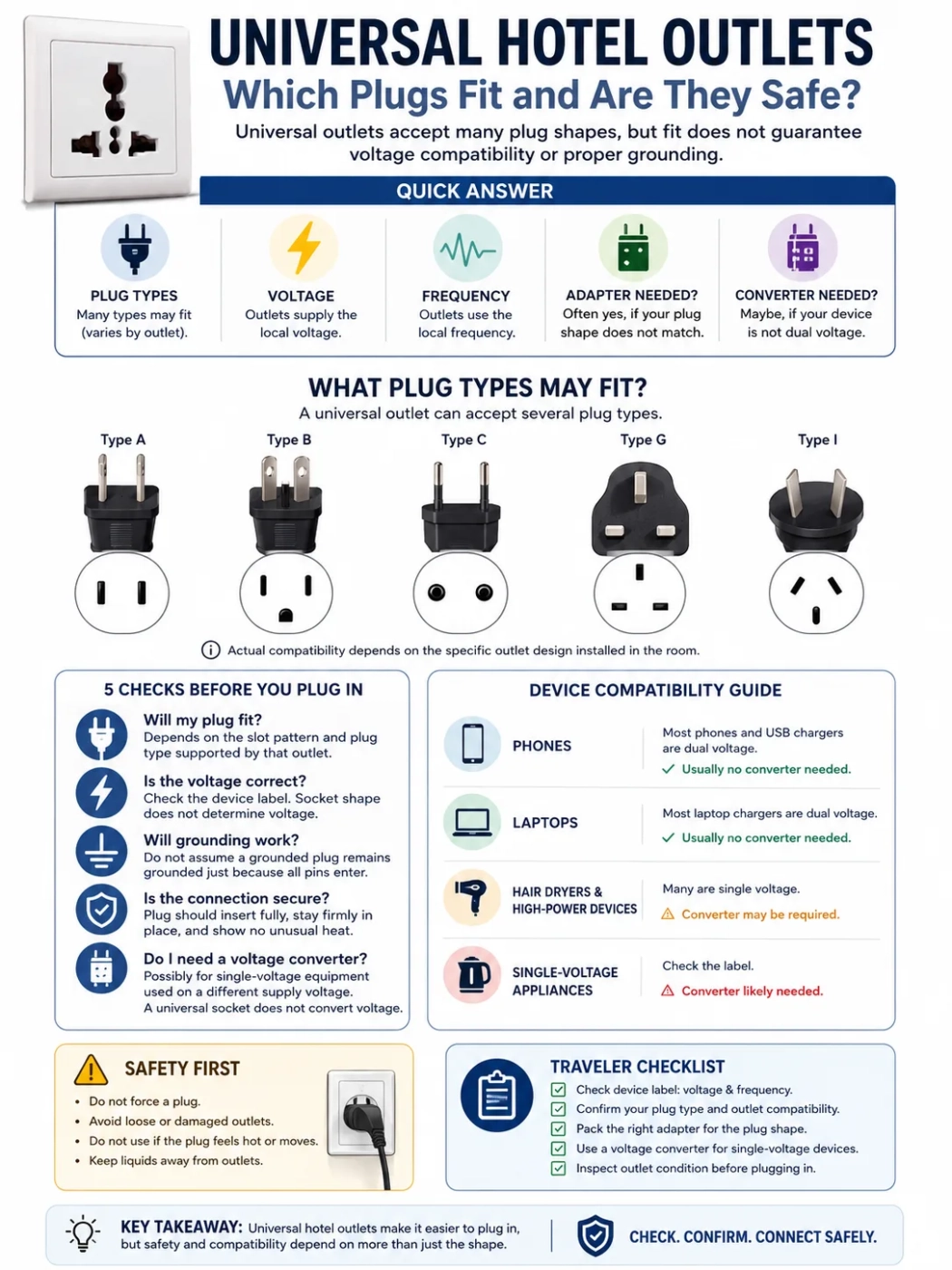
Universal hotel outlets are designed to accept more than one plug shape, but a plug fitting into the socket does not confirm that the connection is electrically suitable. The hotel outlet still supplies the local voltage and frequency, and a multi-standard socket may not preserve the grounding system intended for every plug type. Check the device label, outlet condition, grounding needs, and plug fit before connecting equipment.
| Question | What to check |
|---|---|
| Will my plug fit? | Depends on the slot pattern and plug type supported by that particular outlet. |
| Is the voltage correct? | Check the device label. The socket shape does not determine voltage compatibility. |
| Will grounding work? | Do not assume a grounded plug remains grounded simply because all of its pins enter the socket. |
| Is the connection secure? | The plug should insert fully, stay firmly in place, and show no unusual heat or movement. |
| Do I need a voltage converter? | Possibly for single-voltage equipment used on a different supply voltage. A universal socket does not perform voltage conversion. |
What Is a Universal Hotel Outlet?
A universal hotel outlet, sometimes called a multi-standard or multi-country socket, combines several slot shapes into one outlet face. It is intended to make it easier for international guests to connect different plugs without always using a separate plug adapter.
There is no single universal socket design used by every hotel. One outlet may accommodate flat Type A pins, round Type C pins, a Type G arrangement, or angled Type I pins, while another may support a different combination.
The word universal therefore describes broad physical compatibility rather than a guarantee that every plug type will fit correctly.
Which Plug Types May Fit?
The exact answer depends on the outlet installed in the room. The unusual combination of holes and slots on a universal socket can make several plugs appear compatible, but visual similarity is not enough to confirm correct support.
| Plug type | What travelers may encounter | What deserves attention |
|---|---|---|
| Type A | Two flat parallel pins are accepted by many multi-standard designs. | A 120V-only device can still receive 220–240V if that is the hotel’s supply. |
| Type B | Some outlets provide openings for the two flat pins and round grounding pin. | Confirming physical insertion does not confirm protective grounding. |
| Type C | Two round Europlug-style pins are commonly accommodated. | Watch for loose fit, partial insertion, or exposed conductive portions of the pins. |
| Type E / F | The two main round pins may fit some designs. | Do not assume the Type E or F grounding arrangement is reproduced correctly. |
| Type G | Some hotel outlets include openings for three rectangular pins. | A universal-looking pattern should not automatically be treated as a normal Type G socket. |
| Type I | Angled flat-pin openings appear on some multi-standard outlets. | Support for the grounded three-pin version depends on the socket design. |
| Type D / M | Compatibility is inconsistent because these plugs use larger round pins. | Never force the pins into round openings that only appear similar. |
| Type J / K / L / N | Support varies widely between universal outlet designs. | Use the correct local connection method when the socket does not clearly accommodate the plug. |
Never force a plug into a hotel outlet. Resistance, unusual pin alignment, or a plug that only enters partway is a reason to use another socket or the correct travel adapter.
The Hotel Outlet Does Not Change the Voltage
A multi-standard socket changes which plug shapes may connect to the outlet. It does not normally change the electrical supply behind it.
A universal outlet in a country using 230V still supplies approximately the local mains voltage even when it accepts a North American Type A plug. The same principle applies in a 120V destination: accepting a European-style plug does not turn the outlet into a 230V supply.
A plug adapter does not convert voltage. The same rule applies to the plug-fitting function built into a universal hotel outlet.
What “Input: 100–240V” Means
Look at the power supply, charger, or device label before connecting it. A label such as Input: 100–240V, 50/60Hz means that the power supply is designed to operate across that stated voltage and frequency range.
This is common on many phone chargers, laptop power supplies, tablet chargers, camera chargers, and USB power supplies. If the local electricity supply falls within the printed range, voltage conversion is usually not required. You may still need a suitable plug connection.
A label that says only 120V, 110–120V, 220–240V, or another narrow range needs more attention when the destination uses a different voltage.
Grounded Plugs Need More Than Matching Holes
Grounded plug systems use an additional contact to provide protective earth. Different plug types achieve this in different ways. Type B uses a round grounding pin, Type G uses a third rectangular pin, Type E and Type F use their own grounding arrangements, and grounded Type I plugs use a third pin.
A universal outlet may provide openings that allow these plugs to enter, but the visible slot pattern alone cannot show whether the intended earth connection is present and working.
A device powering on does not prove that it is properly grounded. It only shows that the conductors needed to supply power have made contact.
This distinction matters more for equipment designed to use protective grounding. Do not remove a grounding pin, defeat an earth contact, or use an ungrounded connection simply to make a grounded appliance fit.
Loose and Partial Connections Are Warning Signs
Universal sockets have to accommodate several pin shapes and dimensions. The condition and design of the outlet therefore matter just as much as whether the plug can enter.
A connection should not require the cable to be held at a certain angle or the plug to be supported by furniture. Stop using the outlet if you notice:
- A plug that moves noticeably after insertion
- A plug that repeatedly falls out
- Only part of the pins entering the socket
- Conductive sections of the pins remaining unusually exposed
- Power cutting in and out when the cable moves
- Crackling, buzzing, sparking, or a burning smell
- Scorch marks, discoloration, cracks, or visible socket damage
- An outlet face or plug becoming unusually hot
Poor electrical contact can create unwanted heating and may damage the outlet, plug, adapter, or connected equipment. Do not keep using a questionable socket simply because the device is still receiving power.
Phone Charger and Hair Dryer: Same Plug, Different Decision
Two devices can use the same plug shape and still have completely different travel-power requirements.
| Device | Typical issue to check | What matters most |
|---|---|---|
| Phone charger | Often uses a wide-range power supply | Look for Input: 100–240V, 50/60Hz and a secure plug connection. |
| Laptop charger | Often supports multiple voltages but may use a grounded plug | Check the input range, plug fit, and grounding arrangement. |
| Camera battery charger | Many models use wide-range electronic power supplies | Read the charger label rather than assuming compatibility. |
| Electric shaver | Voltage support varies by model | Check whether it is dual voltage or single voltage. |
| Hair dryer | High wattage and frequently single-voltage unless designed for travel | Voltage compatibility must be confirmed before use. |
| Curling iron or straightener | Heating element may be designed for a limited voltage range | Read the device label and voltage selector, if present. |
| Kettle or clothes iron | High continuous electrical load | Use only when the appliance and outlet are suitable for the local supply. |
| CPAP machine | Reliable overnight operation may be required | Verify the power supply input range, plug connection, grounding needs, and manufacturer instructions. |
A 100–240V Phone Charger in a 230V Hotel
Consider a phone charger with a Type A plug and the label Input: 100–240V, 50/60Hz. If the hotel is supplied at 230V and the universal outlet accepts the plug securely, the charger’s stated input range includes the local voltage. A voltage converter is normally unnecessary.
The physical connection still needs to be sound. A loose universal socket should not be treated as suitable merely because the charger’s voltage range is correct.
A 120V Hair Dryer in the Same Room
Now consider a Type A hair dryer marked only for 120V. It may fit the exact same universal outlet, but the hotel’s 230V supply remains 230V. The multi-standard socket does not protect the appliance from the voltage difference.
Do not connect a 120V-only high-power appliance directly to a 220–240V supply simply because its plug fits.
A suitable voltage converter may be required in such a situation, but high-wattage appliances can demand more power than many travel converters are designed to handle. Checking the appliance rating and converter capacity is necessary before use.
Does 50Hz or 60Hz Matter?
Voltage receives most of the attention, but the frequency printed on a device also matters. Hotels supply the normal local mains frequency; a universal socket does not convert 50Hz to 60Hz or 60Hz to 50Hz.
Many modern electronic chargers state 50/60Hz and are designed for either frequency. Devices containing certain motors, clocks, timers, pumps, or other frequency-dependent components may require closer checking.
For a CPAP machine or other medical equipment, verify the complete input specification on the power supply and follow the manufacturer’s requirements rather than relying only on the shape of the plug.
A Short Safety Check Before Using the Outlet
1. Read the Device Label
Find the input voltage and frequency. 100–240V, 50/60Hz provides much broader international compatibility than a device marked only for 120V or only for 230V.
2. Identify Whether the Plug Is Grounded
Two-pin chargers and three-pin grounded equipment do not have identical connection requirements. A grounded appliance should use a connection that maintains the grounding arrangement it was designed for.
3. Look at the Outlet Before Inserting Anything
Avoid visibly damaged, cracked, scorched, loose, or contaminated sockets. Do not insert objects into unused openings to test a universal outlet.
4. Insert the Plug Without Force
The plug should enter normally and sit securely. Stop if the pin alignment looks wrong or if only part of the plug enters.
5. Check the Connection During Use
Unplug the device if the socket becomes unusually hot, power becomes intermittent, or you notice buzzing, sparking, odor, or other abnormal behavior.
When the Local Socket and a Travel Adapter May Be the Better Choice
A hotel room may provide both a normal local power outlet and a separate multi-standard outlet. If the universal socket is loose, damaged, or does not support your plug correctly, using the normal local socket with an appropriate travel adapter may provide a better connection.
The adapter must match the destination socket and the traveler’s plug. If the equipment requires grounding, the adapter should preserve the required earth connection rather than reducing a grounded plug to an ungrounded two-pin connection.
A plug adapter does not convert voltage. Even with the correct adapter, the device must still support the hotel’s local voltage and frequency.
Avoid stacking several adapters together simply to reach the desired plug shape. Extra connections can make the assembly mechanically unstable, especially when a heavy charger or power supply hangs directly from a wall socket.
High-Power Appliances Need More Care
Phone and laptop chargers commonly use electronic power supplies with broad input ranges. Hair dryers, curling irons, straighteners, kettles, clothes irons, and other heating appliances often deserve a separate check because they draw much more power and may be designed for a narrower voltage range.
For these devices, confirm:
- The input voltage printed on the appliance
- Whether a dual-voltage selector must be changed manually
- The appliance wattage
- The voltage and power rating of any converter being used
- That the hotel socket holds the connection firmly
A dual-voltage hair dryer may have settings such as 120V and 230V rather than an automatic 100–240V input. If a manual selector is present, it must be set correctly before the appliance is connected.
“Universal” Is Not a Safety Certification
The term universal outlet should not be interpreted as proof that the socket forms a certified connection for every plug system shown by its openings. Multi-standard socket designs vary, and electrical safety requirements also vary between countries.
Some universal socket designs have attracted safety attention because accommodating many pin arrangements can affect features such as shutters, contact geometry, partial-insertion protection, and grounding. Travelers cannot assess the internal construction of a hotel socket simply by looking at its face.
The practical approach is simple: use an outlet only when the plug is clearly supported, inserts fully, remains firm, and the device is electrically compatible with the local supply.
Do Not Plan a Trip Around the Hotel Having Universal Outlets
A hotel listing or room photo may show a multi-standard socket, but that does not mean every room has the same outlet. Renovated rooms, older rooms, suites, bedside panels, desks, and different buildings within the same property can use different socket arrangements.
Pack for the destination’s normal plug type rather than depending on a universal hotel outlet being available.
This is especially useful when the trip includes several hotels, apartments, airports, trains, or locations outside tourist accommodation. The normal local plug standard remains the more reliable basis for choosing a travel adapter.
What to Do If a Hotel Outlet Looks Unsafe
- Unplug the device if the connection is loose or abnormal.
- Try another undamaged wall socket in the room.
- Use the proper local outlet with a suitable travel adapter when appropriate.
- Do not bend plug pins to make them fit.
- Do not remove or bypass a grounding pin.
- Do not tape a loose plug into position.
- Do not support a failing connection with furniture or other objects.
- Report scorch marks, heat, sparking, cracked outlets, or intermittent power to hotel staff.
- Avoid using high-power appliances when you cannot confirm that the connection and voltage are suitable.
Frequently Asked Questions
Does a universal hotel outlet convert 230V to 120V?
No. A universal outlet normally changes only the plug shapes that can physically connect. It does not convert the hotel’s supply voltage.
Can I plug a US Type A charger into a universal hotel outlet in a 230V country?
Some universal outlets accept Type A plugs. Check the charger label first. If it states Input: 100–240V, 50/60Hz, the power supply is generally designed for a 230V system. The plug must also fit securely.
Will a Type B plug remain grounded in a universal outlet?
Not necessarily. The round grounding pin entering an opening does not by itself prove that a correct protective-earth connection exists. Grounded equipment should use a connection that properly maintains grounding.
Is a loose universal outlet safe if my charger still works?
A loose connection should be avoided. Intermittent contact or a plug that moves easily can produce unwanted heating and unreliable power even while the charger continues to operate.
Are universal hotel outlets safe for hair dryers?
The outlet shape alone cannot answer that. Check the hair dryer’s voltage and wattage first. A 120V-only dryer should not be connected directly to a 220–240V supply just because its plug fits the socket.
Do all universal hotel outlets accept Type G, Type C, and Type A plugs?
No. Multi-standard socket designs vary. Some support several of these plug shapes, while others accept only certain combinations. Never force a plug that does not enter normally.