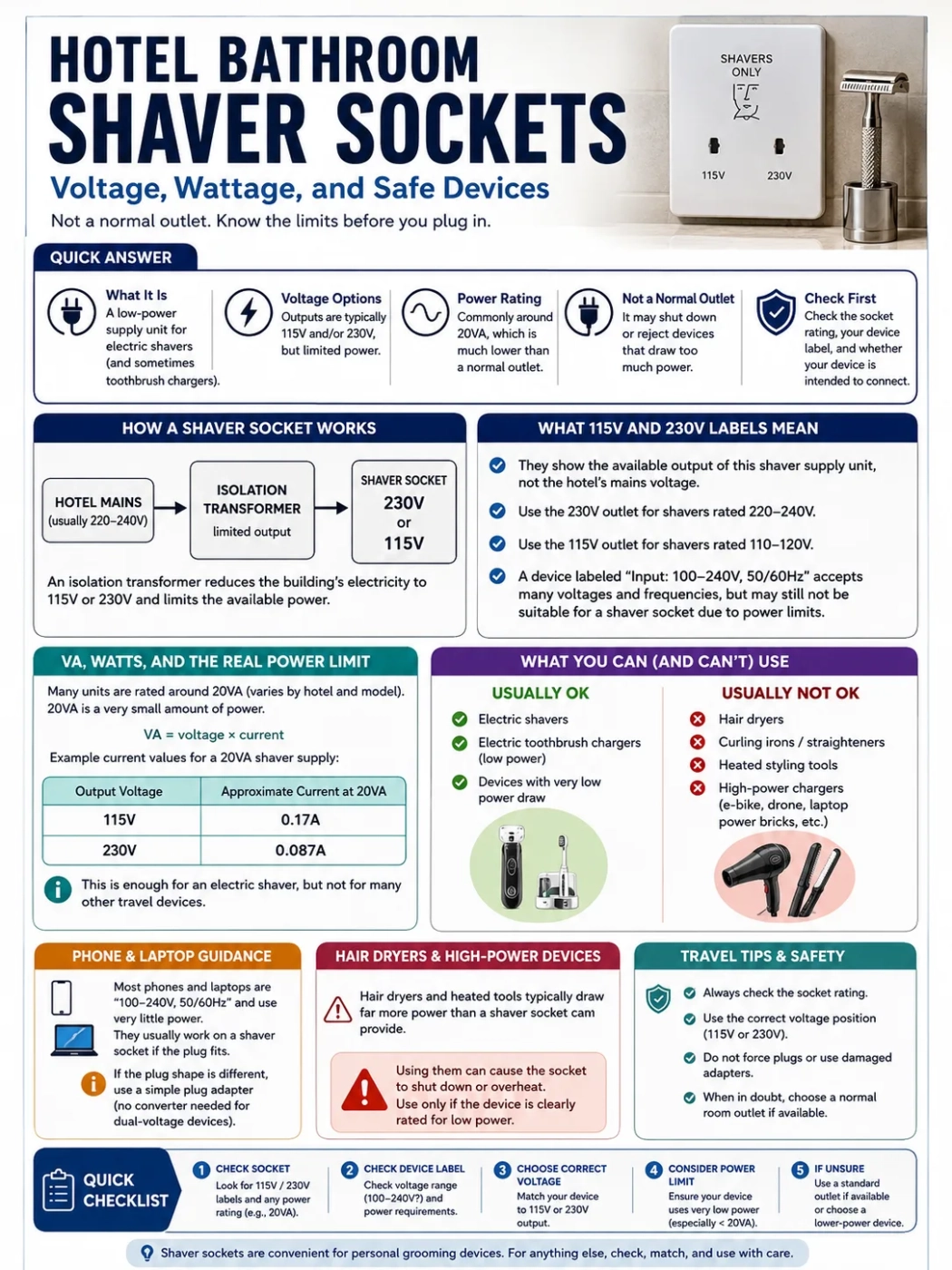
A hotel bathroom shaver socket is not the same as a normal wall outlet. Many are purpose-built, low-power supply units intended for electric shavers and, on some models, electric toothbrush chargers. A socket marked 115V or 230V may look useful for other travel devices, but voltage is only one part of the decision. You also need to check the socket’s power rating, the device’s input label, and whether that type of device is intended to be connected.
A 115V marking on a bathroom shaver socket does not mean the hotel has provided a normal North American 115V outlet. In a hotel supplied at 220–240V, the lower-voltage output may be produced by the shaver supply unit itself.
Why Hotel Shaver Sockets Are Different
A typical bathroom shaver supply unit can contain an isolation transformer between the building’s electrical supply and the outlet used by the guest. Some designs provide two output choices, commonly around 115V and 230V, while keeping the available power much lower than a normal room socket.
This explains why a shaver socket can appear in a bathroom where an ordinary general-purpose socket would not normally be placed in the same way. It also explains why the socket may reject or shut down under loads that a bedroom outlet could easily supply.
What 115V and 230V Labels Actually Tell You
Dual-voltage shaver sockets often have separate positions marked 115V and 230V, or similar values such as 110V, 120V, 220V, or 240V. These markings describe the available output of that particular supply unit. They should not be used to determine the normal voltage of the country or hotel.
If an electric shaver is marked for 220–240V operation, the higher-voltage outlet is normally the relevant one. A shaver intended for approximately 110–120V operation may require the lower-voltage output, provided its frequency and power requirements are also compatible.
A device marked Input: 100–240V, 50/60Hz accepts a wide range of normal AC supply voltages and both common mains frequencies. That makes voltage compatibility much easier, but it does not automatically make the device suitable for a shaver socket.
VA, Watts, and the Real Power Limit
The part travelers often miss is the output capacity. Some bathroom shaver supply units are rated around 20VA, but 20VA should not be treated as a universal specification. Different units can have different ratings, so the marking on the actual socket or its instructions takes priority.
VA means volt-amperes. For a simple calculation:
VA = voltage × current
A 20VA output therefore represents only a small amount of available current:
| Output voltage | Approximate current at 20VA |
|---|---|
| 115V | 0.17A |
| 230V | 0.087A |
These figures explain why a shaver socket behaves very differently from an ordinary wall outlet. They are not a rule saying that every device below those current values is safe to connect.
Why a 20W Charger Is Not Automatically a Match for a 20VA Socket
A USB-C charger advertised as 20W usually states the maximum power it can deliver on its low-voltage USB output. That is not the same measurement as the AC input presented to the bathroom socket.
The charger may also have conversion losses, power-factor characteristics, startup behavior, and an AC input rating that differs from the number printed beside its USB output. Comparing “20W” on a phone charger directly with “20VA” on a shaver socket is therefore not a reliable compatibility test.
When a charger is close to the apparent limit of the socket, use a normal room outlet instead of trying to calculate your way to the edge of the shaver socket’s rating.
Which Devices Belong on a Shaver Socket?
| Device | Typical guidance | What to check |
|---|---|---|
| Electric shaver | Usually the intended device | Voltage, frequency, input power and socket rating |
| Electric toothbrush charger | Often suitable on units designed to support it | Socket instructions and charger input label |
| Phone charger | Prefer a normal room outlet | Input voltage, AC power requirement and socket restrictions |
| Smartwatch charger | Prefer a normal room outlet or hotel USB port | Charger input and socket instructions |
| Camera battery charger | Prefer a normal room outlet | Input voltage and power requirement |
| Laptop charger | Do not rely on a shaver socket | Use an appropriately rated normal outlet |
| Hair dryer | Do not use | High-power heating appliance |
| Curling iron | Do not use unless the outlet is explicitly designed and rated for it, which ordinary shaver outlets are not | Use a normal compatible outlet instead |
| Hair straightener | Do not use on an ordinary shaver outlet | Use a correctly rated normal outlet |
| Clothes iron or kettle | Do not use | Very high power demand |
| CPAP machine | Do not assume compatibility | Use the manufacturer’s approved power supply and an appropriate normal outlet |
| Power strip or multi-port extension | Do not use | Can add several loads to a low-power outlet |
Electric Shavers
Electric shavers are the device these outlets are primarily intended to serve. Check the label on the shaver, charging adapter, or charging base rather than the battery voltage inside the shaver.
A rechargeable shaver may have a low-voltage battery while its wall charger accepts 100–240V, 50/60Hz. A corded shaver can have a narrower input range. Those are different electrical situations even though both devices are called electric shavers.
Electric Toothbrush Chargers
Some modern shaver supply units are specifically designed to support electric toothbrush chargers as well as shavers. Do not assume that every old hotel shaver outlet offers the same capability.
Check for labeling on the socket and check the charger’s input information. If the outlet has no clear rating or instructions, the normal room outlet is the simpler choice when the toothbrush charger can be used there safely.
Phone and USB Chargers
Phone chargers are usually low-power compared with heating appliances, and many are dual voltage. That does not make a bathroom shaver outlet a general charging station.
A charger marked Input: 100–240V, 50/60Hz will normally tolerate the voltage and frequency found in most destinations when connected to a suitable normal outlet. If its plug shape does not match the local outlet, a travel adapter may be required.
A plug adapter does not convert voltage. It changes physical plug compatibility. It does not turn a 230V supply into 120V or increase the power capacity of a shaver socket.
Laptops and Larger Chargers
Laptop power adapters commonly require far more power than a bathroom shaver supply is intended to provide. Even when the laptop charger accepts 100–240V, that only answers the voltage question.
Use a normal hotel room outlet with the correct plug adapter and confirm the charger’s input label. Do not use a shaver socket as a substitute because the bedroom outlet is occupied.
Hair Dryers, Straighteners, Curling Irons, and Kettles
Heating appliances belong in a different power category. Hair dryers, kettles, irons, many straighteners, and similar appliances can demand hundreds or well over a thousand watts.
Do not connect a high-power appliance to a low-power bathroom shaver socket simply because its plug fits.
For these devices, both normal outlet voltage and appliance wattage matter. A traveler moving from a 120V country to a 220–240V country should pay particular attention to single-voltage hair appliances.
Why “Input: 100–240V” Is Only Half the Check
The most useful information on a travel charger is usually the AC input line. For example:
Input: 100–240V~ 50/60Hz
This means the power supply is designed to accept voltages across that range and either 50Hz or 60Hz. A phone, tablet, camera, or laptop charger with this marking normally does not need a voltage converter when used from a suitable normal wall outlet.
There are still separate questions:
- Does the plug physically fit the outlet?
- Is the outlet intended for this type of device?
- Can the outlet provide enough power?
- Does the device require grounding?
- Is the device or charger damaged?
Voltage compatibility answers only one of them.
Does 50Hz or 60Hz Matter?
Many modern electronic chargers accept both frequencies, which is why labels often show 50/60Hz. Frequency deserves more attention with older corded shavers, motor-driven appliances, timing-dependent equipment, and devices that specify only one frequency.
If a shaver says only 120V 60Hz, a 115V output in a 50Hz country does not automatically make the appliance fully compatible. Check the appliance instructions rather than relying only on the voltage number.
Is a Shaver Socket a Voltage Converter?
A dual-voltage shaver supply can produce a lower-voltage output from a higher-voltage building supply. In that limited sense, there is voltage transformation taking place inside some units.
It should still not be treated as a general travel voltage converter. The outlet is intended for a narrow class of low-power devices and has a much smaller power capacity than a normal room socket.
This matters for travelers from 100–120V countries. Seeing “115V” beside a hotel bathroom outlet does not mean a 120V hair dryer, curling iron, coffee maker, or other high-power appliance can be used there.
Plug Fit, Voltage, and Power Are Three Separate Checks
Bathroom shaver sockets may accept more than one two-pin plug shape. Physical fit can therefore create a false sense of compatibility.
| Check | Question |
|---|---|
| Plug | Does the device plug fit the intended socket position correctly? |
| Voltage and frequency | Does the device label accept the outlet voltage and available frequency? |
| Power and permitted use | Is the outlet rated and intended for this device? |
A device should not be judged safe from plug fit alone.
A Practical Check Before Plugging In
- Step 1: Read the bathroom socket. Look for 115V, 230V, VA, “Shavers Only,” toothbrush symbols, or other instructions.
- Step 2: Read the appliance or charger’s INPUT label, not only the wattage advertised on the front of the charger.
- Step 3: Match the device’s accepted voltage and frequency to the available output.
- Step 4: Consider the type of device. A shaver and a hair dryer can operate at similar voltage while requiring completely different amounts of power.
- Step 5: If the outlet’s rating or intended use is unclear, use a suitable normal room outlet instead.
Four Common Hotel Situations
A 120V Shaver in a 230V Country
The hotel bathroom has separate 115V and 230V shaver outputs. The shaver is labeled 120V 50/60Hz and has a low input power requirement. The 115V position may be the appropriate output, subject to the socket’s instructions and the appliance manufacturer’s permitted voltage range.
A 1,500W Hair Dryer Beside a 115V Shaver Socket
The 115V marking does not make the outlet appropriate. A typical low-power shaver supply cannot provide anything close to the power required by a hair dryer. Use a normal outlet only when the dryer’s voltage and wattage are compatible with that supply.
A USB-C Charger Marked 20W
The shaver socket is marked 20VA. Do not assume the two numbers cancel each other out. The charger’s 20W figure commonly refers to its DC output capability, while the bathroom outlet’s 20VA figure describes its AC supply rating. Use a normal room outlet where possible.
A Worldwide Shaver Charger
The charger says Input: 100–240V, 50/60Hz. Voltage and frequency compatibility are broad, but the socket’s intended use and power rating should still be checked. This is the type of low-power personal-care device most likely to match the purpose of a shaver outlet.
Do Not Use a Damaged Bathroom Socket
Do not connect a device if the socket appears damaged. Warning signs include:
- cracks or broken plastic
- a loose faceplate
- dark discoloration or burn marks
- a burnt electrical smell
- buzzing or crackling
- visible arcing
- parts of the socket becoming unusually hot
- water entering or sitting directly around the outlet
Stop using the outlet and report the problem to the hotel. Do not attempt to repair or open a hotel electrical fitting.
The Practical Rule for Travelers
Read hotel shaver sockets in this order: intended device, voltage, frequency, and power rating. A 115V marking does not turn the bathroom outlet into an unrestricted 115V wall socket, and a plug that fits does not prove electrical compatibility.
Electric shavers are usually the intended load. Some units also support toothbrush charging. Phones and laptops are better connected to suitable normal room outlets, while hair dryers, curling irons, kettles, irons, CPAP machines, and other higher-power or specialized devices should never be assumed compatible with a shaver socket.
Frequently Asked Questions
Can I charge my phone from a hotel shaver socket?
Do not assume that you can. Even a low-wattage phone charger may not be an intended load for the shaver supply. A normal room outlet is preferable when available.
Can I plug a 120V electric shaver into a 115V hotel socket?
Possibly, if the shaver’s permitted voltage and frequency range includes the available output and its power requirement is within the socket’s rating. Check both labels before use.
Why does a hotel in a 230V country have a 115V bathroom outlet?
Some shaver supply units use an internal transformer to provide a lower-voltage output for low-power personal-care appliances. That 115V outlet is separate from the normal building supply available from room outlets.
Can I use a hair dryer in a 115V shaver socket?
No, not on an ordinary low-power shaver outlet. Hair dryers require far more power than these outlets are designed to provide.
Does a universal travel adapter make a shaver socket safe for any device?
No. A plug adapter does not convert voltage and does not increase the socket’s power capacity. The device, voltage, frequency, and outlet rating must still be compatible.
Is 20VA the standard rating for every hotel shaver socket?
No. 20VA is used by a number of shaver supply designs, but it should not be treated as a universal rating. Read the markings on the specific outlet whenever they are available.