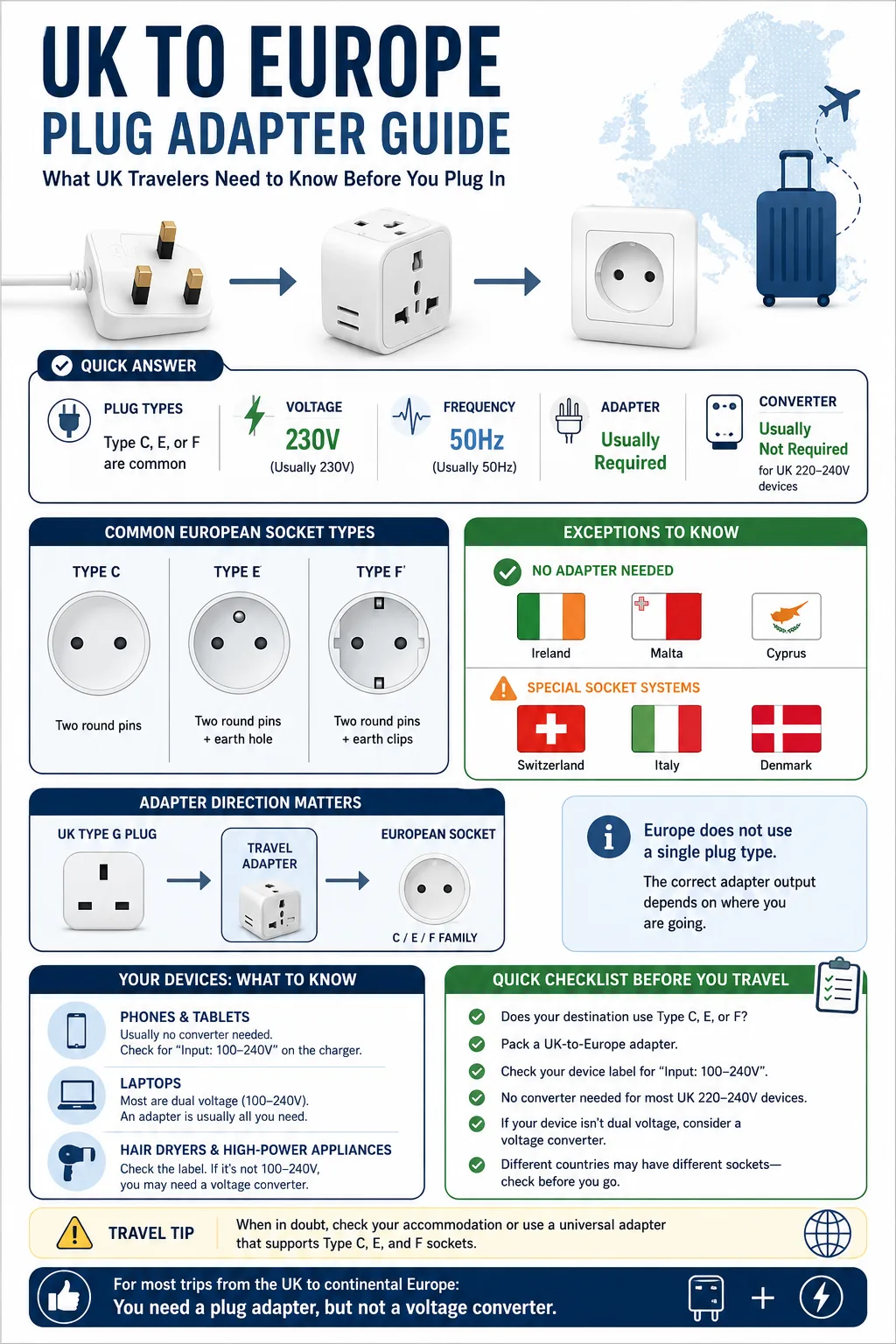
For most trips from the UK to continental Europe, you need a plug adapter but not a voltage converter. UK devices normally use the three-pin Type G plug, while many European destinations use round-pin Type C, E, or F socket systems. The UK and most of Europe use 230V electricity at 50Hz, so a normal UK 220–240V appliance or a charger marked Input: 100–240V is usually voltage-compatible.
There are exceptions to the usual “UK to EU adapter” rule. Ireland, Malta, and Cyprus use Type G sockets, so a standard UK plug generally fits without an adapter. Switzerland, Italy, and Denmark also deserve extra attention because their local grounded socket systems differ from the Type E/F arrangements found across much of continental Europe.
| Check | UK | Most continental European destinations |
|---|---|---|
| Common plug system | Type G | Type C, E, or F are common |
| Nominal voltage | 230V | Usually 230V |
| Frequency | 50Hz | Usually 50Hz |
| Plug adapter | — | Usually required |
| Voltage converter | — | Usually not required for UK 220–240V devices |
| Main exceptions | Type G | Ireland, Malta, and Cyprus also use Type G; Switzerland, Italy, and Denmark have local socket differences |
From a UK Type G Plug to a European Socket
A UK-to-Europe adapter must accept your UK Type G plug on one side and connect to the socket used at your destination on the other. Adapter direction matters: an adapter designed for a European plug going into a UK socket is the opposite product.
The drawing represents the common travel situation rather than one universal European socket. Europe does not use a single plug type. The correct output side of the adapter depends on where you are going.
Europe Does Not Have One Universal Wall Socket
“European adapter” is useful shopping shorthand, but it can hide differences between countries. Type C, E, and F systems cover many popular destinations, while several countries use different grounded designs.
| Destination | Common socket types | Will a UK Type G plug fit directly? | Practical adapter choice |
|---|---|---|---|
| France and Belgium | Type C / E | No | UK-to-Europe adapter compatible with Type E; grounded E/F designs are useful for grounded equipment |
| Germany, Spain, Portugal, Netherlands, Austria | Type C / F | No | UK-to-Type F or E/F-compatible adapter |
| Italy | Type C / F / L | No | Check for Italian Type L compatibility, especially when relying on one adapter |
| Switzerland | Type C / J | No | Swiss Type J-compatible adapter is the safer planning choice |
| Denmark | Type C / F / K arrangements may be encountered | No | Check Danish compatibility when grounding is required |
| Ireland | Type G | Yes | Normally no plug adapter |
| Malta | Type G | Yes | Normally no plug adapter |
| Cyprus | Type G | Yes | Normally no plug adapter |
Socket designs can vary by building and installation. Multi-standard sockets may also appear in some hotels, but they should not be treated as the normal national socket or something you can depend on for a trip.
Which Adapter Covers Most Mainland European Trips?
For travel through countries such as France, Germany, Spain, Portugal, the Netherlands, Austria, and Belgium, an adapter designed for UK Type G plugs and grounded Type E/F-compatible sockets is a practical option.
A basic adapter ending in two round pins may physically work in many sockets, but that does not mean it preserves protective earth. This difference matters more for grounded appliances than for small double-insulated chargers.
Simple two-pin adapters
These are often suitable for low-power equipment that does not require an earth connection, such as many phone chargers and small USB power supplies. Their small size does not make them suitable for every appliance.
Grounded E/F-compatible adapters
These are better suited to equipment that needs protective earth. Type E and Type F use different earth-contact arrangements, so an adapter intended to support both systems is more useful on multi-country trips than a basic ungrounded two-pin design.
Physical plug fit and electrical grounding are separate issues. Do not assume that an adapter preserves earth simply because the appliance turns on.
France and Germany: Similar Pins, Different Grounding
France and Germany are a useful example of why the phrase “two round pins” does not describe the whole socket.
French Type E outlets traditionally use a protruding earth pin. German Type F, often called Schuko, uses earth contacts at the sides of the socket. Many modern grounded plugs and travel adapters are designed to work with both arrangements.
A small ungrounded Europlug-style connection can work with many Type E and Type F sockets, but it does not provide protective earth. For grounded equipment, choose an adapter that specifically maintains the grounding connection.
Italy, Switzerland, and Denmark Need a Closer Check
Italy: Type L remains part of the socket landscape
Italy commonly uses Type C, F, and L arrangements. Some sockets accept more than one plug format, but travelers should not assume that every Italian outlet will accept the same adapter they used in Germany or Spain.
If Italy is part of a multi-country journey, check that the adapter is explicitly compatible with the sockets you expect to use there rather than relying only on a generic “Europe” label.
Switzerland: grounded equipment needs Type J planning
Switzerland uses the Type J system. Small two-pin Type C Europlugs can fit compatible Swiss outlets, but a larger grounded plug made for Type E/F sockets should not automatically be assumed to fit a Swiss Type J outlet.
For a UK traveler carrying grounded equipment, a UK-to-Switzerland Type J adapter is the clearer choice.
Denmark: grounding changes the adapter decision
Denmark uses Type K as its national grounded plug system, although travelers may also encounter sockets that accept other common round-pin plugs. Simple two-pin equipment may be less complicated, but grounded appliances deserve a Denmark-compatible solution rather than relying only on pin dimensions.
Ireland, Malta, and Cyprus Are Different
These destinations are easy to miss when people assume that all European countries use round-pin plugs.
Ireland, Malta, and Cyprus use Type G sockets, the same plug format used in the UK. A normal UK Type G plug therefore generally connects directly without a travel plug adapter.
The electrical supply is also broadly aligned with standard UK equipment at 230V and 50Hz. Device-specific limits still apply, but the normal UK-to-continental-Europe plug problem is absent.
Do UK Devices Need a Voltage Converter in Europe?
For normal UK-market equipment, usually not. The UK uses a nominal 230V supply at 50Hz, and most European destinations also use 230V at 50Hz.
A plug adapter does not convert voltage. It only changes the physical connection between the plug and the wall socket.
If the label says 220–240V, 50Hz
A UK appliance with an input range covering 220–240V and 50Hz is normally electrically suited to the 230V/50Hz supply found across most of Europe. You may still need the correct plug adapter.
If the label says Input: 100–240V, 50/60Hz
This is common on phone chargers, laptop power supplies, camera chargers, and many USB-C chargers.
Input: 100–240V means the power supply is designed to operate across both common low-voltage and high-voltage mains systems within that stated range. A charger with this marking normally does not need a voltage converter in Europe.
You still need a plug adapter when the wall socket does not accept Type G.
If the device says 110V or 120V only
Do not assume the device is suitable simply because you normally use it in the UK. A device originally bought for a 110–120V country can still be a 120V-only appliance even if it has been brought to Britain.
A 120V-only device should not be connected directly to a 230V supply through a simple plug adapter. A suitable voltage conversion solution may be required, and some appliances are poor candidates for travel voltage conversion because of their power demand or motor design.
Does 50Hz Versus 60Hz Matter?
For a normal UK-to-Europe trip, frequency is rarely the main problem because the UK and most European countries use 50Hz.
Modern electronic power supplies marked 50/60Hz are designed for either frequency. Extra checking becomes more relevant if the equipment was imported from a 60Hz-only market or contains a motor, timer, pump, or other component whose operation can depend on supply frequency.
Read the device label rather than assuming that a familiar UK plug proves the equipment itself was designed for 50Hz.
Phones, Laptops, Cameras, and USB Chargers
Modern travel electronics are usually the easiest devices to take from the UK to Europe because their chargers often accept a wide input range.
| Device | Plug adapter? | Voltage converter? | What to check |
|---|---|---|---|
| Phone charger | Usually on mainland Europe | Usually no | Look for Input: 100–240V, 50/60Hz |
| Laptop charger | Usually on mainland Europe | Usually no | Input range and whether grounding is required |
| USB-C charger | Usually on mainland Europe | Usually no | Mains input rating; USB-C output wattage is a separate issue |
| Camera battery charger | Usually on mainland Europe | Usually no if 100–240V | Input label |
| Electric shaver | Usually on mainland Europe | Depends on model | Check whether the shaver or charging base supports 230V |
| CPAP machine | Usually on mainland Europe | Depends on its power supply | Power-brick input rating and manufacturer instructions |
A phone or laptop having a USB or USB-C connection does not tell you the mains input range of its charger. The relevant information is on the charger or power supply that connects to the wall.
Hair Dryers, Straighteners, Kettles, and Irons
High-power appliances need more attention than phone and laptop chargers. A UK hair dryer may already be designed for 220–240V, so voltage itself may not be the problem. The travel adapter must still be designed for the appliance’s load.
This applies to:
- hair dryers
- hair straighteners
- curling irons
- travel kettles
- clothes irons
- other heating appliances
Check both the appliance rating and the adapter’s maximum current or power rating. Do not assume that a small travel adapter can safely carry the same load as a normal UK wall socket.
A low-power phone charger and a 2,000W-class heating appliance place very different demands on an adapter, even when both devices are designed for 230V.
The fuse in a UK plug does not make every adapter suitable
Standard UK Type G plugs normally include a fuse, but that fuse does not increase the rating of the travel adapter connected after it. A poorly rated, loose, damaged, or ungrounded adapter can still be the weak point in the connection.
For high-power equipment, check the adapter’s markings rather than assuming that the fuse in the UK plug makes the whole setup suitable.
Grounding: Plug Fit Is Not Enough
A device can receive power even when the adapter does not maintain its protective earth connection. That makes grounding a separate compatibility check.
A two-pin adapter cannot carry an earth connection through to the socket. This may be acceptable for equipment designed to operate without protective earth, but it is not a substitute for a grounded connection when the appliance requires one.
Do not decide whether a device requires earth only from the appearance of its UK plug. Some double-insulated UK devices still use a Type G-shaped plug arrangement. Check the equipment markings or instructions when grounding matters.
One Adapter for a Multi-Country European Trip?
Whether one adapter is enough depends on the route.
| Route | Socket considerations | Planning approach |
|---|---|---|
| France → Netherlands → Germany → Spain | Mainly Type E/F-family grounded sockets | A grounded E/F-compatible UK adapter can cover many situations |
| France → Germany → Italy | Type E/F plus Italian Type L | Make sure the adapter also covers the Italian sockets you may encounter |
| France → Switzerland | Type E followed by Swiss Type J | Check Swiss Type J compatibility separately |
| Germany → Denmark | Type F followed by Danish Type K considerations | Grounded equipment may need broader compatibility than a basic two-pin adapter provides |
| UK → Ireland → Malta | Type G throughout | A normal UK Type G plug generally needs no adapter |
Travelers carrying only a phone charger have more flexibility than travelers carrying grounded laptops, medical equipment, or high-power appliances. Choose the adapter around the most demanding device you plan to use, not only the smallest charger in your bag.
Compact Europe Adapter or Universal Travel Adapter?
A dedicated UK-to-Europe adapter is usually the simpler option for a trip limited to a few compatible European countries. It is small, has fewer moving parts, and its intended socket family is easier to identify.
A universal travel adapter can be useful for travel across several plug regions, but the word “universal” should not be interpreted as an electrical guarantee.
- Universal does not mean voltage converting.
- Not every universal adapter provides protective earth in every configuration.
- The maximum load may be lower than a high-power appliance requires.
- Swiss, Italian, or Danish socket compatibility should still be checked.
Check the Adapter Before You Pack It
The product label matters more than a generic “Europe” description. Before relying on an adapter, check:
- Direction: it must accept a UK Type G plug and connect to the destination socket.
- Destination compatibility: check Type E/F, J, K, or L support when relevant.
- Grounding: determine whether protective earth is carried through when your equipment requires it.
- Electrical rating: compare the adapter’s maximum current or wattage with the appliance.
- Condition: do not rely on adapters with loose pins, cracked housings, or unstable plug connections.
- Built-in USB charging: check the mains input specification separately from the USB output specification.
Hotel and Universal-Looking Sockets
Some European hotels provide USB charging ports, international sockets, or outlets designed to accept several plug formats. Their availability varies, so they are best treated as an extra rather than a replacement for the adapter you know you need.
Do not assume that a hotel’s universal-looking socket changes the voltage. A multi-standard socket normally changes only which plug shapes can connect to the supply.
Bathroom shaver sockets also deserve separate treatment. They are intended for specific low-power bathroom equipment and should not be treated as general-purpose outlets for hair dryers, kettles, or other high-power appliances.
What to Pack from the UK
- A UK-to-Europe adapter suited to the plug types on your route
- A grounded adapter if any of your equipment requires protective earth
- A separate Type J-compatible solution if Switzerland requires it for your equipment
- Suitable Italy or Denmark compatibility when those destinations are part of the trip
- Your normal UK plugs for Ireland, Malta, or Cyprus, where Type G is used
- Chargers with clearly marked voltage and frequency input ranges
- An adapter rated for the load if you plan to use high-power appliances
Before departure, check the label on every appliance that connects directly to mains electricity. For most phones and laptops the relevant line will be something like Input: 100–240V, 50/60Hz. Hair appliances, kettles, medical equipment, and imported single-voltage devices deserve a separate check.
Common UK-to-Europe Adapter Mistakes
- Buying an EU-to-UK adapter instead of a UK-to-EU adapter
- Assuming every European country uses the same two-pin socket
- Using an ungrounded two-pin adapter for equipment that requires protective earth
- Believing a plug adapter changes 120V into 230V or 230V into 120V
- Assuming the UK plug fuse means any travel adapter can handle a high-power appliance
- Taking a standard Schuko-focused adapter to Switzerland without checking Type J compatibility
- Ignoring Type L when planning travel in Italy
- Buying an adapter for Ireland, Malta, or Cyprus even though normal UK Type G plugs generally fit
- Relying on hotel USB or universal outlets instead of packing the required adapter
Frequently Asked Questions
Do UK plugs work in Europe?
UK Type G plugs do not fit most continental European sockets directly, so a plug adapter is usually required. Ireland, Malta, and Cyprus use Type G, so a normal UK plug generally fits there.
Do I need a voltage converter from the UK to Europe?
Usually not for normal UK equipment. The UK and most of Europe use 230V at 50Hz. Check the device label; equipment marked 220–240V or Input: 100–240V is normally compatible with a 230V supply.
What adapter should I use from the UK to France or Germany?
France uses Type E arrangements while Germany primarily uses Type F. A grounded UK-to-Europe adapter designed for Type E/F compatibility is a practical choice when traveling to both countries.
Can I use the same UK adapter in Spain and Italy?
Possibly, but do not assume every Italian socket matches the Type F arrangement commonly encountered in Spain. Italy also uses Type L, so check the adapter’s Italian compatibility before relying on one adapter for both destinations.
Can I use a UK hair dryer in Europe?
A UK hair dryer designed for 220–240V is usually voltage-compatible with a 230V European supply, but you still need the correct plug adapter. The adapter must also be rated for the hair dryer’s high power demand.
Will my UK phone and laptop chargers work in Europe?
Most modern chargers will if their labels state Input: 100–240V, 50/60Hz. A voltage converter is normally unnecessary, but a plug adapter is still required wherever the local socket does not accept Type G.