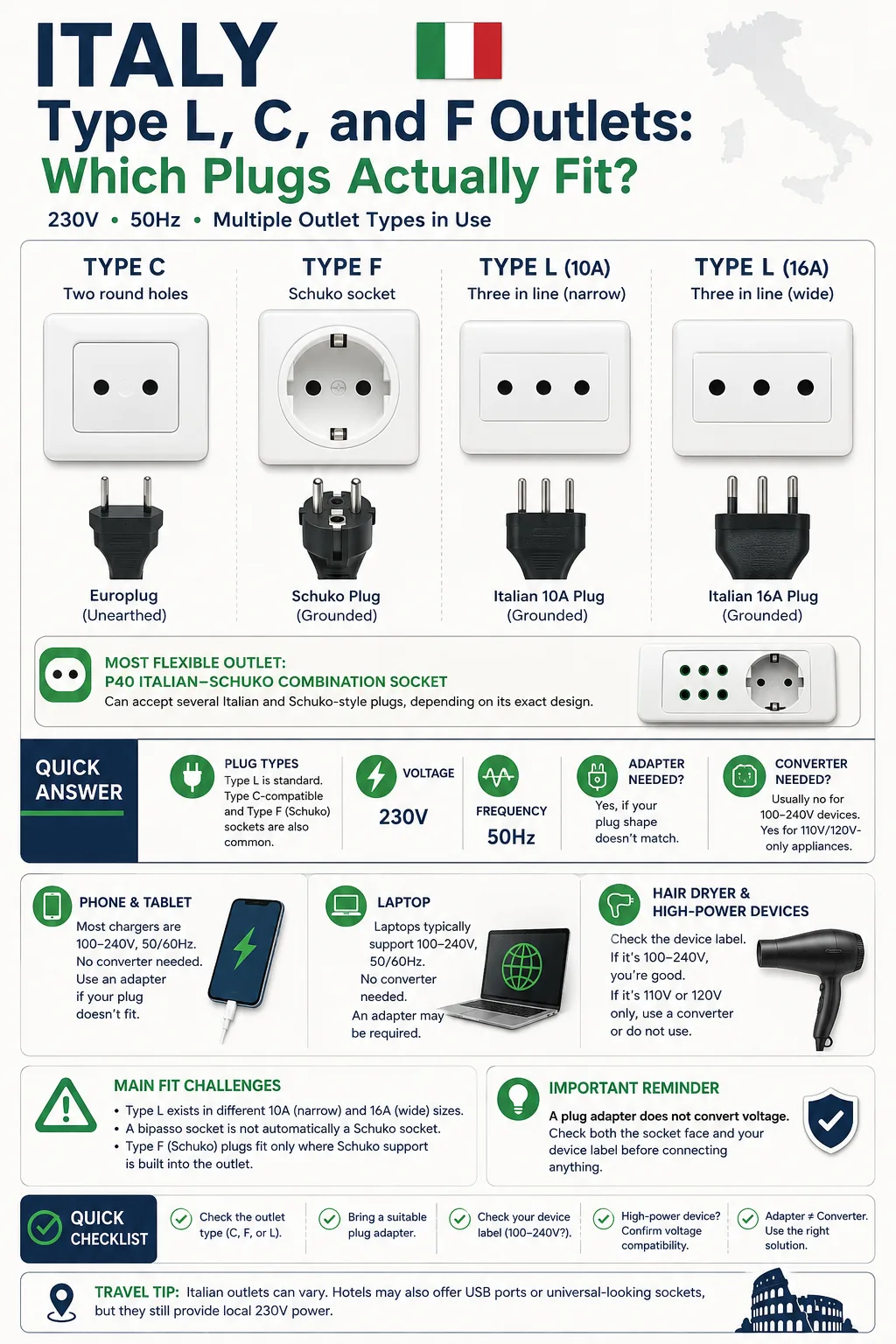
Italy uses 230V electricity at 50Hz, but the wall outlet is not always the same shape. Travelers may see Type L, Type C-compatible openings, Type F Schuko sockets, or Italian combination sockets that accept more than one plug. A thin two-pin Europlug often fits, while a grounded Type F plug fits only where Schuko support is built into the outlet. A plug adapter does not convert voltage. Check both the socket face and the device label before connecting anything.
| Item | What travelers should know |
|---|---|
| Common plug and socket types | Type L is the Italian standard. Type C-compatible and Type F-compatible sockets are also common through combination designs. |
| Standard voltage | 230V |
| Frequency | 50Hz |
| Most flexible Italian outlet | A P40 Italian-Schuko combination socket can accept several Italian and Schuko-style plugs, depending on its exact design. |
| Main fit problem | Type L exists in different 10A and 16A sizes, and a bipasso socket is not automatically a Schuko socket. |
| Voltage converter | Usually unnecessary for devices marked Input: 100–240V, 50/60Hz. A 110V- or 120V-only appliance may need a suitable converter or should not be used. |
What the Power Outlets Look Like
These drawings show the basic front shapes rather than exact engineering dimensions. Real wall sockets can look different because Italian outlets are sold as single-standard and multi-standard designs. Hotels may also install USB ports or universal-looking sockets. Plug shape and voltage are separate issues, and a multi-standard socket still supplies the local 230V electricity.
Why One Italian Wall Plate Can Accept Several Plugs
Italy is unusual for travelers because the same room may contain outlets with very different levels of compatibility. The label “Type L country” is correct, but it does not describe every socket face a visitor may meet.
Standard Type L 10A Socket
The 10A Type L layout has three round holes in a straight line. The center hole is the protective earth connection. Its outer openings use the narrower 19 mm spacing associated with the 10A Italian system.
A thin CEE 7/16 Europlug usually fits this layout because its two pins match the smaller spacing. A Type F Schuko plug does not fit correctly: its pins are thicker, its body is wider, and it expects side grounding contacts that a basic Type L socket does not provide.
Standard Type L 16A Socket
The 16A Type L socket uses the same straight-line arrangement but has larger holes and wider 26 mm spacing. A 10A Type L plug and a 16A Type L plug are therefore not interchangeable in older or single-size sockets.
A traveler should not assume that a thin Europlug will fit a pure 16A Type L outlet. The holes may look familiar, but the spacing is different. Combination sockets solve this problem; a basic 16A-only socket does not.
P17/11 Bipasso Socket
The Italian bipasso socket combines the 10A and 16A Type L dimensions. Its outer openings often resemble a figure eight, allowing both the narrow and wide Italian pin spacing to be used. The center grounding opening serves the Type L earth pin.
Bipasso does not mean universal. A plain bipasso socket may accept Type L 10A, Type L 16A, and a thin Europlug, yet still reject a Type F Schuko plug. The absence of a recessed round Schuko cavity and side grounding clips is the clue.
P40 Italian-Schuko Combination Socket
A P40 socket combines Italian openings with a Schuko-style recessed area and side grounding contacts. This is the outlet most likely to accept Type L plugs, thin Europlugs, and grounded Type F or CEE 7/7 plugs without a separate adapter.
P40 products are not all visually identical, and the accepted plug list depends on the exact socket design. Look for both the round recessed cavity and the metal grounding contacts at the sides before treating an outlet as Type F-compatible.
Which Plugs Actually Fit?
| Traveler’s plug | Type L 10A only | Type L 16A only | Bipasso P17/11 | P40 / Schuko combination |
|---|---|---|---|---|
| Thin Type C Europlug, CEE 7/16 | Usually fits | Do not assume | Usually fits | Usually fits |
| Thick two-pin CEE 7/17 plug | No | No | Usually no | Usually fits |
| Type F Schuko plug | No | No | No, unless Schuko contacts are also present | Yes, when the socket includes side earth contacts |
| CEE 7/7 Type E/F hybrid plug | No | No | No, unless Schuko support is built in | Usually fits through its Schuko-compatible side contacts |
| Type L 10A plug | Yes | No | Yes | Usually yes |
| Type L 16A plug | No | Yes | Yes | Usually yes |
| Type A, B, or G plug | Adapter needed | Adapter needed | Adapter needed | Adapter needed |
The table describes physical fit, not electrical suitability. A device can fit the wall and still be unsafe on 230V. Grounding can also be lost when an adapter accepts a three-prong plug but connects to the wall through only two live pins.
The Two Round Pins Problem: Type C Is Not One Shape
Travelers often call every two-round-pin plug “Type C,” but two common plug designs behave differently in Italy.
Thin CEE 7/16 Europlug
The Europlug has slim round pins and a flat, ungrounded body. It is used on many phone chargers, camera chargers, small laptop power bricks, electric toothbrush chargers, and other low-power devices. It commonly fits Type L 10A, bipasso, Type C, and Schuko-compatible sockets.
Because it has no earth contact, it is suitable only for equipment designed to operate without protective grounding. Its small size does not make it a high-power plug.
Thicker CEE 7/17 Two-Pin Plug
The CEE 7/17 plug also has two round pins, but the pins are thicker and the body is designed for higher-current European sockets. It can appear on hair dryers, vacuum cleaners, heaters, and other appliances that do not require grounding.
This plug should not be forced into an older Type L 10A socket or a plain bipasso outlet. It normally needs a Schuko-compatible socket such as a suitable P40. Counting the pins is not enough; pin thickness and socket construction also matter.
When a Type F Plug Works Without an Adapter
A Type F plug has two thick round pins and metal grounding contacts on its sides. In Italy, it works directly only where the outlet includes Schuko support.
- A recessed round socket with side metal clips is Type F-compatible.
- A P40 combination socket can support Type F while also accepting Italian plugs.
- A straight row of three holes is a Type L socket, not a Schuko socket.
- Figure-eight bipasso openings alone do not provide the side grounding system needed by Type F.
A Type F plug may appear to line up with two openings on an incompatible socket. That is not a valid connection. Do not press, twist, or partly insert the plug to make electrical contact.
Type L 10A and 16A Are Different Physical Standards
| Feature | Type L 10A | Type L 16A |
|---|---|---|
| Pin arrangement | Three round pins in one line | Three round pins in one line |
| Outer-pin spacing | 19 mm | 26 mm |
| Pin size | Smaller | Larger |
| Ground connection | Center pin | Center pin |
| Fits the other single-size socket? | No | No |
| Fits a bipasso socket? | Yes | Yes |
The amperage label is tied to a real size difference. An adapter advertised only as “Type L” may use either the 10A or 16A arrangement, or it may be designed for a multi-standard socket. Check the pin layout, rated current, and whether it preserves grounding for the connected device.
Read the Socket Face Before Using an Adapter
Three Small Holes in One Line
This is likely a Type L 10A socket. A thin Europlug or Type L 10A plug may fit. Type F and Type L 16A plugs do not.
Three Larger, Wider-Spaced Holes
This points to Type L 16A. A Type L 16A plug fits, while a 10A Type L plug or Europlug should not be assumed compatible.
Figure-Eight Openings Around a Center Hole
This is the usual bipasso pattern. It accepts both Italian Type L sizes and commonly accepts a thin Europlug. Without side grounding contacts, it is not a Type F socket.
Round Recess with Side Metal Contacts
This indicates Schuko support. If Italian openings also appear within the recess, it is likely a P40-style combination outlet. This is the best match for travelers carrying Type F plugs.
Grounding Can Be Lost Even When the Device Turns On
Italy’s common plug families use different grounding methods:
- Type L places the protective earth contact in the center of the three-pin line.
- Type F uses metal contacts along the sides of the recessed socket.
- Type C Europlug has no grounding connection.
A grounded laptop cable, desktop computer, medical power supply, or other three-contact device should use an adapter that carries the earth connection from the appliance plug to the Italian outlet. A two-pin adapter may supply electricity while leaving the equipment ungrounded.
Do not remove a grounding pin, use a loose partial connection, or rely on an ungrounded adapter for equipment that is designed to be earthed.
230V and 50Hz: What the Device Label Must Say
Italy’s standard supply is 230V at 50Hz. The safest decision comes from the input line printed on the charger, power brick, appliance label, or instruction plate.
Input: 100–240V, 50/60Hz
This means the power supply is designed to accept the common voltage and frequency ranges used in many countries. Phone chargers, laptop chargers, tablet chargers, camera battery chargers, and USB-C power supplies often carry this marking.
For such a device, the main issue is usually physical plug fit. A suitable plug adapter may be enough. No manual voltage switch should be moved unless the equipment specifically has one.
Input: 220–240V, 50Hz
This rating matches Italy’s normal supply. The device may be used when the plug fits, the outlet is suitable for its load, and any required grounding is preserved.
Input: 110V, 115V, or 120V Only
A single-voltage appliance made only for 110–120V should not be connected directly to an Italian 230V outlet. A plug adapter does not convert voltage. A correctly rated voltage converter may be required, but high-wattage heating appliances can exceed the capacity of small travel converters.
50Hz and Motor-Driven Equipment
Most modern switching chargers marked 50/60Hz handle Italy’s frequency without difficulty. Devices with motors, mechanical timers, pumps, or frequency-dependent speed control may behave differently if they are marked only for 60Hz. Check the manufacturer’s instructions rather than relying on plug fit.
Modern Chargers and High-Power Appliances Need Different Decisions
| Device | What usually matters | Converter likely? |
|---|---|---|
| Phone or tablet charger | Look for Input: 100–240V, 50/60Hz; then solve plug fit. | Usually no when the label covers 230V |
| Laptop or USB-C charger | Check input range, plug shape, wattage, and grounding on three-contact power cords. | Usually no when the power brick covers 230V |
| Camera battery charger | Many are wide-range, but the printed input rating is the deciding information. | Usually no when rated 100–240V |
| CPAP machine | Check the machine’s power supply, humidifier load, grounding, and manufacturer instructions. | Depends on the exact power supply |
| Electric shaver or toothbrush charger | Some are wide-range; older or simpler models may be single-voltage. | Label-dependent |
| Hair dryer, curling iron, or straightener | Check for dual-voltage operation and any manual voltage selector before use. | May be needed for 120V-only models, but converter capacity can be a problem |
| Kettle, clothes iron, or heating appliance | These are high-wattage loads. Plug fit, appliance voltage, adapter rating, and circuit capacity all matter. | Often impractical for a 120V-only model |
Always check the device label before using high-power appliances abroad. A dual-voltage hair tool may still require a selector to be moved to the 220–240V position. A 120V-only hair dryer can overheat or fail quickly on 230V even when an adapter makes the plug fit.
Power Rating Matters After the Plug Fits
At 230V, a 10A connection corresponds to about 2,300W, while a 16A connection corresponds to about 3,680W. These are nominal calculations, not permission to load every outlet or adapter to its maximum.
The safe limit is set by the lowest-rated part in the chain: wall socket, travel adapter, extension lead, power strip, plug, cable, or appliance. A compact travel adapter may have a lower rating than the Italian socket. High-power devices should not be combined on a small multi-plug adapter.
- Stop using a connection that feels loose.
- Disconnect it if the adapter becomes unusually hot.
- Do not use a socket or adapter with scorch marks, cracking, or a burning smell.
- Keep heavy plugs from hanging at an angle and pulling partly out of the wall.
What to Expect in Hotels and Older Apartments
Renovated hotels may install P40 combination sockets, dedicated Schuko outlets, USB charging ports, or multi-standard sockets. Older apartments and historic buildings are more likely to present a mix of Type L 10A, Type L 16A, bipasso, and newer replacement outlets within the same property.
Do not assume that a hotel’s universal-looking socket changes the voltage. It still supplies the local 230V, 50Hz system unless the property clearly provides a separate low-voltage USB output or another labeled supply.
A bedside outlet may accept a Europlug while a desk outlet accepts Type F, or the opposite. Inspect each socket rather than assuming every wall plate in the room has the same compatibility.
Adapter Choices for Common Traveler Plugs
Traveling with a Thin Europlug
You may not need an adapter when the room has Type L 10A, bipasso, Type C, Schuko, or P40 sockets. Carrying a small Italy-compatible adapter can still help when the only available outlet is a less flexible Type L 16A design.
Traveling with a Type F or CEE 7/7 Plug
No adapter is needed at a Schuko or P40 outlet. A Type L adapter with a grounded Schuko input is needed when only Italian Type L or plain bipasso sockets are available. Confirm that the adapter transfers the earth connection and is rated for the appliance load.
Traveling from the United States or Canada
Type A and Type B plugs need an adapter. Many modern phone and laptop chargers accept 100–240V, but North American hair dryers, curling tools, shavers, and small appliances may be 120V-only. Read the input label before packing a converter.
Traveling from the United Kingdom or Ireland
Type G plugs need an adapter. The voltage is similar to Italy’s supply, so equipment rated for 220–240V normally does not need voltage conversion. Choose an adapter that supports grounding when the Type G device requires it.
Traveling with a Swiss Type J Plug
A Type J plug is not the same as Type L even though both use three round pins. The grounding pin position and spacing differ. Use an adapter rather than trying to fit a Swiss plug into an Italian socket.
Five Fit Mistakes to Avoid in Italy
Calling Every Two-Pin Plug Type C
A thin Europlug and a thicker CEE 7/17 plug do not have the same socket compatibility. Check the pin thickness and plug body.
Treating Bipasso as Schuko
Bipasso combines the two Italian Type L sizes. Type F support requires the recessed Schuko shape and side grounding contacts.
Assuming Every Type L Plug Fits Every Type L Socket
The 10A and 16A versions have different pin sizes and spacing. They cross-fit only where the socket is designed for both.
Using a Mechanical Adapter as a Voltage Converter
An adapter changes the physical connection. It does not turn 230V into 120V.
Ignoring the Ground Connection
A device can switch on through an adapter even when its protective earth path has been removed. Grounded equipment needs a grounded connection from plug to wall.
FAQ
Will a Type C plug fit an Italian Type L socket?
A thin CEE 7/16 Europlug usually fits a Type L 10A or bipasso socket. It should not be assumed to fit a pure Type L 16A socket. A thicker two-pin CEE 7/17 plug has different requirements.
Will a Type F plug fit a Type L outlet in Italy?
Not in a basic Type L outlet. A Type F plug fits directly only when the socket includes Schuko support, such as a dedicated Type F socket or a suitable P40 combination socket.
What is the difference between bipasso and P40?
Bipasso accepts the 10A and 16A Italian Type L dimensions. P40 also includes a Schuko-style recess and side grounding contacts, allowing compatible Type F plugs to connect.
Do I need a voltage converter for my phone charger in Italy?
Usually not when the charger says Input: 100–240V, 50/60Hz. You may still need a plug adapter if its plug does not fit the available outlet.
Can I use a 120V hair dryer in Italy with an adapter?
No, not with a plug adapter alone. Italy supplies 230V. A 120V-only hair dryer would need a converter rated for its high wattage, and using a locally compatible or dual-voltage dryer is often more practical.
Does a universal hotel socket make a 120V device safe?
No. A universal-looking socket may accept the plug shape, but it normally still supplies 230V. Check the device label before connecting it.