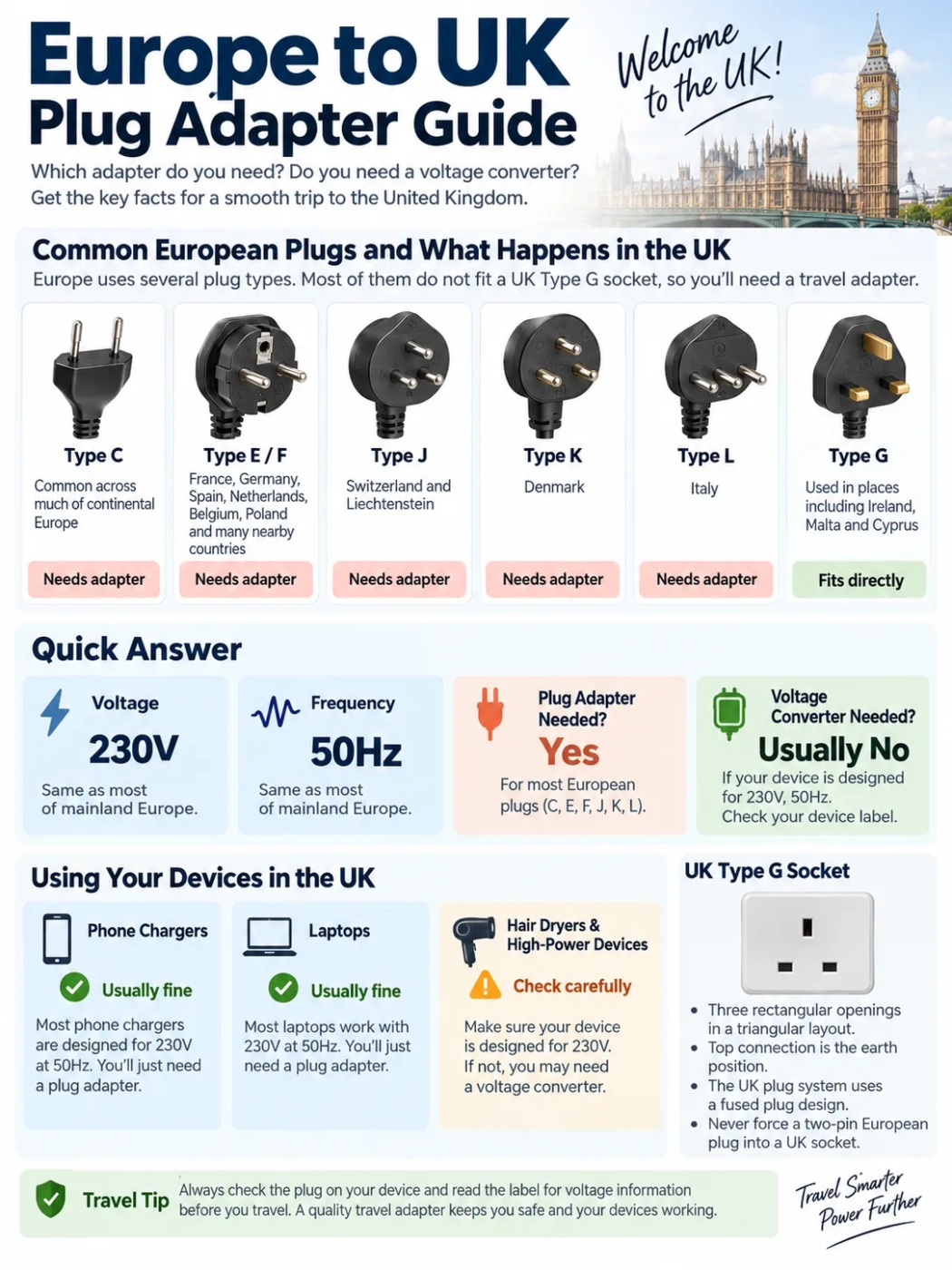
Most travelers arriving in the United Kingdom from continental Europe need a plug adapter that accepts their European plug and fits a UK Type G socket. A voltage converter is usually unnecessary when the device is designed for the 230V, 50Hz supply used across most of mainland Europe, because the UK also uses 230V at 50Hz. The main exceptions are travelers whose devices already have Type G plugs, such as many devices from Ireland, Malta, and Cyprus.
The safest starting point is the plug actually attached to your charger or appliance. Europe does not use one single plug type: Type C, E, F, J, K, L, and G can all appear depending on the country and device.
| Plug on your device | Typical European use | Fits a UK Type G socket? | Usual solution |
|---|---|---|---|
| Type C | Common across much of continental Europe | No | Type C to Type G travel adapter |
| Type E / F | France, Germany, Spain, Netherlands, Belgium, Poland and many nearby countries | No | Grounded E/F-compatible adapter to Type G |
| Type J | Switzerland and Liechtenstein | No | Type J-compatible adapter to Type G |
| Type K | Denmark | No | Type K-compatible adapter to Type G |
| Type L | Italy | No | Type L-compatible adapter to Type G |
| Type G | Used in places including Ireland, Malta and Cyprus | Yes | Usually no plug adapter |
How European Plugs Meet a UK Type G Socket
A UK Type G socket uses three rectangular openings in a triangular layout. The top connection is the earth position, and the UK plug system uses a fused plug design. Round-pin continental plugs do not belong directly in this socket.
Never force a two-pin European plug into a UK socket or use another object to open the socket shutters. If the plug does not fit normally, use a travel adapter intended for that plug type and for UK Type G outlets.
Why a Voltage Converter Is Usually Not Needed
The United Kingdom uses 230V at 50Hz. Most mainland European countries also use a nominal 230V, 50Hz supply. For a device designed for that European supply, the electrical voltage and frequency are therefore normally compatible even though the plug shape is different.
A plug adapter does not convert voltage. It only changes the physical connection between the plug and the wall socket. That is usually enough for a European device already rated for 230V operation, but the device label should still be checked before use.
| Label on the device or power supply | What it usually means in the UK |
|---|---|
| Input: 100–240V, 50/60Hz | The power supply is designed for the UK voltage and frequency; normally only plug compatibility needs to be solved. |
| Input: 220–240V, 50Hz | Normally compatible with the UK supply. |
| Input: 230V, 50Hz | Matches the nominal UK supply. |
| Input: 120V only | Do not assume an adapter is enough; this rating is not suitable for direct connection to 230V. |
| Output: 5V, 9V, 12V or 20V | This is the low-voltage output to the device, not the wall-input rating. Find the line marked Input. |
The wording may vary. A charger marked Input: 100–240V is designed to accept any mains voltage within that range. The 50/60Hz marking means the power supply is also designed for either of those common frequencies.
Grounding Matters: Type C Is Not the Same as Type E or F
A small Type C Europlug has two round pins and is normally used with equipment that does not require an earth connection. Type E and Type F arrangements are different because they support grounding. That difference matters when choosing an adapter.
If an appliance has a grounded Type E or F plug, use an adapter that accepts that grounded plug correctly and maintains an earth connection to the UK Type G side. A mechanical fit alone does not prove that grounding is preserved.
Double-insulated equipment is often marked with a square-inside-a-square symbol and may not require an earth connection. Even then, the adapter still needs an appropriate voltage and power rating for the equipment being used.
Why a small Europlug adapter is not a universal answer
A simple adapter designed around a narrow two-pin Type C plug may be suitable for a phone charger yet be the wrong choice for a larger grounded Schuko-style plug. Check what the adapter accepts rather than relying on the words “European plug.”
Phones, Tablets, Laptops and USB-C Charging
Modern phone, tablet, camera and laptop power supplies are often the easiest devices to use on a Europe-to-UK trip. Many are marked Input: 100–240V, 50/60Hz, which means the power supply itself normally accepts the UK mains supply.
| Device | Typical issue | What to check |
|---|---|---|
| Phone charger | Plug shape | Input rating and the plug fitted to the charger |
| Tablet charger | Plug shape | Input rating and adapter compatibility |
| Laptop power brick | Plug shape, grounding, cable type | Input rating and whether the AC mains lead is detachable |
| Camera battery charger | Plug shape | Input rating, especially on older chargers |
| Electric shaver | Plug shape and possibly voltage on older or single-voltage models | Input rating; do not rely on bathroom socket shape alone |
| CPAP or other powered medical device | Power-supply compatibility and reliable connection | Exact input rating, required grounding and manufacturer instructions |
| USB multi-port charger | Total charging capacity plus plug shape | Mains input and total USB output rating |
For a CPAP machine or other powered medical equipment, do not rely on a general travel rule alone. Check the exact power supply, grounding needs and manufacturer instructions, and plan for the connection the device requires.
A UK mains cable can be cleaner than an adapter
Some laptop power bricks use a detachable AC cable. If the power brick accepts 100–240V input, an appropriate UK mains lead with the correct equipment connector can remove the need for a travel adapter on that charger. Common removable connector families include figure-8, cloverleaf and IEC-style leads.
The connector shape, cable current rating and the power supply label all need to match. Replacing a detachable manufacturer-style mains lead is different from modifying or rewiring a sealed appliance plug.
USB-C does not standardize the wall socket
USB-C describes the charging connection used by many modern laptops and portable devices; it does not describe the wall plug. A USB-C laptop can still need a Type G solution if its charger has a fixed Type C, E, F, J, K or L mains plug.
If the charger has a detachable mains lead or interchangeable plug head, a suitable UK version may remove the need for a separate travel adapter. The charger’s mains input rating still needs to support 230V, 50Hz.
Hair Dryers, Kettles and Other High-Power Appliances
For high-power equipment, matching voltage is only part of the check. A 230V European hair dryer may be voltage-compatible with the UK yet draw far more current than a small travel adapter is designed to carry.
This matters for hair dryers, curling irons, hair straighteners, kettles, clothes irons, portable heaters and other heat-producing appliances. Check the appliance wattage and the adapter’s maximum rating before use.
| Current rating | 230V × current | Approximate power |
|---|---|---|
| 5A | 230 × 5 | 1,150W |
| 10A | 230 × 10 | 2,300W |
| 13A | 230 × 13 | 2,990W |
These calculations show the electrical relationship between voltage, current and power; they are not permission to operate an adapter continuously at the calculated figure. Use the adapter manufacturer’s stated maximum wattage or current limit, grounding requirements and intended use.
For example, a 2,000W appliance on a 230V supply draws about 8.7A. A travel adapter rated only to 5A would be below that calculated current requirement. A higher current label still does not remove the need to check the adapter’s own wattage limit and earth connection.
Hair tools deserve a label check even when bought in Europe
Many European hair dryers and straighteners are built for 220–240V and are electrically suitable for the UK supply, but older, imported or travel-specific appliances may have different ratings. Read the label rather than assuming the country of purchase proves compatibility.
Short Trip or Long-Term Move?
A travel adapter is a practical solution for a holiday, business trip or other temporary stay. Someone moving from Europe to the UK has a different use case: leaving a travel adapter permanently between an appliance and the wall is not the same as giving the appliance a proper long-term UK connection.
For equipment with a detachable mains lead, an appropriate UK lead can be a cleaner long-term option. Some equipment may instead use a properly designed conversion solution intended for continued UK use. Do not improvise a permanent conversion or rewire a molded plug unless the work and the equipment are suitable for that type of modification.
This distinction is especially useful for students, relocating workers and anyone bringing monitors, desktop computers, game consoles, audio equipment or other devices that will remain plugged in regularly.
UK Socket Details That Can Confuse European Travelers
Wall sockets are often switched
Many UK wall sockets have an individual on/off switch. If a compatible charger is connected but receives no power, check the socket switch before assuming the adapter or charger is faulty.
Universal-looking hotel sockets do not change the electrical supply
Some hotels provide multi-standard sockets or USB charging points. Their presence can reduce the number of adapters you use, but do not assume that a universal-looking socket changes the voltage. The device input rating still matters.
Bathroom shaver outlets are not normal high-power outlets
A bathroom shaver socket can look inviting to someone carrying a two-pin European plug, but it is intended for limited bathroom appliances such as shavers and certain toothbrush chargers. It should not be treated as a general outlet for laptops, kettles, hair dryers or other high-power devices.
Choosing the Right Europe-to-UK Adapter
The adapter should be chosen from the plug on your device, not simply from your departure country. A traveler leaving Italy might carry a Type C phone charger and a Type L appliance; a traveler leaving Denmark may have Type C, E, F or K equipment; a traveler leaving Switzerland may carry either Type C or Type J plugs.
- Destination side: it must fit a UK Type G socket.
- Input side: it must accept the exact plug fitted to your device.
- Grounding: grounded equipment should remain grounded through a suitable adapter.
- Voltage: the adapter must be suitable for 230V mains use.
- Current or wattage: the device must remain within the adapter’s stated rating.
- Condition: do not use an adapter that is cracked, loose, scorched or unusually hot in normal service.
When You May Not Need an Adapter at All
If your device already has a Type G plug, it normally fits UK sockets directly. This is often relevant to travelers coming from Ireland, Malta or Cyprus, where Type G is used. Check the actual device rather than assuming every item bought in the same country has the same detachable lead or charger head.
You may also avoid a travel adapter when a compatible power supply uses an interchangeable UK plug head or a detachable UK-rated mains cable. The power supply still needs an input rating suitable for 230V, 50Hz.
Practical Packing Setups
| What you are carrying | Practical setup |
|---|---|
| Phone only with a Type C charger | One Type C-to-Type G adapter, after checking the charger input rating |
| Phone, tablet and laptop | A suitable Type G adapter plus a UK laptop mains lead if the laptop brick supports a detachable lead |
| Several USB devices | A UK-compatible multi-port USB charger can reduce the number of individual mains adapters, provided its input and output ratings suit the devices |
| Grounded laptop or appliance | An adapter that accepts the original grounded plug and preserves earth continuity |
| Hair dryer or styling tools | Check 220–240V compatibility and the adapter’s current or wattage rating before packing |
| Long-term move to the UK | Consider a proper UK mains lead or suitable long-term conversion arrangement rather than relying on a travel adapter indefinitely |
| Type G equipment from Ireland, Malta or Cyprus | Usually no plug adapter for the UK |
Unsafe Shortcuts to Avoid
- Do not force round European pins into a UK Type G socket.
- Do not use an object to defeat the socket shutter mechanism.
- Do not rely on an ungrounded adapter for equipment that requires an earth connection.
- Do not assume that 230V compatibility means a small adapter can carry any wattage.
- Do not chain several travel adapters, splitters and converters unless every part is specifically intended for that setup and the total load remains within all ratings.
- Do not use a damaged or loose adapter.
- Do not treat a plug adapter as a voltage converter.
Frequently Asked Questions
Do European plugs work in UK sockets?
Most continental European plugs do not fit UK Type G sockets. Type C, E, F, J, K and L plugs normally need a suitable Type G travel adapter. A device that already has a Type G plug normally fits without an adapter.
Do I need a voltage converter from Europe to the UK?
Usually not for a device designed for the common European 230V, 50Hz supply. Check the device label. A charger marked Input: 100–240V, 50/60Hz is normally suitable for the UK supply, with only plug compatibility to solve.
Can I use a European hair dryer in the UK?
A hair dryer rated for 220–240V can normally operate on UK voltage, but its high wattage makes the adapter rating important. Check both the dryer label and the adapter’s maximum current or wattage before use.
Can I use a Schuko plug with a UK adapter?
Yes, if the adapter is designed to accept the grounded Type F or compatible E/F plug and maintains the required earth connection to the Type G side. A simple ungrounded Europlug adapter is not automatically suitable for grounded equipment.
Does a USB-C laptop still need a UK plug adapter?
It can. USB-C describes the charging connection at the device, not the wall socket. If the charger has a continental European mains plug, you still need a Type G solution unless you can use a suitable interchangeable UK plug head or detachable UK mains lead.
Is the plug system the same across England, Scotland, Wales and Northern Ireland?
Yes. The UK uses Type G sockets with a nominal 230V, 50Hz supply across England, Scotland, Wales and Northern Ireland.