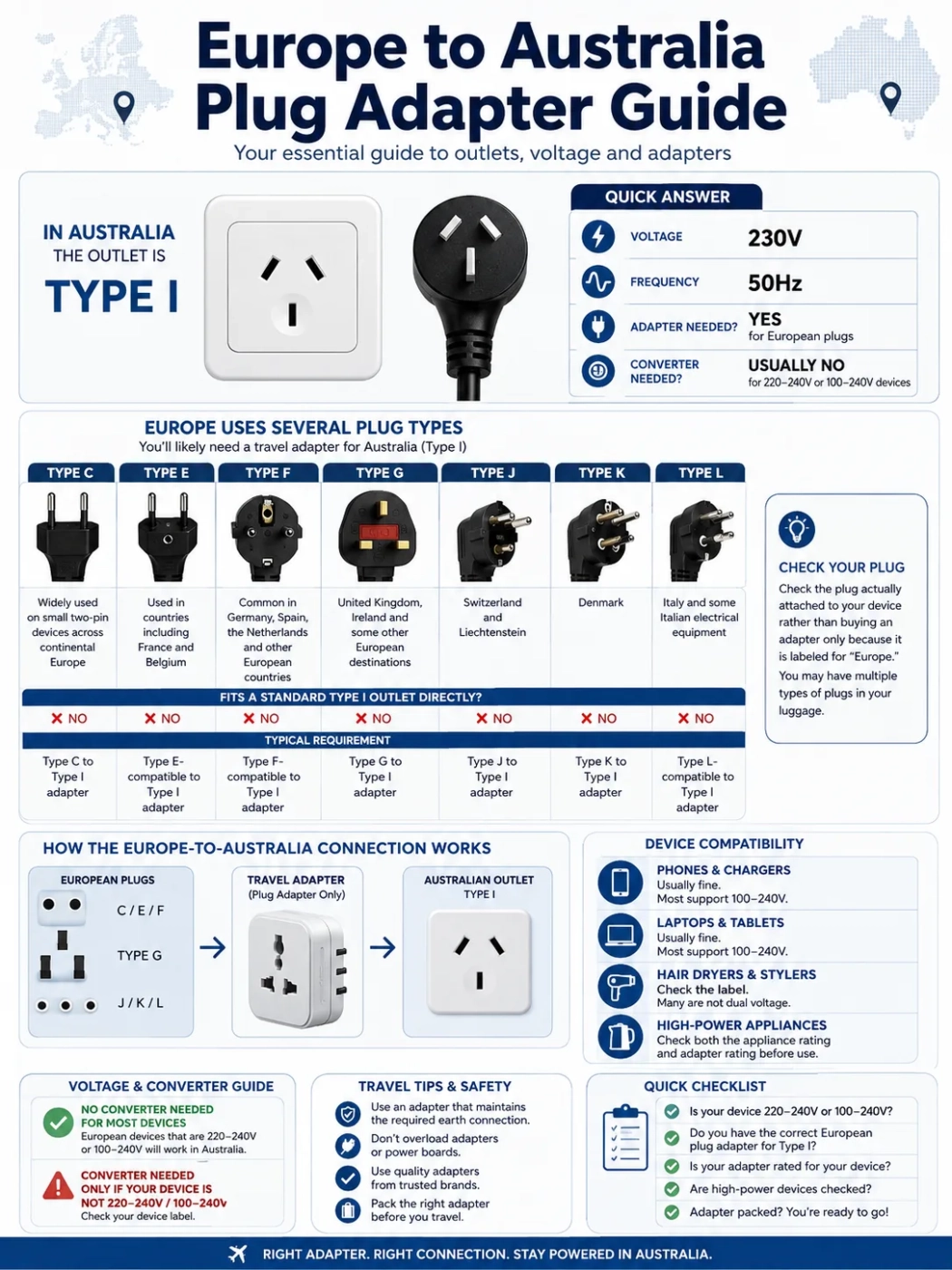
Traveling from Europe to Australia usually creates a plug-shape problem rather than a voltage problem. Australia uses Type I power outlets and operates on 230V at 50Hz. Most European devices either use 220–240V power or have modern power supplies marked Input: 100–240V, 50/60Hz, so a voltage converter is often unnecessary.
The part that changes is the plug. Type C, E, F, G, J, K and L plugs used across different parts of Europe do not match a standard Australian Type I socket, so most travelers need a suitable plug adapter. A plug adapter does not convert voltage.
| What to check | Europe to Australia |
|---|---|
| Australian socket type | Type I |
| Australian voltage | 230V |
| Australian frequency | 50Hz |
| Plug adapter | Usually required for European plugs |
| Voltage converter | Usually not required for 220–240V or 100–240V devices |
| Grounded equipment | Use an adapter that maintains the required earth connection |
| High-power appliances | Check both the appliance rating and adapter rating before use |
Europe Uses Several Plug Types, but Australia Uses Type I
There is no single plug type covering all of Europe. A traveler from Germany may carry a Type F plug, someone from France may have Type C or E equipment, a UK traveler may have Type G, while Switzerland, Denmark and Italy have other plug designs.
The destination side is simpler: standard Australian outlets use Type I. A Type I plug has two angled flat pins, with a grounding pin on grounded versions.
| European plug | Where travelers may encounter it | Fits a standard Type I outlet directly? | Typical requirement |
|---|---|---|---|
| Type C | Widely used on small two-pin devices across continental Europe | No | Type C to Type I adapter |
| Type E | Used in countries including France and Belgium | No | Type E-compatible to Type I adapter |
| Type F | Common in Germany, Spain, the Netherlands and other European countries | No | Type F-compatible to Type I adapter |
| Type G | United Kingdom, Ireland and some other European destinations | No | Type G to Type I adapter |
| Type J | Switzerland and Liechtenstein | No | Type J to Type I adapter |
| Type K | Denmark | No | Type K to Type I adapter |
| Type L | Italy and some Italian electrical equipment | No | Type L-compatible to Type I adapter |
Check the plug actually attached to your device rather than buying an adapter only because it is labeled for “Europe.” A traveler carrying a Type C phone charger and a grounded Type F laptop cable may need an adapter that properly accommodates both.
How the Europe-to-Australia Connection Works
Real adapters and wall sockets can look different from this simplified illustration. Some hotels may also provide multi-standard outlets, but these should not be assumed to be available. Do not assume that a hotel’s universal-looking socket changes the voltage.
Why a Voltage Converter Is Usually Not Needed
Australia uses a nominal 230V supply at 50Hz. Much of Europe also uses 230V at 50Hz, which makes the electrical side of this trip easier than travel between a 120V country and Australia.
A European appliance designed for 220–240V operation will usually be within the voltage range expected on the Australian supply. A modern charger labeled for 100–240V is even more flexible.
If the Label Says “Input: 100–240V, 50/60Hz”
This is common on phone chargers, laptop power supplies, camera chargers and USB-C chargers. It means the power supply is designed to accept voltages from 100V through 240V and both 50Hz and 60Hz frequencies.
For Australia, such a charger normally needs only the correct Type I plug adapter. It does not normally require a voltage converter.
If the Label Says “220–240V, 50Hz”
This rating is normally compatible with Australia’s 230V, 50Hz supply. The plug may still be physically incompatible, so the correct Type I adapter is required.
If the Voltage Rating Is Different or Unclear
Do not decide from the plug shape alone. Find the electrical rating on the appliance, charger, power brick or charging base. If the rating does not include 230V, or the information cannot be identified, verify the appliance requirements before connecting it.
A mechanical travel adapter must never be treated as a substitute for checking the device voltage.
Why Europe to Australia Is Different From a 120V-to-230V Trip
Travelers sometimes see general Australia power advice warning that a converter may be required. That warning depends heavily on the electrical system of the country where the device was designed to be used.
| Travel situation | Plug shape changes? | Supply voltage changes? | Main concern |
|---|---|---|---|
| Most of Europe to Australia | Yes | Usually not in a meaningful way | Correct Type I adapter |
| 120V-only device to Australia | Usually | Yes | Voltage compatibility must be checked |
| 100–240V charger to Australia | Usually | Charger accepts the range | Correct plug adapter |
This is why buying a voltage converter simply because you are flying to Australia may add unnecessary equipment to your luggage. The rating printed on the device is what determines whether voltage conversion is needed.
Grounded European Plugs Need the Right Kind of Adapter
Not every European plug is an ungrounded two-pin plug. Type E, F, G, J and other grounded systems can be used with appliances that rely on an earth connection.
A travel adapter may physically accept a grounded European plug without necessarily providing the intended grounding path. For grounded equipment, choose an adapter designed to preserve the required earth connection through to the Australian outlet.
Physical fit and grounding are separate compatibility checks. This matters more for appliances and power supplies designed with a protective earth connection than for double-insulated two-pin chargers.
If a device has a three-contact grounded plug, do not intentionally reduce it to an ungrounded connection simply to make it fit.
Phones, Laptops and Other Travel Electronics
Modern electronic chargers are generally the simplest devices to bring from Europe because many use wide-range switching power supplies.
| Device | Plug adapter? | Voltage converter? | What to check |
|---|---|---|---|
| Phone charger | Usually yes | Usually no | Look for Input: 100–240V, 50/60Hz |
| USB-C charger | Usually yes | Usually no | Input range and required USB-C output wattage |
| Laptop charger | Usually yes | Usually no | Input range and grounding if present |
| Camera battery charger | Usually yes | Usually no | Input voltage printed on the charger |
| Electric toothbrush charger | Usually yes | Depends on model | Charging base input rating |
| Electric shaver | Usually yes | Depends on model | Whether the charger is 100–240V or single voltage |
| CPAP machine | Usually yes | Depends on the exact power supply | Power supply label and manufacturer instructions |
Phone and USB Chargers
If your charger states Input: 100–240V, 50/60Hz, it should normally accept Australian mains power without voltage conversion. You still need a way to connect its European plug to Type I.
A multi-port charger designed to connect directly to an Australian outlet can also reduce the number of mechanical adapters needed when several phones, tablets or USB devices are being charged.
Laptop Power Supplies
Many laptop power bricks accept 100–240V, 50/60Hz. Check the label rather than assuming this is true for every charger.
Some laptops use a detachable mains cable between the wall and the power brick. In that case, another practical option may be to use a compatible Australian Type I mains cable with the existing power supply instead of placing a travel adapter between the European cable and wall socket.
The replacement cable must match the power supply connector and its electrical requirements.
CPAP Machines and Other Medical Equipment
Many medical-device power supplies use broad input ranges, but medical equipment should not be treated as interchangeable travel electronics. Check the power supply label, any separate humidifier or accessory requirements, and the manufacturer’s travel instructions.
For equipment needed every night or for medical support, also consider how many outlets will be available and whether a backup charging or power plan is appropriate for the trip.
Hair Dryers, Curling Irons and Other High-Power Appliances
A European hair dryer rated for 220–240V may be voltage-compatible with Australia’s 230V supply. The same can apply to European curling irons, straighteners, kettles and clothes irons.
The fact that the voltage matches does not make every travel adapter suitable for these appliances. High-power appliances can draw far more current than a phone or laptop charger.
Before using one, check:
- The appliance input voltage.
- The appliance wattage or current rating.
- The maximum current or wattage allowed by the travel adapter.
- Whether the appliance requires grounding.
- Whether the adapter instructions permit use with that type of high-power appliance.
Always check the device label and adapter rating before using heat-producing appliances abroad.
Hair Dryers
A 230V European hair dryer usually does not need the voltage conversion that a 120V-only dryer would need on Australian power. Its high wattage still makes adapter capacity important.
If the appliance label shows a range such as 220–240V and 50Hz, the electrical supply is normally compatible. If the label shows another voltage or requires a manual voltage setting, follow the appliance instructions before use.
Curling Irons and Hair Straighteners
Many newer styling tools are dual voltage, but not all are. A device marked 100–240V can normally operate from Australian voltage with the appropriate adapter. A 220–240V European model is also normally within the expected Australian voltage range.
Single-voltage equipment should be checked individually rather than grouped with dual-voltage travel styling tools.
Kettles and Clothes Irons
These are often high-wattage appliances. Even when a European model is voltage-compatible, carrying it may provide little practical benefit compared with using equipment available at the accommodation.
If one is used through an adapter, the adapter must be rated for the electrical load. Do not rely on a compact adapter simply because the plug fits.
Does the 50Hz Frequency Cause a Problem?
Australia operates at 50Hz, which matches the frequency used across most European mains systems. As a result, European equipment designed for 50Hz normally avoids the frequency mismatch that can occur when traveling to a 60Hz destination.
Modern electronic power supplies labeled 50/60Hz accept either frequency. Frequency deserves more attention with some motor-driven appliances, timing equipment and other devices whose operation depends directly on the AC supply.
If a device specifies only one frequency, use the printed rating and manufacturer instructions rather than assuming voltage compatibility also guarantees frequency compatibility.
Using a European Power Strip in Australia
Some travelers consider connecting one European power strip to a Type I adapter so several European chargers can share one Australian outlet. This can reduce the number of adapters, but it also places the combined electrical load through a single adapter.
Check the voltage and current rating of the power strip and the travel adapter, and keep the total connected load within their limits. A group of phone and laptop chargers creates a very different load from several heat-producing appliances.
A simple electrical relationship is:
Power in watts = voltage × current in amps.
Do not use a travel adapter as a convenient way to run multiple high-wattage appliances from one outlet. Grounded equipment also requires the grounding path to remain intact through the entire setup.
Type I Adapter or Universal Travel Adapter?
For a trip limited to Australia, a dedicated adapter that converts your actual European plug type to Type I is often the simplest option. It can be smaller and easier to fit behind furniture or beside other plugs.
A universal travel adapter can be useful when Australia is one stop on a multi-country trip, but the word “universal” does not mean that every electrical problem has been solved.
- Confirm that it accepts your exact European plug.
- Confirm that its destination pins include Australian Type I.
- Check whether it supports grounded plugs when grounding is needed.
- Check its current and wattage limits.
- Check USB-C output separately if charging a laptop.
A universal adapter is still not a voltage converter unless it specifically includes voltage-conversion circuitry.
The Device Label Decides Whether the Adapter Is Enough
The fastest reliable check is usually printed on the charger, power brick, appliance label or charging base.
| Label example | What it usually means in Australia |
|---|---|
| Input: 100–240V, 50/60Hz | Voltage and frequency are normally compatible; use the correct Type I adapter |
| Input: 220–240V, 50Hz | Normally compatible with Australia’s 230V, 50Hz supply; plug adaptation is still needed |
| Input: 230V, 50Hz | Normally matches the Australian supply; check plug and adapter requirements |
| Voltage range does not include 230V | Do not assume an ordinary plug adapter is enough |
| Rating cannot be identified | Verify the device requirements before connecting it |
A Simple Europe-to-Australia Decision
1. Identify the plug on your device
If it is Type C, E, F, G, J, K or L, it will normally require an adapter to connect to a standard Australian Type I outlet.
2. Read the input voltage
If the device says 100–240V or is designed for 220–240V, a voltage converter is usually unnecessary for Australia.
3. Check the frequency
Australia is 50Hz. Most European equipment intended for 50Hz, as well as chargers rated 50/60Hz, normally has no frequency mismatch.
4. Check grounding and power demand
A grounded laptop supply or high-wattage hair dryer needs more attention than a small two-pin phone charger. Make sure the adapter is suitable for the connection and electrical load.
Plug Mistakes to Avoid on This Route
Buying an Adapter for the Wrong Direction
The adapter must accept the plug you are bringing and have pins that fit an Australian Type I outlet. Product descriptions can use phrases such as “Australia to Europe” and “Europe to Australia,” so confirm the physical input and output rather than relying on the title alone.
Assuming Every European Device Has a Type C Plug
Europe includes several plug systems. A Type G laptop cable from the UK, Type J equipment from Switzerland and Type F plug from Germany require different adapter input designs even though all are traveling to the same Type I destination socket.
Buying an Ungrounded Adapter for Grounded Equipment
A three-contact plug should not be treated as an ordinary two-pin charging plug. If the equipment relies on protective grounding, the adapter should maintain that connection.
Buying a Converter Without Checking the Label
A traveler carrying only 230V European devices and 100–240V chargers may have no practical need for voltage conversion. Read the labels before adding a heavy converter to your luggage.
Assuming “Universal” Means Unlimited Power
Every adapter has electrical limits. High-wattage appliances require a check of both the appliance rating and adapter rating regardless of how many plug types the adapter accepts.
What to Pack for Australia
For a typical traveler carrying a phone, laptop, tablet and camera, one or more suitable Type I adapters are usually enough if all chargers accept 230V. Travelers with several USB-powered devices may prefer a power solution that reduces the number of separate mains adapters required.
If you are bringing grounded equipment, choose a solution that maintains grounding. If you are bringing a hair dryer, straightener, kettle or other high-power appliance, check its voltage and wattage before deciding whether it is worth packing.
For a multi-country itinerary, a suitable universal travel adapter may be convenient, but each destination’s plug type, voltage and frequency still need to be considered separately.
The practical rule for this route is simple: European plug to Australian Type I adapter, then verify the device label. For most properly rated European electronics, the Australian 230V, 50Hz supply means the trip requires plug adaptation rather than voltage conversion.
Frequently Asked Questions
Do I need a plug adapter from Europe to Australia?
Usually, yes. Australia uses Type I outlets, while European devices may use Type C, E, F, G, J, K or L plugs. These do not normally fit a standard Australian Type I socket directly.
Do I need a voltage converter from Europe to Australia?
Usually not for devices rated 220–240V or 100–240V. Australia uses 230V at 50Hz, which is compatible with many European appliances and modern chargers. Always check the device label.
Can I use a European Type C plug in Australia?
A standard Type C plug does not match a standard Australian Type I outlet. Use an adapter that accepts Type C and connects to Type I.
Can I use a Type F Schuko plug in Australia?
Yes, if the device voltage is compatible and you use a suitable Type F-to-Type I adapter. For grounded equipment, make sure the adapter maintains the required earth connection.
Will my European hair dryer work in Australia?
A European hair dryer rated for 220–240V will usually be voltage-compatible with Australia’s 230V supply. Because hair dryers are high-power appliances, also check the adapter’s current or wattage rating before use.
Will my phone or laptop charger work in Australia?
Most modern chargers marked Input: 100–240V, 50/60Hz can operate on Australian power without a voltage converter. You will normally need the correct Type I plug adapter.