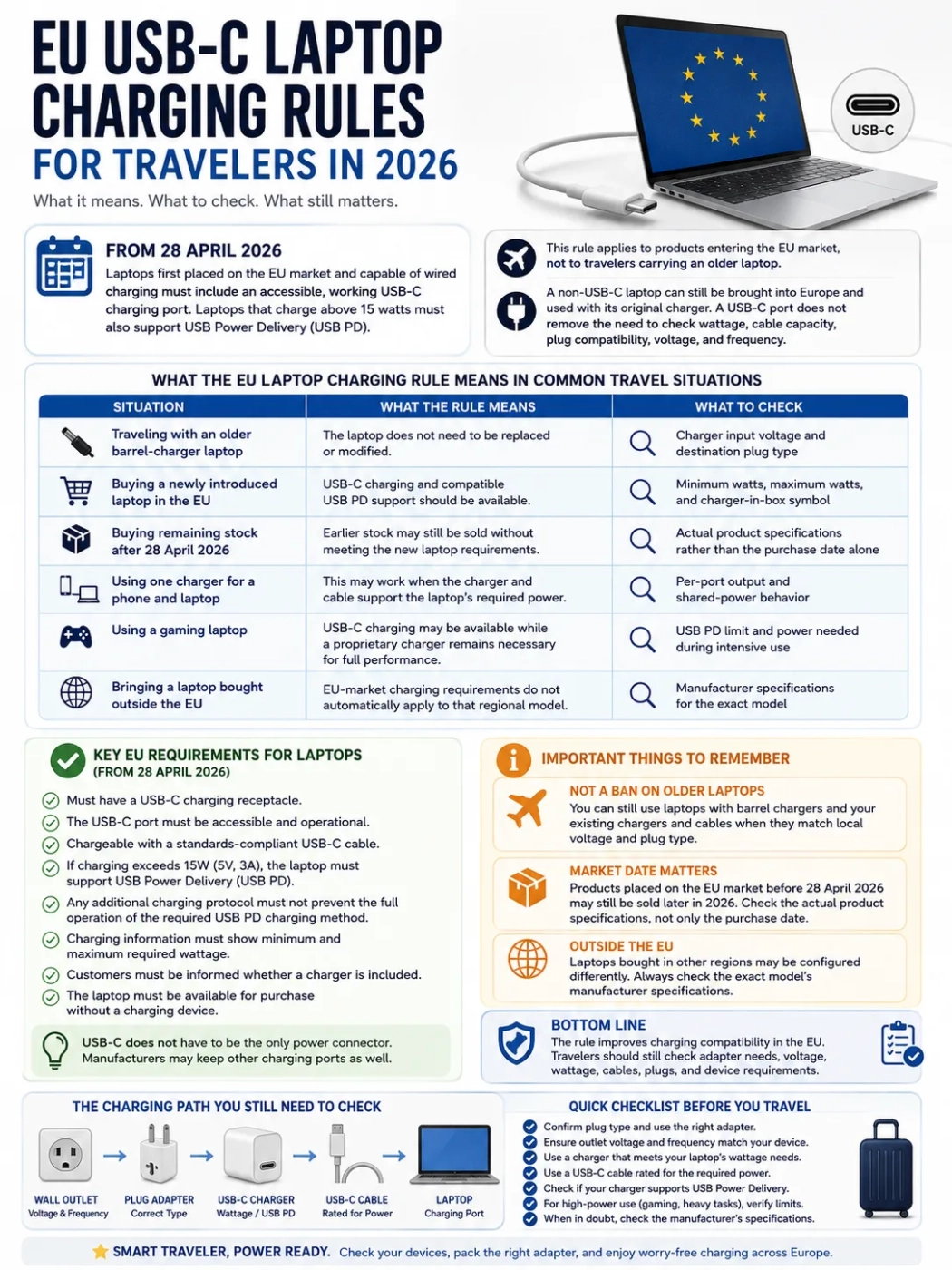
From 28 April 2026, laptops first placed on the European Union market and capable of wired charging must include an accessible, working USB-C charging port. Laptops that charge above 15 watts must also support USB Power Delivery. The rule applies to products entering the EU market, not to travelers carrying an older laptop.
A non-USB-C laptop can still be brought into Europe and used with its original charger. A USB-C port also does not remove the need to check charger wattage, cable capacity, wall plug compatibility, voltage, and frequency.
| Situation | What the rule means | What to check |
|---|---|---|
| Traveling with an older barrel-charger laptop | The laptop does not need to be replaced or modified. | Charger input voltage and destination plug type |
| Buying a newly introduced laptop in the EU | USB-C charging and compatible USB PD support should be available. | Minimum watts, maximum watts, and charger-in-box symbol |
| Buying remaining stock after 28 April 2026 | Earlier stock may still be sold without meeting the new laptop requirements. | Actual product specifications rather than the purchase date alone |
| Using one charger for a phone and laptop | This may work when the charger and cable support the laptop’s required power. | Per-port output and shared-power behavior |
| Using a gaming laptop | USB-C charging may be available while a proprietary charger remains necessary for full performance. | USB PD limit and power needed during intensive use |
| Bringing a laptop bought outside the EU | EU-market charging requirements do not automatically apply to that regional model. | Manufacturer specifications for the exact model |
What Changed for Laptops on 28 April 2026?
The laptop stage of the EU Common Charger rules began on 28 April 2026. It covers laptops with rechargeable batteries that can be charged through a wired connection and fall within the relevant EU radio-equipment rules.
A covered laptop must meet several separate requirements:
- It must have a USB-C charging receptacle.
- The USB-C receptacle must remain accessible and operational.
- The laptop must be chargeable with a standards-compliant USB-C cable.
- If charging exceeds 5 volts, 3 amperes, or 15 watts, the laptop must support USB Power Delivery.
- Any additional charging protocol must not prevent the full operation of the required USB PD charging method.
- Charging information must identify the minimum and maximum required wattage.
- The customer must be told whether a charging device is included.
- The laptop must be available for purchase without a charging device.
The rules do not require USB-C to be the laptop’s only power connector. A manufacturer may retain a barrel connector, magnetic connector, docking connector, or another proprietary charging option as long as the required USB-C charging solution is also present and operational.
The Rule Applies to EU Products, Not Personal Travel Laptops
The 2026 date is sometimes mistaken for a ban on older computers. It is not a border rule, a luggage rule, or a requirement to replace equipment that a traveler already owns.
An older laptop can still be used in Europe
A laptop that charges only through a barrel connector can still be packed for an EU trip. Its original charging brick can also continue to be used when the charger accepts the local voltage and can be connected safely to the local power outlet.
The same applies to existing USB-C cables, older charging devices, and personal equipment already in use. The Common Charger rules do not require consumers to discard them.
Purchase date and EU market date are different
The relevant concept is when each product is first placed on the EU market. It is not simply the date printed on a sales receipt.
A laptop first placed on the EU market before 28 April 2026 may remain in legal stock and be sold later. A traveler shopping in Europe during the second half of 2026 could therefore encounter both:
- Newly placed products that must follow the USB-C laptop requirements
- Earlier stock that entered the EU market before the requirements applied
Checking the physical charging ports and the product’s charging specifications is more reliable than assuming every laptop sold after the deadline must be identical.
A laptop sold outside the EU may be configured differently
The EU requirements apply within the EU market. A model purchased in another region is not automatically covered merely because the same product name is also sold in Europe.
Regional versions can differ in their charger, plug, power cord, included accessories, and available charging ports. Travelers should check the exact model number rather than relying only on the product family name.
The Charging Path Travelers Still Need to Check
USB-C standardizes the connection at the laptop. It does not standardize every other part of the travel charging path.
A traveler may still need to verify:
- The plug type used at the destination
- The charger’s accepted AC input voltage
- The charger’s USB PD output
- The maximum output of the selected USB-C port
- The cable’s supported wattage
- The laptop’s minimum and maximum charging requirements
A plug adapter does not convert voltage. It only changes the physical connection between a charger plug and a power outlet.
USB-C Does Not Mean Every Charger Is Suitable
USB-C describes the connector shape. It does not tell a traveler how much power the charger can provide.
The same USB-C connector can appear on a small phone charger, a 45W travel charger, a 65W laptop charger, a 100W desktop charger, or a high-output USB PD power supply. Each may fit the laptop physically, but the charging result can differ.
USB Power Delivery is required above 15W
A laptop covered by the EU rule must support USB Power Delivery when its wired charging exceeds 5V, 3A, or 15W. Most modern laptops operate above this level, making USB PD the normal charging method for covered computers.
USB PD lets the laptop and charger agree on a supported voltage and current combination. The charger does not simply send its highest advertised wattage into every connected device.
A higher-rated charger does not normally force extra power
A 100W USB PD charger can usually be used with a laptop that requests 65W, provided the charger, cable, and laptop follow compatible USB PD profiles. The laptop requests the level it can accept.
The number printed on the charger describes its maximum available output under stated conditions. It is not a fixed amount that must flow into the computer.
A lower-rated charger may work with restrictions
A charger below the laptop’s preferred wattage can produce different results:
- The laptop may charge slowly while switched off.
- It may charge during light use but not during heavier work.
- Battery percentage may remain almost unchanged.
- The battery may continue to fall while the charger is connected.
- The laptop may display a low-power charger warning.
- Charging may not begin if the available power is below the permitted minimum.
The exact behavior depends on the laptop’s firmware, battery state, operating mode, and power demand.
How to Read the EU Laptop Charging Information
Covered laptops must provide information about the wired charging power they require. The two most useful values for a traveler are the minimum charging power and the power needed for maximum charging speed.
Minimum power
The minimum value is not merely the power needed to turn on the charging indicator. It represents the power needed to keep the laptop operating and provide enough additional power for the battery to begin charging.
If a laptop shows a minimum requirement of 45W, a 30W phone charger should not be treated as a suitable replacement simply because both devices use USB-C.
Maximum power for the fastest charging
The upper value shows the power required to maintain laptop operation while also reaching the highest supported battery charging rate.
A laptop labeled 45–100W may operate with a compatible 65W charger while charging more slowly than it would with a 100W charger. The actual result can also depend on workload and temperature.
USB PD fast-charging information
Laptops charging above the stated fast-charging threshold must identify USB PD support. Additional proprietary charging methods may also exist, but they cannot be used to remove or block the required USB PD operation.
Charger included or not included
EU packaging and online sales information must indicate whether a charging device is included. For online purchases, the information should be displayed where it can be seen near the price.
The rule does not mean every laptop must be sold with a charger. It requires the option to buy the covered laptop without a charging device.
A manufacturer may also offer a version with a charger. When a charging device is supplied, the product information should state whether it is compatible with the harmonized charging solution.
The cable is treated separately
The charger-unbundling requirement does not automatically require a USB-C cable to be included or excluded. Cable supply remains a separate product decision.
Travelers buying a laptop without a charging device should check whether the package still contains a suitable cable. A cable that came with a phone or older accessory may not support the laptop’s required power.
Choosing a Charger from the Minimum and Maximum Watts
| Charger output | Likely result | Travel use |
|---|---|---|
| 30W | Below the stated minimum; charging may be refused or may work only in limited conditions. | Not a suitable primary laptop charger |
| 45W | Meets the stated minimum but may charge slowly, especially during use. | Possible lightweight backup |
| 65W | Falls within the supported range but may not provide the fastest charging. | Often practical for lighter travel use |
| 100W | Meets the stated level for maximum charging speed. | Suitable when the port and cable also support 100W |
| 140W | Can normally be used when it offers a compatible USB PD output; the laptop requests what it supports. | Useful for sharing one charger across several devices |
The values in this table are illustrative. A charger should be checked for its supported USB PD profiles, not only the large wattage number printed on the front.
The USB-C Cable Can Reduce Available Power
A capable charger cannot deliver its full laptop output through every USB-C cable. The cable must be designed to carry the required voltage and current.
Before relying on a cable for travel, check:
- Its maximum supported wattage
- Whether it supports USB Power Delivery
- Whether the connector is USB-C at both ends when required
- Whether it is intended for charging rather than only low-power accessories
- Whether the cable or packaging identifies a power rating
- Whether the connectors are damaged, loose, bent, or unusually hot during use
A laptop that normally charges at 100W may fall back to a lower level when connected through a cable intended for lower-power use.
Some USB-C cables already carry clear wattage markings. A separate EU charger regulation applying from 14 December 2028 will introduce broader 60W or 240W marking requirements for covered USB-C-to-USB-C cables. That later rule should not be mistaken for a cable-label requirement that already applies to every cable in 2026.
Multi-Port GaN Chargers and Shared Power
A multi-port GaN charger can reduce the number of charging bricks in a travel bag, but its advertised total wattage may not be available from every port at the same time.
A charger described as 140W may mean:
- Up to 140W from one selected USB-C port when used alone
- 140W divided across all active ports
- A lower laptop output after a phone or tablet is connected
- Different maximum outputs on visually similar USB-C ports
| Connected devices | Possible distribution | Laptop effect |
|---|---|---|
| Laptop only | 100W to the primary USB-C port | Maximum laptop charging may be available |
| Laptop and phone | 65W to laptop, 30W to phone | Laptop charging may slow |
| Laptop, phone, and tablet | 65W, 20W, and 15W | Laptop remains powered but may charge slowly |
| Two laptops | Power divided according to the charger’s port rules | One or both laptops may receive less than their preferred wattage |
Actual distributions vary by charger. Check the small output table printed on the charger or in its instructions, including the combinations used when two or more ports are active.
Some chargers briefly interrupt output when a second device is connected because the internal power allocation is being changed. This can cause the laptop charging icon to disappear and return.
Gaming and Workstation Laptops Can Retain Proprietary Chargers
The EU rule does not ban high-power laptop charging bricks or barrel connectors. A covered gaming laptop may offer both USB-C charging and a proprietary high-output input.
Laptops requiring more than 240W are not automatically excluded. A covered laptop with a 300W proprietary charging system must also support the harmonized USB PD solution up to 240W.
This does not mean USB-C must provide full gaming performance under every workload. During demanding GPU or processor use, the laptop may consume more power than the USB-C source can provide. The proprietary adapter may still be needed for:
- Maximum gaming performance
- Heavy video rendering
- High-performance operating modes
- Fast charging while the processor and graphics system are heavily loaded
- Powering attached high-demand accessories
A smaller USB-C charger may still be useful for office work, web browsing, standby charging, or charging while the laptop is switched off. The manufacturer’s power-mode instructions should be checked before leaving the original charging brick at home.
USB-C Charging Does Not Guarantee Data or Display Features
The EU charging requirement deals with charging interfaces and charging communication. It does not require every compliant USB-C port to provide the same data or video features.
A USB-C charging port does not automatically guarantee:
- Thunderbolt support
- USB4 data speed
- DisplayPort video output
- External monitor support
- Docking-station compatibility
- High-speed storage performance
- Charging through every USB-C port on the laptop
A laptop may have several USB-C ports while only certain ports support charging, video, or the fastest data rate. Port symbols and the laptop specification sheet remain relevant.
USB-C Does Not Standardize European Wall Outlets
Most EU destinations use a nominal supply of about 230V at 50Hz, but they do not all use the same physical power outlet.
Type C, Type E, and Type F connections are widespread, while other systems appear in particular countries. Examples include Type G in Ireland, Malta, and Cyprus, Type L in Italy, and Type K in Denmark. A charger that works electrically can still need a plug adapter to fit the wall socket.
A USB-C rule does not turn every European wall outlet into a USB-C outlet. It standardizes the wired charging connection supported by the laptop.
Check the AC input on the charging brick
Look for the word Input on the charger. A common laptop charger label may show:
Input: 100–240V, 50/60Hz
This usually means the charger can accept common mains voltage and frequency systems used in Europe, North America, and many other regions. When the destination socket is physically different, a plug adapter may be all that is required.
| Input label | Meaning for an EU trip | Likely requirement |
|---|---|---|
| 100–240V, 50/60Hz | The charger is designed for both common voltage ranges and both frequencies. | A plug adapter may be needed; a voltage converter is usually unnecessary. |
| 220–240V, 50Hz | The charger is electrically suited to normal EU mains power. | A plug adapter may still be needed. |
| 100–120V, 60Hz only | The charger is not labeled for a normal 230V supply. | Do not connect it directly without an appropriate solution. |
| Input information missing or unreadable | Voltage compatibility cannot be confirmed from the charger. | Use a charger with clear specifications or verify the original documentation. |
Do not connect a charger labeled only for 100–120V directly to a 230V outlet through a mechanical plug adapter.
Frequency is normally handled by modern laptop chargers
A charger labeled 50/60Hz is intended to accept both frequencies. This is common for modern switch-mode phone chargers and laptop chargers.
Frequency deserves more attention with some motor-driven appliances, clocks, and older equipment. It is normally less troublesome for a laptop charger that explicitly lists both 50Hz and 60Hz.
Hotel, Airport, Train, and Airplane Power Is Not Standardized by This Rule
The EU laptop rule does not require hotels, airports, trains, lounges, or airplane seats to provide a certain USB-C wattage.
A USB port in a hotel room may be intended mainly for phones. It may provide too little power for a laptop or may use an older USB connection. A universal-looking hotel socket may accept several plug shapes, but it does not change the building’s supply voltage.
Do not assume that a hotel’s universal-looking socket changes the voltage.
Airplane seat power can also be limited. Possible issues include:
- A low maximum output
- Power shutting off when a laptop draws too much
- A loose universal AC socket
- USB ports intended only for phone charging
- Power becoming unavailable during takeoff, landing, or certain flight phases
A seat outlet should not be the only charging plan for a long journey. Start with a charged battery and use a charger that stays within the outlet limits stated by the airline or aircraft system.
How the Rule Affects Common Travel Devices
The 2026 laptop rule does not make every electrical device voltage-compatible. Phone chargers, laptop chargers, heating appliances, and medical devices should still be assessed separately.
| Device | Typical concern | What to check |
|---|---|---|
| Phone charger | Usually low risk when it accepts worldwide voltage | Input: 100–240V, plug type, and USB output |
| Laptop charger | Voltage may be compatible while USB-C wattage is too low | AC input, USB PD output, port output, and cable rating |
| Camera battery charger | Many models accept worldwide voltage, but not all | Input range on the charging base or power supply |
| Electric shaver | Some are dual voltage; others use a dedicated charging base | Voltage, frequency, and whether wet-use charging restrictions apply |
| CPAP machine | The power supply may be universal, but medical equipment needs careful planning | Power supply input, manufacturer instructions, plug fit, and backup arrangements |
| Hair dryer | High wattage and single-voltage models can be damaged on the wrong supply | Dual-voltage setting and required wattage |
| Curling iron or hair straightener | Heat-producing devices may be single voltage even when the plug can be adapted | Voltage label and dual-voltage switch |
| Travel kettle or clothes iron | High power can exceed converter or travel adapter ratings | Voltage, wattage, grounding, and accessory rating |
Modern phone and laptop charging devices commonly accept 100–240V, but the label should still be read. Hair dryers, curling irons, kettles, clothes irons, and other high-power appliances deserve more caution because an unsuitable voltage converter may not support their wattage.
Always check the device label before using high-power appliances abroad.
A Laptop Charging Kit for an EU Trip
A practical charging kit should be selected from the laptop’s actual requirements rather than from the USB-C connector alone.
- A USB PD charger that meets the laptop’s minimum power requirement
- A charger that reaches the maximum value when fast charging is needed
- A USB-C cable rated for the intended wattage
- A plug adapter that fits the destination’s power outlet
- The proprietary charging brick when a gaming or workstation laptop needs it
- A spare cable if the trip depends on daily computer use
- A compact extension solution only when it is properly rated and permitted at the accommodation
When using a multi-port charger, record which port provides the highest output. Ports that look identical may have different limits.
Travelers moving between several EU countries should also check whether the same plug adapter covers the whole route. A Type E/F-compatible solution used in continental Europe will not necessarily fit Type G outlets in Ireland, Malta, or Cyprus.
What Changes Again in December 2028?
The laptop rules that applied from 28 April 2026 mainly concern the charging port and charging behavior on the device side.
A separate EU ecodesign regulation for external power supplies and charging equipment is scheduled to apply from 14 December 2028. For covered products, it introduces wider charger-side requirements such as:
- Greater use of USB-C or USB PD outputs
- Detachable output cables for interoperable chargers
- Maximum-power markings on USB-C ports
- An EU Common Charger logo on covered charging devices
- 60W or 240W markings on covered USB-C-to-USB-C cables
- Updated efficiency and no-load power requirements
Some product categories and specialized power supplies have exemptions. The 2028 requirements should not be described as if every charger and cable already carried those markings in 2026.
Questions Travelers Ask About the 2026 Rule
Can I bring an old non-USB-C laptop into the EU?
Yes. The rule does not prohibit travelers from bringing or using an older laptop. Check the original charger’s input voltage and use the correct plug adapter for the destination.
Must every laptop sold after 28 April 2026 have USB-C charging?
Not solely because of the sale date. Products first placed on the EU market before 28 April 2026 may remain in stock and be sold afterward. Newly placed covered laptops must follow the applicable requirements.
Can a 65W charger charge a laptop labeled for 100W?
It may work when 65W is within the laptop’s supported charging range. Charging can be slower, and the battery may still discharge during heavy use. Check the stated minimum power.
Is a 140W USB-C charger safe for a 65W laptop?
A compatible USB PD charger normally provides only the power requested by the laptop. The cable and selected charger port must also support the required USB PD connection.
Do I still need a travel adapter for an EU trip?
Possibly. USB-C does not determine the shape of the wall plug. Compare the charger plug with the power outlet used in each destination country.
Do I need a voltage converter for a laptop charger?
A converter is usually unnecessary when the charger states Input: 100–240V, 50/60Hz. A plug adapter may still be needed. Do not assume compatibility when the input label is missing or limited to 100–120V.
Does an EU-compliant USB-C port support Thunderbolt and external monitors?
Not necessarily. The charging rule does not guarantee Thunderbolt, USB4 speed, video output, or docking support. Those features must be checked separately.
Can a new EU laptop still use a barrel charger?
Yes. An additional proprietary charging connector is allowed when the covered laptop also includes the required accessible and operational USB-C charging solution.