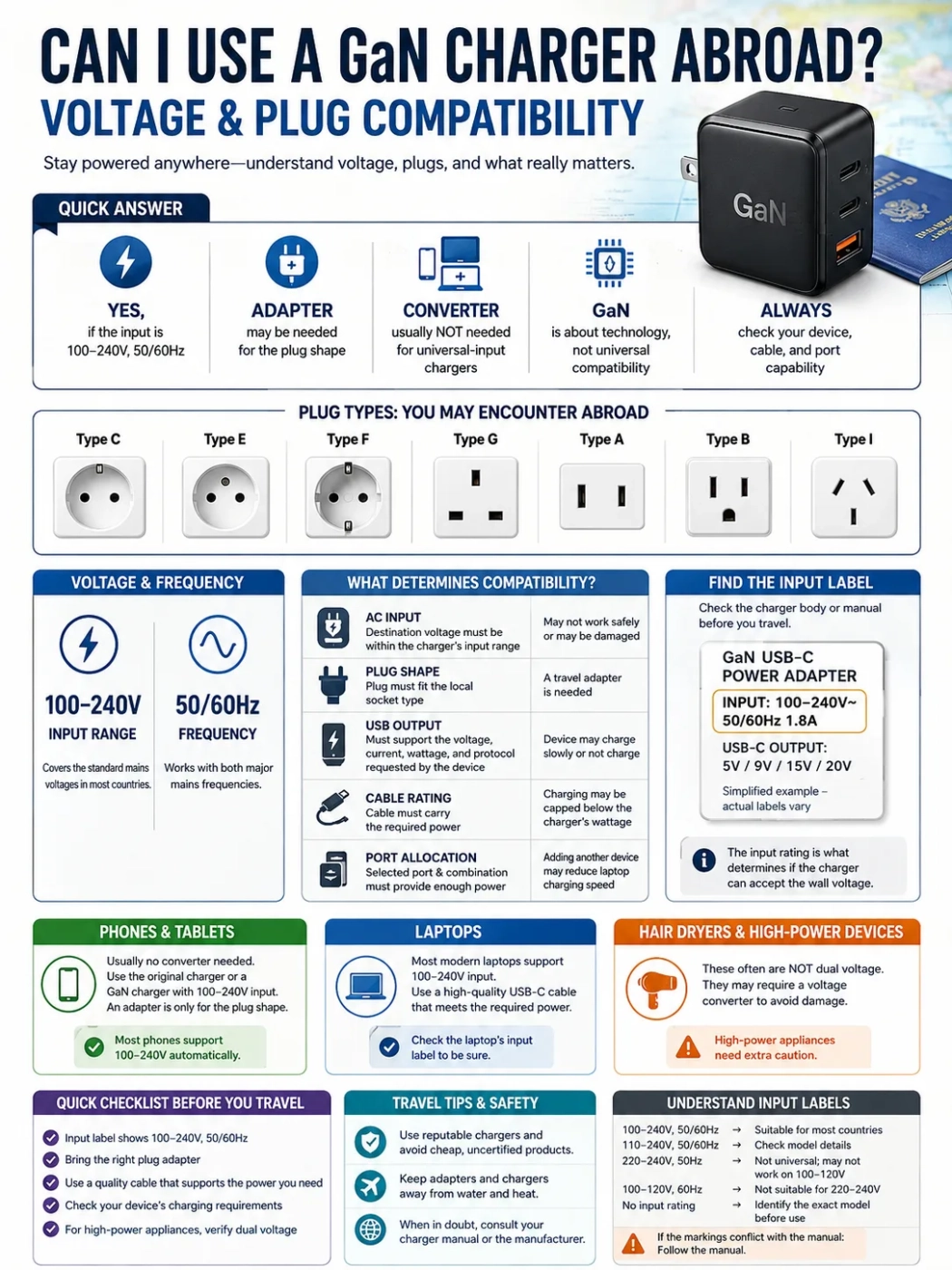
Yes, you can usually use a GaN charger abroad when its label shows Input: 100–240V, 50/60Hz. That input range covers the standard mains voltages used in most destinations. You may still need a plug adapter so the charger fits the local power outlet. A voltage converter is normally unnecessary for a universal-input charger. GaN describes the charger’s semiconductor technology; it does not prove that the charger supports every voltage, plug type, cable, or fast-charging system.
| Check | What must match | What happens if it does not |
|---|---|---|
| AC input | The destination voltage must fall within the charger’s input range | The charger may not work safely or may be damaged |
| Plug shape | The charger plug must fit the local socket type | A suitable travel adapter is needed |
| USB output | The charger must support the voltage, current, wattage, and protocol requested by the device | The device may charge slowly or not charge |
| Cable rating | The cable must carry the required power | Charging may be capped below the charger’s advertised wattage |
| Port allocation | The selected port and port combination must provide enough power | Connecting another device may reduce laptop charging speed |
GaN Is Not the Same as Universal Voltage
GaN stands for gallium nitride. It is used in the power-conversion stage of many modern chargers and can help manufacturers produce smaller chargers with high output and efficient switching. A compact 65W, 100W, or 140W charger may therefore replace several larger charging bricks during a trip.
That does not make every GaN charger internationally compatible. Two chargers with the same wattage and the same GaN label can have different AC input ranges, USB protocols, port limits, plug designs, and safety approvals. One may accept 100–240V and another may be designed for a narrower market. One may deliver its full rating from a single USB-C port, while another lists only a shared total across several ports.
The word GaN should therefore be treated as a design feature, not as a travel compatibility statement. The information printed next to Input is what determines whether the charger can accept the wall voltage.
Find the AC Input Label Before You Travel
The rating is usually printed on the body of the charger in small text. It may appear near the folding pins, under a removable plug head, beside the model number, or in the model-specific manual.
What “Input: 100–240V~ 50/60Hz” Means
- 100–240V means the charger is designed to accept AC supply voltages across that range.
- 50/60Hz means it is designed for both of the common mains frequencies.
- The tilde symbol after the voltage indicates alternating current at the wall input.
- The input current, such as 1.5A or 1.8A, is not the same as the USB output current delivered to a phone or laptop.
A label showing 100–240V, 50/60Hz normally covers common 100V, 110V, 120V, 220V, 230V, and 240V supplies. It does not make the plug pins fit every outlet, so a mechanical adapter may still be required.
Labels That Need a Closer Look
| Input marking | Travel meaning |
|---|---|
| 100–240V, 50/60Hz | Usually suitable for the standard mains supplies used in most countries |
| 110–240V, 50/60Hz | Do not assume full compatibility with a 100V supply; check the model documentation |
| 220–240V, 50Hz | Not a universal-input charger and may not operate correctly on 100–120V supplies |
| 100–120V, 60Hz | Not suitable for direct use on a 220–240V supply |
| No readable input rating | Do not rely on the product name or the word GaN; identify the exact model before use |
If the markings on the charger conflict with a marketplace listing, use the model-specific manufacturer information and the label on the actual unit. Similar-looking models may have different regional versions.
Plug Shape, Wall Voltage, and USB Charging Are Separate Tests
A charger can pass one compatibility test and fail another. For example, an American Type A charger may accept 230V but still require an adapter to fit a Type C, E, F, or G outlet. A charger may also fit the wall and accept the voltage yet charge a laptop slowly because its USB-C output or cable is not powerful enough.
1. Will the Plug Fit the Power Outlet?
The pins on the charger must match the destination’s socket type. Common travel changes include Type A or B to Type C, E, or F in continental Europe; Type C or F to Type G in the United Kingdom; and Type A, C, or G to Type I in Australia and New Zealand.
A travel adapter changes the physical connection. A plug adapter does not convert voltage. It also does not add USB Power Delivery, increase the charger’s wattage, or guarantee that a grounded plug remains grounded.
2. Can the Charger Accept the Local Voltage and Frequency?
Compare the destination supply with the charger’s AC input range. A 100–240V, 50/60Hz charger will usually accept both a 120V, 60Hz supply and a 230V, 50Hz supply. A charger marked only for 100–120V must not be connected directly to 220–240V power.
Frequency is usually straightforward for a modern switching charger when the label includes both 50Hz and 60Hz. Frequency deserves more attention for some clocks, motors, pumps, and other equipment whose operation may depend on the mains cycle. The charger label, not the USB-C connector, confirms frequency support.
3. Can the USB Port Deliver What the Device Requests?
Wall compatibility only gets power into the charger. The charger and connected device must then agree on a supported USB output. USB Power Delivery allows the device to request a suitable voltage and current profile rather than receiving the charger’s maximum output automatically.
A 100W charger does not normally force 100W into a phone. A phone that requests a lower profile receives only what the charger, cable, and phone agree to use. The same charger may provide much more power to a compatible laptop.
Travel Adapter or Voltage Converter?
| Equipment | What it changes | When it is relevant |
|---|---|---|
| Plug adapter | Changes the physical plug-to-socket connection | The charger accepts the destination voltage, but its pins do not fit |
| Voltage converter | Changes the supply voltage | The device input does not include the destination voltage |
| USB-C GaN charger | Converts accepted AC input into supported USB output profiles | It can charge compatible USB devices within its wattage and protocol limits |
For a GaN charger marked Input: 100–240V, 50/60Hz, the usual travel requirement is an appropriate plug adapter, not a voltage converter. If the charger is limited to 100–120V and the destination uses 220–240V, using another universal-input charger is often simpler than adding a converter to a USB charging setup.
Never use a mechanical plug adapter as though it were a voltage converter. A shape change can allow an incompatible device to be inserted into a higher-voltage outlet, which is exactly when the voltage label matters most.
A Wall-to-Device Compatibility Check
The safest decision can be made in a fixed order. Each stage must support the next one.
- Check the destination’s socket type, voltage, and frequency.
- Read the charger’s AC input rating.
- If the voltage is supported but the plug does not fit, select a plug adapter for the local outlet.
- Check the charger’s output by individual port, not only the total wattage printed on the front.
- Use a cable rated for the power your device may request.
- Confirm that the device accepts USB-C charging and supports the charger’s protocol.
Typical Country-to-Country Charging Situations
| Travel situation | Likely result for a 100–240V GaN charger | Main point to check |
|---|---|---|
| United States to continental Europe | Usually needs a plug adapter, not a voltage converter | The adapter must fit the local Type C, E, or F outlet arrangement |
| Continental Europe to the United States or Canada | Usually needs a Type A/B-compatible plug adapter | Large round-pin plugs can sit poorly in weak travel adapters |
| United States or Europe to the United Kingdom | Usually needs a Type G adapter | Use an adapter suitable for the charger’s current and physical weight |
| Europe to Japan | Usually needs a Type A adapter if the input begins at 100V | A charger marked 110–240V should not automatically be treated as 100V-compatible |
| United States or Europe to Australia or New Zealand | Usually needs a Type I adapter | Check both the plug configuration and the adapter rating |
| Travel to destinations using Type D or Type M | A common “universal” adapter may not cover every socket | Verify the exact plug types used at the destination before departure |
Outlet availability can vary within a building. Hotels may provide multi-standard sockets, USB charging modules, or a mix of renovated and older outlets. Do not assume that a universal-looking hotel socket changes the voltage. It may only accept several plug shapes while delivering the normal local mains supply.
USB-C Power Delivery and GaN Chargers
USB-C describes the connector shape. It does not guarantee a particular wattage, charging speed, data rate, or video capability. A USB-C port may offer basic charging, USB Power Delivery, Programmable Power Supply support, or a manufacturer-specific mode.
Why a 100W Charger Does Not Always Deliver 100W
The printed wattage is an upper limit under stated conditions. The connected device requests a supported power profile, and the charger offers only profiles implemented on that port. The cable must also be able to carry the negotiated current.
- A phone may request 18W, 20W, 25W, or another supported level from a much larger charger.
- A tablet may use more power than a phone but less than the charger’s maximum.
- A laptop may request 45W, 65W, 100W, 140W, or another supported profile.
- A high-power laptop may accept USB-C charging but still limit performance when its original power supply is much larger.
USB Power Delivery can support up to 240W through compatible Extended Power Range equipment. The higher levels use additional fixed voltages, including 28V, 36V, and 48V, and require a charger, cable, and device designed for the same mode. A USB-C connector alone does not indicate EPR support.
PPS and Manufacturer-Specific Fast Charging
Some phones use Programmable Power Supply profiles for their fastest USB-PD charging mode. Others may use a manufacturer-specific system that requires a particular charger and cable. A phone can remain safely chargeable at a lower rate even when its highest advertised speed is unavailable.
The useful distinction is:
- Basic charging: the device receives an accepted power level.
- Fast charging: the charger and device share a suitable fast-charging protocol.
- Maximum advertised charging: the charger, port, cable, device, temperature, and battery condition all meet the required conditions.
The Cable Can Limit an Otherwise Compatible Setup
A cable can be the reason a charger works but does not reach the expected speed. USB-C cables that look alike can differ in current rating, power support, data rate, video support, construction quality, and electronic identification.
60W, 100W, and 240W Labels
A 3A USB-C cable is commonly used for power levels up to 60W. Higher-current charging normally requires a 5A cable with electronic identification. Older product descriptions may use a 100W label, while newer certified USB-C cable markings commonly distinguish 60W and 240W capabilities. Not every cable sold in every market is certified or visibly marked, so the model specification still matters.
A 140W charger connected through a cable limited to 60W cannot deliver 140W to the laptop. The charger’s AC voltage compatibility may be perfect, the plug adapter may be correct, and the remaining bottleneck may still be the cable.
Cable Length and Condition
Long, thin, damaged, or poorly terminated cables can add resistance and unstable connections. Replace a cable that has loose connectors, damaged insulation, bent metal, unusual heat near the connector, or repeated charging interruptions.
Multi-Port Chargers Change Their Output When Devices Are Added
A charger advertised as 100W may mean 100W from one port under single-device use, 100W shared across all ports, or both under different conditions. The printed port diagram or manual should show the allocation.
Common behavior includes:
- USB-C1 provides the highest single-port output.
- USB-C2 has a lower maximum.
- Using a USB-A port reduces the power available to one or more USB-C ports.
- Connecting a second device triggers a new USB-PD negotiation.
- A laptop may briefly disconnect and reconnect when the power split changes.
| Devices connected | Possible allocation | Travel effect |
|---|---|---|
| One laptop | Up to the charger’s highest single-port rating | Best chance of reaching the laptop’s expected input |
| Laptop and phone | Power may split, such as 65W plus 30W | The laptop may show a lower-power charger notice |
| Laptop, tablet, and phone | Total power is divided across three ports | All devices may charge, but one or more may charge more slowly |
These allocations are examples rather than universal rules. The exact split depends on the charger. Check the port-combination table for the model being packed.
Which Devices Usually Work with a Travel GaN Charger?
| Device | Plug adapter needed? | Voltage converter needed? | What to check |
|---|---|---|---|
| Phone | Possibly, for the charger’s wall plug | Usually no when the charger input is 100–240V | USB-PD, PPS, cable type, and desired charging speed |
| Tablet | Possibly | Usually no with a universal-input charger | Required wattage and whether the selected port provides it |
| USB-C laptop | Possibly | Usually no with a universal-input charger | Laptop input requirement, USB-PD level, cable rating, and port allocation |
| Camera battery charger | Possibly | Depends on the charger’s own input label | Whether it charges by USB or uses a separate AC power supply |
| Electric shaver | Possibly | Depends on whether it is USB-powered or single-voltage | Input voltage, frequency, and wet-area usage instructions |
| CPAP machine | Possibly | Depends on the medical device power supply | Manufacturer instructions, input range, required wattage, grounding, and approved cable or adapter |
| Hair dryer or curling iron | Possibly | May be needed for a single-voltage appliance | Appliance voltage, wattage, dual-voltage switch, and converter suitability |
| Kettle or clothes iron | Possibly | May be needed, but many travel converters are unsuitable for prolonged high loads | Input voltage and very high wattage |
Phones, Tablets, and Small USB Devices
These are usually the simplest devices to travel with because the GaN charger, rather than the phone, connects directly to the local mains supply. When the charger accepts 100–240V, the remaining checks are plug fit, USB protocol, cable, and output power.
USB-C Laptops
Many lightweight laptops can be powered by 45W to 100W USB-C chargers, while newer or more demanding models may request 140W or more. Some gaming laptops accept USB-C charging only for light work, standby charging, or reduced performance. A laptop with a 180W, 240W, or larger original adapter should not be assumed to run at full performance from a small travel charger.
Check whether the laptop’s USB-C port accepts power input. Some USB-C ports are data-only, and some laptops accept charging on only one of several ports.
CPAP Machines and Other Medical Equipment
A GaN charger should be used with a CPAP machine only when the machine and its approved power arrangement support that input method. Some units use USB-C Power Delivery, while others require a dedicated DC cable or manufacturer power supply. Humidifier and heated-tube use can raise the required wattage.
Do not assume that a USB-C connector makes a medical device compatible with any USB-C charger. Check the device instructions, approved voltage, required output profile, grounding needs, and backup-power plan before the trip.
High-Power Appliances Are a Different Travel Problem
A universal-input GaN charger may work worldwide while a hair dryer in the same suitcase does not. Hair dryers, curling irons, straighteners, kettles, clothes irons, and heating appliances often draw much more power and may be sold as single-voltage devices.
Examples:
- A 120V-only hair dryer should not be connected directly to a 230V supply.
- A dual-voltage styling tool may require a manual switch to be set before it is plugged in.
- A small electronic converter may be unable to support the sustained wattage of a heater.
- A plug adapter can make the pins fit while leaving the voltage completely unchanged.
Always check the device label before using high-power appliances abroad. The word “travel” in a product name does not prove dual-voltage operation.
Grounding and Heavy Chargers
Many compact GaN chargers use two pins and are designed as double-insulated power supplies. Others use a grounded plug, a removable grounded cable, or a country-specific plug head. A grounded wall outlet does not guarantee that a travel adapter carries the earth connection through to the device.
When grounding matters, check:
- Whether the charger or powered equipment has a grounding pin or earth contact.
- Whether the travel adapter supports that grounding arrangement on both sides.
- Whether the local outlet is actually grounded.
- Whether the equipment instructions require a grounded supply.
A heavy multi-port charger can also pull against a loose wall outlet. This can cause intermittent contact, heat at the adapter, or repeated charging interruptions. A short, rated extension lead or a cabled travel adapter can provide better mechanical support where permitted, but it must still match the local electrical system and the charger load.
A faint sensation on the metal case of a laptop can sometimes occur with two-pin power supplies, but it should not be used as proof that a setup is safe. Stop using equipment that produces a painful shock, visible arcing, smoke, melting, discoloration, a burning smell, or severe heat.
Universal Travel Adapters Have Limits
The word universal usually describes plug coverage, not voltage conversion. A travel adapter may accept several incoming plug shapes and provide several outgoing pin arrangements while passing the local mains voltage straight through.
Before connecting a high-output GaN charger, check the adapter for:
- Supported plug and socket types
- Maximum voltage
- Maximum current
- Maximum power rating
- Fuse rating, where applicable
- Grounding support
- Indoor-use restrictions
- Physical fit with a large charger body
An adapter marked 10A at 250V may display a high theoretical capacity, but safe use also depends on construction quality, local compliance, contact condition, and how long the load is applied. The small USB ports built into a travel adapter may also have much lower output than a separate GaN charger.
Hotels, Airports, and Airplane Seat Power
Hotel Rooms
Hotel rooms may contain local outlets, multi-standard sockets, bedside USB-A ports, USB-C ports, desk power modules, or low-power bathroom outlets marked for shavers. The presence of a USB-C socket does not reveal its charging wattage. A laptop may charge from the wall charger but not from the room’s built-in USB-C port.
Some room outlets switch off when the key card is removed. A device left charging may therefore stop when the room is unoccupied.
Airport Charging Areas
A personal wall charger connected to an AC outlet gives more control over charging protocol and output than an unknown public USB port. Check that the charger and adapter fit firmly, and do not use an outlet that is cracked, scorched, loose, or making noise.
Airplane Seat Outlets
Seat power varies by aircraft, cabin, seat, and airline configuration. An outlet may have a watt limit below the requirement of a gaming laptop or high-performance workstation. It may switch off when the load is too high, remain unavailable during parts of the flight, or be physically loose.
A 100–240V input label confirms voltage compatibility with a supported supply; it does not guarantee that an airplane outlet can deliver the charger’s full rated power.
Heat: Normal Warmth and Warning Signs
A small charger operating near its rated output can become warm. Temperature may rise further in a hot destination, a closed bedside space, a crowded power strip, or continuous multi-port use. Place the charger where air can circulate and keep it away from bedding, clothing, and direct sun.
Stop using the charger or adapter when there is:
- A burning or chemical smell
- Melting or darkening around the pins
- Visible sparks beyond a brief insertion spark
- Crackling from the outlet or adapter
- Repeated disconnects linked to movement
- Heat severe enough to make normal handling difficult
What Changed for Travelers in 2026?
USB-C use continues to spread, but connector standardization does not make every charger interchangeable at every power level. The current USB Power Delivery base specification published in May 2026 is Revision 3.2 Version 1.2. USB-PD equipment can support levels up to 240W, but only when the charger, cable, and device support the required profiles.
USB-IF cable certification requirements also use 60W or 240W power markings for USB-C to USB-C cable categories submitted through the compliance program. An unmarked cable may still work, but its capability should not be guessed from appearance alone.
In the European Union, common-charger rules already covered several portable device categories from December 28, 2024, and extended to laptops from April 28, 2026. This makes USB-C charging more common among new laptops sold within the rule’s scope. It does not mean every laptop accepts the same wattage, every USB-C port supports charging, or every GaN charger provides the device’s preferred protocol.
Pre-Trip Charger Check
- Read the exact AC input range on the charger.
- Confirm that both 50Hz and 60Hz are listed when visiting a destination with a different frequency.
- Identify the plug types used at the destination.
- Pack an adapter that fits the local socket and supports the charger load.
- Check whether grounding is retained when it is required.
- Find the maximum output of each USB port.
- Read the multi-port power-allocation table.
- Use a cable rated for the laptop or device power requirement.
- Confirm that the laptop accepts USB-C input on the selected port.
- Check for USB-PD, PPS, or manufacturer-specific charging requirements.
- Inspect the charger, cable, and adapter for damage or loose parts.
- Keep a lower-power backup option for essential phones or medical planning where appropriate.
Why a GaN Charger May Charge Slowly Abroad
| Symptom | Likely causes | What to check first |
|---|---|---|
| No power | Dead outlet, switched hotel circuit, loose adapter, incompatible input voltage, or damaged cable | Try a known working outlet and recheck the input label |
| Phone charges but not rapidly | Missing PPS or other protocol, low-power port, cable limit, heat, or multi-port sharing | Use the main USB-C port and a suitable cable |
| Laptop reports a slow charger | Insufficient port output, 60W cable, shared power, or laptop-specific input requirements | Disconnect other devices and check the laptop’s requested wattage |
| Power disconnects when another device is connected | Normal USB-PD renegotiation or a new port-power split | Review the charger’s port-combination table |
| Adapter or plug becomes very hot | Loose contact, damaged socket, poor adapter construction, or excessive load | Stop use and move to a sound, correctly rated connection |
| Works in a hotel but not on a plane | Aircraft seat outlet power limit or outlet shutdown | Reduce the load or charge smaller devices separately |
Frequently Asked Questions
Can I plug a 65W GaN charger into a 240V outlet?
Yes, when its input label includes 240V, commonly shown as 100–240V, 50/60Hz. A plug adapter may still be required.
Do I need a voltage converter for a GaN charger in Europe?
Usually not when the charger accepts 100–240V. A charger with a North American plug will normally need a suitable European plug adapter.
Will a 100W GaN charger damage a 20W phone?
Normally no when the charger, cable, and phone use compatible USB charging standards. The phone requests a supported power level rather than taking the charger’s full maximum output.
Why does my 140W charger only provide 60W?
The cable may be limited to 60W, the device may request less power, the wrong charger port may be in use, or power may be shared with another connected device.
Can one GaN charger replace every charger in my luggage?
It can often replace phone, tablet, camera, and compatible USB-C laptop chargers. It will not replace power supplies for devices that need a different connector, a manufacturer-specific profile, grounding, or more power than the charger can provide.
Is a universal travel adapter enough for every country?
No. Some universal adapters do not support every socket type, and they normally do not convert voltage. Check the destination plug types, adapter rating, grounding, and the input label of each device.