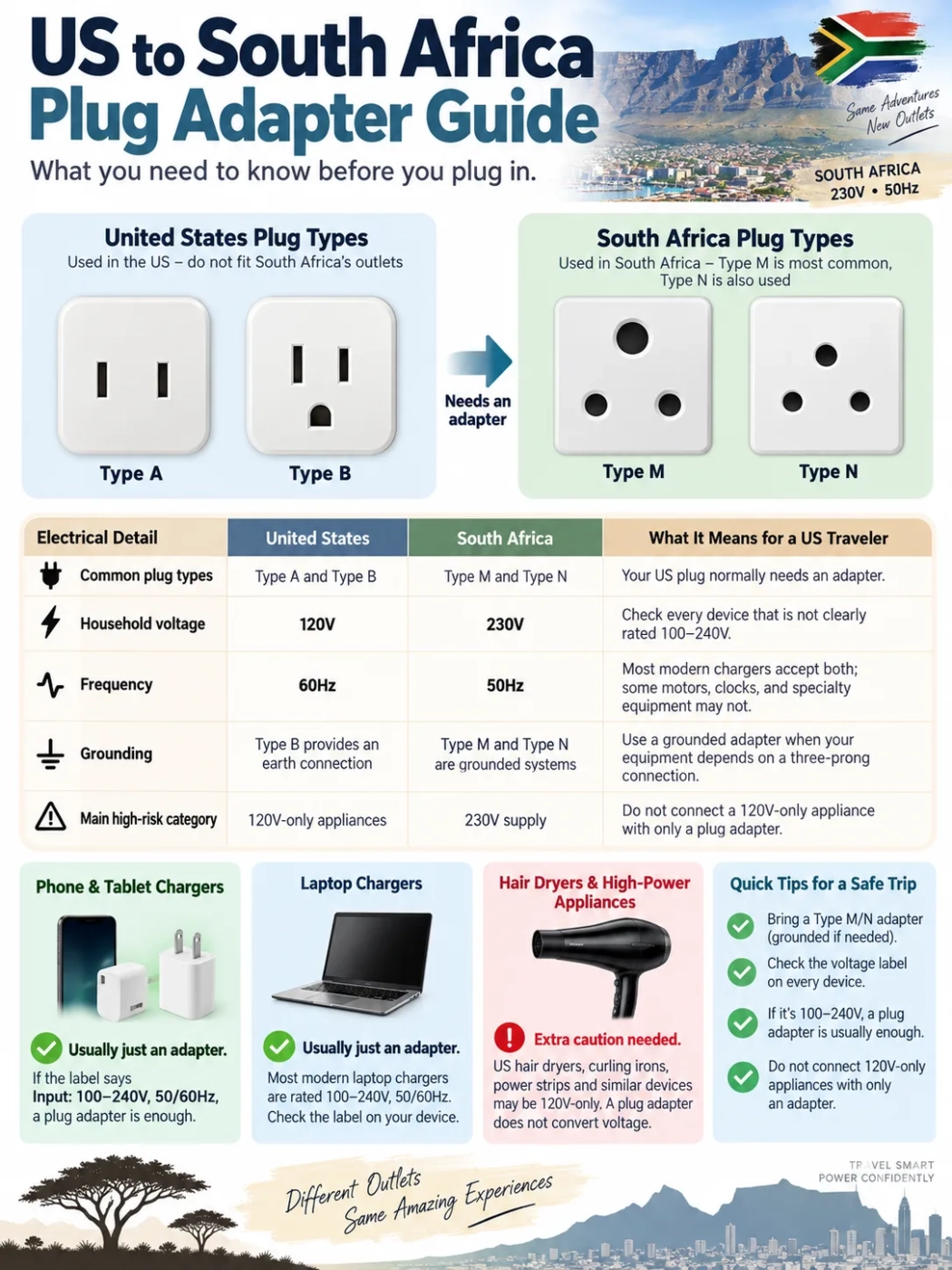
US Type A and Type B plugs do not fit South Africa’s Type M or Type N wall sockets directly, so an American traveler will normally need a South Africa plug adapter. The electrical difference matters just as much: the United States uses 120V at 60Hz, while South Africa uses 230V at 50Hz. If a charger is marked Input: 100–240V, 50/60Hz, a plug adapter is usually enough. A device marked only for 120V needs different treatment.
A plug adapter does not convert voltage. This is especially important for US hair dryers, curling irons, power strips, surge protectors, and other equipment that may be designed only for a 120V supply.
From a US Outlet to a South African Outlet: What Changes?
| Electrical detail | United States | South Africa | What it means for a US traveler |
|---|---|---|---|
| Common plug types | Type A and Type B | Type M and Type N | Your US plug normally needs an adapter. |
| Household voltage | 120V | 230V | Check every device that is not clearly rated 100–240V. |
| Frequency | 60Hz | 50Hz | Most modern chargers accept both; some motors, clocks, and specialty equipment may not. |
| Grounding | Type B provides an earth connection | Type M and Type N are grounded systems | Use a grounded adapter when your equipment depends on a three-prong connection. |
| Main high-risk category | 120V-only appliances | 230V supply | Do not connect a 120V-only appliance with only a plug adapter. |
There are two separate compatibility checks. First, the plug must physically fit the socket. Second, the device must accept South Africa’s voltage and frequency. Passing the first check does not mean the second one is safe.
US and South Africa Plug Shapes
Type M is the larger South African three-round-pin system. Type N is a newer, more compact three-round-pin system. Real wall plates can vary by manufacturer, building age, switches, and combined socket layouts. Plug shape and voltage are separate issues.
Which Adapter Should an American Traveler Pack?
A US Type A plug has two flat blades. A US Type B plug adds a round grounding pin. Neither shape plugs directly into Type M or Type N. The safest buying rule is to choose an adapter that explicitly states support for South Africa Type M and, for broader coverage, South Africa Type N or ZA.
| Your US plug | South African outlet | What you need | Grounding point |
|---|---|---|---|
| Type A | Type M | Type A-compatible input to Type M adapter | Type A itself is ungrounded. |
| Type A | Type N | Type A-compatible input to South African Type N/ZA adapter | Type A itself is ungrounded. |
| Type B | Type M | Grounded Type B-compatible input to Type M adapter | Choose an adapter that preserves the earth connection. |
| Type B | Type N | Grounded Type B-compatible input to South African Type N/ZA adapter | Ground continuity matters for equipment designed to use it. |
One adapter can be convenient if it genuinely supports both South African outlet systems. Another practical option is one dedicated Type M adapter plus a separate Type N/ZA adapter. This avoids relying on a single mechanism and gives you a second connection when a room has more than one outlet.
Do not rely on the word universal by itself. Some universal travel adapters cover US, European, UK, and Australian plug patterns but omit the large Type M pins. Check the actual destination plug specification rather than the product name.
Why South Africa Has Both Type M and Type N
South Africa is in a long-running transition between its older large round-pin system and a newer compact socket standard. Type M remains in use, while the SANS 164-2 system commonly identified to travelers as South African Type N or the ZA plug is used in newer electrical work. South African wiring rules have required SANS 164-2 provision at socket-outlet points in new installations since 2018, while older SANS 164-1 Type M outlets can still be installed alongside it.
For a traveler, the practical result is simple: Type N is not merely a future replacement, and Type M has not disappeared. A recently built or renovated property may offer Type N, Type M, or a combined arrangement. Older properties may still rely heavily on Type M.
Type M is not Type D
Type M and Type D both use three round pins in a triangular layout, but their pin dimensions differ. An adapter described only for India or Type D should not be assumed to fit a South African Type M socket securely.
A UK adapter is not a South Africa adapter
South Africa does not use the UK Type G socket as its normal domestic standard. A Type G adapter with three rectangular pins will not solve a Type M or Type N connection.
Check the Device Label Before You Think About a Converter
The fastest way to decide whether a US device can handle 230V is to read the input rating on the charger, power brick, charging base, or appliance body. The word Input matters: output voltage printed near a USB port or laptop connector tells you something different.
| Label example | 230V compatibility | Typical travel decision |
|---|---|---|
| Input: 100–240V, 50/60Hz | Normally compatible | Use the correct plug adapter; a voltage converter is usually not needed. |
| Input: 110–240V, 50/60Hz | Normally compatible | Use the correct plug adapter. |
| Input: 220–240V, 50/60Hz | Normally compatible | Use a plug adapter if the attached plug is US Type A or B. |
| Input: 120V, 60Hz | Not directly compatible | Do not connect it to 230V with only a plug adapter. |
| 120/240V or 125/250V selector | May be compatible | Set the appliance to the high-voltage position before use and follow its instructions. |
| No readable voltage information | Unknown | Do not assume compatibility. |
Input: 100–240V means the power supply is designed to accept a wide voltage range that includes both US 120V and South African 230V. If the same label also states 50/60Hz, the power supply is designed for both frequencies. The plug shape still needs to be adapted.
When a step-down voltage converter may be needed
A 120V-only device may require a step-down converter that accepts the local 230V supply and provides an output suitable for the device. The converter must also be able to handle the appliance’s power demand. A small converter intended for low-power electronics may be unsuitable for a heat-producing appliance.
Do not connect a 120V-only appliance directly to South Africa’s 230V supply simply because an adapter makes the plug fit.
50Hz versus 60Hz can still matter
Most modern phone chargers, laptop power supplies, USB chargers, and many camera chargers accept both 50Hz and 60Hz. Frequency deserves more attention with devices that use AC motors, mechanical timing, older clock mechanisms, or specialized electrical equipment. A voltage converter does not necessarily change 50Hz into 60Hz.
One US Item That Deserves Extra Attention: Power Strips
A common travel setup is to connect one South Africa adapter to a familiar US power strip and then plug several American chargers into it. That setup is only appropriate if the power strip itself is rated for the South African supply.
Many US power strips and extension strips are marked around 120V or 125V. If that is the only voltage rating, do not use the strip on 230V. The same warning applies more strongly to US surge-protected strips because their internal protective components are designed around a particular supply voltage. An adapter does not raise the voltage rating of a power strip or surge protector.
A better multiple-device setup is often a 100–240V multi-port charger connected through one correctly rated South Africa adapter. This can charge several phones, tablets, watches, cameras, or a compatible laptop without placing a 125V US strip in the chain.
Phones, Laptops, Cameras, and USB-C Chargers
Modern travel electronics are often easier to use than household appliances because their power supplies commonly accept a wide input range. Still, the label on the actual charger decides compatibility.
Phone and tablet chargers
If the charger says Input: 100–240V, 50/60Hz, it will normally accept South Africa’s power supply without a voltage converter. You still need a Type M or Type N solution for the wall connection.
Laptop chargers and grounded Type B plugs
Many laptop power bricks also accept 100–240V and 50/60Hz. Check the input side of the charger rather than the low-voltage output shown near the laptop connector.
If the US cord ends in a three-prong Type B plug, choose an adapter that keeps the grounding path intact. A two-contact adapter may make a plug physically connect while removing the earth connection the equipment was designed to use.
USB-C charging has a separate wattage question
A USB-C charger can be fully compatible with 230V and still be too weak for a laptop. Input compatibility tells you whether the charger can safely connect to the local supply. USB-C output wattage tells you whether it can provide enough power to the device. A phone-sized charger may charge a laptop slowly or fail to keep up while the computer is in use.
Camera and drone charging
Camera battery chargers and many drone power supplies use universal-voltage inputs, but battery docks and multi-battery hubs should be checked individually. For a safari trip, it is useful to confirm the charging equipment before departure rather than discovering that a battery hub has a different input rating from the camera charger.
Hair Dryers, Curling Irons, and Other High-Power Appliances
Heat-producing appliances are where the 120V-to-230V difference causes the most trouble for US travelers. Hair dryers, curling irons, straighteners, kettles, and clothes irons should not be treated like phone chargers.
US hair dryers
A hair dryer labeled only for 120V should not be connected directly in South Africa. Even if a step-down converter is considered, it must be rated for the full load of the dryer. High-power heating appliances can exceed the capacity of small travel converters.
A dual-voltage travel dryer may have a selector such as 120/240V or 125/250V. Move it to the high-voltage position before connecting it to a South African outlet, and follow the appliance instructions.
Curling irons and hair straighteners
Some styling tools are sold with 100–240V input support; others are 120V-only. Check the label on the handle, cord tag, or power unit. A small appliance is not automatically a low-power or universal-voltage appliance.
Electric shavers and toothbrush charging bases
Shavers often use compact power supplies, but the voltage range varies. Toothbrush charging bases are easy to overlook because the input information may be printed underneath the stand. Check the base itself rather than assuming the toothbrush system is dual voltage.
CPAP Machines and Other Powered Medical Equipment
Many modern medical-device power supplies use wide-range inputs, but each device should be checked by its exact power supply and manufacturer instructions. Confirm voltage, frequency, grounding requirements, and any external humidifier or accessory power supply separately.
If you depend on powered medical equipment during a lodge or remote-area stay, ask the accommodation which room outlets are available and whether those outlets are connected to backup power. An inverter, generator, or battery system may serve only selected circuits. A travel adapter solves the plug connection; it does not provide backup electricity.
What to Expect in Hotels, Apartments, and Safari Lodges
South African accommodation can present a mix of Type M, Type N, USB ports, and multi-standard socket panels. A newer room may have the compact Type N system while an older property may still use large Type M outlets. Some wall plates combine more than one socket type.
Do not assume that a hotel’s universal-looking socket changes the voltage. The room supply remains the local electrical supply unless a separately identified system says otherwise.
Remote lodges and camps may also have fewer charging points than an urban hotel, and some properties may operate selected outlets from backup or limited-power systems. If camera batteries, medical equipment, or work devices are essential, carrying a power bank and charging when power is available can reduce dependence on a single wall outlet.
A Practical Charging Setup for Several US Devices
For a traveler carrying a phone, laptop, watch, camera, and power bank, the cleanest setup is often one 100–240V multi-port charger plus the appropriate South Africa wall adapter. It reduces the number of plug adapters needed and avoids using a US-only power strip.
Check the adapter’s maximum current and wattage before connecting equipment. Avoid stacking one plug adapter into another unless the products are specifically designed for that arrangement.
Adapter Mistakes That Cause Problems on a US-to-South-Africa Trip
- Buying only by the word “universal”: the adapter may not include South African Type M pins.
- Preparing for only one South African socket: Type M and Type N can both appear, so one-shape-only planning can leave you without a usable outlet.
- Treating Type D as Type M: their three-round-pin layouts look similar, but the pin dimensions differ.
- Taking a UK Type G adapter: South Africa’s normal domestic sockets are not UK Type G.
- Plugging in a 120V-only hair tool: physical fit does not make a 120V appliance compatible with 230V.
- Using a 125V US power strip behind an adapter: the strip’s own voltage rating still applies.
- Removing grounding from a Type B device: use an adapter that preserves earth continuity when the equipment requires it.
- Assuming every hotel USB port will handle a laptop: connector shape and charging wattage are separate issues.
What to Pack for Different US Travel Setups
| Travel setup | Useful power gear | Main check before departure |
|---|---|---|
| Phone and smartwatch | Type M/Type N solution, 100–240V USB charger, charging cables, power bank | Confirm the charger says 100–240V and 50/60Hz. |
| Laptop and phone | Grounded South Africa adapter, laptop charger, multi-port USB-C charger if useful | Preserve grounding and confirm enough USB-C output power. |
| Safari photography | Type M and Type N coverage, camera charger, spare batteries, power bank | Check every charging dock or battery hub rather than only the camera body. |
| Hair tools | Adapter only for tools already compatible with 230V; suitable voltage solution for 120V-only devices | Read the appliance voltage rating before packing it. |
| CPAP or powered medical equipment | Grounded adapter when required, original power supply, backup charging plan where appropriate | Confirm voltage, frequency, grounding, accessories, and accommodation power arrangements. |
Final Device Check Before Leaving the US
- Identify whether the plug is US Type A or grounded Type B.
- Pack a South Africa adapter solution that covers Type M and Type N/ZA.
- Read the Input line on every charger and appliance.
- If it says 100–240V, 50/60Hz, a voltage converter is usually unnecessary.
- If it says only 120V, do not use it on 230V with only a plug adapter.
- Check 50Hz compatibility for motor-driven, timed, medical, or specialty equipment.
- Keep grounded Type B equipment grounded through the adapter.
- Do not use a US 120V/125V power strip or surge protector on 230V unless its own rating clearly permits it.
- Check the adapter’s current and wattage rating before connecting high-power equipment.
Frequently Asked Questions
Do US plugs work in South Africa?
No. US Type A and Type B plugs do not fit South African Type M or Type N outlets directly. A South Africa-compatible plug adapter is normally required.
Should I take a Type M or Type N adapter to South Africa?
Prepare for both. Type M remains in use, while the newer South African Type N/ZA socket also appears in newer and renovated electrical installations. An adapter that clearly supports both, or two separate adapters, gives better coverage.
Can I charge a US iPhone or Android phone in South Africa?
Usually yes if the charger is labeled Input: 100–240V, 50/60Hz. In that case, the charger normally needs only the correct plug adapter. Check the charger label rather than relying on the phone model.
Can I use a US laptop charger in South Africa?
Most modern laptop power supplies accept 100–240V and 50/60Hz, but check the exact charger. If it has a grounded US Type B plug, use an adapter that preserves the earth connection.
Can I use a 120V US hair dryer in South Africa?
Not directly. South Africa supplies 230V. A 120V-only hair dryer should not be connected with only a plug adapter. A dual-voltage model set correctly for 220–240V is usually easier to travel with than a high-wattage 120V-only dryer.
Does a universal travel adapter convert 230V to 120V?
No. A universal plug adapter normally changes only the physical plug connection. It does not make a 120V-only appliance safe on a 230V supply unless the product specifically includes an appropriate voltage-conversion function and is rated for the device being used.