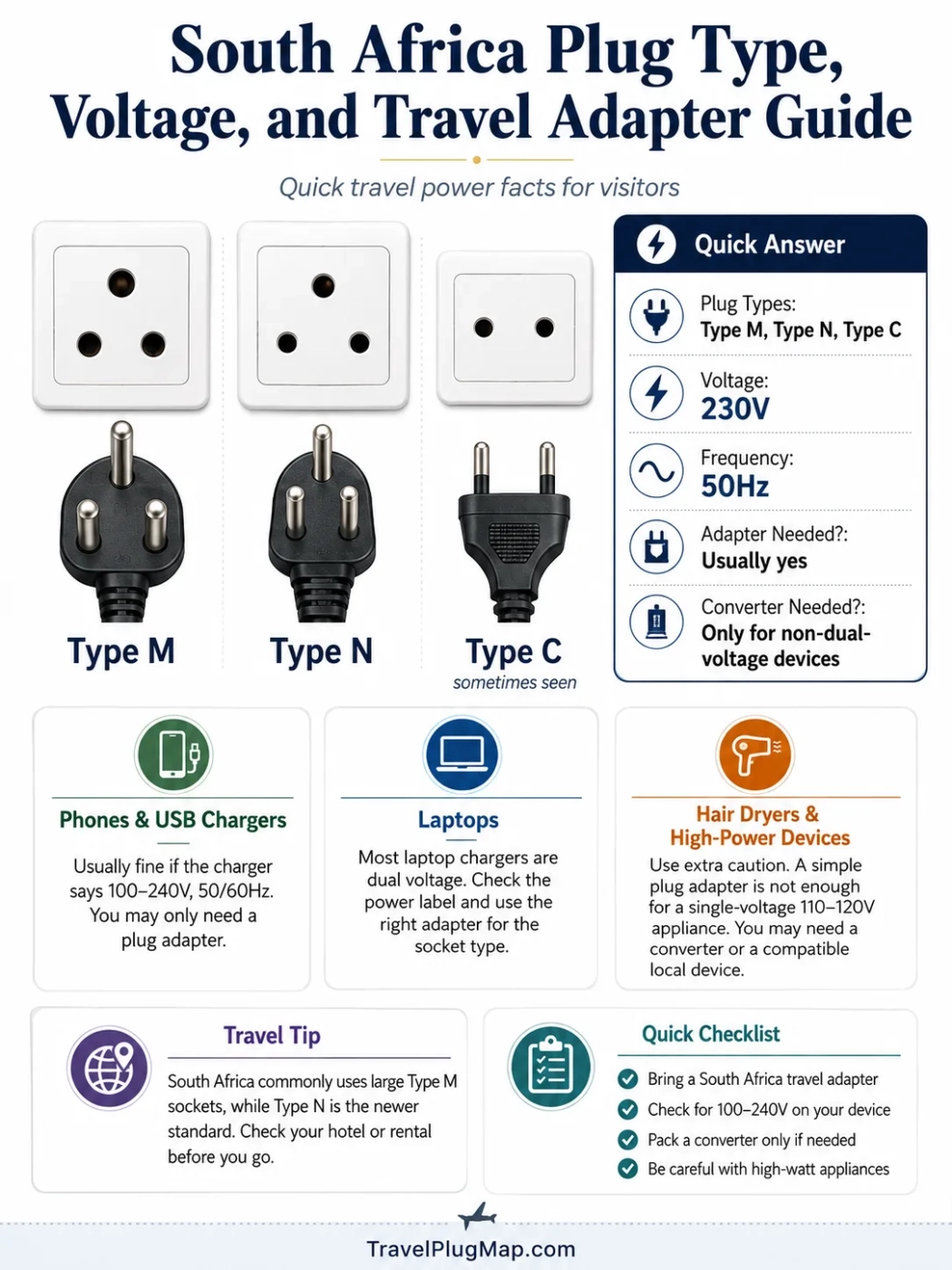
South Africa uses a 230V, 50Hz electricity supply and travelers may encounter both Type M and the newer Type N power outlets. Most visitors need a South Africa-compatible plug adapter, but a voltage converter is usually unnecessary for devices labeled Input: 100–240V, 50/60Hz. Because older and newer socket standards can appear in the same destination, an adapter that clearly supports both South African Type M and Type N connections is the most dependable choice.
South Africa Power Essentials
| Electrical detail | South Africa standard | What it means for travelers |
|---|---|---|
| Common plug types | Type M and Type N | Plan for both outlet systems when choosing an adapter. |
| Standard voltage | 230V | Check devices brought from 100–120V countries. |
| Frequency | 50Hz | Most modern chargers support 50/60Hz, but some motors and timers may not. |
| Plug adapter | Usually required | Choose an adapter that specifically lists South Africa or ZA compatibility. |
| Voltage converter | Depends on the device | Usually not needed for equipment marked 100–240V. |
| Best device check | Read the input label | Confirm voltage, frequency, and wattage before connecting the device. |
A plug adapter does not convert voltage. It only changes the physical connection between your plug and the South African power outlet. Voltage compatibility must be checked separately.
What the Power Outlets Look Like
These illustrations show the basic front-facing layouts travelers may see. Real outlets can look different depending on the socket manufacturer, building age, faceplate design, and whether the outlet includes switches or multiple standards. Some hotels also install multi-standard sockets. The outlet shape tells you whether a plug can connect; the device label tells you whether the equipment can use South Africa’s 230V, 50Hz supply.
Why South Africa Has Type M and Type N Outlets
South Africa is in a long transition between two domestic outlet systems. Type M remains widely encountered, while the smaller Type N system is used in newer installations under the South African SANS 164-2 standard. Travelers may see one type or both during the same trip.
Older homes, hotels, guesthouses, offices, and safari properties may retain Type M outlets. Renovated and newer properties may include Type N sockets, sometimes on the same outlet panel as Type M.
Type M: The Large Three-Round-Pin Plug
Type M has three large round pins arranged in a triangle. The upper pin provides the earth connection, while the two lower pins carry the electrical supply. The matching socket is visibly larger than most European round-pin outlets.
American, British, Australian, Japanese, and standard continental European plugs need a suitable adapter for a Type M outlet. Many compact “universal” adapters cover Type A, Type C, Type G, and Type I destinations while omitting the larger Type M connection, so the product specification should list South Africa or Type M.
Type N: The Newer South African ZA Plug
South African Type N uses three smaller round pins in a compact grounded layout. It may also be described as the ZA plug or as a SANS 164-2 connection. Newer homes, offices, renovated hotel rooms, and recently installed outlet panels are more likely to include it.
Type M remains common during the transition. For a trip that includes several accommodations, adapter coverage for both Type M and South African Type N gives the most flexibility.
Type C Europlugs in Type N Sockets
The South African Type N system can accommodate the slim two-round-pin plug used by compatible low-power Class II equipment, including many phone and small-device chargers. This is useful for travelers carrying a genuine Type C Europlug.
That two-pin compatibility applies to the compact Europlug format. Grounded Type E and Type F plugs use a different connection, and Type C still has no fit in a Type M socket. Travelers from continental Europe or Türkiye therefore benefit from carrying a South Africa adapter when the itinerary includes more than one property.
Type M and Type D: Similar Shape, Different Dimensions
Type M and Type D both use three round pins in a triangular arrangement, which makes them easy to confuse in photographs. Type M uses larger pins and different dimensions from the Type D system associated with India and several other destinations.
An adapter labeled for South Africa or Type M is the appropriate choice for the larger socket. Type D-sized hardware can be loose, fail to enter the socket correctly, or produce an unreliable connection.
South African Type N and Brazilian Type N
South Africa and Brazil both use systems commonly grouped under the Type N name, but the national implementations are different. South Africa uses SANS 164-2, while Brazil uses NBR 14136. Pin diameters and current ratings differ between these systems.
For grounded equipment or heavier loads, use an adapter whose specification explicitly includes South Africa, ZA, or SANS 164-2 compatibility. A country-specific rating is more useful than the Type N letter by itself.
Voltage and Frequency in South Africa
The standard electricity supply in South Africa is 230V at 50Hz. This is similar to the electrical system used in the United Kingdom, Ireland, most of continental Europe, Australia, New Zealand, and many countries in Africa and Asia.
Travelers from the United States, Canada, Japan, and other locations where 100–120V electricity is common should check each device before use. The plug adapter solves the physical connection; electrical suitability depends on whether the device accepts South Africa’s 230V supply.
How to Read the Device Label
Look on the charger, power brick, appliance body, battery dock, or manufacturer label for the word Input. The voltage and frequency range usually appears beside it.
| Example device label | South Africa compatibility | What you may need |
|---|---|---|
| Input: 100–240V, 50/60Hz | Usually compatible | A plug adapter only |
| Input: 220–240V, 50Hz | Usually compatible | A plug adapter if the plug shape differs |
| Input: 230V, 50Hz | Designed for the local supply | Only a physical adapter when necessary |
| Input: 110–120V, 60Hz | Not directly compatible | An appropriate voltage converter or a different device |
| Input: 120/240V | May be compatible | Set the voltage selector correctly before connecting |
The label Input: 100–240V, 50/60Hz means the charger is designed to accept a wide range of international electricity supplies. In most cases, it can be used in South Africa without a voltage converter. You still need the correct plug adapter.
When the 50Hz Frequency Matters
Most modern phone chargers, laptop power supplies, camera chargers, and USB adapters support both 50Hz and 60Hz. Frequency is more likely to matter for equipment that uses an AC motor, mechanical timer, compressor, or clock mechanism.
Examples can include older electric clocks, some fans, record players, specialist medical equipment, certain grooming devices, and appliances labeled only for 60Hz. Many travel voltage converters change voltage while leaving the 50Hz supply frequency unchanged, so frequency-sensitive equipment needs a check for both values.
Do You Need a Travel Adapter for South Africa?
Most international travelers need a plug adapter because Type M and Type N are not the standard household outlets in many countries. The exact adapter depends on the plug attached to your device.
| Home country or region | Common plug type | Will it fit directly? | Recommended preparation |
|---|---|---|---|
| United States and Canada | Type A and Type B | No | Carry a South Africa Type M and Type N compatible adapter. |
| United Kingdom and Ireland | Type G | No | Use a Type G to South Africa adapter. |
| Continental Europe | Type C, Type E, and Type F | Only some Type C plugs may fit some Type N sockets | Carry a South Africa adapter rather than relying on Type C compatibility. |
| Türkiye | Type C and Type F | Type F does not fit; Type C may fit selected Type N sockets | Carry an adapter that supports Type M and Type N. |
| Australia and New Zealand | Type I | No | Use a Type I to South Africa adapter. |
| Japan | Type A and Type B | No | Carry an adapter and check the voltage label carefully. |
| India | Type C, Type D, and Type M | Depends on the exact plug | Identify whether the device uses Type M, Type D, or Type C and check its voltage. |
| Brazil | Type C and Type N | Country-specific Type N versions differ | Use an adapter that specifically lists South African Type N or ZA outlets. |
Travel Adapter or Voltage Converter?
A travel adapter changes the physical plug connection so a device can enter the local socket. South Africa’s wall supply remains 230V after the adapter is fitted.
A voltage converter changes the electrical voltage supplied to an appliance. A 110–120V-only appliance may require a step-down converter for South Africa, and the converter must be rated for the appliance’s continuous wattage and device type. Hair dryers, kettles, irons, and other heating appliances can exceed the capability of compact travel converters.
A 110–120V-only appliance needs electrical compatibility with the 230V supply before it is connected. A correctly shaped plug adapter only solves the socket connection.
| Device situation | Typical requirement |
|---|---|
| Different plug shape, compatible voltage | Plug adapter |
| Compatible plug shape, incompatible voltage | Suitable voltage converter or a locally compatible device |
| Different plug shape and incompatible voltage | Plug adapter plus a suitable voltage converter |
| Input: 100–240V, 50/60Hz | Usually a plug adapter only |
Will Your Devices Work in South Africa?
Phones, Tablets, Laptops, Cameras, and Drones
Most modern phone, tablet, and laptop chargers are designed for international input. Check the charger or power brick for Input: 100–240V, 50/60Hz. With that range, South Africa’s 230V, 50Hz supply is normally suitable and the remaining requirement is the correct plug connection.
Grounded laptop chargers need an adapter that carries the earth connection through to the wall socket. For USB-C laptops, also check the charger’s output wattage; a low-power phone charger can fit the connector while providing too little power for normal laptop use.
Camera battery chargers are commonly dual voltage, while drone battery hubs and multi-battery chargers may draw more power. Read the input rating on the charging dock or power adapter and keep the load within the adapter’s current and wattage limits. For wildlife reserves or remote accommodation, charging spare batteries whenever power is available can be useful.
Hair Dryers, Curling Irons, and Hair Straighteners
Hair dryers and styling tools deserve extra attention because heating elements draw high power. A 120V-only hair dryer from the United States or Canada needs a correctly rated conversion solution for South Africa’s 230V supply; in many cases, using a locally supplied dryer is simpler.
Dual-voltage travel dryers may have a selector marked 120V/240V or 125V/250V. Set the selector to the higher-voltage position before connecting the dryer in South Africa. Curling irons and hair straighteners vary by model, so use the voltage information on the handle, cord label, or manufacturer plate.
Check the printed voltage and wattage before using any high-power appliance.
Electric Shavers and Toothbrush Chargers
Many electric shavers use universal-voltage chargers. Toothbrush bases and other bathroom charging stands can be single-voltage products, with the electrical label often placed underneath the base. A label that includes 230V or a 100–240V input range is the useful reference for South African use.
CPAP Machines and Medical Equipment
Many modern CPAP power supplies accept 100–240V, but medical equipment should be checked by model. Confirm the voltage range, frequency range, grounding requirement, external power supply, and manufacturer instructions.
Travelers who depend on powered medical equipment should ask the accommodation which outlets remain active during an interruption and whether backup power covers bedroom sockets. A generator or inverter may supply selected circuits rather than every outlet in the property.
Game Consoles, Monitors, and Work Equipment
Compatibility depends on the console, external power brick, monitor, or desktop power supply. Many recent devices accept 100–240V automatically; older equipment can use region-specific power supplies or manual voltage selectors.
For a workstation with several devices, use a properly rated South Africa-compatible connection and check the maximum current and wattage of adapters, extension leads, and power strips. Heavy chargers are more stable when the plug and adapter fit firmly in the outlet.
Hotels, Guesthouses, and Safari Lodges
South African accommodation can contain a mix of outlet hardware. A hotel room may have Type M, Type N, Type C-compatible points, USB charging ports, or a multi-standard panel. Renovations completed in stages can leave different room types with different electrical fittings, so booking photographs are best treated as examples rather than an exact inventory.
Safari lodges, camps, farms, mountain properties, and smaller guesthouses may provide fewer charging points than an urban hotel. Some properties operate selected circuits or scheduled power hours. A compact multi-port charger can reduce the number of wall sockets needed when it is used with one stable, correctly rated South African adapter.
Built-in hotel USB ports vary in output. Older USB-A ports may charge slowly and may lack the USB-C Power Delivery levels required by laptops or newer phones. Using your own universal-voltage charger gives you a known input rating and the charging output your devices require.
Choosing a South Africa Travel Adapter
A dedicated Type M adapter is useful for the large three-round-pin sockets still found across South Africa. Travelers staying in several properties can add a South African Type N / ZA option for newer installations.
Universal adapters vary widely in country coverage. Check the technical specification for:
- Explicit Type M or South Africa support
- South African Type N or ZA compatibility
- Maximum voltage and current rating
- Maximum wattage
- Grounding support
- USB-A and USB-C output ratings
- Overcurrent protection or a replaceable fuse, when provided
For trips that move between city hotels, guesthouses, and lodges, a practical setup can be one stable Type M adapter, one South Africa-compatible Type N option, and a universal-voltage multi-port USB charger. This also gives access to a second outlet when the room provides more than one socket.
Power Interruptions and Charging Strategy
Local power interruptions can occur because of maintenance, faults, weather, infrastructure problems, or constrained electricity supply. A travel adapter handles the plug connection only; backup electricity and voltage conditioning require separate equipment.
Practical preparation includes:
- Charge phones, cameras, laptops, and power banks when electricity is available.
- Keep essential devices above a useful battery level rather than waiting until they are nearly empty.
- Ask the accommodation whether backup power covers bedroom sockets.
- Carry a suitable power bank for phones and small USB devices.
- Consider a vehicle USB charger for long road trips.
- Disconnect sensitive equipment if an outlet is repeatedly switching on and off.
A generator, solar system, battery bank, or inverter may operate only selected circuits. Air conditioning, kettles, hair dryers, and other high-power devices may be unavailable even when lights and charging sockets continue to work.
Grounding and High-Power Appliance Safety
Grounded laptop chargers, desktop computers, medical devices, and other Class I equipment should retain a continuous earth path through the adapter to the wall outlet. Choose a grounded adapter designed for the South African socket type in use.
Every adapter also has a maximum electrical rating. Match its permitted voltage, current in amps, and power in watts to the South African supply and the connected appliance. High-power appliances such as hair dryers, kettles, irons, portable heaters, and cooking equipment need adapters or converters rated for their load.
Type M uses large pins, and a heavy charging block can pull downward on a loose connection. Stop using an adapter that becomes hot, crackles, sparks, or repeatedly falls out of the outlet. Stacking travel adapters adds more mechanical joints and makes the final current and grounding path harder to verify.
What to Pack for Different South Africa Trips
| Trip type | Useful electrical gear |
|---|---|
| Short city visit | Type M and South African Type N adapter coverage, universal-voltage phone charger, device cables, compact power bank |
| Business trip | Grounded laptop adapter, Type M connection, Type N backup, multi-port USB-C charger with sufficient wattage, phone or hotspot power bank |
| Safari or remote lodge stay | Type M and Type N options, airline-compliant power bank, vehicle USB charger, spare camera batteries, low-power charging gear |
| Family travel | Multi-port charger, enough cables for each device, clearly labeled adapters, and a setup that keeps the total load within the outlet and adapter rating |
A short extension lead can be useful when it is rated for 230V use and for the expected current. High-wattage 120V-only heating appliances add converter and load requirements that are often easier to avoid by using local equipment.
South Africa Device Compatibility Matrix
| Device | Plug adapter | Voltage converter | What to check |
|---|---|---|---|
| Smartphone charger | Usually needed | Usually not needed | Look for Input: 100–240V, 50/60Hz. |
| Tablet charger | Usually needed | Usually not needed | Check the charger, not only the tablet. |
| Laptop charger | Usually needed | Usually not needed | Confirm input range and preserve grounding. |
| Camera battery charger | Usually needed | Depends on the charger | Read the charging dock input label. |
| 120V-only hair dryer | Needed | Appropriate step-down conversion with adequate wattage | A local 230V dryer is often the simpler option. |
| Dual-voltage hair dryer | Needed | Usually not needed | Move the selector to the 220–240V position. |
| Curling iron or straightener | Usually needed | Depends on voltage range | Check for 100–240V or dual-voltage support. |
| Electric shaver | Usually needed | Depends on the charger | Check voltage and frequency. |
| Electric toothbrush base | Usually needed | May be needed | Read the label underneath the charging base. |
| CPAP machine | Usually needed | Depends on the power supply | Confirm voltage, frequency, grounding, and backup power. |
| Gaming console | Needed | Model dependent | Check the console or external power brick. |
South Africa Adapter Compatibility Checks
- Type M vs Type D: Both use three round pins, but Type M uses larger dimensions. Use hardware labeled for South Africa or Type M.
- Type G: South Africa’s household outlet system differs from the modern UK Type G system.
- Type M and Type N coverage: Type M remains common while Type N appears in newer installations, so multi-property trips benefit from access to both.
- European Type C: A genuine Europlug can work with compatible Type N sockets; Type M requires an adapter.
- Brazilian and South African Type N: The national versions use different specifications. Choose equipment that lists South Africa or ZA support.
- Voltage: A plug adapter changes the physical connection. Devices still receive South Africa’s 230V supply.
- Heating appliances: 120V-only hair dryers and similar high-power devices need a correctly rated electrical solution for 230V.
- Grounded chargers: Keep the protective earth connection when the device is designed to use one.
- Adapter rating: Match the maximum amps and watts to the connected load, especially for kettles, irons, and hair dryers.
- Hotel USB: Port type and charging output vary, so a personal charger is useful for devices that need fast charging or USB-C Power Delivery.
- Mechanical fit: Firm, correctly sized connections are preferable to stacks of loosely fitted adapters.
- Battery planning: At properties with limited or backup power, charge essential devices while the relevant circuits are available.
South Africa Pre-Trip Electrical Check
- Read the input voltage on every charger and appliance.
- Confirm whether the label includes 230V or 100–240V.
- Check whether the device supports 50Hz.
- Pack a Type M-compatible South Africa adapter.
- Add a Type N or ZA-compatible option.
- Confirm that grounded equipment remains grounded.
- Check the maximum amps and watts of the adapter.
- Leave unsuitable 120V-only heating appliances at home.
- Pack a power bank for phones and small USB devices.
- Ask remote accommodation about charging hours and backup power.
Frequently Asked Questions
What plug type is used in South Africa?
South Africa uses Type M and the newer Type N power outlets. Type M has three large round openings, while Type N uses a smaller three-round-pin layout.
Do I need a travel adapter for South Africa?
Most international travelers need a plug adapter. Choose one that clearly supports South African Type M and preferably Type N or ZA outlets.
Do European plugs work in South Africa?
A slim two-pin Type C Europlug can fit compatible South African Type N sockets. Type M uses the larger three-round-pin connection, while grounded Type E and Type F plugs require an adapter suited to the South African outlet.
Is the South African plug the same as the UK plug?
No. The United Kingdom uses the rectangular-pin Type G system. South Africa mainly uses round-pin Type M and Type N outlets.
Do I need a voltage converter in South Africa?
You usually do not need a converter for a device labeled Input: 100–240V, 50/60Hz. A 110–120V-only appliance may require an appropriate converter.
Can I use my hair dryer in South Africa?
You can normally use it if it supports 220–240V or is correctly set to its dual-voltage 240V position. A 120V-only hair dryer needs a suitable step-down solution rated for the dryer’s full wattage; a local 230V dryer is often easier.