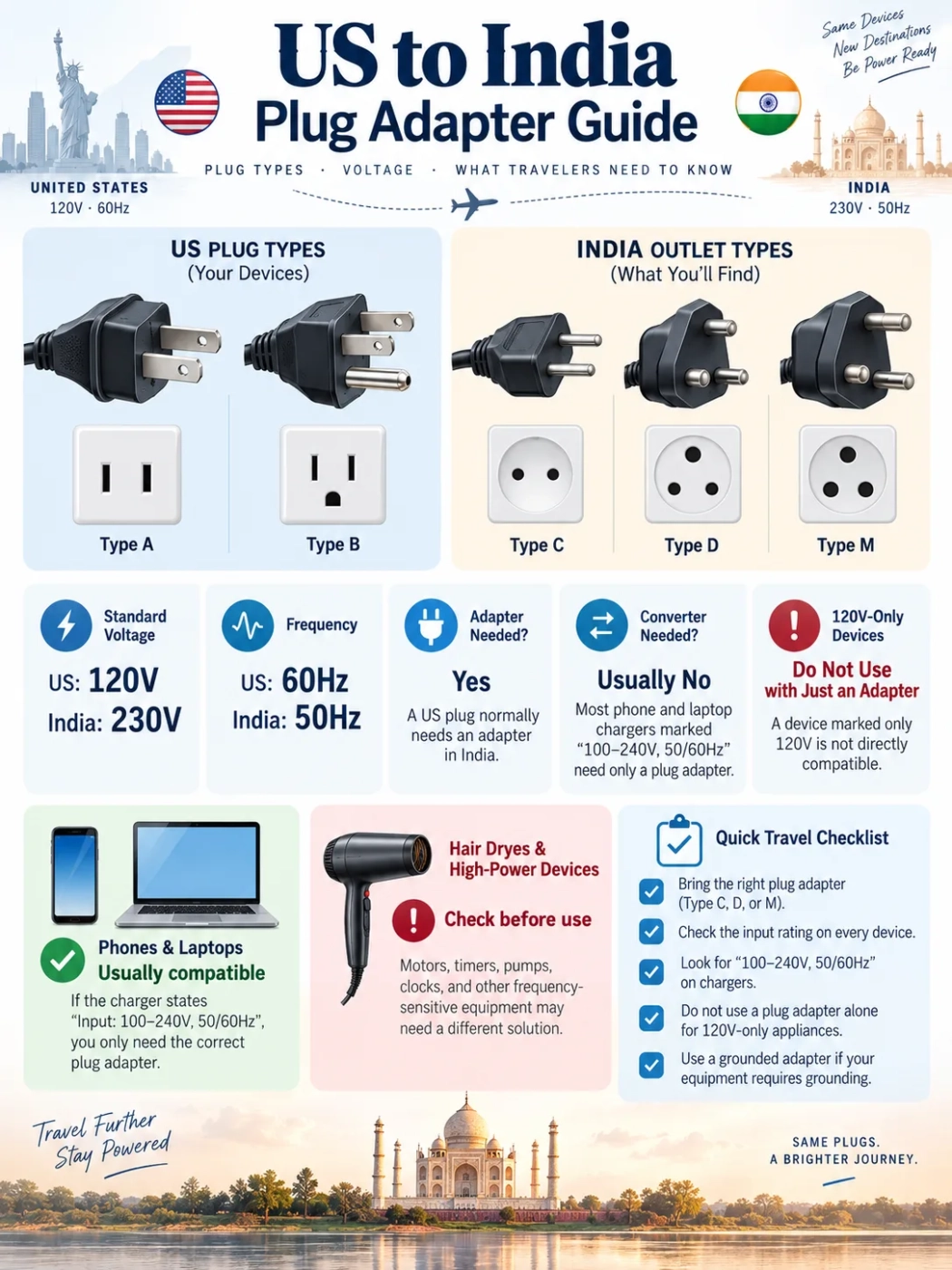
If you are traveling from the United States to India, plan on bringing a plug adapter and checking the voltage rating on every device you intend to use. US devices commonly have Type A or Type B plugs and are designed around a 120V, 60Hz supply. India uses 230V, 50Hz electricity and travelers can encounter Type C, Type D, and Type M outlets. Most phone and laptop chargers marked “Input: 100–240V, 50/60Hz” need only the correct plug adapter. A device marked only 120V needs a different decision.
| Power detail | United States | India | What it means for the traveler |
|---|---|---|---|
| Common plug types | Type A and Type B | Type C, Type D, and Type M | A US plug normally needs an adapter. |
| Standard voltage | 120V | 230V | Check the device input rating before connecting it. |
| Frequency | 60Hz | 50Hz | Check motors, timers, pumps, clocks, and other frequency-sensitive equipment. |
| Modern chargers | Often 100–240V | 230V supply | Normally compatible when the charger itself states 100–240V, 50/60Hz. |
| 120V-only appliances | Normal at home | Not directly compatible | A plug adapter alone must not be used. |
| Grounded US devices | Type B uses a grounding pin | Grounding depends on the outlet and adapter | Use an adapter that maintains earth continuity when the equipment requires grounding. |
US Plugs and Indian Outlets: What Changes
A standard US Type A or Type B plug should not be expected to fit a normal Type D or Type M socket. Type C has two round openings, Type D has three round openings arranged in a triangle, and Type M has a similar triangular layout with larger contacts.
Type D is the main Indian socket shape worth planning around for an ordinary trip, but it is not the only one you may encounter. Type C and Type M outlets, as well as multi-standard sockets, can also appear. Outlet designs can vary by building, socket manufacturer, and age of installation.
Do not plan your entire trip around a hotel advertising universal sockets. A multi-standard socket may accept an American plug in one room while another property uses ordinary Indian outlets.
Choosing an Adapter for a US Type A or Type B Plug
Two-Prong Type A Devices
A Type A plug has two flat parallel blades and normally has no protective earth connection. For India, the adapter needs to accept the American Type A plug and connect safely to the Indian socket available at your destination.
Do not choose an adapter simply because its destination side has two round pins. India does not use one interchangeable “round-pin” system. Type C, Type D, and Type M have different physical arrangements.
Three-Prong Type B Devices
Type B adds a grounding pin to the two flat blades. This matters with some laptop power cords, desktop equipment, monitors, audio equipment, and other devices designed to remain earthed.
Physical fit does not guarantee grounding. An adapter may accept all three prongs of a Type B plug yet provide no electrical connection for the grounding conductor. If the equipment requires a protective earth, use a grounded adapter intended to maintain that connection through a compatible grounded outlet.
A three-prong plug inserted into an adapter should not be treated as proof that the device remains grounded.
The 120V-to-230V Difference Matters More Than the Plug Shape
The United States and India are on opposite sides of a large voltage difference. US household electricity is commonly 120V, while India uses 230V. An adapter can solve the physical plug mismatch while leaving the voltage completely unchanged.
A plug adapter does not convert voltage. Connecting a 120V-only appliance to 230V through a mechanical adapter can damage the appliance and may create an electrical or overheating hazard.
The safest decision comes from the input label on the charger, power supply, or appliance itself rather than from the type of device, its brand, or the fact that the plug fits.
How to Read the Device Label Before Using It in India
If the Label Says “Input: 100–240V, 50/60Hz”
This is the rating travelers want to see on devices brought from the US. A power supply with Input: 100–240V, 50/60Hz is designed to operate across the voltage and frequency ranges used in both the United States and India.
For such a charger, voltage conversion is normally unnecessary. You still need a physical plug adapter if the US plug cannot connect directly to the available outlet.
This rating is common on modern phone chargers, USB-C power supplies, laptop power bricks, tablet chargers, camera chargers, and similar electronics. Check the actual charger rather than assuming compatibility from the device category.
If the Label Says Only “120V” or “120V 60Hz”
A device marked only for 120V should not be connected directly to India’s 230V supply with a basic plug adapter.
The options depend on the appliance. A correctly specified step-down voltage converter may be possible for some devices. With high-wattage appliances, a converter can become large, heavy, expensive, or unsuitable for the load, so using a 230V-compatible appliance can be the more practical choice.
If the Appliance Has a 120V/240V Selector
Some travel hair dryers, shavers, styling tools, and older appliances use a manual voltage selector rather than automatic wide-range input. Check the markings and the manufacturer’s instructions before connecting the appliance.
If the appliance is designed for 220–240V operation, set the selector to the appropriate high-voltage position before plugging it into the wall. A dual-voltage switch should not be treated as a substitute for checking the appliance’s complete voltage and frequency rating.
Phone, Laptop, Camera, and USB Chargers
Modern electronic chargers are the easiest US devices to travel with because many use wide-range switching power supplies. If the charger states 100–240V, 50/60Hz, India’s 230V, 50Hz supply is normally within its rated input range.
| Device | Plug adapter? | Voltage converter? | What to check |
|---|---|---|---|
| Phone charger | Usually | Normally no when rated 100–240V | Read the input rating on the wall charger. |
| USB-C charger | Usually | Normally no when rated 100–240V | Check both voltage range and maximum charger rating. |
| Laptop power brick | Usually | Normally no when rated 100–240V | Check input voltage, 50/60Hz support, and grounding. |
| Camera battery charger | Usually | Depends on the charger label | Check the charger’s input rather than the camera battery. |
| Electric toothbrush charger | Usually | Model dependent | Charging bases do not all use the same input voltage. |
| Electric shaver | Usually | Model dependent | Look for 100–240V, 220–240V, or a voltage selector. |
| CPAP power supply | Usually | Depends on the exact power supply | Confirm voltage, frequency, grounding, and manufacturer instructions. |
| Hair dryer | Usually | May be needed for a 120V-only model | Check voltage, wattage, frequency requirements, and any selector switch. |
| Curling iron or straightener | Usually | Model dependent | Check whether the appliance is genuinely dual voltage. |
For phones and laptops, the cable does not determine mains-voltage compatibility. The relevant rating is on the charger, power brick, charging base, or detachable AC power supply.
Hair Dryers and Other High-Wattage US Appliances
Hair dryers, curling irons, straighteners, clothes irons, travel kettles, and other heat-producing appliances deserve more attention than phone chargers. A high-power appliance can draw far more electrical power than a small USB charger, and many US models are built specifically for 120V operation.
Never connect a 120V-only high-power appliance directly to a 230V Indian outlet through only a plug adapter.
If the appliance is marked 100–240V or has a properly configured 120/240V selector, check its wattage and the rating of the travel adapter as well. Voltage compatibility does not remove the adapter’s own current and load limits.
If a 120V-only appliance requires conversion, the converter must be designed for step-down use from the local supply and must be rated for the appliance’s actual load. A small converter intended for low-power electronics should not be assumed suitable for a 1500W or 1800W heating appliance.
Why High-Wattage Converter Use Can Be Impractical
A high-output step-down converter must handle the appliance continuously for as long as it is operating. Heat-producing appliances can place a heavy load on both the converter and the outlet.
For a short trip, using a hotel-provided hair dryer or a styling appliance specifically designed for 220–240V operation can be simpler than carrying a large converter for a single 120V appliance.
India Is 50Hz While the US Is 60Hz
Voltage is not the only electrical difference. The US uses 60Hz power, while India uses 50Hz.
A standard voltage converter changes voltage; it does not normally convert 50Hz electricity into 60Hz. This distinction matters for equipment whose operation depends on mains frequency.
Check the frequency rating more carefully on:
- motor-driven appliances;
- equipment with mains-powered clocks or timers;
- some pumps and compressors;
- older electromechanical equipment;
- specialized laboratory or technical equipment;
- medical devices whose instructions specify a particular frequency.
A charger marked 50/60Hz is designed for both frequencies within its other stated limits. Equipment marked only 60Hz requires more investigation even if a voltage converter is available.
Do Not Bring a 125V-Only US Power Strip for a 230V Outlet
A common travel setup is to bring one plug adapter and connect a familiar US power strip so several chargers can be used at once. This can create a separate voltage problem.
Your phone and laptop chargers may each support 100–240V, but the power strip itself also has an electrical rating. A strip marked only 125V is not made for direct connection to a 230V supply.
The same caution applies to US surge protectors. Surge-protection components intended for a 120V electrical system should not be assumed suitable for a 230V system simply because the attached devices are dual voltage.
Before using any extension strip or multi-outlet accessory in India, check its:
- rated voltage;
- rated current;
- maximum load;
- grounding arrangement;
- surge-protection voltage rating, if surge protection is built in.
If it is labeled only for 120V or 125V operation, do not connect it directly to India’s 230V mains supply.
Grounding Matters With US Three-Prong Equipment
The third pin on a US Type B plug is not there simply to make the plug harder to fit. It can provide a protective earth connection for equipment designed around grounding.
An inexpensive two-pin travel adapter may allow a three-prong US plug to be connected while leaving that protective earth disconnected. This is especially relevant to grounded laptop cords, desktop equipment, monitors, certain chargers, and other Class I electrical equipment.
When grounding is required, check that:
- the travel adapter accepts the Type B grounding contact;
- the adapter actually carries that earth connection through to its destination-side contacts;
- the wall outlet itself provides a functioning earth connection;
- the adapter is rated for the voltage and load involved.
A three-prong plug fitting into an adapter is not proof of grounding continuity.
Type D and Type M Look Similar but Are Not the Same Size
Type D and Type M both use three round contacts in a triangular pattern, which can make them look interchangeable in photographs. Type M uses noticeably larger contacts.
A travel adapter designed only for one configuration should not be forced into a different socket. If your itinerary includes several hotels, homes, offices, or regions, an adapter setup that covers the Indian socket types you are likely to encounter offers more flexibility than relying on a single physical configuration.
Type C is different again: it uses two round contacts and does not provide the same grounding arrangement as a three-contact socket. A Type C connection should therefore not be used as a substitute for grounding required by a Type B appliance.
Universal Hotel Sockets Do Not Remove the Voltage Difference
Some hotels and travel-oriented properties use multi-standard sockets capable of accepting more than one plug shape. A US Type A plug may sometimes fit directly into such an outlet.
Do not assume that a hotel’s universal-looking socket changes the voltage. A socket that accepts an American plug can still supply India’s 230V, 50Hz electricity.
Before using a direct-fit hotel socket, make the same electrical check you would make with an adapter: confirm that the charger or appliance is rated for the supply.
A direct physical fit is convenient for a 100–240V phone charger. It does not make a 120V-only hair dryer compatible.
Adapter Load Rating Still Has to Match the Device
An adapter has its own voltage, current, and sometimes wattage limits. These limits matter most with high-power appliances.
For a device already designed to operate at 230V, approximate current can be estimated with:
Current in amps ≈ device watts ÷ 230
A 1600W appliance designed for 230V operation, for example, draws roughly 7A at its rated load. The adapter must be rated appropriately for that load and for the local voltage.
This calculation should not be used to justify connecting a 120V-only appliance directly to 230V. Voltage compatibility must be established first.
What to Pack for Different US-to-India Trips
Phone and Tablet Only
Check the wall charger’s input label. If it states 100–240V, 50/60Hz, a suitable India plug adapter is normally all that is required for mains compatibility.
Laptop, Phone, and Camera
Check each power supply separately. Wide-range chargers normally do not need voltage conversion. If the laptop uses a grounded Type B connection, choose an adapter arrangement that maintains grounding rather than automatically reducing the connection to two pins.
Several USB-C Devices
A multi-port USB or USB-C charger rated for 100–240V can reduce the number of separate US wall chargers that need adapters. The charger itself still has to be appropriate for 230V, and its destination connection must fit the available Indian socket.
Hair Styling Equipment
Check the appliance body for voltage and wattage markings. If there is a voltage selector, verify the correct setting before connecting it. For a 120V-only high-wattage appliance, do not assume that a small travel converter will be suitable.
Medical Equipment
CPAP machines and other medical equipment require model-specific checking. Confirm the power supply input range, frequency rating, plug arrangement, grounding requirements, and manufacturer instructions before travel. Do not base a medical-device setup only on the fact that a travel adapter fits.
A 20-Second Check Before Plugging In
- Check the plug: Does your Type A or Type B plug connect through the correct adapter without forcing it?
- Check voltage: Does the device support 230V, either through a 100–240V input range or an appropriate 220–240V setting?
- Check frequency: Does it support 50Hz when frequency matters?
- Check grounding: If the device uses a protective earth connection, does the adapter preserve it?
- Check load: Is the adapter or converter rated for the appliance’s current and wattage?
If the answer to one of these checks is unclear, do not use the physical fit of the plug as evidence that the device is electrically compatible.
The Setup Most US Travelers Need
For a typical US traveler carrying a phone, tablet, camera, and laptop, the electrical setup for India is often straightforward: verify that each charger says Input: 100–240V, 50/60Hz, then use an adapter that matches the Indian outlet available.
The devices that need closer attention are 120V-only appliances, high-wattage hair tools, grounded Type B equipment, 125V US power strips, surge protectors, and devices that depend specifically on 60Hz power.
Keep the three compatibility questions separate: Does the plug fit? Does the device accept 230V? Does it support 50Hz where required? An adapter solves only the first one.
FAQ
What plug adapter do I need from the US to India?
US Type A and Type B plugs normally need an adapter for India’s round-pin outlets. Travelers may encounter Type C, Type D, and Type M sockets, with Type D being an important configuration to plan for.
Can I plug a US phone charger into an outlet in India?
Usually, if the wall charger says Input: 100–240V, 50/60Hz. You will still need a suitable adapter unless the available socket safely accepts your US plug.
Do I need a voltage converter from 120V to 230V?
Not for a device already rated for 100–240V. A 120V-only appliance cannot be made compatible simply by adding a plug adapter and may require a properly rated step-down converter or a different appliance.
Will a US Type B three-prong plug remain grounded in India?
Only if the adapter and destination outlet provide a real earth connection. An adapter accepting all three US prongs does not automatically guarantee grounding continuity.
Can I use my US power strip in India?
Only if the strip itself is rated for the local voltage. Do not connect a power strip or surge protector marked only 120V or 125V directly to India’s 230V supply.
Does a voltage converter change India’s 50Hz power to US 60Hz?
Normally no. Ordinary step-down converters change voltage but not mains frequency. Check devices with motors, pumps, clocks, timers, or other frequency-sensitive components separately.