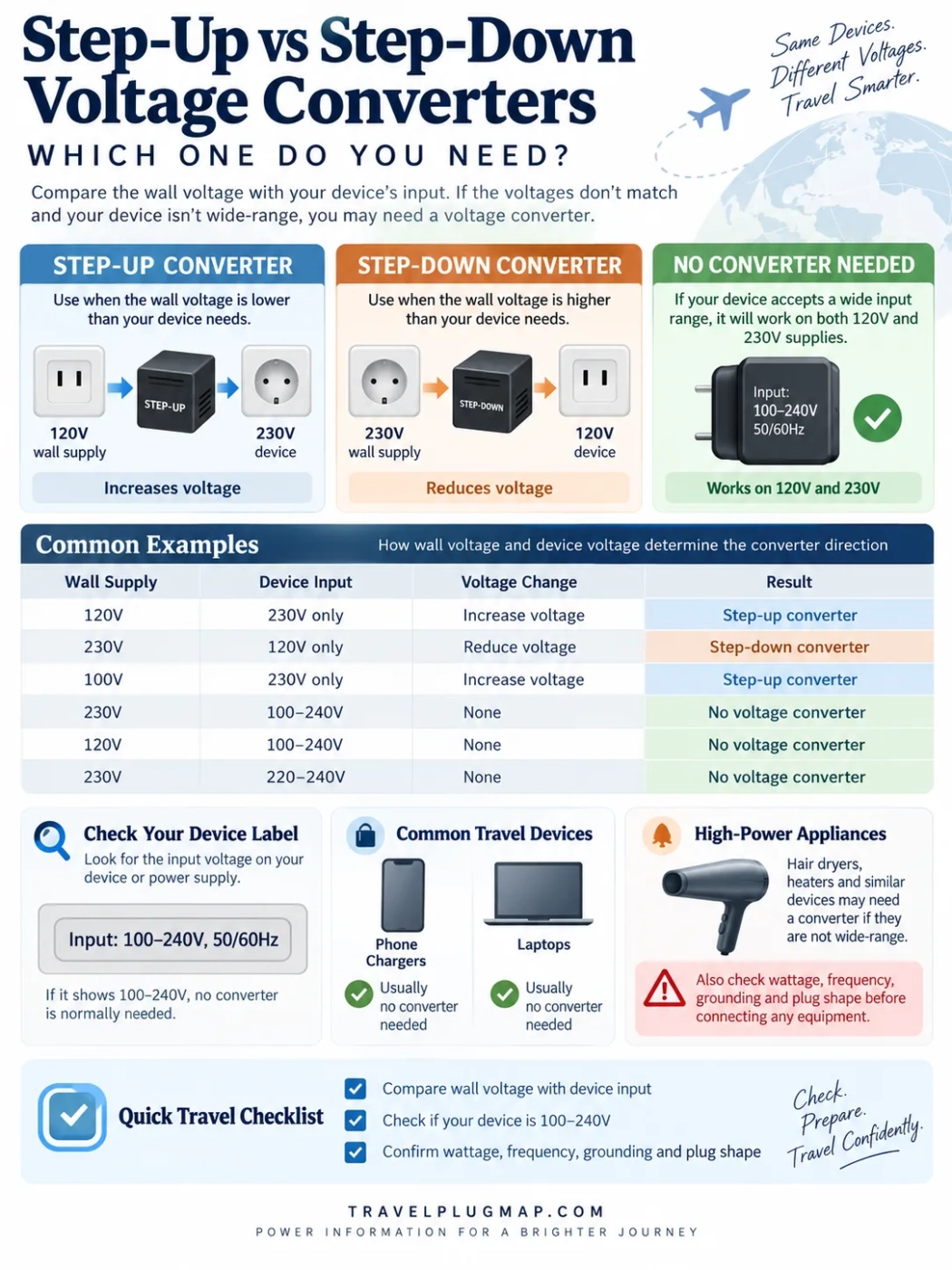
A step-up voltage converter is used when the available wall voltage is lower than the voltage a device needs. A step-down voltage converter is used when the wall voltage is higher than the device’s rated input. If the device accepts the local supply already—such as a charger marked Input: 100–240V, 50/60Hz—neither type is normally needed.
The direction is therefore simple: compare the voltage coming from the power outlet with the voltage range printed on the device or its power supply. After that, check wattage, frequency, grounding, and plug shape before connecting the equipment.
Step-Up or Step-Down: The Direction Rule
| Wall Supply | Device Input | Voltage Change | Result |
|---|---|---|---|
| 120V | 230V only | Increase voltage | Step-up converter |
| 230V | 120V only | Reduce voltage | Step-down converter |
| 100V | 230V only | Increase voltage | Step-up converter |
| 230V | 100–240V | None | No voltage converter |
| 120V | 100–240V | None | No voltage converter |
| 230V | 220–240V | None | No voltage converter |
When You Need a Step-Up Voltage Converter
A step-up converter raises the supplied voltage. The typical travel situation is a device designed only for a higher-voltage electrical system being used where the outlet provides a lower voltage.
For example, a device marked 220–240V only cannot obtain its intended supply directly from a 120V outlet. If that device is suitable for use through voltage conversion, the required direction is:
120V wall supply → step-up conversion → 220–240V device
The same principle applies when the supply is 100V. A device that truly requires 220–240V needs the voltage raised. However, 100V and 120V should not be merged into one generic value when checking equipment. The usable input range printed by the manufacturer is more useful than a broad regional label such as “110V system.”
European Appliances Used in a 120V Country
A single-voltage appliance purchased for a 220–240V market may require step-up conversion when taken to a destination using about 120V. The converter must also be able to handle the appliance’s electrical load. This becomes especially important with heating elements, motors, pumps, kitchen appliances, and other equipment that draws much more power than a charger.
When You Need a Step-Down Voltage Converter
A step-down converter reduces the voltage before it reaches the device. This is commonly relevant when a 120V-only appliance is taken to a destination where the wall supply is around 220–240V.
The electrical path would be:
230V wall supply → step-down conversion → 120V device
A simple mechanical travel adapter is not enough in this situation. The adapter can make the plug fit the socket, but the outlet still supplies its normal voltage. Voltage conversion must be handled separately.
A 120V Appliance on a 230V Supply
Consider an appliance marked:
120V ~ 60Hz, 1500W
If the destination provides 230V, the voltage direction points to a step-down converter. The 1500W rating then creates a second question: can the converter safely supply that load for the required operating time?
A correct step-down direction is not enough when the converter’s power rating is too low for the appliance.
Read the Input Rating Before Choosing a Converter
The fastest reliable method is to find the electrical input information on the device, charger, power brick, or appliance plate. Look for a line containing voltage and frequency.
What “Input: 100–240V” Means
If a charger says Input: 100–240V, 50/60Hz, its power supply is designed to accept voltages throughout that range and both common mains frequencies. It can therefore normally be connected to a 120V or 230V electrical system without a step-up or step-down converter.
The plug may still be physically incompatible with the destination socket. In that case, a suitable plug adapter handles the shape difference while the charger handles the electrical input range itself.
Read INPUT, Not the USB OUTPUT
USB chargers can display several output values, for example:
Output: 5V, 9V, 15V or 20V DC
Those figures describe what the charger supplies to the phone, tablet, or laptop. They are not the mains-voltage rating used for the step-up versus step-down decision. For international outlet compatibility, find the AC INPUT specification.
Plug Shape, Voltage and Frequency Are Separate Checks
| Question | What It Affects | Typical Solution |
|---|---|---|
| Will the plug fit? | Physical plug and socket shape | Travel plug adapter |
| Can the device accept the wall voltage? | Electrical input voltage | Step-up or step-down conversion if required |
| Can the device operate on the local frequency? | 50Hz / 60Hz compatibility | Device-specific compatibility or dedicated frequency-conversion equipment |
A travel adapter changes the physical connection between plug and socket. It leaves the building’s supply voltage unchanged. This distinction matters most for single-voltage appliances brought between 120V and 220–240V regions.
A Voltage Converter Does Not Normally Change 50Hz to 60Hz
Step-up and step-down describe voltage direction. A standard voltage transformer or travel voltage converter generally preserves the incoming mains frequency.
For example:
230V / 50Hz → step-down converter → 120V / 50Hz
The output voltage has been reduced, but the frequency remains 50Hz.
Similarly:
120V / 60Hz → step-up converter → 230V / 60Hz
This distinction can matter for equipment containing AC motors, timing mechanisms, pumps, some fans, older turntables, compressors, and other devices whose operation depends on mains frequency. Equipment marked 50/60Hz already accepts both common frequencies.
Converter Wattage Can Matter as Much as Converter Direction
After deciding between step-up and step-down, compare the appliance’s power demand with the converter’s rated output. A converter marked for a lower wattage than the appliance is not an appropriate match.
| Situation | Voltage Direction | Additional Check |
|---|---|---|
| 500W 230V device on 120V supply | Step-up | Converter must support the device load |
| 1500W 120V appliance on 230V supply | Step-down | High wattage and operating duration require careful matching |
| 65W laptop charger marked 100–240V | Neither | Plug shape and grounding if applicable |
| Motor-driven device with a compatible voltage | Possibly neither | Frequency and starting current may still matter |
Continuous Load and Starting Surge
Some equipment draws extra current when starting. Motors, compressors, pumps, and similar loads can therefore require more capacity than their normal running demand suggests. Converter specifications may distinguish between continuous power and short-duration surge capacity.
For this reason, choosing a converter solely because its printed maximum watt number matches the appliance can be too simplistic. The converter must be rated for the actual type of load and intended operating time.
Phone and Laptop Chargers Are Usually the Easy Case
Modern phone chargers, tablet chargers, camera chargers, USB power supplies, and laptop power adapters often use wide-range switched-mode power supplies. A label such as 100–240V ~ 50/60Hz means the charger normally handles both major travel-voltage families without external voltage conversion.
For these devices, the travel question often comes down to whether the plug fits the destination outlet and whether any required grounding is preserved.
Still, the printed input range is the deciding specification. Older, specialized, or unusually designed chargers may use a narrower range.
Hair Dryers, Curling Irons and Kettles Need More Care
High-power appliances create a different problem from phone and laptop charging. Hair dryers, curling irons, hair straighteners, kettles, clothes irons, steamers, coffee makers, and portable heaters can draw far more power than small electronics.
A 120V-only hair dryer used in a 230V destination points to step-down conversion, but that statement alone does not establish that a compact travel converter can run it. The converter must be designed for the appliance’s wattage and load type.
Dual-voltage travel appliances simplify the issue. A hair tool marked with two selectable voltage ranges, or with a range that includes the destination supply, may not need a voltage converter when configured correctly. Devices with a manual voltage selector must be set for the local supply before use.
Bidirectional Step-Up/Step-Down Converters
Some transformers can operate in both directions, allowing 110–120V equipment to run from 220–240V supplies and allowing 220–240V equipment to run from 110–120V supplies.
The controls deserve close attention. A unit may have:
- a manual input-voltage selector;
- separate sockets for different output voltages;
- different power limits depending on operating mode;
- specific instructions for grounding or fuse protection.
On a manually switched unit, the input selector corresponds to the voltage coming from the wall. It is not a request for the output voltage you want.
For example, when a converter is connected to a 230V supply, a selector marked for 220–240V input must be configured according to the converter manufacturer’s instructions before a 120V device is connected.
100V, 110V, 120V, 220V, 230V and 240V Labels
Travel power information often groups countries into broad voltage families, but equipment labels can be more precise. A destination described generally as a 120V system and another described as 100V should not be treated as identical for every appliance.
The same applies to 220V, 230V and 240V terminology. Many devices are deliberately designed for a range such as 220–240V, while others list a wider range. Use the device’s stated input tolerance rather than trying to convert every nominal number into a universal equivalent.
Four Travel Scenarios
120V Appliance Used on a 230V Supply
Device rating: 120V only
Local supply: 230V
Required voltage direction: step-down.
If the device is a high-power appliance, wattage and load type still need to match the converter.
230V Appliance Used on a 120V Supply
Device rating: 220–240V only
Local supply: 120V
Required voltage direction: step-up.
Check the frequency as well when the device specifies only 50Hz.
100–240V Laptop Charger Used Abroad
Charger rating: 100–240V, 50/60Hz
Local supply: 120V or 230V
Voltage converter: not required.
A plug adapter may still be required when the charger’s plug shape does not match the local socket.
120V Hair Dryer Used in a 230V Country
Hair dryer rating: 120V, 1875W
Local supply: 230V
The electrical direction is step-down, but the appliance’s high wattage makes converter capacity a major part of the decision. A small low-power travel converter is not suitable merely because it produces 120V.
When a Simple Travel Converter May Be the Wrong Tool
Extra planning is sensible for equipment with any of the following characteristics:
- high continuous wattage;
- motor or compressor starting surge;
- 50Hz-only or 60Hz-only operation;
- grounding requirements;
- long operating periods;
- manufacturer restrictions on external transformers or converters;
- medical or life-support use.
For CPAP machines and other medical devices, verify the power supply rating and the manufacturer’s operating instructions rather than relying only on a country voltage comparison. Many modern medical power supplies accept wide voltage ranges, but individual equipment can differ.
A Practical Step-Up vs Step-Down Decision Path
FAQ
Do I need step-up or step-down for a 120V device in Europe?
If the local supply is around 220–240V and the device accepts only 120V, the required direction is step-down. The converter must also be suitable for the device’s wattage and load type.
Do I need a converter for a charger marked 100–240V?
Normally no. A charger marked 100–240V, 50/60Hz is designed for both common travel voltage ranges. A plug adapter may still be necessary for the destination’s socket type.
Can a step-down converter also work as a step-up converter?
Only if the unit is specifically designed for bidirectional operation. A converter labeled only for one direction should be used according to its stated input and output specifications.
Will a step-down converter change 50Hz to 60Hz?
A standard voltage converter normally changes voltage, not mains frequency. Equipment that requires a particular frequency needs separate compatibility checking.
Is a travel adapter enough for a 120V hair dryer in a 230V country?
No if the hair dryer accepts only 120V. The adapter changes the plug connection but leaves the outlet voltage at 230V. A suitable step-down solution would be required, with enough capacity for the dryer’s high wattage.
Which number on a charger determines voltage compatibility?
Use the INPUT rating. Values such as 5V, 9V or 20V shown under OUTPUT describe power sent from the charger to the device, not the wall voltage the charger can accept.