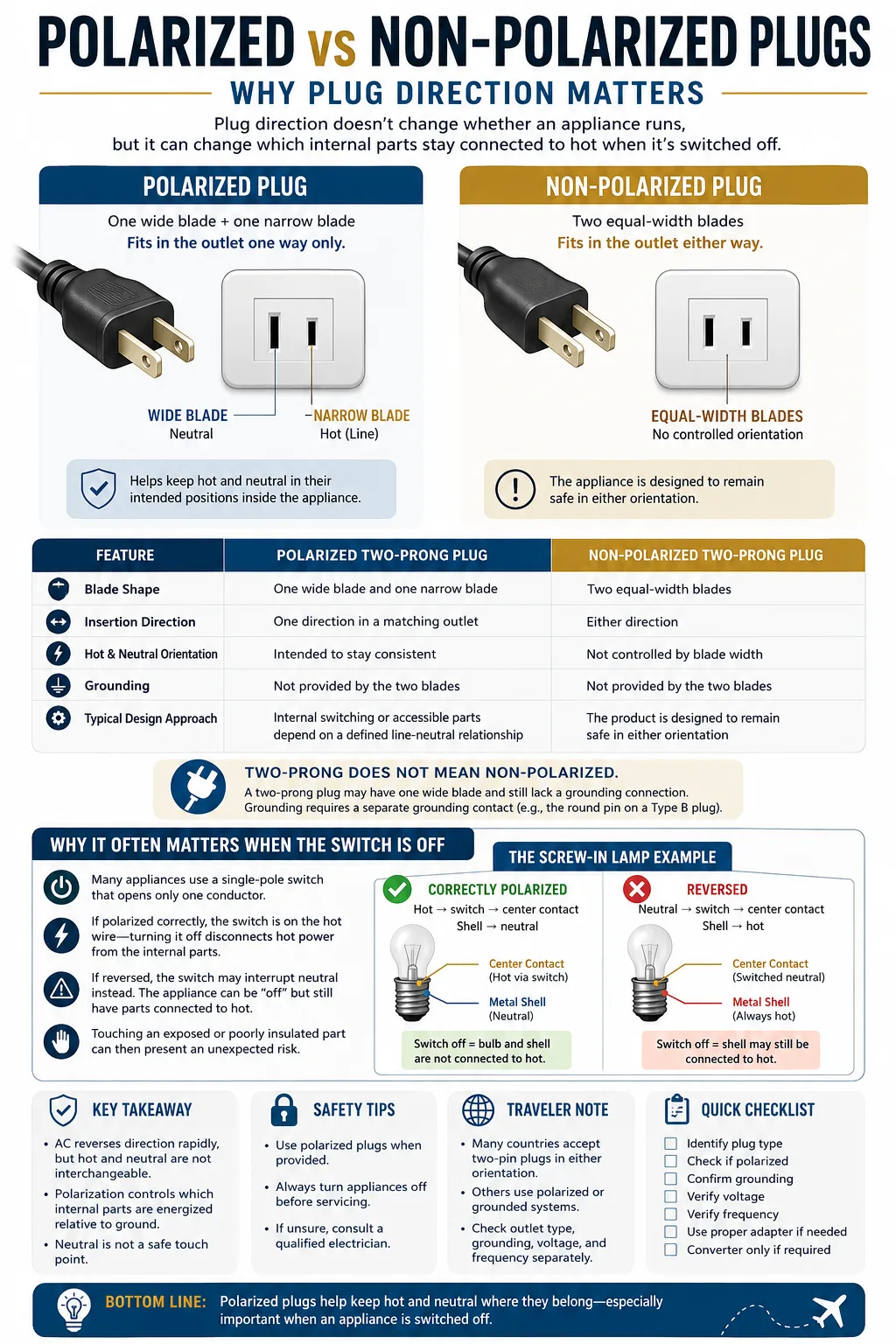
A polarized plug has one blade wider than the other, so it can enter a matching power outlet in only one direction. The wider blade is intended for neutral and the narrower blade for the hot or line conductor. A non-polarized plug has two equal blades and can be inserted either way. The difference often does not change whether an appliance runs, but it can change which internal parts remain connected to the hot conductor when the appliance is switched off.
Polarization is most familiar on North American Type A and Type B connections. It is not a universal feature of every plug system. Many outlets used around the world accept two-pin plugs in either orientation, so travelers should treat plug direction, grounding, voltage, and frequency as separate checks.
What the Two Plug Designs Look Like
| Feature | Polarized two-prong plug | Non-polarized two-prong plug |
|---|---|---|
| Blade shape | One wide blade and one narrow blade | Two equal-width blades |
| Insertion direction | One direction in a matching outlet | Either direction |
| Hot and neutral orientation | Intended to stay consistent | Not controlled by blade width |
| Grounding | Not provided by the two blades | Not provided by the two blades |
| Typical design approach | Internal switching or accessible parts depend on a defined line-neutral relationship | The product is designed to remain safe in either orientation |
Two-prong does not mean non-polarized. A two-prong plug may have one wide blade and still lack a grounding connection. Grounding requires a separate grounding contact, such as the round pin found on a Type B plug.
Why Plug Direction Matters When AC Changes Direction
Alternating current reverses direction many times per second, but the hot and neutral conductors do not become interchangeable parts of the wiring system. The hot conductor is the energized side relative to ground. Neutral is the identified return conductor and is connected to ground at a defined point in the electrical system.
A polarized connection keeps the appliance’s intended hot-side components connected to the outlet’s hot side. It also keeps components intended for neutral connected to neutral. The purpose is not to make current flow through the appliance in only one direction. It is to control which internal path is energized relative to ground.
Neutral should not be treated as a safe touch point. It can carry current, wiring faults can occur, and voltage can appear where it should not. Polarization reduces a particular set of risks; it does not make an energized appliance safe to open or repair.
The Difference Often Appears After the Switch Is Turned Off
Many simple appliances use a single-pole switch that opens only one conductor. In a correctly polarized design, the switch is placed in the hot conductor. Turning the appliance off then disconnects the hot supply from the parts located after the switch.
If hot and neutral are reversed, the switch may interrupt neutral instead. The appliance can stop operating and appear fully off while parts of its internal circuit remain connected to hot. Touching an exposed or poorly insulated part can then present a different risk than the user expects from an appliance with its switch in the off position.
The Screw-In Lamp Socket Example
A table lamp with an Edison-style screw socket shows why orientation matters. The socket has a small center contact and a threaded metal shell. In a properly polarized lamp, hot is routed through the switch to the center contact, while neutral is connected to the threaded shell.
This arrangement reduces the chance that a person changing a bulb will touch a part connected to hot. If polarity is reversed, the threaded shell can be connected to hot even when the lamp switch interrupts the other conductor. The bulb may be dark, yet the socket can still have an energized relationship to ground.
Unplug a lamp before changing a bulb when the socket is damaged, loose, altered, or of unknown wiring history. A switch should not be used as the only form of isolation when inspecting or repairing electrical parts.
Why the Appliance May Still Work Normally
A lamp, heater, motor, or simple power supply can often operate as long as the required voltage exists across its two input conductors. Reversing hot and neutral may leave normal operation unchanged. The fault becomes visible only through testing, during maintenance, after insulation damage, or when a user touches a part that was expected to remain on the neutral side.
“It works” confirms that the circuit is receiving power. It does not confirm that the outlet, extension cord, replacement plug, or internal wiring has the intended polarity.
Polarization, Grounding, and Double Insulation Are Separate Protections
| Protection method | What it controls | What it does not provide |
|---|---|---|
| Polarization | Keeps hot and neutral connected to their intended internal paths | No equipment grounding path |
| Grounding | Provides a fault-current path for exposed conductive parts | No guarantee that hot and neutral are correctly wired |
| Double insulation | Uses added insulation or separation between energized parts and touchable surfaces | No proof that every two-prong product has the same construction |
The wide blade on a polarized Type A plug is neutral, not ground. A Type B plug adds a round grounding pin, and that third pin also fixes the plug’s orientation. Removing the grounding pin does not turn the plug into a proper two-prong design; it defeats part of the product’s protection.
Some products use two equal blades because they are designed and tested for either orientation. Others use double insulation so accessible surfaces remain separated from energized parts without an equipment ground. The plug shape alone cannot confirm the entire safety design. Product markings, the original cord, and the manufacturer’s instructions matter.
Why Modern Products May Use Non-Polarized Plugs
A non-polarized plug is not automatically an outdated or unsafe plug. Small chargers, plastic-bodied electronics, and certain double-insulated products may be built so neither blade must always connect to neutral. Their protection may rely on insulation, internal separation, fusing, switching on more than one conductor, or a power-supply layout that accepts either orientation.
The decision belongs to the product design as a whole. Replacing a polarized plug with an equal-blade plug because the appliance “only needs two wires” can remove an intended safeguard. The reverse is also true: fitting a polarized plug to a product does not repair unknown internal wiring or make an unapproved modification safe.
A Polarized Plug Cannot Correct a Reversed Outlet
The wide and narrow blades provide mechanical orientation only. They assume every part of the connection is correctly wired. A wall outlet can be miswired, an old extension cord can have reversed conductors, or a replacement plug can be attached incorrectly. In those cases, the plug enters in the expected direction while hot and neutral arrive at the appliance in the wrong positions.
Outlet and Extension Cord Problems
Possible warning signs include an outlet that is loose, scorched, unusually warm, cracked, or unable to hold the plug securely. These symptoms do not prove reversed polarity, but they are enough to stop using the connection until it is checked.
A receptacle tester can identify several common wiring conditions on compatible outlets, but it cannot detect every possible fault. Fixed wiring, damaged cords, unfamiliar installations, and inconsistent test results should be assessed by a qualified electrician rather than by opening a live outlet.
Replacement Cords and Marked Conductors
Flat two-conductor lamp cord often has a rib, stripe, printing, or another identifying feature on one side. That marking commonly identifies the conductor intended for neutral. The exact markings can vary, so a repair should follow the appliance instructions and the approved replacement part rather than appearance alone.
On a polarized replacement plug, the identified neutral conductor is intended to remain connected to the wide blade. Inside a screw-in lamp holder, it is intended to continue to the threaded shell. A mismatched repair can reverse the connection even when the new plug looks correct from the outside.
Travel Adapters May Not Preserve Plug Direction
A polarized Type A plug is designed around an outlet system with a wide neutral slot and a narrow hot slot. Travel changes that assumption. Many destination plug systems use round pins or reversible two-pin plugs, and the local outlet may not define a fixed insertion direction at the appliance connection.
A universal travel adapter may accept the wide blade of a polarized plug while presenting a reversible plug to the wall. The device can receive power, but the original hot-neutral orientation may no longer be assured. Some simple adapters do not accept polarized blades at all.
Do not file down the wide blade, bend it to fit, or force it into an adapter. Choose an adapter that accepts the original plug without alteration. For equipment whose instructions depend on a polarized connection, confirm that the intended use is supported in the destination’s electrical system.
| Question | What to know |
|---|---|
| Will the plug physically fit? | A compatible plug adapter can change the blade or pin shape. |
| Will polarization remain fixed? | Not always. Reversible destination plugs and universal sockets may not preserve the original orientation. |
| Will grounding continue through the adapter? | Only when the adapter and destination outlet both provide a compatible grounding path. |
| Will the voltage become safe? | A plug adapter does not convert voltage. |
| Will frequency change? | No. An ordinary plug adapter does not change 50Hz to 60Hz or 60Hz to 50Hz. |
Plug Direction Is Only One Part of Travel Compatibility
Before using a device abroad, check four separate points: plug shape, voltage, frequency, and grounding. A plug can fit while the voltage is wrong. A device can accept the voltage while its grounded plug is connected through an ungrounded adapter. A charger can work electrically while the destination system does not preserve the polarized orientation used at home.
What “Input: 100–240V” Means
A label reading Input: 100–240V, 50/60Hz means the power supply is designed to accept the listed voltage and frequency range. This is common on phone chargers, laptop chargers, tablet power supplies, camera chargers, and many USB power adapters.
The label does not mean the plug will fit every outlet. It also does not promise that grounding or polarization will be preserved through every adapter. A suitable plug adapter may still be needed.
Phone Chargers and Laptop Chargers
Modern phone and laptop chargers are often easier to use abroad because many accept 100–240V and both 50Hz and 60Hz. Check the printed input range on the charger body or power brick. Do not rely on the device brand, USB connector, or plug shape as proof of voltage compatibility.
For a detachable laptop cord, both the power brick and the replacement wall cord must be suitable for the intended use. A locally compatible cord can be a cleaner option than stacking adapters, provided it matches the power supply inlet and retains any required grounding.
Hair Dryers, Curling Irons, Kettles, and Clothes Irons
Heat-producing appliances often draw far more power than chargers and may be made for only one voltage. A 120V hair dryer connected to a 230V supply can overheat or fail very quickly. A 230V appliance used on 120V may heat weakly or not perform as intended.
Always check the device label before using high-power appliances abroad. A voltage converter, when appropriate, must support the appliance type and wattage. Small electronic converters intended for chargers are not automatically suitable for heating appliances or motor-driven devices.
Shavers, CPAP Machines, and Frequency-Sensitive Equipment
Many electric shavers and CPAP power supplies support a wide voltage range, but model differences matter. Check the device label, external power supply, required grounding, and manufacturer instructions. Medical equipment should not be assumed compatible because another model from the same product category worked abroad.
Frequency can matter for motors, clocks, pumps, and equipment that uses line frequency for timing or speed. A label that lists only 60Hz should not be treated as automatically suitable for 50Hz operation. Resistive heating devices are usually more affected by voltage than frequency, but their power demand still makes them poor candidates for improvised converter or adapter setups.
| Device group | Typical travel concern | What to check |
|---|---|---|
| Phone, tablet, camera, and laptop chargers | Plug fit and input range | Look for Input: 100–240V, 50/60Hz |
| Hair dryers and styling tools | Single-voltage design and high wattage | Voltage selector, rated voltage, wattage, and converter suitability |
| Kettles, irons, and heating appliances | Very high power demand | Destination voltage and whether use with a converter is allowed |
| Electric shavers and toothbrush chargers | Model-dependent voltage range | Input label on the charger or base |
| CPAP machines and medical devices | Power supply, grounding, reliability, and backup needs | Manufacturer instructions, input range, cord type, and destination conditions |
| Motor-driven or timing-sensitive devices | 50Hz and 60Hz differences | Rated frequency and manufacturer approval |
Changes That Defeat the Original Plug Design
- Filing or cutting the wide blade so the plug fits either way
- Bending blades to fit a tight or incompatible socket
- Removing the ground pin from a Type B plug
- Replacing a polarized plug with an equal-blade plug
- Using a loose adapter that leaves part of a blade exposed
- Stacking multiple adapters without confirming grounding, fit, voltage, and current rating
These changes can remove orientation or grounding, weaken the electrical contact, and create heat at the connection. A plug that does not fit is a compatibility warning, not a part that should be reshaped.
A Practical Check Before Connecting a Device
- Inspect the plug. One wide blade means the original design expects a defined orientation. A third pin means grounding is also involved.
- Read the device label. Find the input voltage, frequency, current, or wattage.
- Compare the destination supply. Confirm the local voltage, frequency, and outlet type.
- Choose the correct adapter. It should accept the original plug without cutting, filing, bending, or removing pins.
- Check grounding and polarity limits. A physical connection does not always preserve either one.
- Use a converter only when suitable. Match the converter to the device type and power demand.
- Stop if the connection is loose or hot. Disconnect equipment that sparks, smells burnt, or does not remain firmly seated.
Misunderstandings About Polarized Plugs
“AC reverses direction, so hot and neutral are interchangeable.”
Current reverses direction, but the conductors retain different functions relative to grounding, switching, fusing, and accessible parts. Reversing them can leave parts connected to hot when the appliance appears off.
“The wide blade is the ground.”
The wide blade is intended for neutral. Grounding requires a separate grounding contact.
“Every non-polarized plug is unsafe.”
No. A properly designed product may be safe in either orientation. The complete product construction matters more than blade symmetry alone.
“A polarized plug proves the outlet is wired correctly.”
No. The plug controls insertion direction, but a miswired outlet, cord, or replacement plug can still reverse hot and neutral.
“A universal travel adapter solves the problem.”
It may solve physical fit. It may not preserve polarization, grounding, voltage, or frequency compatibility.
“If a device works, the connection must be correct.”
Many AC appliances operate with reversed hot and neutral. Normal operation is not a wiring test.
Frequently Asked Questions
Can a polarized plug be inserted upside down?
Not in a correctly shaped polarized outlet. The wide blade should fit only the wide neutral slot. An adapter or altered outlet may remove that restriction.
Is a non-polarized plug safe?
It can be safe when the product is designed and approved for either orientation. Equal blades do not provide grounding and do not reveal the product’s internal insulation method.
Why does my appliance work when the plug is reversed?
Many appliances need only the correct voltage across two conductors to operate. Reversed polarity may affect the off-state or fault behavior rather than normal operation.
Can I file down the wide blade to fit an old outlet or travel adapter?
No. Filing the blade removes the feature that controls orientation and can damage the contact surface. Use a suitable, undamaged adapter or have the outlet assessed.
Does a polarized plug need a voltage converter abroad?
Polarization does not determine voltage compatibility. Read the device label. Equipment marked Input: 100–240V, 50/60Hz usually needs only the correct plug connection, while a single-voltage device may need a properly rated converter.
Do travel adapters keep hot and neutral in the same positions?
Not always. If the destination plug can be inserted either way, the original hot-neutral orientation may not remain fixed. The device must also be compatible with the destination voltage, frequency, and grounding arrangement.
Do not use a plug, outlet, extension cord, or travel adapter that is loose, scorched, cracked, modified, or unusually warm.