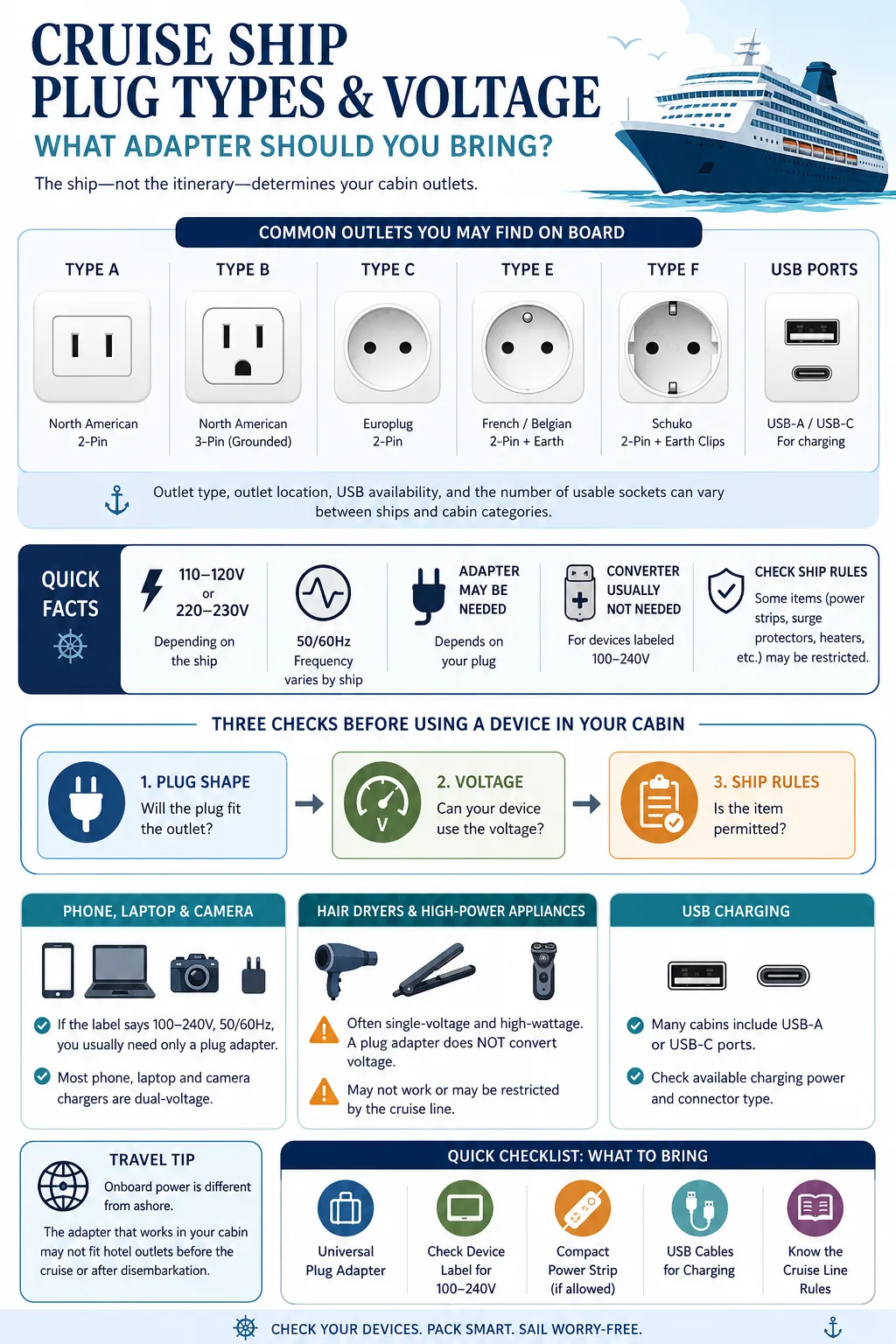
Cruise ship cabins may have North American-style 110/120V outlets, European-style 220/230V outlets, or both. The exact socket layout depends on the ship, not on the countries visited during the cruise. If your phone, laptop, camera charger, or other power supply says Input: 100–240V, 50/60Hz, you will usually need only the correct plug adapter for the available outlet.
Single-voltage appliances need more care. A plug adapter does not convert voltage. Cruise lines also set their own rules for extension cords, power strips, surge protectors, and heat-producing appliances, so electrical compatibility is only one part of the decision.
| Cabin connection | Typical supply | What travelers should check |
|---|---|---|
| North American-style AC outlet | About 110–120V | Whether your plug fits and your device accepts the voltage |
| European-style AC outlet | About 220–230V | Plug compatibility and the device input voltage |
| Other regional AC outlets | Ship-specific | The exact ship and cabin outlet information |
| USB-A or USB-C port | Low-voltage USB charging | Available charging power and connector type |
Outlet type, outlet location, USB availability, and the number of usable sockets can vary between ships and cabin categories.
The Ship Determines Your Cabin Outlets, Not the Itinerary
A Mediterranean cruise does not automatically mean the cabin uses only European Type C or Type F outlets. A Caribbean sailing does not automatically mean every cabin outlet is Type A or Type B.
The ship has its own electrical distribution and cabin design. A vessel sailing from Barcelona can still provide a North American outlet, while an international ship departing from Miami may also provide a 220/230V European-style socket.
This creates two separate power environments during the same vacation:
- Onboard: the outlet and voltage installed in the ship and cabin.
- Ashore: the plug type, voltage, and frequency used by the country you are visiting.
An adapter that works perfectly in the cabin may not fit a hotel outlet before the cruise or an accommodation after disembarkation.
What Plug Types and Voltages Are Common on Cruise Ships?
There is no single worldwide cruise ship socket standard. Large cruise fleets commonly use one or both of two electrical systems: North American-style power around 110/120V and European-style power around 220/230V.
North American Type A and Type B connections
Many cruise cabins provide a North American-style outlet for two-flat-pin Type A plugs or grounded Type B plugs. These outlets are normally associated with a supply around 110–120V.
Travelers from the United States and Canada may therefore be able to connect many devices without a plug adapter. Travelers from the UK, continental Europe, Australia, New Zealand, and other plug systems may need an adapter.
European-style 220/230V outlets
European-style round-pin connections also appear on many ships. Some ships provide them alongside a North American outlet, allowing travelers to choose between separate voltage circuits.
A charger marked 100–240V can normally use either voltage when connected through the appropriate plug interface. A 120V-only appliance cannot be made 230V-compatible merely by changing the plug shape.
Type G, Type I and other ship-specific layouts
Some ships use less typical cabin arrangements. Disney Adventure, for example, uses a 230V cabin system with Type F, Type G, and Type I connections as well as USB charging ports. Other Disney Cruise Line ships use a different combination of 110V North American and 220V European outlets.
This is why the cruise line name alone may not provide enough information. The exact ship matters.
USB-A and USB-C ports
Newer cabins may include USB-A, USB-C, or both. These ports are useful for phones, watches, headphones, and similar electronics, but their presence should not be assumed.
A USB-C socket also does not automatically mean high-power USB-C Power Delivery is available. A laptop that requires substantial USB-C charging power may still need its normal charger connected to an AC outlet.
Why Checking the Exact Ship Is Worth Doing
Cruise fleets contain ships built at different times and for different markets. Cabins can also be updated during refurbishment. Outlet quantity, voltage options, USB ports, and socket locations can therefore differ even within one cruise company.
| Cruise line | Published cabin power information | Practical meaning |
|---|---|---|
| Norwegian Cruise Line | 110V North American and 220/230V European outlets | Many dual-voltage chargers can use either suitable outlet |
| MSC Cruises | 110V and 220V cabin electricity | Device voltage still needs to be checked |
| Celebrity Cruises | Dual-voltage 110/220V outlets | A compatible charger may have more than one AC option |
| Princess Cruises | 110V and 220V outlets are provided, with exact accessibility varying by ship | Check the ship if you depend on a particular outlet |
| Disney Cruise Line | Outlet arrangements differ between Disney Adventure and other ships | Do not apply one fleet-wide plug assumption |
Published fleet information is useful for planning, but the cabin information for the booked ship should take priority when a particular socket or voltage is necessary.
Adapter or Voltage Converter? Start With the Device Label
The small electrical label on the charger or power supply usually tells you more than the plug itself.
| Device label | What it means for a cruise |
|---|---|
| Input: 100–240V, 50/60Hz | Designed to accept both common voltage ranges and either listed frequency; usually only plug compatibility needs to be solved |
| Input: 110–120V only | Do not connect directly to a 220/230V outlet through a simple adapter |
| Input: 220–240V only | Do not assume it will work correctly from a 110/120V outlet |
| Voltage rating unreadable or unknown | Do not guess; verify the device or power supply specifications first |
What “Input: 100–240V” means
A power supply marked Input: 100–240V is designed to operate across the common voltage ranges travelers encounter. Modern phone chargers, many laptop chargers, tablet chargers, camera battery chargers, and USB power supplies commonly use this type of wide-range input.
If the label also says 50/60Hz, the power supply is designed for either frequency shown on the label.
In that situation, the main problem is usually mechanical: does the plug fit the cabin socket? If not, an appropriate plug adapter can solve that part.
When a converter becomes relevant
A single-voltage appliance creates a different problem. A device marked only for 120V should not be connected to a 230V outlet with a basic travel adapter.
Never treat a plug adapter as a voltage converter. If a device does not support the available cabin voltage, use another compatible outlet if the ship provides one or leave the appliance unused unless an appropriate solution is specifically suitable for the device.
Which Adapter Should You Bring?
The useful adapter depends on both your normal plug and the sockets available on the ship. There is no single adapter required for every cruise.
| Your usual plug | If the cabin has Type A/B | If the cabin has a European-style outlet |
|---|---|---|
| Type A/B — US, Canada and similar | Usually no plug adapter | Adapter usually needed; device must also accept 220/230V |
| Type C/E/F — much of continental Europe | Adapter usually needed | May connect directly when the specific socket and plug are compatible |
| Type G — UK and Ireland | Adapter needed | Adapter commonly needed unless a Type G outlet is specifically provided |
| Type I — Australia and New Zealand | Adapter needed | Adapter commonly needed unless a Type I outlet is specifically provided |
Grounded equipment deserves extra attention. An adapter that physically accepts a three-prong plug does not automatically preserve a safe grounding connection. Avoid using an ungrounded adapter to bypass the grounding requirements of equipment designed to be earthed.
A Multi-Port USB Charger Can Reduce the Number of AC Outlets You Need
Cruise cabins can have fewer conveniently located AC outlets than travelers expect. A traveler carrying two phones, a smartwatch, headphones, a camera, and a tablet does not necessarily need six separate wall chargers.
A suitable multi-port USB or USB-C charger marked 100–240V, 50/60Hz can charge several compatible low-voltage devices from one AC outlet. This can be more practical than trying to add multiple mains sockets.
Check the charger’s total output as well as the device requirements. A charger with several USB-C sockets does not guarantee that every port can provide full laptop charging power at the same time.
Power Strips and Surge Protectors Need a Separate Onboard Check
A plug adapter, multi-port USB charger, multi-plug adapter, extension cord, power strip, and surge protector are not interchangeable terms. Cruise lines may treat each category differently.
Surge-protected strips are particularly problematic on ships and are restricted by many cruise operators. Extension cords and multi-socket accessories may also be limited even when they do not contain surge protection.
Policies are not identical. Royal Caribbean states that guests cannot bring extension cords, power boards, or surge-protected power boards. Carnival publishes different rules and permits certain power strips, multi-plug adapters, and extension cords without surge protection when used with proper caution.
Do not assume that removing surge protection automatically makes a multi-socket accessory acceptable on every cruise line. Check the prohibited-items rules for the booked sailing before packing it.
Phones and Laptops Are Usually Easier Than Heat-Producing Appliances
Modern electronics and high-wattage appliances should not be treated as one category.
Phones, tablets, cameras and laptops
These devices commonly use an external charger or power supply with wide-range voltage input. If the charger says 100–240V, 50/60Hz, it can normally handle both the 110/120V and 220/230V supplies found on many cruise ships.
The correct plug adapter may still be required.
Hair dryers, curling irons and straighteners
Heating appliances draw far more power and are more likely to be single-voltage. Dual-voltage travel models need to be set or operated according to their own instructions.
There is another issue onboard: cruise lines may restrict specific heat-producing devices even when their electrical ratings match the cabin supply. Some ships provide a hair dryer in the cabin, reducing the need to bring one.
Kettles, clothes irons and heating appliances
These items should not be packed merely because their voltage is compatible. Cruise operators commonly control appliances that create high heat or a fire risk, and some categories may be prohibited.
Electrical compatibility does not mean an appliance is permitted onboard.
Frequency: When 50Hz and 60Hz Matter
Travelers often focus on voltage and overlook frequency. Cruise lines do not always publish the frequency of every passenger outlet, and the electrical arrangement can differ by ship.
Most modern electronic chargers marked 50/60Hz are designed for either frequency. Motor-driven devices, clocks that depend on the AC cycle, and some specialized equipment may be more sensitive.
If a device lists only one frequency, do not assume that an outlet with the correct voltage is automatically suitable.
CPAP Machines and Other Medical Equipment Need Ship-Specific Planning
A CPAP power supply often supports a wide voltage range, but the label on the actual power supply should be checked. Medical-device planning also involves outlet location, grounding, overnight power availability, and any need for an extension cord.
Extension-cord rules vary between cruise lines, and medical equipment may be handled under a separate accessibility procedure. Contact the cruise operator before sailing if the device depends on a particular power arrangement.
Do not rely only on a generic cabin-outlet description for medical equipment. Confirm the device requirements and the arrangements available on the booked ship.
Pack for the Ship and for Your Time Ashore
The cabin is only one part of the trip. A traveler from the United States taking a cruise from Barcelona might have access to a familiar 110V outlet onboard while still needing a European plug adapter for a hotel before departure.
The reverse can happen for a European traveler boarding a ship with a North American cabin outlet.
Before packing, consider:
- the exact cruise ship and cabin outlet information;
- your normal plug type;
- the input voltage printed on every charger or important appliance;
- the plug and voltage system at the embarkation destination;
- any hotels before or after the cruise;
- the cruise line’s rules for electrical accessories.
A Practical Cruise Charging Setup
For many travelers carrying only modern electronics, the simplest setup is enough:
- A phone and laptop charger that accept 100–240V, 50/60Hz.
- A simple plug adapter that matches the available cabin socket when required.
- A multi-port USB charger if several low-voltage devices need charging.
- No unnecessary surge protector, extension cord, or AC power strip unless the cruise line specifically permits the item.
If you are bringing a single-voltage hair appliance, medical device, grounded equipment, or another unusual electrical load, check it separately rather than assuming the same setup will work.
Frequently Asked Questions
Do cruise ships use US or European plugs?
Many ships provide North American-style 110/120V outlets, European-style 220/230V outlets, or both. The exact plug types depend on the ship, so check the vessel rather than relying on the itinerary.
Do I need a travel adapter on a cruise ship?
You need a plug adapter when your device plug does not physically match an available cabin outlet. If the plug already fits, an adapter is not normally needed. Voltage compatibility still needs to be checked separately.
Will my phone charger work on a cruise ship?
Most modern phone chargers marked Input: 100–240V, 50/60Hz can use the common voltage systems found on cruise ships. You may still need a plug adapter.
Do I need a voltage converter for a cruise?
Usually not for chargers that accept 100–240V. A converter may become relevant for a single-voltage device when the only suitable cabin outlet supplies a different voltage. High-wattage appliances also need to comply with the cruise line’s rules.
Can I bring a power strip or extension cord on a cruise?
It depends on the cruise line. Some prohibit extension cords and power boards, while others permit certain non-surge accessories. Surge protectors are commonly restricted. Check the rules for your booked sailing before packing one.
Does the destination country’s plug type tell me which outlet will be in my cabin?
No. The cabin electrical system belongs to the ship. The countries on the itinerary determine what you may encounter ashore, not which outlets are installed inside the stateroom.