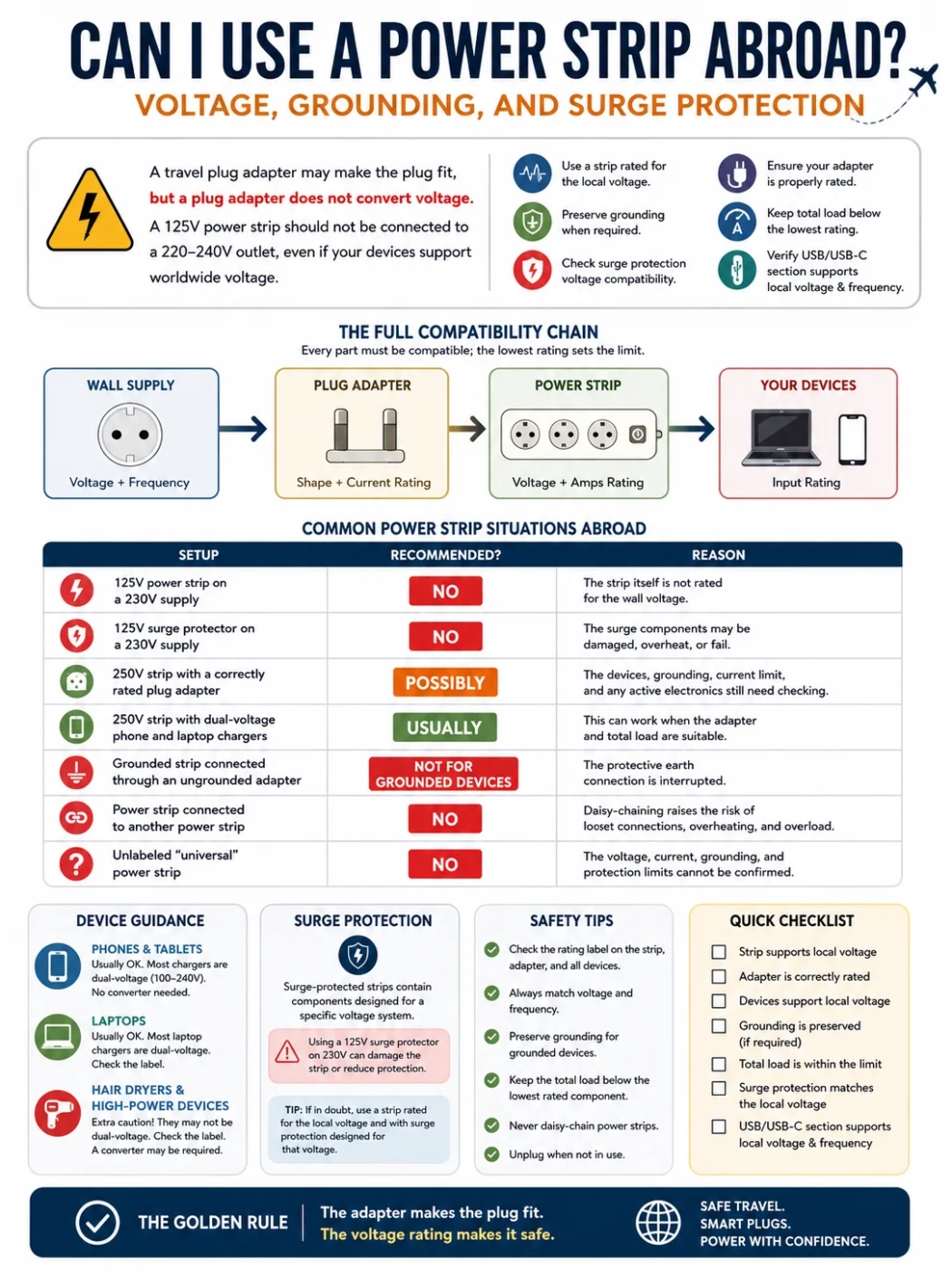
You can use a power strip abroad only when the strip itself, the plug adapter, the wall supply, and every connected device are electrically compatible. A travel plug adapter may make the plug fit, but a plug adapter does not convert voltage. A 125V power strip should not be connected to a 220–240V outlet simply because the phone or laptop chargers plugged into it accept worldwide voltage.
The safest setup is a power strip rated for the destination’s voltage, connected through a properly rated plug adapter that preserves grounding when required. The total load must stay below the lowest rating in the entire connection chain. Surge-protected strips need extra care because their protection components are designed for a particular voltage system.
When a Power Strip Can Be Used Abroad
A power strip may be suitable for international travel when all of the following conditions are met:
- The strip’s rated voltage includes the local supply voltage.
- The strip’s current rating is not exceeded.
- The travel adapter is rated for the same or a higher current.
- Every connected device supports the destination voltage.
- Grounding remains connected when grounded devices are used.
- Any built-in surge protection is designed for the local voltage system.
- Any USB or USB-C charging section accepts the local voltage and frequency.
| Setup | Recommended? | Reason |
|---|---|---|
| 125V power strip on a 230V supply | No | The strip itself is not rated for the wall voltage. |
| 125V surge protector on a 230V supply | No | The surge components may be damaged, overheat, or fail. |
| 250V strip with a correctly rated plug adapter | Possibly | The devices, grounding, current limit, and any active electronics still need checking. |
| 250V strip with dual-voltage phone and laptop chargers | Usually | This can work when the adapter and total load are suitable. |
| Grounded strip connected through an ungrounded adapter | Not for grounded devices | The protective earth connection is interrupted. |
| Power strip connected to another power strip | No | Daisy-chaining raises the risk of loose connections, overheating, and overload. |
| Unlabeled “universal” power strip | No | The voltage, current, grounding, and protection limits cannot be confirmed. |
The Full Compatibility Chain
A safe result depends on every part of this chain. A correctly rated power strip can still become unsafe when it is connected through a weak travel adapter. A high-quality adapter cannot make a 125V strip suitable for a 230V wall outlet. Dual-voltage chargers do not change the rating of the strip supplying them.
A Power Strip Does Not Convert Voltage
Several travel power products can look similar while performing different jobs.
Power Strip
A power strip divides one wall connection into several outlets. It passes the local supply voltage to those outlets. It does not normally reduce, increase, stabilize, or convert that voltage.
Travel Plug Adapter
A travel adapter changes the physical connection between a plug and a socket type. It may allow a Type A plug to fit a Type C, Type E, Type F, Type G, or another destination outlet.
A plug adapter does not convert voltage. If the wall supplies 230V, the equipment connected through the adapter still receives about 230V.
Voltage Converter or Transformer
A voltage converter changes one voltage range to another, such as 230V to 120V. Its output type, continuous wattage, grounding design, and compatibility with electronic or motor-driven devices must match the intended load.
Surge Protector
A surge protector attempts to limit short voltage spikes. It is not a voltage converter, and it does not make a 120V appliance safe on a 230V supply.
USB Travel Charger
A USB charger is an active power supply. It converts wall voltage into low-voltage DC power for phones, tablets, cameras, and other USB devices. Its input rating is separate from the rating of any AC outlets built into the same product.
Check the Power Strip Label First
The technical label on the bottom, back, cable, or plug of the strip matters more than words such as “international,” “travel,” or “universal.” Look for the following information:
- Rated voltage, such as 125V, 230V, 250V, or 100–250V
- Rated current, such as 10A, 13A, 15A, or 16A
- Maximum wattage
- Frequency, commonly shown as 50Hz, 60Hz, or 50/60Hz
- Indoor-use limitations
- Grounding information
- Fuse or circuit-breaker rating
- Surge protection status
- USB input and output ratings
- Model, manufacturer, and testing information
If the strip has no readable electrical rating, it should not be used as travel power equipment. A product may accept several plug shapes while still being designed for only one voltage system.
One Product Can Have Several Different Ratings
A travel power strip with USB ports can display separate values for different parts of the product:
- The voltage and current allowed through the AC outlets
- The input voltage accepted by the USB charging circuit
- The total USB or USB-C output power
- The maximum power available from one USB-C port
- The reduced output available when several USB ports are used together
For example, the USB section may state Input: 100–240V, 50/60Hz while the AC outlets carry a different rating. The worldwide input range of the USB charger does not automatically make the AC section suitable for every country.
Why a 125V Power Strip Is Unsafe on a 230V Supply
A power strip intended for a 120–125V electrical system may contain switches, indicator lamps, wiring, insulation, filters, capacitors, and surge components selected for that voltage range. Connecting it to a 220–240V supply can place those parts under much more electrical stress than intended.
This remains unsafe even when every connected phone or laptop charger says Input: 100–240V. Those chargers may tolerate 230V, but the 125V strip between them and the wall may not.
Do not connect a 125V power strip to a 220–240V outlet through a simple plug adapter.
A 125V strip without visible damage may still be unsuitable. Electrical compatibility cannot be judged by whether the switch lights up or the connected charger appears to work.
Why Surge-Protected 125V Strips Need Extra Caution
Many surge protectors use components that begin conducting when voltage rises above a selected level. A surge strip designed for a 120V system may treat normal 230V operation as an abnormal condition. It may fail immediately, degrade over time, overheat, trip, or lose its protection function.
A joule rating does not prove that a surge protector works worldwide. The normal operating voltage and maximum continuous operating voltage must match the destination supply.
Does a 250V Rating Mean Worldwide Use?
A 250V rating can make a strip more suitable for 220–240V destinations, but it does not settle every compatibility question. The following still need to match:
- The plug adapter’s voltage and current rating
- The strip’s maximum current
- The grounding arrangement
- The connected devices’ input voltage
- The local socket and plug type
- The frequency rating of any active electronics
- The surge protection design, when present
- The permitted use stated by the manufacturer
A 250V strip taken to a 120V destination may be able to tolerate the lower wall voltage, but a device designed only for 230V may not work correctly on 120V. Voltage tolerance of the strip and operating voltage of the device are separate questions.
Every Connected Device Must Be Checked Separately
The power strip distributes the wall voltage to its outlets. It does not make single-voltage equipment compatible. Each charger, appliance, and power supply needs its own label check.
| Device | Plug adapter | Voltage converter | What to check |
|---|---|---|---|
| Phone charger | May be needed | Usually not if dual voltage | Look for Input: 100–240V, 50/60Hz. |
| Laptop charger | May be needed | Usually not if dual voltage | Check input range, grounding, and wattage. |
| Tablet or camera charger | May be needed | Usually not if dual voltage | Read the charger label rather than assuming. |
| CPAP machine | May be needed | Depends on the power supply | Check the machine, external power supply, humidifier load, and manufacturer instructions. |
| Electric shaver | May be needed | Depends on the model | Some are dual voltage; others are made for one voltage. |
| Hair dryer | May be needed | Often needed for single-voltage models | Check voltage selector position and high wattage. |
| Curling iron or hair straightener | May be needed | Depends on the label | Dual-voltage models must still be set or used correctly. |
| Kettle or clothes iron | May be needed | Often impractical | High wattage can exceed strips, adapters, and small converters. |
| Desktop computer or monitor | May be needed | Depends on the power supply | Check voltage range, grounding, and any 115V/230V selector. |
What “Input: 100–240V” Means
A charger marked Input: 100–240V, 50/60Hz is designed to accept the common voltage and frequency ranges used in many destinations. In most cases, it needs only a suitable plug adapter when the plug shape does not match the local socket.
The output side of the label may show values such as 5V, 9V, 15V, or 20V DC. Those are the voltages supplied to the phone, laptop, camera, or other device. They are not the wall voltage rating.
A label that shows only “120V,” “125V,” “220V,” “230V,” or another single range needs more care. Do not assume that a product is dual voltage because it has a detachable cable, USB port, or travel-sized design.
Phone and Laptop Chargers Are Usually the Easier Loads
Modern phone chargers, laptop power supplies, tablet chargers, and camera battery chargers commonly support 100–240V input. When their labels confirm that range, they generally do not need a voltage converter.
They may still need:
- A plug adapter for the destination socket type
- A grounded adapter for a three-prong charger
- A power strip rated for the local voltage
- A cable that supports the charger’s intended USB-C Power Delivery level
- Enough shared USB output when several devices charge together
A 100W laptop charger does not always draw 100W continuously, but its maximum demand should still be included when evaluating a small travel adapter or USB charging hub.
High-Power Appliances Create a Different Risk
High-power appliances such as hair dryers, kettles, clothes irons, curling irons, hair straighteners, portable heaters, and cooking devices can draw far more current than phone and laptop chargers.
These appliances may overload a travel adapter even when the power strip itself has a higher rating. They can also overheat loose socket contacts, compact universal adapters, or lightweight extension cables.
Always check the device label before using heat-producing appliances abroad.
A typical travel setup intended for chargers should not be treated as a general-purpose supply for heating appliances. A hotel hair dryer or locally rated appliance is often a safer option than combining a single-voltage device with a small converter and power strip.
Grounding Must Continue All the Way to the Building
A grounded power strip has no protective earth connection if it is attached to the wall through an ungrounded two-pin adapter. The earth path must remain continuous from the connected device, through the strip and adapter, to a grounded wall outlet.
A Three-Prong Strip Can Become Ungrounded
A three-prong plug can sometimes be physically connected through a two-prong travel adapter. The device may switch on, but the protective grounding conductor is no longer connected.
This matters for equipment such as:
- Desktop computers with metal cases
- Monitors and printers
- Three-prong laptop power supplies
- Audio and studio equipment
- Kitchen appliances
- Testing and measuring equipment
- Medical equipment that requires protective earth
A Ground-Shaped Contact Does Not Prove Continuity
Some multi-country adapters have parts that resemble grounding contacts but do not support protective earth for every plug and socket combination. Check whether the exact input and output arrangement is described as grounded or earthed.
A universal-looking socket on a hotel wall or travel adapter also does not prove that every accepted plug remains grounded.
Double-Insulated Devices
A device marked with a square inside another square is generally designed as Class II or double-insulated equipment. It normally does not require a protective earth connection.
This does not remove the need to check voltage, current, physical condition, or adapter quality. It only changes the grounding requirement of that device.
Four Different Electrical Protections
Grounding, overcurrent protection, surge protection, and residual-current protection perform different jobs. A product that offers one does not automatically provide the others.
| Protection | Main purpose | What it does not prove |
|---|---|---|
| Grounding | Provides a protective path for fault current. | It does not prevent every overload or voltage spike. |
| Fuse or circuit breaker | Interrupts excessive current under defined conditions. | It does not convert voltage or provide complete surge protection. |
| Surge protection | Limits certain short-duration voltage spikes. | It does not replace grounding, a converter, or an RCD/GFCI. |
| RCD or GFCI | Disconnects power when leakage or current imbalance is detected. | It does not make a single-voltage device suitable for another supply. |
A power strip labeled “protected” may refer only to surge protection. A strip with a resettable breaker may offer overload protection without surge protection. A three-prong outlet may be grounded only when the wall connection and travel adapter preserve the earth path.
Can Surge Protection Work Without Grounding?
The result depends on the internal protection design. Some surge protection operates between live and neutral conductors. Other protection paths use the grounding conductor. When the earth connection is missing, those ground-dependent paths cannot work as intended.
A “protected” indicator light may confirm only that part of the circuit remains connected. It does not prove that the wall outlet is correctly grounded or that every surge path is active.
Surge protection should therefore be evaluated by voltage rating, grounding requirements, status indicators, and product instructions rather than by the presence of a single light.
The Lowest-Rated Part Sets the Load Limit
The usable current is not determined only by the number printed on the power strip. The wall outlet, plug adapter, power strip, extension cable, converter, and connected devices form one system.
If a 16A power strip is connected through a 6A travel adapter, the connection should not be treated as a 16A setup. The lower 6A rating becomes the practical upper limit, subject to any lower restriction from the wall outlet or local electrical installation.
Calculating Approximate Power
The basic relationship is:
Watts = volts × amps
| Electrical rating | Calculated power |
|---|---|
| 125V at 15A | 1,875W |
| 230V at 10A | 2,300W |
| 230V at 13A | 2,990W |
| 230V at 16A | 3,680W |
These calculations are not automatic permission to run a load at the full value. Product instructions, local socket limits, continuous-use restrictions, cable condition, ambient heat, and adapter ratings may require a lower load.
Port count does not increase the available power. An eight-outlet strip still has one total current limit shared by all eight outlets.
Loads That Commonly Work Better on a Travel Strip
A correctly rated travel power strip is most useful for several relatively low-power electronic chargers, such as:
- Phone chargers
- Laptop chargers
- Tablet chargers
- Camera battery chargers
- Electric toothbrush chargers with suitable input ratings
- Small USB accessories
- Low-power monitors
Even within this group, every label should be checked. Older chargers, specialized equipment, and equipment with a fixed-voltage external power supply may not support worldwide input.
Loads That Should Usually Bypass a Travel Strip
High-wattage devices are better connected directly to a suitable wall outlet when local rules and the device rating allow them to be used at all. Examples include:
- Hair dryers
- Kettles
- Clothes irons
- Portable heaters
- Microwaves
- Coffee machines
- Portable air conditioners
- Cooking appliances
A high-current appliance can heat the adapter-to-wall connection even when the strip’s printed wattage appears adequate. Compact adapters can place additional mechanical strain on the wall socket, especially when a heavy strip hangs from them.
USB and USB-C Ports Need Their Own Check
A power strip with built-in USB ports contains an electronic charger as well as passive AC outlets. The USB charger should display an input range, commonly in a format such as:
Input: 100–240V, 50/60Hz
The output section may state:
- Total USB output
- Maximum output from one USB-C port
- USB-C Power Delivery profiles
- Combined output when several ports are active
- Reduced laptop charging power during shared use
A product advertised as having a 65W or 100W USB-C port may provide that output only when the port is used alone. Connecting a phone, tablet, and laptop at the same time may divide the available power among the ports.
USB input compatibility does not confirm AC outlet compatibility. The switch, cable, AC contacts, fuse, and surge circuit may have different limits.
Does 50Hz or 60Hz Matter to a Power Strip?
A simple passive power strip without USB charging, timers, filters, smart controls, or other active parts is generally less sensitive to the difference between 50Hz and 60Hz. Its voltage and current rating remain the main checks.
Frequency becomes more relevant when the strip includes:
- USB charging electronics
- Timers
- Smart switching
- Power-line filters
- Digital meters
- Frequency-dependent control circuits
The connected devices may also be frequency-sensitive. Motor-driven appliances, clocks tied to supply frequency, and some specialized equipment may run at the wrong speed, become hotter, or operate incorrectly.
A label stating 50/60Hz confirms that the manufacturer designed that power supply for both common frequencies. It does not settle plug, voltage, or grounding compatibility.
Can a Power Strip Be Connected to a Voltage Converter?
Connecting a power strip to a voltage converter is not automatically safe. Many compact travel converters are designed for one appliance, limited operating periods, or a narrow type of electrical load.
Before using this arrangement, verify:
- The converter’s output voltage
- Its continuous wattage rating
- Any short-duration wattage claim
- Whether it supports electronic devices
- Whether it supports motor-driven or heating appliances
- Whether grounding passes through the converter
- Whether multiple connected devices are permitted
- The combined running and startup load
A converter advertised with a high peak rating may have a much lower continuous rating. Startup demand from motors, compressors, printers, or some power supplies can exceed normal running demand.
For phones, laptops, tablets, and camera chargers, using power supplies marked Input: 100–240V is usually simpler than converting the wall voltage. A correctly rated power strip can then be used only as an outlet distributor.
Common Direction-of-Travel Scenarios
Taking a US or Canadian Power Strip to Europe
Europe commonly uses a 220–240V supply. A power strip marked only 125V should not be used, even with a Type C, Type E, Type F, Type G, or another European plug adapter.
Phone and laptop chargers marked 100–240V may work from the local supply, but they should be connected through an adapter or strip that is itself rated for 220–240V operation.
Taking a US Power Strip to Türkiye
Türkiye uses a 230V, 50Hz system with Type C and Type F outlets commonly encountered. A 125V US strip is not suitable. A travel strip intended for 230–250V operation needs a suitable plug connection, and grounded equipment should retain Type F grounding support.
Taking a European 250V Strip to the United States or Canada
The lower 120V supply may be within the strip’s voltage tolerance, but connected devices must also support 120V. A 230V-only kettle, heating appliance, or motor may not operate correctly.
The plug adapter should be rated for the expected current. Grounded European plugs need an adapter that provides a real connection to a grounded Type B outlet rather than reducing the connection to two ungrounded pins.
Using a Power Strip in Japan
Japan’s nominal 100V supply should not be treated as identical to a 120V system. Many modern chargers support 100–240V, but the power strip and every device should include 100V within the stated input range.
Grounded outlets may not be available in every location. Equipment that depends on protective earth may require more planning than a basic two-pin charger.
Using a Power Strip in the United Kingdom
UK Type G plugs normally include a fuse as part of the plug system. A travel adapter used with a foreign power strip should have an appropriate rating and should preserve grounding when needed.
The presence of a fuse in the adapter does not make an unsuitable 125V strip compatible with a 230V wall supply. It also does not raise the strip’s own current limit.
Traveling in a Country with More Than One Voltage
Some countries use more than one supply voltage across different cities, regions, or buildings. In these destinations, the country name alone is not enough to confirm compatibility.
Check the voltage shown at the accommodation, on the outlet label when available, or in information provided by the property. A plug shape can remain the same while the supplied voltage changes.
Hotels and Universal-Looking Sockets
Hotels may offer local sockets, USB ports, desk-mounted charging panels, or multi-standard outlets that accept several plug shapes. These features can reduce the need for a mechanical adapter, but they do not change the room voltage.
Do not assume that a hotel’s universal-looking socket changes the voltage.
Hotel rooms can also contain:
- Shaver-only bathroom outlets with limited power
- Loose sockets worn by frequent adapter use
- Desk sockets controlled by a room key card
- USB outlets with slow or shared charging power
- Ungrounded sockets in older installations
- Outlets hidden behind furniture
A loose connection should not be supported by hanging a heavy power strip or travel cube from it. A short cable between the wall adapter and strip can reduce leverage, but every component still needs the correct rating.
Cruise Ship Cabins Need Separate Planning
Cruise ships may provide more than one plug type or voltage in the same cabin. The available outlets depend on the ship rather than only on the country of departure.
Some cruise operators restrict surge-protected power strips, extension cables, multi-plug devices, or products with certain protection circuits. A strip that is acceptable in a hotel may be prohibited onboard.
Before sailing, check:
- The cabin’s available plug types
- The voltage supplied by each outlet
- The operator’s policy on power strips
- Whether surge protection is prohibited
- Whether medical equipment requires advance notice
- Whether a non-surge multi-port USB charger is permitted
Airports and Public Charging Areas
Airport outlets receive heavy use and may have loose contacts. Large plug adapters and cube-style strips can fall out or place too much weight on the socket.
Avoid routing a power-strip cable through a walkway. Do not leave chargers, adapters, or devices unattended. Public USB charging ports may not provide the voltage or charging protocol needed for a laptop, even when they can charge a phone slowly.
Do Not Daisy-Chain Power Equipment
Daisy-chaining means connecting one distribution device to another. Examples include:
- One power strip plugged into another power strip
- An extension lead connected to another extension lead
- A multi-outlet travel cube attached to a multi-outlet wall adapter
- A power strip connected through several stacked plug adapters
- A converter connected through an extension and another strip
Each added connection creates another possible loose contact, heating point, or overload location. The combined arrangement can also hide the true load from the user.
A practical rule for travel is one wall outlet, one correctly rated distribution device. A separate mechanical plug adapter may be necessary, but it should be suitable for the strip’s plug, current, and grounding arrangement.
Warning Signs That Require Immediate Disconnection
Stop using the setup if any of the following occurs:
- A hot-plastic or burning smell
- Crackling, buzzing, or repeated clicking
- Sparks during normal operation
- Discoloration, softening, or melting
- A plug that moves loosely in the adapter or wall socket
- A strip, plug, or adapter that becomes unusually hot
- A fuse or breaker that repeatedly trips
- A surge protection light that turns off
- A grounding warning indicator
- Intermittent charging when the cable or adapter moves
- Unusual noise from the USB charging section
Warmth around a high-load connection can be an early warning. Do not cover the strip with clothing, bedding, luggage, or other materials that trap heat.
A Pre-Trip Power Strip Check
1. Confirm the Destination Supply
Identify the destination voltage, frequency, and common plug types. Check for regional exceptions when a country uses more than one voltage or frequency.
2. Read the Strip Rating
Find the strip’s rated voltage, current, wattage, grounding details, and surge information. Do not rely on product shape or the word “travel.”
3. Read Every Device Label
Look for Input: 100–240V, 50/60Hz on phone, laptop, camera, CPAP, shaver, and other power supplies. Treat single-voltage appliances separately.
4. Check the Plug Adapter
Confirm its destination plug type, current rating, voltage rating, grounding support, and any fuse limit.
5. Find the Lowest Rating
Compare the wall connection, adapter, strip, converter, and devices. The lowest current or wattage rating controls the usable load.
6. Remove High-Power Appliances
Keep kettles, hair dryers, heaters, and irons off a travel charging strip unless the complete setup is specifically rated and permitted for that load.
7. Inspect the First Use
Check for heat, looseness, smell, sound, unstable charging, or warning lights during the first few minutes. Disconnect the setup if anything appears abnormal.
Power Strip Travel Decision Table
| Question | Safe direction | Stop condition |
|---|---|---|
| Does the strip support the wall voltage? | The local voltage is within the printed range. | The strip is marked only 125V and the supply is 220–240V. |
| Does every device support the wall voltage? | Each label includes the destination voltage. | Any device is single voltage and incompatible. |
| Is the plug adapter rated for the load? | Its voltage and current ratings meet the planned use. | The rating is missing or lower than the expected load. |
| Is grounding required? | The earth path continues through the strip and adapter. | A grounded device is connected through a two-pin adapter. |
| Is the strip surge protected? | The surge circuit is rated for the destination voltage. | A 120V surge strip is being taken to a 230V system. |
| Are several high-power devices connected? | The strip is used mainly for compatible chargers. | Hair dryers, kettles, heaters, or irons share the strip. |
| Are devices chained together? | One distribution device is connected to the wall. | Multiple strips, cubes, or extensions are connected in series. |
| Is the equipment in good condition? | Plugs, sockets, and cables are firm and undamaged. | There is heat, looseness, cracking, melting, or discoloration. |
Claims on Travel Power Products That Need Checking
“Works Worldwide”
This phrase has little value without a voltage range, current limit, frequency rating, grounding description, and supported plug configurations.
“2500W International Power Strip”
A wattage claim is tied to a voltage and current. A product rated 10A can theoretically carry about 2,300W at 230V but only about 1,200W at 120V. The same wattage claim should not be assumed in every country.
“Surge Protected”
The protection must match the normal wall voltage. A joule number or indicator light does not establish international voltage compatibility.
“Grounded Universal Socket”
The output socket may include grounding contacts while the selected input plug configuration remains ungrounded. Grounding must be confirmed for the complete connection path.
“USB-C Fast Charging”
This describes the USB output, not the AC outlet rating. It also may apply only when one port is used.
“Universal Socket”
A socket that accepts several plug shapes does not convert voltage. It may also provide weaker mechanical contact with some plug designs than a dedicated local socket.
Frequently Asked Questions
Can I use an American power strip in Europe?
Not when the strip is rated only for 120V or 125V. Most European supplies are around 230V. A simple plug adapter does not make a 125V strip compatible.
Can I use a 250V power strip in the United States?
Possibly, but the plug adapter, grounding, current rating, and connected devices still need checking. A 230V-only appliance may not work correctly from a 120V supply.
Can I plug several dual-voltage chargers into one travel strip?
Usually, when the strip and adapter support the local voltage and the combined load remains below the lowest current rating. Check every charger label separately.
Does a surge protector need grounding?
Some protection paths may work between live and neutral, while others depend on protective earth. Without grounding, full protection should not be assumed.
Can I use a three-prong power strip with a two-prong travel adapter?
Not for equipment that requires grounding. The device may receive power, but the protective earth path is lost.
Can I use a power strip with a voltage converter?
Only when the converter permits multiple devices, provides the correct output, preserves required grounding, and supports the combined continuous and startup load. Many small travel converters are not designed for this arrangement.