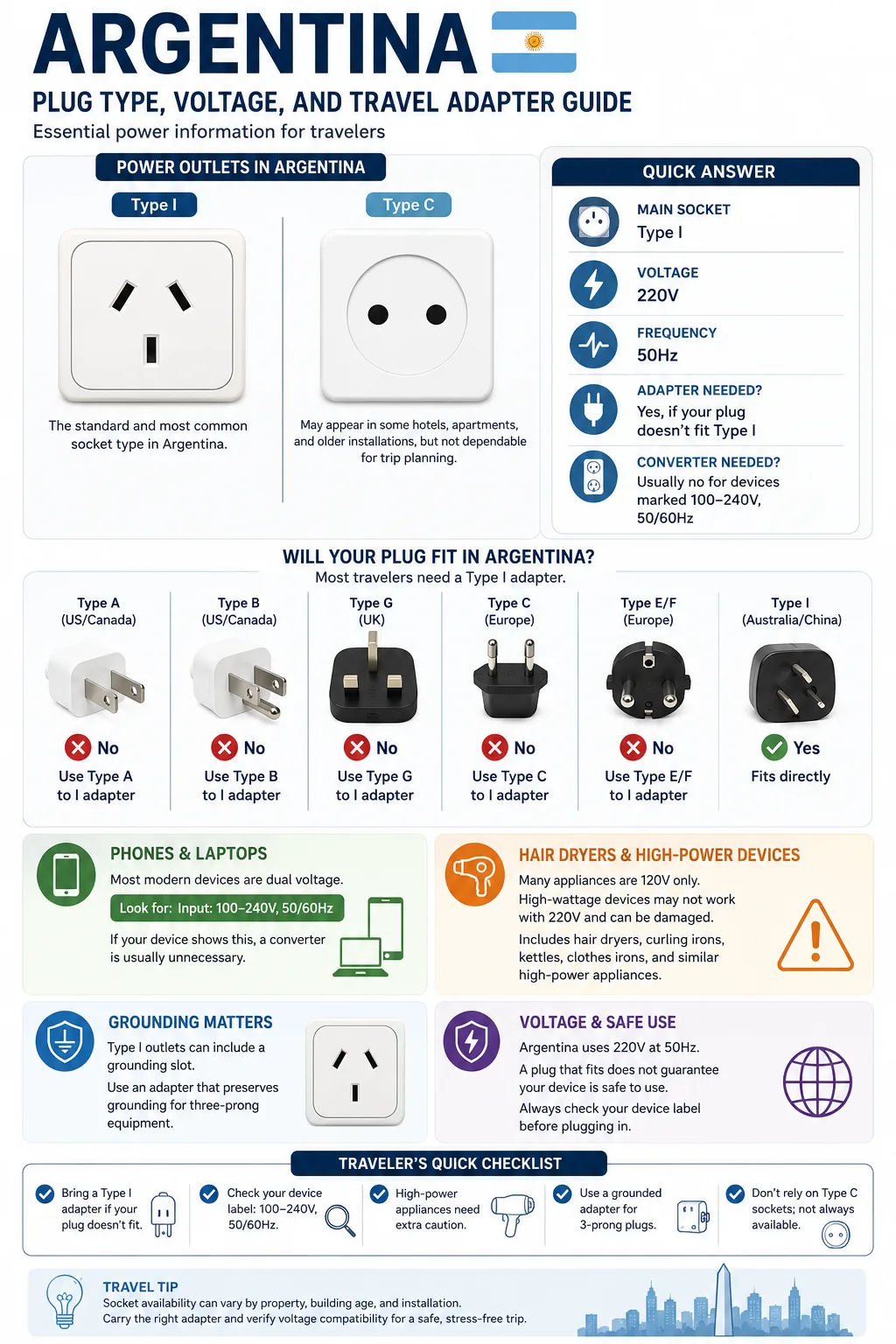
Argentina uses Type I power outlets, with a standard supply of 220V at 50Hz. Type C sockets may still appear in some hotels, apartments, and older installations, but travelers should not depend on finding them. Visitors carrying Type A, B, G, E, F, N, or most other plug shapes will normally need a Type I plug adapter. A voltage converter is a separate requirement only when the device itself cannot accept Argentina’s voltage.
| Travel question | Argentina |
|---|---|
| National socket to plan for | Type I |
| Other socket sometimes encountered | Type C, but not dependable for trip planning |
| Standard voltage | 220V |
| Frequency | 50Hz |
| Plug adapter | Needed when the device plug does not fit Type I |
| Voltage converter | Usually unnecessary for devices marked Input: 100–240V, 50/60Hz |
| Main appliance risk | 120V-only hair dryers, curling irons, kettles, clothes irons, and other high-wattage devices |
| Grounding | Use an adapter that preserves grounding for three-prong equipment |
What the Power Outlets Look Like
These drawings show the basic socket shapes a traveler may encounter. Real wall outlets can look different depending on the building, manufacturer, and age of the installation. Some hotel sockets combine more than one opening pattern. Plug shape and voltage are separate issues, so a plug that fits is not proof that the connected device is safe to use.
Why Type I Is the Socket to Plan For
Type I is the local plug and socket format that should guide packing decisions for Argentina. Its two current-carrying slots are flat and angled, creating an inverted V shape. Grounded versions add a third vertical slot. A two-pin charger may use an ungrounded Type I adapter, while a three-prong laptop supply, desktop device, or other grounded appliance needs an adapter designed to maintain the earth connection.
Argentina’s domestic Type I system is associated with national IRAM plug and socket standards. Travelers do not need to study the standard numbers to choose an adapter, but the local-standard point matters: a product that looks similar to another country’s Type I plug is not automatically the best choice for every Argentine installation.
Why Type C Sockets Still Cause Confusion
Two-round-pin Type C outlets and combination sockets can be found in some Argentine homes, apartments, and accommodation. This reflects older installations, imported equipment, and sockets designed to accept more than one plug shape. Their presence is useful when a small Europlug charger fits, but it is not consistent enough to replace a Type I adapter in a travel kit.
A visitor from continental Europe or Türkiye may discover that a slim Type C phone charger works in one room and does not fit the next property. Type E and Type F plugs, including many grounded European appliances, should not be treated as interchangeable with a simple two-pin Type C connection. An ungrounded fit is not a substitute for a grounded connection.
Will Your Plug Fit in Argentina?
| Traveler’s plug | Will it fit Type I? | What to pack | Voltage point |
|---|---|---|---|
| United States or Canada, Type A | No | Type A-to-I adapter | Check carefully because many appliances are 120V-only |
| United States or Canada, Type B | No | Grounded Type B-to-I adapter | Preserve grounding and verify the input voltage |
| United Kingdom or Ireland, Type G | No | Type G-to-I adapter | Most 220–240V devices do not need voltage conversion |
| Continental Europe or Türkiye, Type C | Sometimes in a secondary socket, not reliably | Type C-to-I adapter | Most modern chargers and 220–240V devices are voltage-compatible |
| Continental Europe, Type E or F | No | Grounded Type E/F-to-I adapter | Check that the adapter carries the earth connection |
| Australia or New Zealand, Type I | Often physically similar | Verify that the plug or adapter is marked for Argentina | Voltage is usually compatible, but grounded and high-power equipment deserves closer checking |
| Brazil, Type N | No | Type N-to-I adapter | Do not assume a shared South American trip uses one socket system |
| Japan, Type A | No | Type A-to-I adapter | 100V-only equipment should not be connected directly to 220V |
Travelers from Australia and New Zealand often focus only on the familiar angled-pin appearance. The plug family is similar, but locally compliant products, grounding, orientation, and the condition of the wall socket still matter. Avoid forcing a plug that does not seat cleanly, and use an Argentina-compatible adapter when the product documentation is unclear.
Argentina’s 220V, 50Hz Supply
Argentina’s standard travel power information is 220V at 50Hz. This is broadly compatible with many devices sold for 220–240V regions, including much of Europe, the United Kingdom, Australia, New Zealand, and parts of Asia and South America. It creates a direct voltage risk for appliances designed only for 100V, 110V, or 120V.
Some international electrical tables group Argentina within a 230V nominal category. For practical travel decisions, treat the local supply as 220V and choose devices that clearly cover the operating range. A charger marked 100–240V is designed with enough range for either label.
A plug adapter does not convert voltage. It changes the physical connection between the device plug and the wall outlet. A mechanical adapter can make a 120V appliance fit a 220V socket without making the appliance electrically compatible.
What “Input: 100–240V, 50/60Hz” Means
The input line on a charger or power supply states what electricity it can receive from the wall. A label reading Input: 100–240V, 50/60Hz normally means the power supply can operate on Argentina’s voltage and frequency without a voltage converter. The remaining task is to make the plug fit Type I.
Do not use the USB output line for this decision. A label such as “Output: 5V, 3A” describes the electricity sent from the charger to the phone or tablet. It does not describe compatibility with the wall supply.
| Label | Use in Argentina |
|---|---|
| Input: 100–240V, 50/60Hz | Usually needs only the correct Type I plug adapter |
| Input: 220–240V, 50Hz | Voltage and frequency are normally compatible; check the plug shape |
| Input: 120V, 60Hz | Do not connect directly; a suitable conversion solution may be required |
| Input: 100V only | Do not connect directly to Argentina’s 220V supply |
| Output: 5V, 3A | Not enough information; find the separate input line |
When 50Hz Matters
Frequency is normally a minor issue for modern chargers that state 50/60Hz. It can matter more for older clocks, turntables, pumps, motor-driven appliances, and equipment designed only for 60Hz. A device may run at the wrong speed, operate hotter, keep inaccurate time, or fail to work as intended.
A basic step-down transformer may change 220V to a lower voltage without changing 50Hz to 60Hz. When the label lists only 60Hz, check the manufacturer’s instructions rather than assuming voltage conversion solves both differences.
Modern Chargers and High-Power Appliances Need Different Decisions
Small electronic chargers often use switching power supplies that accept a wide voltage range. Heat-producing appliances usually draw far more power and are more likely to be single-voltage. Treating these two groups as if they have the same travel requirements is a common cause of damaged equipment.
Phones, Tablets, Laptops, Cameras, and USB-C Chargers
Phone chargers, tablet chargers, camera battery chargers, and many laptop power supplies are commonly marked 100–240V, 50/60Hz. When that input range is present, a Type I adapter is normally enough.
USB-C does not describe wall-voltage compatibility or charging speed by itself. A laptop may require 65W, 100W, 140W, or another USB Power Delivery level even though a lower-powered USB-C port fits the cable. Check both the charger’s AC input range and its USB-C output rating. A multiport adapter may also divide its total wattage when several devices are connected.
Grounded laptop supplies deserve extra attention. A two-pin adapter may power the charger while removing the earth connection intended by its three-prong plug. Use a grounded adapter when the original equipment uses grounding.
Hair Dryers, Curling Irons, Straighteners, Kettles, and Clothes Irons
Never connect a 120V-only heating appliance directly to Argentina’s 220V supply. Hair dryers, curling irons, hair straighteners, travel kettles, steamers, and clothes irons can draw hundreds or thousands of watts. A small electronic converter or a lightweight multi-country adapter may not be rated for that load.
A dual-voltage hair tool may show “120/240V,” “110–240V,” or a manual selector. When a selector is present, set it to the 220–240V position before plugging in the appliance. Confirm the wattage limit of the adapter as well as the voltage setting. Using the appliance supplied by the hotel is often simpler than carrying a single-voltage model from a 120V country.
Electric Shavers, Toothbrushes, CPAP Machines, and Medical Equipment
Electric shavers and toothbrush chargers vary. Some accept 100–240V, while others are tied to one voltage or a specific charging base. Read the label on the base or power supply rather than the handheld device alone.
Many modern CPAP power supplies accept 100–240V, 50/60Hz, but this should be confirmed on the exact unit. Heated humidifiers, battery accessories, grounded power supplies, and medical-device instructions can change the setup. Carry the correct adapter before arrival, keep the original power supply, and follow the manufacturer’s requirements. No travel adapter should be treated as a safety guarantee for medical equipment.
Grounding, Polarity, and the Australian-Plug Assumption
Argentina’s Type I outlet uses a third connection for grounding on grounded installations. The protective earth path matters for devices designed with three-prong plugs, metal-bodied equipment, and some laptop or medical power supplies. A cheap two-pin adapter may create physical contact while leaving the device ungrounded.
Type I is also used in Australia, New Zealand, China, and several other places, but local versions are governed by different national standards. Their plugs can look very similar. For low-power, double-insulated chargers, a correctly fitting product with the right voltage range is often straightforward. For grounded or high-wattage equipment, look for explicit Argentina compatibility instead of relying only on the words “Type I” or “Australia.”
- Do not remove or bypass a grounding pin.
- Do not use a loose adapter that moves under the weight of a charger.
- Do not force an angled plug into a socket that resists insertion.
- Stop using an outlet that shows heat damage, sparking, burning odor, or poor contact.
Hotels, Apartments, and Mixed Socket Designs
Argentine accommodation can include standard Type I outlets, Type C openings, or multi-standard sockets designed for international visitors. The exact mix depends on the property and installation. A renovated hotel may provide USB ports or combination sockets, while an apartment may have only local Type I outlets.
Do not assume that a hotel’s universal-looking socket changes the voltage. A multi-standard face may accept several plug shapes while still delivering 220V at 50Hz. The same device-label check applies.
Large universal adapters can hang awkwardly from recessed or worn outlets. A compact Argentina-specific adapter often sits more securely when the trip is limited to one country. For a medically necessary device or a work laptop, asking the accommodation for a current outlet photo can resolve uncertainty before arrival.
Buying an Imported Electrical Device in Argentina
A 2025 change to Argentina’s electrical-product rules allowed certain imported products to be sold with plug geometry that does not match the local Type I format, subject to labeling and applicable safety conditions. The practical result is simple: a device purchased inside Argentina may still come with a foreign plug.
This rule did not replace Argentina’s 220V, 50Hz supply or the Type I socket travelers should expect. Before buying a charger, appliance, or electronic device locally, inspect three separate items:
- The plug attached to the product or power supply
- The input-voltage and frequency label
- Any notice stating that an adapter is required for local use
“Bought in Argentina” should not be used as proof that the plug fits an Argentine wall outlet. Imported items can also be dual-voltage, 220V-only, or designed for another electrical market, so the input label remains the deciding information.
Choosing a Type I Adapter for Argentina
The best adapter depends on the plug, grounding needs, device wattage, and whether the trip continues to another country. Product branding is less useful than clear electrical ratings.
- Look for explicit Argentina or Argentine Type I compatibility.
- Match the adapter input side to the exact plug being carried.
- Choose a grounded model for equipment with a three-prong plug.
- Check the current, voltage, and wattage rating before using high-power equipment.
- For built-in USB ports, check the total shared output and the output of each port.
- For USB-C laptop charging, verify the required Power Delivery wattage.
- Avoid adapters with loose sliders, exposed metal, poor pin alignment, or no readable rating.
Dedicated Argentina Adapter or Universal Travel Adapter?
A dedicated Type I adapter is compact and can place less leverage on the wall outlet. It is a practical choice for a trip focused on Argentina. A universal adapter is more convenient for a multi-country itinerary, but it may be heavier, may not preserve grounding in every mode, and may have a lower shared USB output than expected.
Neither style converts voltage unless the product explicitly includes a voltage-conversion function. Even then, the converter must be suitable for the appliance type and wattage.
Argentina and Brazil Do Not Use the Same Main Socket
A side trip between Argentina and Brazil can require two plug solutions. Argentina’s local standard is Type I, while Brazil’s main national standard is Type N. Similar regional voltage labels do not create plug compatibility.
A multi-country adapter that clearly supports both Type I and Type N may cover the route. A single Argentina-only adapter will not normally fit a Brazilian Type N outlet. Check every destination separately rather than packing one adapter for “South America” as a whole.
Power Mistakes to Avoid in Argentina
- Depending on Type C because a European charger fitted one hotel socket
- Assuming a plug adapter reduces 220V to 120V
- Using a two-pin adapter for equipment designed to remain grounded
- Reading the USB output line instead of the AC input line
- Connecting a 120V hair dryer or curling iron directly to 220V
- Assuming every Type I product is equally suitable for Argentina
- Expecting a basic voltage converter to change 50Hz into 60Hz
- Overloading one adapter with a laptop, battery chargers, and a heating appliance
- Assuming a device sold locally must have a local plug
What to Pack for Reliable Charging
- One Argentina-compatible Type I adapter for each location where simultaneous charging matters
- A grounded Type I adapter for three-prong equipment
- A multiport 100–240V charger for phones, tablets, watches, and cameras
- A USB-C Power Delivery charger with enough wattage for the laptop
- Original power supplies for CPAP and other medical equipment
- A power bank for transit days, carried according to airline battery rules
- A device list showing the input voltage, frequency, wattage, and plug type of each appliance
Leave single-voltage, high-wattage appliances at home unless there is a tested and properly rated plan for using them on 220V. Packing a compatible dual-voltage device is usually safer and lighter than depending on a heavy converter.
Frequently Asked Questions
What plug type is used in Argentina?
Type I is the national socket to plan for. Type C outlets may appear in some buildings, but they are not reliable enough to remove the need for a Type I adapter.
Is Argentina 220V or 230V?
Travel information for Argentina commonly states 220V at 50Hz. Some international tables group the system under a 230V category. Devices marked 100–240V or 220–240V normally cover this range.
Can a European Type C plug work in Argentina?
It may fit a Type C or combination socket in some accommodation, but not every property provides one. Pack a Type I adapter rather than depending on Type C availability.
Will a US phone charger work in Argentina?
Usually, when the charger says Input: 100–240V, 50/60Hz. It will still need a Type A-to-I plug adapter. A charger marked only for 120V should not be connected directly.
Can I use a US hair dryer in Argentina?
Only when it is designed for 220–240V or has a dual-voltage setting placed in the correct position. A 120V-only hair dryer should not be used with a simple plug adapter.
Is Argentina’s Type I plug exactly the same as Australia’s?
The shapes are closely related and often physically similar, but local standards and grounded-use details should still be checked. For high-power or three-prong equipment, choose a product that clearly lists Argentina compatibility.