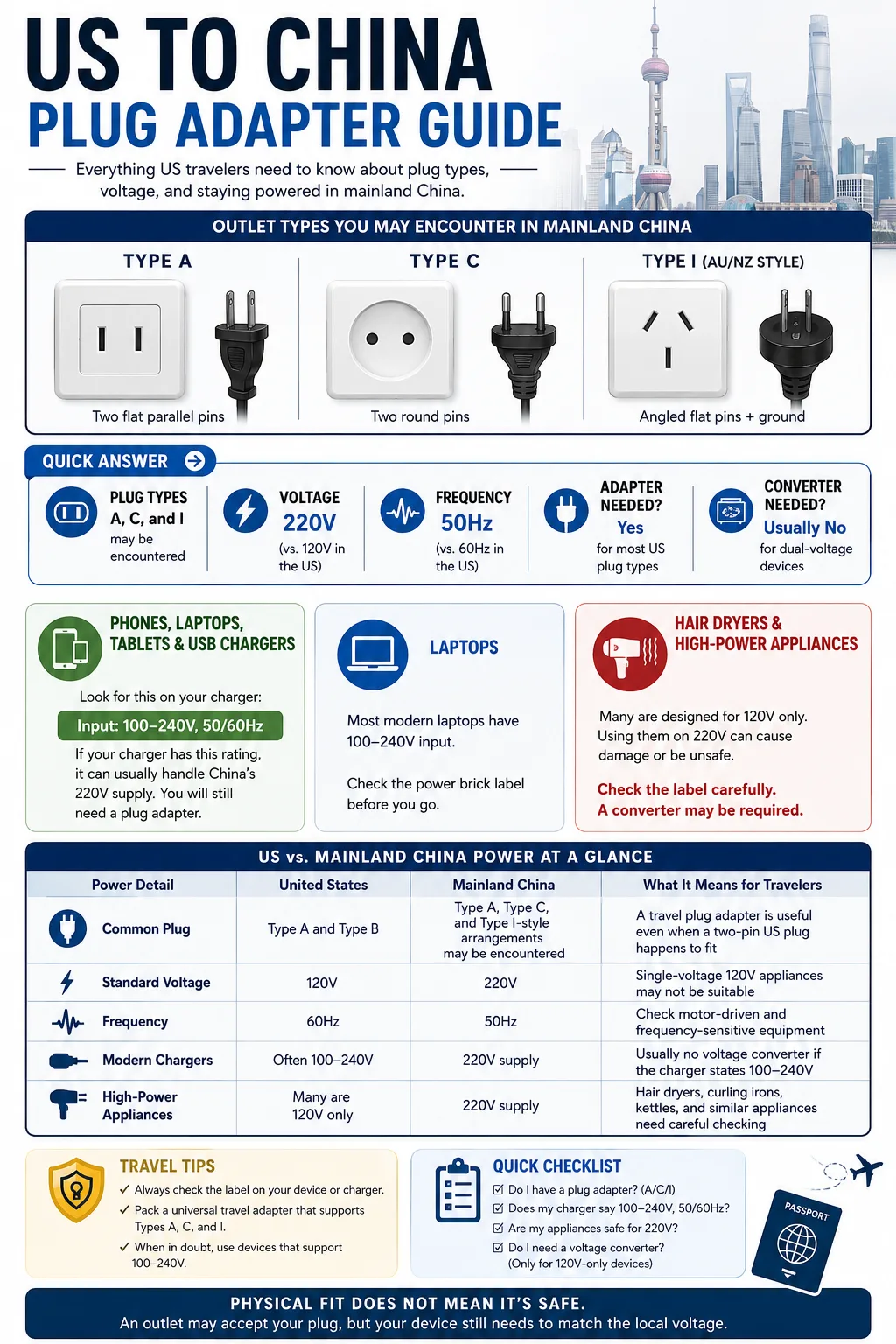
Travelers going from the United States to mainland China face two separate electrical differences: plug shape and voltage. US devices normally use Type A or Type B plugs on a 120V, 60Hz supply, while mainland China uses a 220V, 50Hz supply and several socket configurations. Some two-pin US plugs may physically fit certain Chinese outlets, but physical fit does not mean the device is safe for 220V.
For phones, laptops, tablets, cameras, and many USB chargers, the most important line on the charger is usually Input: 100–240V, 50/60Hz. A charger with that rating can normally accept China’s 220V supply without a voltage converter. A plug adapter may still be needed. Appliances marked only for 110V or 120V require much more caution.
| Power detail | United States | Mainland China | What it means for travelers |
|---|---|---|---|
| Common plug | Type A and Type B | Type A, Type C, and Type I-style arrangements may be encountered | A travel plug adapter is useful even when a two-pin US plug happens to fit |
| Standard voltage | 120V | 220V | Single-voltage 120V appliances may not be suitable |
| Frequency | 60Hz | 50Hz | Check motor-driven and frequency-sensitive equipment |
| Modern chargers | Often 100–240V | 220V supply | Usually no voltage converter if the charger states 100–240V |
| High-power appliances | Many are 120V only | 220V supply | Hair dryers, curling irons, kettles, and similar appliances need careful checking |
How US Plugs Match Chinese Power Outlets
A US Type A plug has two flat parallel pins. A Type B plug adds a round grounding pin. Mainland China can present more than one socket layout, including outlets that accept two flat pins, outlets for two round pins, and angled flat-pin arrangements associated with Type I-style plugs.
This creates an unusual situation for US travelers: a two-pin Type A charger may fit some Chinese wall outlets directly. That does not remove the voltage issue. The outlet is still supplied according to the local electrical system.
Outlet designs can vary by building, socket manufacturer, and age of installation. Hotels may also install multi-standard sockets intended for international guests. A universal-looking socket does not change the local voltage.
The 120V to 220V Difference Matters More Than the Plug Shape
The US electrical system normally supplies about 120V, while mainland China uses 220V. That difference is much larger than the physical difference between two plug shapes.
A travel plug adapter changes how the plug connects to the wall. A plug adapter does not convert voltage. If a 120V-only appliance is connected to a 220V supply through a simple adapter, the adapter does not protect the appliance from the higher voltage.
A voltage converter is a different device. It is designed to change the supplied voltage for equipment that cannot accept the destination voltage. Whether one is appropriate depends on the appliance, its wattage, its electrical design, and the converter’s rating.
When an adapter is usually enough
If the device or charger says Input: 100–240V, 50/60Hz, it is designed to accept a broad range of international power supplies. For travel from the US to China, this usually means the charger can operate from the local 220V supply without a voltage converter.
The remaining question is physical connection. If the plug does not fit the outlet securely, use a suitable plug adapter.
When voltage conversion may be needed
If the label states only 110V, 115V, 120V, or a similarly narrow US voltage range, do not assume a plug adapter is enough. The appliance may require voltage conversion or may be better replaced with a dual-voltage or locally compatible alternative.
Do not connect a 120V-only appliance directly to a 220V outlet through a mechanical plug adapter.
Read the Input Line Before Packing the Device
The electrical label usually gives a faster answer than the plug itself. Look for the word INPUT on the charger, power brick, charging base, or appliance.
| Label example | What it means | Typical China decision |
|---|---|---|
| Input: 100–240V, 50/60Hz | Wide-range international input | Normally no voltage converter; plug adapter may still be needed |
| Input: 110–120V, 60Hz | Designed around US voltage and frequency | Do not use on 220V with only a plug adapter |
| 110/220V or 120/240V selectable | Device may support two voltage settings | Check and set the selector correctly before connecting it |
| No readable electrical rating | Compatibility cannot be confirmed from the plug | Avoid guessing; verify the charger or appliance specification |
Do not confuse input and output voltage
A phone charger may show output values such as 5V, 9V, 12V, or 20V. Those values describe the power sent from the charger to the device. They do not describe what the charger can accept from a Chinese wall outlet.
For wall-power compatibility, read the INPUT rating.
Adapter Only, Converter, Both, or Neither?
| Device situation | Plug adapter | Voltage converter |
|---|---|---|
| 100–240V charger and plug fits securely | May not be needed at that outlet | Normally not needed |
| 100–240V charger but plug does not fit | Needed | Normally not needed |
| 120V-only appliance | May be needed for physical fit | May be required; appliance suitability and wattage must be checked |
| Dual-voltage appliance with manual selector | Depends on plug | Normally not needed when correctly set for the local voltage |
| Electrical rating is unknown | Do not decide from plug shape alone | Compatibility should be verified first |
Phones, Laptops, Cameras, and USB Chargers
Modern portable electronics are usually easier to travel with because many charging adapters use wide-range switching power supplies. The device itself is not the only part that matters; check the charger that connects to the wall.
| Device | Typical situation | What to check |
|---|---|---|
| Phone charger | Many support worldwide voltage | Look for 100–240V, 50/60Hz on the charger |
| USB-C charger | Often wide-range, but not guaranteed by the USB-C connector | Read the AC input rating |
| Laptop charger | Many modern power bricks accept 100–240V | Check the power brick, not only the laptop |
| Tablet charger | Often similar to phone chargers | Confirm the input voltage range |
| Camera battery charger | Many travel-friendly chargers support 100–240V | Read the charger label |
| Gaming handheld charger | Often powered through USB-C | Check the AC adapter’s input rating |
USB-C does not guarantee 220V compatibility
USB-C describes the connector and charging system on the low-voltage side. A charger can have a USB-C port without automatically being suitable for every country’s mains voltage. The AC input specification remains the deciding factor.
Laptop power bricks can create a mechanical problem
A wide-range laptop charger may be electrically compatible with 220V but still sit poorly in a loose or recessed outlet when combined with a bulky travel adapter. A secure connection is preferable to allowing a heavy charger to hang from a wall socket.
If the laptop power supply uses a removable AC cable, an appropriately rated destination-compatible cable may also provide a cleaner connection than stacking a heavy charger onto a small plug adapter.
US Type B Plugs and Grounding
Three-prong US Type B plugs deserve separate attention because the third pin provides grounding. A travel adapter can make a Type B plug physically connect to another socket shape, but physical connection alone does not prove that grounding remains available.
An adapter that accepts a three-prong US plug is not automatically a grounded adapter. If the equipment relies on protective grounding, use an adapter and outlet arrangement that maintain the required earth connection.
This matters more for equipment designed with a grounded plug than for typical two-prong phone chargers. Never remove or defeat a grounding connection simply to make a plug fit.
Hair Dryers, Curling Irons, Kettles, and Other High-Power Appliances
Heat-producing appliances are the devices most likely to create problems when moving from the US 120V system to China’s 220V system.
Common examples include:
- hair dryers
- curling irons
- hair straighteners
- travel kettles
- clothes irons
- heated styling tools
Many US versions are designed only for 120V. A plug adapter is not enough for a 120V-only heating appliance.
Dual-voltage hair tools
Some travel hair dryers and styling tools support two voltage ranges, sometimes through a manual voltage selector. If the appliance is marked for both approximately 120V and 220–240V operation, make sure the selector is set correctly before connecting it.
Do not assume that the presence of a selector means every operating mode works identically on both voltages. Follow the appliance’s own instructions.
Why small travel converters are not a universal solution
Hair dryers and kettles can draw far more power than phone and laptop chargers. A converter must be designed for the voltage, wattage, operating time, and type of appliance involved.
For a 120V-only high-power appliance, a dual-voltage travel version or a suitable appliance available at the destination can be simpler than carrying a large converter.
Electric Shavers, Toothbrushes, and Small Personal Appliances
Small size does not automatically mean worldwide voltage support. Charging bases for electric toothbrushes, shavers, grooming tools, and similar appliances vary by model.
A charger marked 100–240V can normally accept China’s supply. A base marked only 120V should not be connected to 220V through a simple plug adapter.
Some rechargeable devices use an external USB power supply, which can make travel easier if that USB charger itself supports 100–240V.
CPAP Machines and Other Medical Equipment
Many modern medical-device power supplies are designed for international voltage ranges, but this should never be assumed. Check the exact CPAP machine, external power supply, humidifier, and any separate accessories that connect to mains power.
Look for an input range that includes 220V and 50Hz. If the specification is unclear, verify the manufacturer’s operating instructions before travel.
Do not rely on a generic travel adapter as proof that medical equipment is electrically compatible.
Your US Power Strip Needs Its Own Voltage Check
A common travel mistake is checking every charger but forgetting the power strip that connects them to the wall.
Suppose a phone charger and laptop charger both support 100–240V. If they are connected through a US surge protector or power strip marked only for 125V, the strip itself may not be suitable for a 220V supply.
Check the electrical rating printed on:
- power strips
- surge protectors
- extension cords
- multi-outlet adapters
- travel charging hubs
Adding a China plug adapter does not turn a 125V-only US power strip into a 220V-rated product.
What 50Hz Instead of 60Hz Means
The United States uses 60Hz power, while mainland China uses 50Hz. Chargers marked 50/60Hz are designed to accept either frequency, so this difference is usually straightforward for modern phone, tablet, camera, and laptop chargers.
Frequency deserves more attention when a device contains an AC motor, timing mechanism, transformer, pump, or other component designed specifically around 60Hz operation. A voltage converter does not necessarily change the frequency.
If a device label states only 60Hz, check its operating instructions before using it on China’s 50Hz supply.
Hotel Universal Sockets Do Not Solve the Voltage Difference
Some hotels in mainland China provide multi-standard sockets that accept several international plug shapes. These can be convenient for US Type A or Type B chargers, but they should not be treated as built-in voltage converters.
Do not assume that a hotel’s universal-looking socket changes the voltage. Unless the outlet is specifically labeled otherwise, plan around the local 220V supply.
Hotel rooms can also contain a mix of socket designs. A desk outlet may accept one plug shape while another outlet near the bed may use a different arrangement. Carrying a suitable adapter avoids relying on a particular hotel installation.
Choosing a Plug Adapter for a US to China Trip
The best adapter choice depends on the plugs attached to the equipment you are bringing rather than on the number of countries printed on the packaging.
For two-prong US Type A chargers
A simple China-compatible travel adapter can provide a more predictable connection when the wall outlet does not directly accept the US flat pins. Even if some outlets accept Type A, carrying an adapter provides flexibility across different socket layouts.
For three-prong US Type B equipment
Choose an adapter that accepts the full three-prong plug and, when the device requires grounding, preserves an appropriate grounding path. A two-pin adapter should not be treated as a grounded solution merely because the US plug can be inserted into it.
Universal travel adapters
A universal adapter can be convenient when China is one stop in a multi-country trip. It may accept several plug formats and sometimes includes USB charging ports.
Universal travel adapters normally change plug shape, not voltage. The device connected through the adapter must still be suitable for China’s 220V supply.
| Feature | Simple destination adapter | Universal travel adapter |
|---|---|---|
| China-only trip | Often compact and practical | May provide more plug options than needed |
| Multi-country trip | Limited to supported plug formats | More flexible |
| Size | Usually smaller | Usually larger |
| USB charging | Not always included | Often included on some designs |
| Voltage conversion | No | Usually no |
| Grounding | Depends on design | Depends on design |
Mainland China Is a Separate Plug-Planning Zone
This page covers mainland China. Travelers combining mainland China with Hong Kong or Macao should check those destinations separately rather than assuming the same plug arrangement will cover the entire itinerary.
The voltage difference may not be the only issue on a multi-stop trip. Plug shapes and grounding arrangements can change even when destinations use similar mains voltages.
A 20-Second Check Before You Plug In
- Find the electrical label on the charger, power brick, charging base, or appliance.
- Read the INPUT line.
- Confirm that the voltage range includes 220V.
- For electronics, check whether the label also states 50/60Hz.
- Identify whether the US plug is Type A or grounded Type B.
- Use a suitable plug adapter if the outlet does not provide a secure physical fit.
- Check grounding separately for three-prong equipment.
- Do not connect a 120V-only appliance to China’s 220V supply through a simple plug adapter.
What to Pack From the United States
| Usually useful to pack | Needs extra checking |
|---|---|
| China-compatible plug adapter | 120V-only hair dryer |
| 100–240V phone charger | US curling iron or straightener |
| 100–240V laptop power supply | 125V-only surge protector |
| Dual-voltage camera charger | US kettle or clothes iron |
| Correctly rated USB-C charger | Single-voltage shaver or toothbrush base |
| Ground-capable adapter when required | Medical equipment with unclear electrical specifications |
Common US-to-China Power Mistakes
Assuming a fitting Type A plug is automatically safe
A two-pin US plug can physically fit some Chinese sockets while the outlet still supplies 220V. Always check the device’s voltage rating.
Assuming every universal adapter converts voltage
Most travel adapters are mechanical plug converters. They do not step 220V down to 120V.
Checking the phone instead of the charger
The charger is the part connected to mains power. Read its AC input rating.
Treating every USB-C charger as worldwide voltage
USB-C does not replace the need to check the AC input label.
Forgetting about the power strip
Every mains-powered item in the connection chain needs an appropriate voltage rating, including extension leads and surge protectors.
Depending entirely on hotel sockets
Socket layouts vary. Carrying an adapter provides a more reliable plan than assuming every room will accept a US plug directly.
Frequently Asked Questions
Do US plugs work in China?
Some two-pin US Type A plugs can fit certain outlets in mainland China, but this does not guarantee voltage compatibility. China uses 220V, so the device or charger must also support that voltage.
Do I need a plug adapter from the US to China?
It is sensible to carry one. Some US Type A plugs may fit directly, while Type B and other plug arrangements may require an adapter depending on the outlet you encounter.
Do I need a voltage converter in China?
If your charger says Input: 100–240V, 50/60Hz, a voltage converter is normally not needed. A 120V-only appliance may require a suitable converter or a different appliance.
Can I charge my phone in China?
Usually yes if the wall charger supports 100–240V. Check the charger’s input label and use a plug adapter when needed.
Can I use a US laptop charger in China?
Many laptop power supplies accept 100–240V and 50/60Hz. If yours does, it can normally use China’s 220V supply without a voltage converter, although a plug adapter may still be required.
Can I use a US hair dryer in China?
Only if the hair dryer is designed for China’s voltage or is correctly configured as a dual-voltage appliance. A 120V-only US hair dryer should not be connected to a 220V outlet through only a plug adapter.