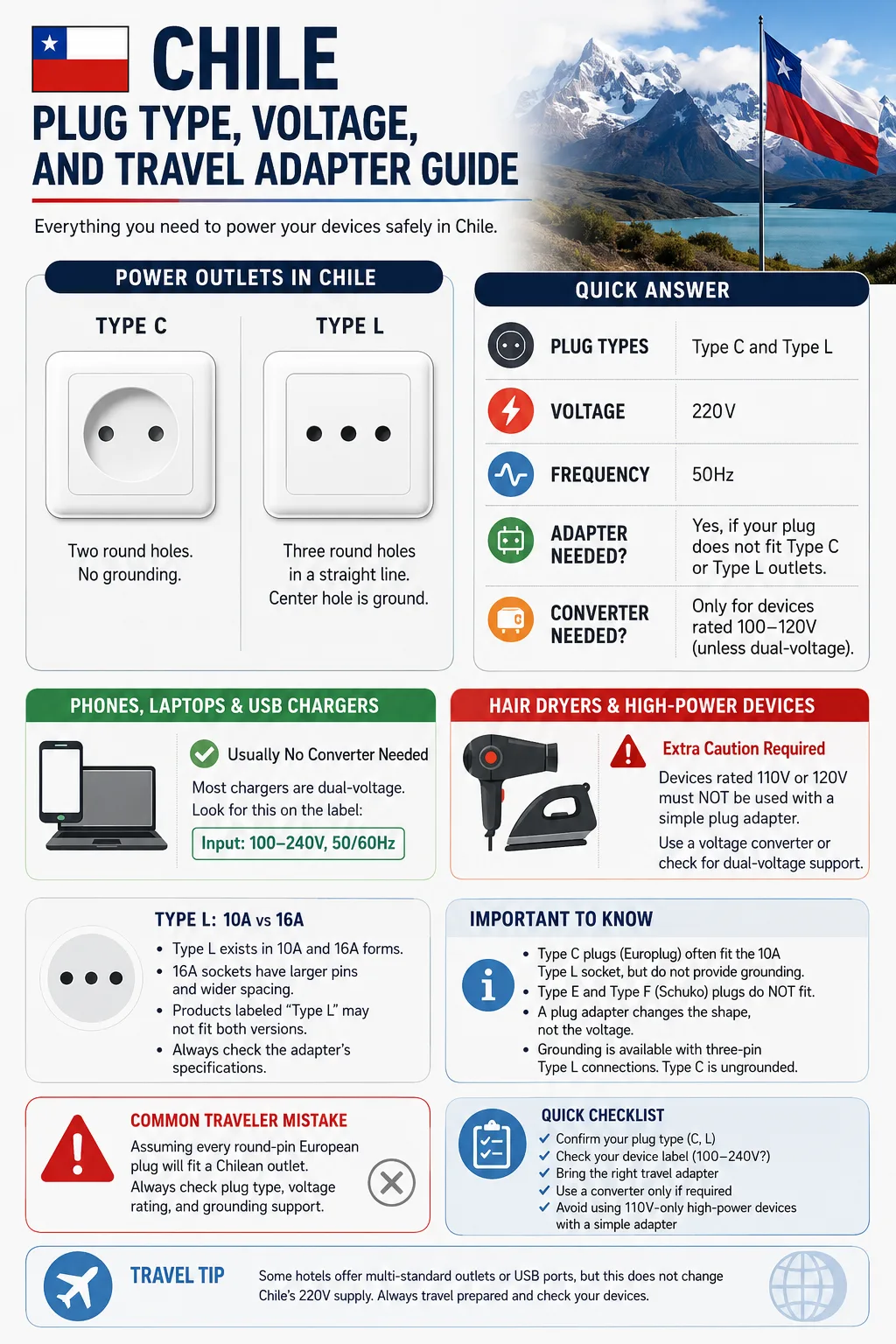
Chile uses 220V electricity at 50Hz, with Type C and Type L power outlets commonly associated with the country. Travelers arriving with Type A, B, G, I, or other non-compatible plugs will normally need a travel adapter. A voltage converter is usually unnecessary for phone chargers, laptop chargers, camera chargers, and USB power supplies marked Input: 100–240V, 50/60Hz.
A 110V or 120V appliance must not be connected to Chile’s 220V supply through a simple plug adapter. Hair dryers, curling irons, heated styling tools, kettles, clothes irons, and other high-wattage appliances need closer checking because a plug adapter changes the plug shape but does not change the voltage.
| Common plug types | Type C and Type L |
|---|---|
| Standard voltage | 220V |
| Frequency | 50Hz |
| Who usually needs an adapter? | Travelers whose plugs do not physically fit Type C or Type L outlets |
| When may a converter be needed? | For devices rated only for 100–120V, unless the device has a usable dual-voltage setting |
| Grounding point | Three-pin Type L connections can provide grounding; Type C is ungrounded |
| Common traveler mistake | Assuming every round-pin European plug will fit a Chilean outlet |
What the Power Outlets Look Like
These drawings show the basic socket shapes travelers may encounter. Real outlets can differ in color, faceplate design, shutter layout, manufacturer, and age of installation. Some hotels may also provide multi-standard sockets or separate USB charging ports. Plug shape and voltage are separate issues, and a universal-looking hotel socket does not change Chile’s 220V supply.
Chile’s Type L Socket and the Type C Connection
Type L is easy to recognize by its three round contacts in one straight line. On a grounded three-pin connection, the center contact is the protective earth connection. This layout is different from Type J, Type N, and other three-round-pin systems, even when they look similar in a product photo.
Type C is the familiar two-pin Europlug format. Its slim round pins can often be accepted by the 10A form of a Type L socket. This is why a small European phone charger may plug in without an adapter while a larger grounded European appliance does not.
That partial compatibility should not be treated as proof that every continental European plug will fit. Type E and Type F plugs use thicker pins and different grounding arrangements. A Schuko plug should not be forced into a Type L socket, and a Type C connection cannot preserve grounding for equipment designed to use it.
The 10A and 16A Type L Difference
Type L exists in 10A and 16A forms. The 16A form uses larger pins and wider spacing, so the two versions are not mechanically identical. Travelers are more likely to deal with ordinary low-power charging needs than dedicated high-current outlets, but the distinction explains why products simply labeled “Type L” do not always offer the same fit.
When selecting an adapter, check its supported plug type, voltage rating, current rating, and whether it maintains a grounding path. A product name such as “Europe adapter” or “Italy adapter” is not enough by itself. The output side should clearly support the socket arrangement needed in Chile.
Adapter Only or Voltage Converter?
A travel adapter and a voltage converter solve different problems:
- Plug adapter: changes the physical connection so one plug shape can enter another socket type.
- Voltage converter: changes the supplied voltage for a device that cannot accept Chile’s 220V system.
- Transformer: may provide ongoing voltage conversion when properly sized for the appliance and intended use.
- USB charger: converts its accepted AC input into the lower DC output required by a phone, tablet, camera, or laptop.
A plug adapter does not convert voltage. The word “universal” on an adapter normally refers to plug-shape compatibility, not automatic conversion from 220V to 120V.
| Device label | Use on 220V / 50Hz | What may still be needed |
|---|---|---|
| Input: 100–240V, 50/60Hz | Normally voltage-compatible | A plug adapter if the plug does not fit |
| 220–240V, 50Hz | Normally compatible | A plug adapter and a suitable current rating |
| 220–240V, 50/60Hz | Normally compatible | A plug adapter if required |
| 110V, 115V, or 120V only | Not directly compatible | A correctly sized converter, or a different appliance |
| 120/240V with a manual selector | Potentially compatible | Set the selector to the 220–240V position before connection |
Read the Device Label Before Packing
The most useful information is usually printed on the charger, power brick, appliance base, battery charger, or molded plug. Look for the line beginning with “Input” rather than the output delivered to the device.
What “Input: 100–240V” Means
A charger marked Input: 100–240V, 50/60Hz is designed to accept both lower-voltage and higher-voltage mains supplies within that range. On Chile’s 220V, 50Hz system, it will usually need only a physical plug adapter when its original plug does not fit.
The label may also show an input current such as 1.5A. The output line may list figures such as 5V, 9V, 15V, or 20V for USB charging. Those output values do not describe the wall supply and should not be used to decide whether the charger is compatible with Chile.
Four Details to Check
- The accepted input voltage range
- Whether the charger accepts 50Hz, usually shown as 50/60Hz
- The appliance wattage or current draw
- Whether the original plug and appliance rely on protective grounding
A worn label, missing rating plate, or unclear manual makes the decision less certain. Do not assume compatibility based only on the device category or the shape of its plug.
Plug Compatibility Based on Where You Are Traveling From
United States and Canada
Type A and Type B plugs do not directly match Chile’s Type C or Type L sockets. A plug adapter is normally required. The larger issue is voltage: the United States and Canada commonly use 120V supplies, while Chile uses 220V.
Most modern phone and laptop chargers accept 100–240V, but a 120V-only hair dryer, curling iron, steamer, electric blanket, or similar appliance cannot be made safe by changing the plug shape. A grounded Type B device also needs an adapter that preserves grounding when the appliance requires it.
United Kingdom and Ireland
Type G plugs require an adapter for Type C or Type L outlets. Many devices sold for 220–240V systems are already within Chile’s voltage range, but the device label remains the deciding factor. For three-pin equipment, confirm that the adapter maintains the earth connection rather than simply accepting the plug.
Continental Europe and Türkiye
A slim two-pin Type C plug may fit many compatible Type L sockets without an adapter. A Type E or Type F plug should be treated differently. Its thicker pins and grounding design mean direct fit should not be assumed.
Travelers carrying a Type C phone charger and a grounded Schuko laptop cable may therefore face two different answers: the phone charger may fit, while the laptop cable may need a Type L adapter that supports grounding.
Australia and New Zealand
Type I plugs need an adapter. Many appliances from these countries are designed for 220–240V and 50Hz, making the electrical supply broadly compatible, but high-wattage devices and grounded equipment still require label and adapter checks.
Argentina and Brazil
A regional trip does not guarantee one direct-fit plug. Argentina commonly uses Type I, while Chile uses Type C and Type L. Brazil’s Type N also has round contacts, but its arrangement and dimensions are different from Type L. Similar appearance is not a reliable compatibility test.
Low-Power Chargers, Medical Equipment, and High-Wattage Appliances
| Device group | Typical concern | What to check |
|---|---|---|
| Phone, tablet, laptop, camera charger | Plug shape | Input: 100–240V, 50/60Hz and adapter fit |
| USB-C or GaN charger | Input range and available output power | AC input rating, port sharing, and required USB-C wattage |
| Hair dryer, curling iron, straightener | 220V exposure and high wattage | Dual-voltage rating, selector position, and wattage |
| Kettle, clothes iron, heating appliance | High current draw | Voltage rating and adapter current capacity |
| Electric shaver or toothbrush charger | Older single-voltage power supply | Exact input range and frequency marking |
| CPAP or medical equipment | Reliable supply, grounding, and accessories | Power brick label, manufacturer instructions, and backup planning |
Phones, Laptops, Cameras, and USB Chargers
Modern electronics are often the easiest devices to use in Chile because their chargers commonly accept 100–240V and 50/60Hz. Check every power supply separately. The voltage rating on one charger does not confirm the rating of another.
A USB-C cable does not determine wall-voltage compatibility. The AC charger connected to that cable must accept 220V. A 65W or 100W USB-C charger may be voltage-compatible yet still provide less power when several ports are used together. That affects charging speed, not the Chilean plug standard.
GaN describes the charger’s internal technology, not automatic worldwide compatibility. The printed AC input range still controls whether it can be used on Chile’s supply.
Hair Dryers and Styling Tools
Heat-producing appliances draw much more power than a phone charger. A 120V-only hair dryer connected to 220V may overheat or fail very quickly. Small travel converters may also be unsuitable for the wattage required by a dryer, curling iron, straightener, kettle, or clothes iron.
For a dual-voltage appliance, check whether voltage selection is automatic or controlled by a manual switch. Set a manual selector before connecting the device. Also confirm the permitted wattage and operating instructions for the 220–240V setting.
Do not test a 120V-only heating appliance on a 220V outlet to see whether it works. Using a locally supplied appliance or a verified dual-voltage model is often more practical than carrying a large converter.
CPAP Machines and Other Medical Equipment
Many CPAP power supplies accept 100–240V, but the rating on the exact power brick must be checked. Heated humidifiers can raise power use, and some setups rely on a grounded connection. Medical devices should be planned around their manufacturer instructions, power supply, battery needs, and the availability of a suitable outlet near the bed.
Electric wheelchair or mobility-scooter chargers need the same careful review. Check the charger’s AC input, its DC output for the battery system, grounding, connector type, and any transport rules that apply to spare batteries.
Grounding Is Not Guaranteed by Physical Fit
Type C uses two contacts and does not provide protective earth. Type L can provide grounding through the center contact on a three-pin connection. This distinction matters for metal-cased equipment, some laptop power cords, medical devices, and appliances designed around an earth connection.
An adapter can accept a three-prong plug while failing to pass the earth connection through to the wall socket. A visible third opening is not proof of grounding continuity. Check the adapter specification rather than relying on appearance.
Never remove a grounding pin, defeat a safety shutter, or use a loose two-pin adapter for equipment that requires grounding. Physical operation and electrical protection are not the same result.
Hotels, Apartments, and Tourist Facilities
A hotel room may contain Type C, Type L, multi-standard sockets, USB-A ports, USB-C ports, or a mixture of older and newer fittings. Availability varies by property, so it is safer to pack for Chile’s local socket types rather than depend on a universal outlet.
Do not assume that a hotel’s universal-looking socket changes the voltage. It may accept several plug shapes while still supplying 220V at 50Hz.
Inspect a socket before use. Avoid outlets that are cracked, scorched, unusually loose, or unable to hold the adapter securely. Heavy all-in-one adapters can pull away from worn wall sockets, especially when a large charger is attached.
Do not support a loose adapter with paper, fabric, tape, or other improvised material. Move to another outlet or ask the accommodation provider for a safe option.
Power Strips and Multi-Port Setups
A power strip brought from home must be rated for Chile’s voltage. A strip marked only 125V should not be used on a 220V supply, even when a plug adapter makes the connection possible.
Check the complete setup:
- The wall adapter’s voltage and current rating
- The power strip’s accepted voltage
- The combined load of connected devices
- Whether surge protection, switches, indicator lights, or USB ports are rated for 220V
- Whether grounding remains continuous through every connection
The lowest-rated part limits the whole setup. Do not connect several high-wattage appliances to one small travel adapter. Stop using any adapter, charger, or power strip that becomes unusually hot, smells burnt, sparks, or makes an intermittent connection.
Buying an Adapter After Arrival
Adapters and power accessories may be available after arrival, particularly in larger urban and tourist areas, but packing a suitable adapter avoids depending on local stock or opening hours. Remote travel plans make advance preparation more useful.
When buying an electrical accessory in Chile, look for the Sello SEC certification marking and its verification information where applicable. Check the stated voltage, current, supported plug arrangement, grounding capability, and manufacturer details. A product labeled only “worldwide” or “universal” does not confirm that it converts voltage or supports high-wattage equipment.
Four Common Packing Decisions
A US Traveler with a Phone and Laptop
If both chargers show 100–240V and 50/60Hz, a Type A/B-to-Type L travel adapter is normally enough. A grounded laptop cable should be paired with an adapter that maintains grounding.
A Traveler from Türkiye with Type C and Type F Plugs
The slim Type C phone charger may fit a compatible Type L socket. The grounded Type F laptop plug should not be assumed to fit and may need a Type L adapter designed to maintain the earth connection.
A UK Traveler Charging Several USB Devices
A Type G-to-Type L adapter is needed. A multi-port charger marked 100–240V can reduce the number of wall adapters required, but its total output and port-sharing limits should match the phone, tablet, and laptop being charged.
A Canadian Traveler Carrying a 120V Hair Dryer
A mechanical adapter is not enough. The dryer needs a properly sized voltage converter or should be replaced for the trip with a verified dual-voltage or locally supplied appliance.
What to Pack for Chile
- A Type L-compatible travel adapter for plugs that do not fit
- A grounding-capable adapter when the device requires protective earth
- Chargers marked 100–240V, 50/60Hz where possible
- A power strip only if it is clearly rated for 220V or higher
- A dual-voltage personal-care appliance instead of a 120V-only model
- A backup charging plan for medical equipment or remote travel
Check the input labels before departure rather than sorting devices by country of purchase alone. Two products bought in the same country can have different voltage limits.
Plug and Voltage Mistakes to Avoid
- Treating Type C and Type F as the same plug
- Assuming every Type L outlet and adapter has identical 10A or 16A dimensions
- Believing a universal adapter reduces 220V to 120V
- Using a 120V-only hair tool through a shape adapter
- Losing the grounding path through an ungrounded adapter
- Using a 125V power strip on Chile’s 220V supply
- Choosing an adapter without checking its current or wattage limit
- Confusing Brazil’s Type N or Switzerland’s Type J with Type L
- Depending on a universal hotel socket without checking voltage
- Forcing a thick round-pin plug into an incompatible outlet
Frequently Asked Questions
Is Chile’s plug the same as the standard European plug?
Only partly. A slim Type C Europlug can fit many compatible Type L sockets, but Type E and Type F plugs should not be assumed to fit. Grounding arrangements also differ.
Do I need a travel adapter for Chile?
You usually need one if your plug is Type A, B, G, I, or another shape that does not fit Type C or Type L outlets. Some Type C plugs may connect directly.
Is Chile 220V or 230V?
Chile’s standard supply is commonly stated as 220V at 50Hz. Equipment marked 220–240V will normally include that nominal voltage within its accepted range.
Will my phone or laptop charger work in Chile?
Usually, when the charger is marked Input: 100–240V, 50/60Hz. You may still need a plug adapter, and grounded laptop cables need an adapter that preserves grounding.
Can I use a 120V hair dryer in Chile?
Not through a simple plug adapter. A 120V-only dryer is not directly compatible with 220V and would need a correctly rated voltage converter. A verified dual-voltage or locally supplied dryer is often easier.
Can the same adapter cover Chile, Argentina, and Brazil?
Not always. Chile commonly uses Type C and Type L, Argentina commonly uses Type I, and Brazil uses Type N. A regional adapter must explicitly support the required plug systems and the devices must still be voltage-compatible.