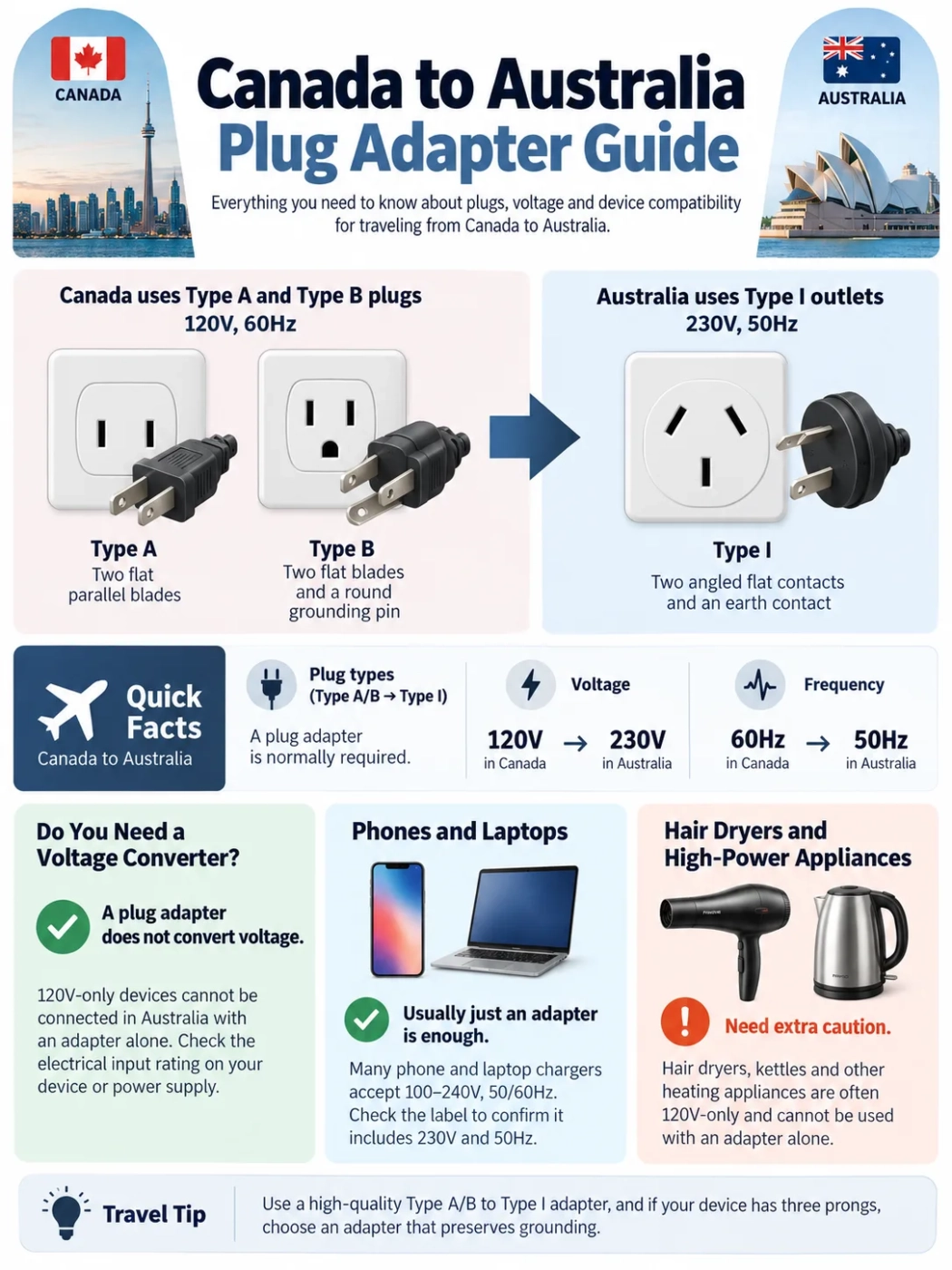
Canadian plugs do not fit Australian wall outlets directly. Canada mainly uses Type A and Type B plugs on a 120V, 60Hz supply, while Australia uses Type I outlets on a 230V, 50Hz supply. Travelers from Canada therefore normally need a Type A/B to Type I plug adapter. Many phone and laptop chargers need only the adapter because they accept Input: 100–240V, 50/60Hz, but 120V-only appliances need much more caution.
A plug adapter does not convert voltage. This matters more on a Canada-to-Australia trip than on routes where both countries use similar voltages. Before connecting any Canadian appliance in Australia, check the electrical input rating printed on the device or its power supply.
| Electrical detail | Canada | Australia | What it means for a Canadian traveler |
|---|---|---|---|
| Common plug types | Type A and Type B | Type I | A plug adapter is normally required |
| Standard voltage | 120V | 230V | 120V-only devices cannot be connected with an adapter alone |
| Frequency | 60Hz | 50Hz | Check equipment marked 60Hz only |
| Grounded plug | Type B | Grounded Type I | A three-prong Canadian device should use an adapter that preserves grounding |
| Modern chargers | Often 100–240V, 50/60Hz | Compatible when the label includes 230V and 50Hz | Usually an adapter is enough after checking the label |
| High-power 120V appliances | Common | 230V supply | Hair dryers, kettles and heating appliances require careful voltage checking |
How Canadian Plugs Connect to Australian Outlets
Canadian Type A plugs have two flat parallel blades. Type B adds a round grounding pin. Australian Type I uses two angled flat contacts, with an additional earth contact on grounded connections. The shapes are mechanically different, so a Canadian plug should not be forced into an Australian socket.
Actual outlet faces can vary slightly by manufacturer and installation. The electrical rating of the supply does not change with the appearance of the socket.
Type A plugs from Canada
A two-pin Canadian Type A plug needs an adapter that accepts the North American flat blades and connects to an Australian Type I outlet. Because Type A itself is normally ungrounded, there is no earth conductor to carry through the adapter.
The voltage still has to be checked separately. A Type A plug can be attached to anything from a universal-voltage phone charger to a 120V-only appliance, and those two devices have very different requirements in Australia.
Type B plugs and grounding
Canadian Type B plugs add a third pin for protective earth. If a device was designed to use that grounding connection, the travel adapter should carry the earth connection through to the Australian Type I outlet.
A three-prong plug fitting into an adapter does not prove that the adapter preserves grounding. Avoid relying on a two-pin adapter for equipment that has a three-prong Type B plug merely to make the plug fit.
This is especially relevant to equipment such as some laptop power cords, desktop computer equipment, monitors and other grounded appliances.
Polarized Type A plugs can also affect adapter choice
Some Canadian Type A plugs are polarized, with one flat blade wider than the other. An adapter intended for North American plugs should be able to accept that wider blade.
If a polarized Canadian plug does not enter an adapter normally, do not file, bend, trim or force the blade. Use an adapter designed to accept the plug correctly.
Why the 120V to 230V Difference Matters
Canada’s normal household supply is around 120V, while Australia’s is 230V. That difference means physical plug compatibility is only the first part of the decision.
A simple travel adapter changes the connection between the plug and socket. It does not reduce Australia’s 230V supply to 120V.
| Input label | Plug adapter | Voltage conversion | What to do |
|---|---|---|---|
| 100–240V, 50/60Hz | Yes | Normally no | Use a suitable Type I adapter |
| 110–240V, 50/60Hz | Yes | Normally no | The power supply covers Australia’s voltage and frequency |
| 120V, 50/60Hz | Yes | Required if the appliance itself cannot accept 230V | Do not connect directly through a simple adapter |
| 120V, 60Hz only | Yes | Voltage reduction may be required | Frequency compatibility also needs to be checked |
| 120/240V, 50/60Hz with selector | Yes | Normally no when set correctly | Set the device to its 220–240V position before use |
| No readable input rating | Possibly | Unknown | Do not assume compatibility |
Read the INPUT Rating Before You Plug In
The most useful information is normally printed on the charger, power brick, appliance label or rating plate. Look for the word INPUT.
What “Input: 100–240V” means
If a charger says INPUT: 100–240V and includes 50/60Hz, its power supply is designed to operate across both Canada’s and Australia’s normal mains systems. The remaining issue is the plug shape, so a Type I adapter is normally enough.
This wide-range input is common on modern switch-mode power supplies used for phones, tablets, laptops, cameras and similar electronics. Still, check the actual charger rather than assuming that every device has the same rating.
Do not confuse INPUT with OUTPUT
A charger may show an output such as 5V, 9V, 15V or 20V. That is the electricity delivered from the charger to the device. It does not tell you what wall voltage the charger can accept.
For Canada-to-Australia compatibility, the useful line is the one beginning with INPUT.
Devices with a manual voltage selector
Some older or travel-oriented appliances support both voltage ranges but require a physical switch to be moved between them. A label may show 120V/240V or a similar pair of ratings.
If the appliance has a manual selector, set it to the 220–240V position before connecting it to Australian mains power. A dual-voltage label does not protect the appliance if the selector remains in its 120V position.
Australia Uses 50Hz While Canada Uses 60Hz
Frequency is a separate electrical property from voltage. Canada uses 60Hz power, while Australia uses 50Hz.
Most modern electronic chargers marked 50/60Hz are designed for either frequency. That includes many phone chargers, USB-C power supplies, laptop adapters and camera battery chargers.
More care is needed when a device is marked 60Hz only. Equipment containing certain AC motors, mains-synchronized clocks, older transformers, pumps or timing systems can behave differently on 50Hz power.
A step-down transformer that changes 230V to 120V does not automatically change 50Hz to 60Hz. A device marked only for 120V, 60Hz therefore needs both its voltage requirement and its frequency requirement checked.
Phones, Tablets and USB Chargers
For many Canadian travelers, these are the easiest devices to use in Australia. A modern phone or USB charger that says 100–240V, 50/60Hz normally needs only a Type I plug adapter.
| Device | Adapter needed? | Converter normally needed? | What to check |
|---|---|---|---|
| Phone charger | Yes, if using a Canadian wall plug | Usually no | Input voltage and frequency |
| USB-C charger | Yes, unless it has an Australian plug | Usually no | Look for 100–240V, 50/60Hz |
| Tablet charger | Yes | Usually no | Charger input rating |
| Camera battery charger | Yes | Usually no | Input printed on the charger |
| Power bank | Not for its USB output | Not for the battery itself | Check the wall charger used to recharge it |
| Smartwatch charger | Depends on its wall power supply | Usually no | Wall adapter input rating |
A power bank itself does not care whether the wall socket is Type A or Type I when it is supplying power over USB. The relevant part is the charger used to recharge the power bank from the wall.
Laptop Chargers Often Have Two Good Options
Most modern laptop power bricks are designed for international use and commonly show an input range covering 100–240V and 50/60Hz. If yours does, the power brick normally does not need a voltage converter in Australia.
The simplest option for a short trip is usually a suitable Type I adapter. If the Canadian laptop cable uses a grounded Type B plug, use a grounded adapter rather than deliberately removing the earth connection.
A removable mains cable can eliminate the travel adapter
Many laptop power bricks use a detachable AC cable between the wall and the charger. Common equipment-side connectors include figure-8, cloverleaf and standard computer-style connectors.
If the power brick itself is marked for 100–240V, 50/60Hz, an Australian mains lead with the correct connector for that power brick can sometimes replace the Canadian wall cable entirely.
This approach can be convenient for a longer stay because there is no travel adapter hanging between the laptop cable and the wall. The replacement cable still needs the correct equipment-side connector and an appropriate electrical rating.
Hair Dryers and Styling Tools Need More Caution
Hair dryers, curling irons, hair straighteners and other heat-producing appliances should not be treated like phone chargers. Many consume far more power, and Canadian versions may be designed only for 120V.
120V-only hair dryers
If a Canadian hair dryer says only 120V, do not connect it directly to an Australian 230V outlet through a plug adapter.
The fact that the adapter fits does not make the appliance electrically compatible. High-power heating appliances can draw much more power than small chargers, so a compact converter intended for light electronics should not be assumed suitable.
Dual-voltage hair tools
A hair dryer, straightener or curling iron marked for a range that includes 230V may be usable with a Type I adapter. Some models switch voltage automatically; others have a manual selector.
Check both the voltage marking and the operating instructions. If the device has a voltage switch, it must be placed in the correct position before use.
Kettles, clothes irons and heating appliances
Canadian travel kettles, clothes irons, heating pads and similar appliances can also be 120V-only. Their high power draw makes them poor candidates for assuming that any small travel converter will solve the problem.
For a short trip, using equipment already designed for Australia’s 230V supply is often simpler than bringing a high-wattage 120V appliance and the conversion equipment needed to operate it.
Electric Shavers, Toothbrushes and Motor-Driven Devices
Small bathroom appliances vary more than many travelers expect. Some electric shavers and toothbrush chargers are designed for 100–240V international use, while others use narrower voltage ranges.
Check the base or power supply rather than the removable handpiece. A rechargeable device may operate from its internal battery while its charging stand has its own voltage limitation.
Motor-driven equipment marked 60Hz only deserves extra attention because Australia’s 50Hz frequency remains 50Hz even when a transformer reduces the voltage.
CPAP Machines and Other Medical Equipment
Many CPAP power supplies use wide-range inputs, but medical equipment should be checked individually. Read the rating on the external power supply and the manufacturer’s operating requirements.
If a CPAP power brick says 100–240V, 50/60Hz, the electrical supply is normally within that stated input range and a Type I adapter may be the only mains connection change required.
Do not assume compatibility for medical equipment when the input rating, grounding requirement or frequency requirement is unclear. Accessories such as heated humidifiers can also have requirements that differ from the main device.
Do Not Automatically Bring a Canadian 125V Power Strip
A common travel idea is to connect one Australian adapter to a Canadian power strip and then plug several familiar chargers into the strip. This only works safely if the power strip itself is rated for Australia’s supply.
If a Canadian power bar is marked only for 125V, it should not be treated as a 230V product simply because every charger connected to it supports 100–240V.
The rating of each part matters:
- the Australian wall outlet,
- the travel adapter,
- the power strip,
- any surge-protection circuitry,
- and every connected charger or appliance.
The wide-voltage rating of the devices connected to a power strip does not change the voltage rating of the power strip itself.
Canadian surge protectors deserve extra care
A surge protector is not merely an extension cord. Its protective components are designed around an intended mains system. A Canadian surge strip marked only for 120V or 125V should not be connected to Australian 230V power through a simple travel adapter.
For several phones, tablets and other USB devices, a power supply specifically rated for 100–240V can reduce the number of individual wall connections needed without relying on a 125V Canadian power bar.
Choosing a Canada-to-Australia Plug Adapter
The destination side of the adapter should be designed for an Australian Type I outlet. The input side needs to accept the Canadian plug you actually use.
For two-prong Type A devices
Choose an adapter that accepts North American flat blades, including a polarized plug if one blade is wider.
For three-prong Type B devices
Choose a grounded adapter that accepts the Type B grounding pin and provides a proper earth path through the Type I connection.
Check the electrical rating
The adapter itself must be suitable for use on Australia’s mains supply. Do not assume that every adapter accepting a Canadian plug has the same electrical rating or grounding design.
An adapter may also have a current limit. This is particularly relevant when connecting higher-power equipment. The appliance and adapter ratings both need to be suitable for the intended use.
Australian Wall Outlets May Have a Power Switch
Many Australian wall outlets have an individual on/off switch beside the socket. A Canadian traveler can plug in an adapter correctly and still get no power if the outlet switch remains off.
If a known-compatible charger is connected but does not start charging, check:
- whether the wall outlet is switched on,
- whether the travel adapter is fully seated,
- whether the charger is connected firmly,
- and whether the charger label actually covers 230V, 50Hz.
The wall switch does not change voltage; it simply controls power to the outlet.
Universal-Looking Hotel Sockets Do Not Remove the Voltage Issue
Some accommodation may provide USB ports or sockets designed to accept more than one plug shape. Availability varies, so a traveler should not rely on finding one.
Do not assume that a hotel’s universal-looking socket changes the voltage. A socket that physically accepts a Canadian Type A plug can still be connected to Australia’s 230V supply.
The device label remains the deciding factor. A universal-voltage phone charger may be fine, while a 120V-only appliance can still be unsuitable even when its plug fits the socket.
What to Pack Based on the Devices You Are Bringing
| What you are bringing | Practical power setup |
|---|---|
| Phone only | Type I adapter after confirming the charger supports 230V, 50Hz |
| Phone and tablet | Type I adapter with a compatible wide-voltage charger |
| Laptop with 100–240V power brick | Grounded Type I adapter if required, or a compatible Australian mains lead |
| Camera and battery chargers | Check each charger separately for 100–240V, 50/60Hz |
| Several USB-C devices | A wide-voltage multi-port charging setup can reduce the number of wall connections |
| Dual-voltage hair tool | Type I adapter plus the correct voltage setting if the device has a selector |
| 120V-only hair dryer | Do not use with a plug adapter alone |
| 125V Canadian power strip | Do not use on 230V unless its own rating explicitly permits it |
| 120V, 60Hz specialty equipment | Check both voltage and 50Hz compatibility before travel |
| CPAP or medical equipment | Verify the power supply label, grounding requirements and manufacturer instructions |
Common Canada-to-Australia Power Mistakes
Buying the adapter in the wrong direction
Travel adapters are often described by both origin and destination. A product intended for an Australian plug going into a Canadian outlet is the opposite of what a Canadian traveler needs in Australia.
The required direction is:
Canadian Type A/B plug → Australian Type I outlet
Thinking a plug adapter makes a 120V appliance safe
It does not. The adapter changes the plug connection, while the Australian outlet continues to supply 230V.
Using an ungrounded adapter with Type B equipment
A three-prong Canadian plug normally indicates that the equipment was designed with a protective earth connection. Do not intentionally remove that protection merely to make the plug fit.
Assuming a Canadian power strip is acceptable because the chargers are universal-voltage
Every item in the power chain needs its own suitable rating. A 100–240V laptop charger does not make a 125V power bar suitable for 230V.
Checking voltage but ignoring frequency
A transformer can reduce voltage without changing Australia’s 50Hz frequency. Equipment labeled 60Hz only needs separate frequency consideration.
Reading the charger OUTPUT line
The output rating describes what the charger supplies to the device. Look for the INPUT line to determine whether the charger can accept Australian mains power.
Forgetting the voltage selector on a dual-voltage appliance
A manually switched appliance can still be damaged if it remains set to 120V when connected to a 230V outlet.
Canada to Australia Device Decision Table
| Device marking | Type I adapter | Voltage issue | Frequency issue | Typical decision |
|---|---|---|---|---|
| 100–240V, 50/60Hz | Yes | No | No | Adapter normally enough |
| 120–240V, 50/60Hz | Yes | No | No | Adapter normally enough |
| 120V, 50/60Hz | Yes | Yes | Normally not | Do not connect directly to 230V |
| 120V, 60Hz | Yes | Yes | Potentially yes | Voltage and frequency both require checking |
| 120/240V selectable, 50/60Hz | Yes | No when correctly set | No | Set to the 220–240V range first |
| 125V-only power strip | Physical connection may be possible | Yes | Not the main concern | Do not use on Australian 230V mains |
FAQ
Do Canadians need a plug adapter in Australia?
Yes. Canada mainly uses Type A and Type B plugs, while Australia uses Type I outlets. A Canada-to-Australia Type I plug adapter is normally required.
Can I use my Canadian phone charger in Australia?
Usually, if the charger says Input: 100–240V, 50/60Hz. In that case, you normally need only a Type I plug adapter.
Can I use a Canadian laptop charger in Australia?
Many laptop power supplies accept 100–240V and 50/60Hz, so a voltage converter is often unnecessary. Check the input rating on the power brick. A grounded Canadian cable should remain grounded through the adapter.
Can I use a Canadian hair dryer in Australia?
Only if its voltage rating includes Australia’s 230V supply or it is correctly configured as a dual-voltage appliance. A 120V-only hair dryer should not be connected through a simple plug adapter.
Does a voltage converter change Australia’s 50Hz power to Canada’s 60Hz?
No. Ordinary voltage conversion and frequency conversion are different functions. Equipment marked 60Hz only needs its frequency compatibility checked separately.
Can I use my Canadian power strip in Australia?
Not if the strip itself is rated only for 120V or 125V. The fact that the chargers connected to it accept 100–240V does not make the power strip suitable for Australia’s 230V supply.