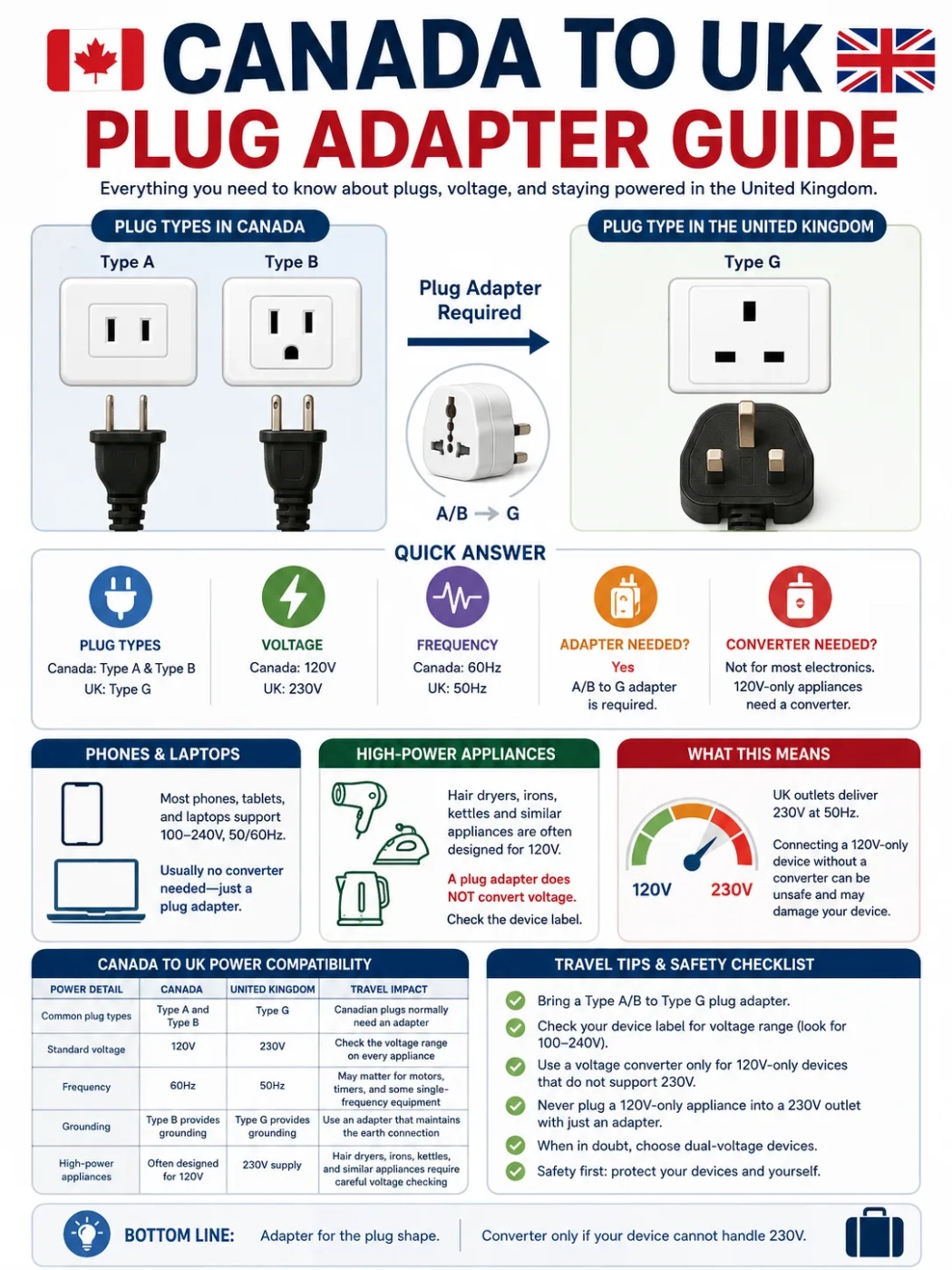
Canadian Type A and Type B plugs do not fit standard UK Type G sockets, so travelers from Canada will normally need a Type A/B-to-Type G plug adapter. The larger issue is voltage: Canada commonly uses 120V at 60Hz, while the United Kingdom uses 230V at 50Hz. Many phone and laptop chargers handle both systems, but 120V-only appliances need extra attention. A plug adapter does not convert voltage.
| Power detail | Canada | United Kingdom | Travel impact |
|---|---|---|---|
| Common plug types | Type A and Type B | Type G | Canadian plugs normally need an adapter |
| Standard voltage | 120V | 230V | Check the voltage range on every appliance |
| Frequency | 60Hz | 50Hz | May matter for motors, timers, and some single-frequency equipment |
| Grounding | Type B provides grounding | Type G provides grounding | Grounded equipment should use an adapter that maintains the earth connection |
| High-power appliances | Often designed for 120V | 230V supply | Hair dryers, irons, kettles, and similar appliances require careful voltage checking |
Canada and UK Plug Compatibility
Real plugs and wall sockets can look slightly different depending on the manufacturer and installation. The shape of the socket only tells you whether the plug physically fits. Voltage, frequency, and grounding must be checked separately.
Why the 120V to 230V Difference Matters
The electrical change between Canada and the UK is larger than the change in plug shape. A mechanical travel adapter can make a Canadian plug fit a Type G socket, but the connected device will still receive the UK supply voltage.
This is normally straightforward for modern electronics with universal power supplies. It can be unsafe for a Canadian appliance designed only for 120V.
Do not connect a device marked only for 120V to a normal 230V UK outlet through a simple plug adapter.
The safest way to decide is to ignore the appearance of the device and read the electrical label on the charger, power supply, or appliance itself.
Read the Input Label Before Connecting Your Device
Look for a line marked INPUT, Input, or electrical ratings near the power cable, charger, power brick, or underside of the appliance.
If the label says “Input: 100–240V, 50/60Hz”
A rating such as Input: 100–240V, 50/60Hz means the power supply is designed to operate across both Canadian and UK voltage and frequency ranges. In this situation, a Type G plug adapter is normally all that is needed.
This type of wide-range input is common on many modern phone chargers, laptop power supplies, tablet chargers, camera chargers, and USB power adapters.
If the label says “120V”
A device marked only for 120V should not be treated as UK-compatible simply because an adapter makes the plug fit. The UK supply is around 230V, so a suitable voltage conversion solution would be required if the appliance is to be used at all.
For many high-power travel appliances, replacing the appliance with a UK-compatible or dual-voltage version can be simpler than carrying a large transformer.
If the label shows a voltage range
Check whether 230V falls inside the stated range. A label such as 110–240V or 100–240V covers the UK supply. A range that ends below 230V does not.
If the device has a 120V/240V selector
Some dual-voltage hair tools and older travel appliances use a manual voltage switch. The switch must be set to the appropriate higher-voltage position before connection to a UK outlet. Follow the markings and instructions supplied with the device rather than guessing from the plug.
Which Adapter Should You Take From Canada?
The destination side of the adapter should be Type G. On the device side, it should accept the Canadian plug you plan to use.
For a two-prong Type A plug
A Canada-to-UK adapter that accepts Type A and connects to a Type G outlet is normally sufficient when the device itself supports 230V.
For a three-prong Type B plug
Choose an adapter that accepts the full Type B plug and maintains grounding where the connected equipment requires it. Removing or bypassing the grounding connection is not an appropriate substitute.
A generic “European” adapter is not necessarily the right choice. Much of continental Europe uses round-pin plug systems, while the United Kingdom uses the three-rectangular-pin Type G system.
Phones, Laptops, Cameras, and USB Chargers
Modern charging equipment is generally the easiest category for Canadian travelers because many power supplies already support a wide input range.
| Device | What to check | Typical travel solution |
|---|---|---|
| Phone charger | Look for 100–240V and 50/60Hz | Type G adapter if the charger supports UK voltage |
| Laptop charger | Read the input rating on the power brick | Often adapter only when rated for 100–240V |
| Tablet or e-reader charger | Check the charger rather than only the device | Usually adapter only with universal input |
| Camera battery charger | Input voltage and frequency | Adapter only if the charger covers 230V and 50Hz |
| USB-C charger | AC input rating and port output | Type G adapter if AC input is UK-compatible |
| Portable game console charger | Power supply input range | Often adapter only when using a universal-input charger |
USB wattage and AC input voltage are different specifications. A charger may advertise 30W, 65W, 100W, or another USB output while still accepting 100–240V AC. Check both pieces of information for the job they describe.
Hair Dryers and Other High-Power Canadian Appliances
Hair dryers, curling irons, straighteners, kettles, clothes irons, and other heating appliances deserve more attention than ordinary USB electronics. Canadian versions are often designed around a 120V supply, and these devices can draw substantial power.
A Type G adapter alone is not enough for a 120V-only hair dryer or heating appliance.
Hair dryers
Check for a dual-voltage marking such as 120/240V or a range that includes 230V. If the dryer is marked only 120V, do not connect it directly to a UK outlet through a basic adapter.
Curling irons and hair straighteners
Some models are dual voltage and others are not. A device that supports 100–240V may only need the plug adapter. A 120V-only styling tool needs another solution.
Kettles and clothes irons
These are high-wattage appliances, making voltage conversion less convenient for travel. A transformer must be able to handle the appliance’s actual load, not merely change the plug shape.
Does a Voltage Converter Solve a 120V Device Problem?
A suitable step-down transformer can reduce the UK supply from around 230V to a voltage suitable for some 120V equipment. That does not mean every Canadian appliance becomes suitable for UK use.
The converter or transformer must be rated for the connected load. High-wattage appliances may require equipment that is heavy and impractical for ordinary travel.
Frequency is also separate. A standard voltage transformer does not normally convert 50Hz into 60Hz. A device that depends on 60Hz for a motor, clock, timer, or other internal function may still require further checking even when its voltage has been reduced.
The 60Hz to 50Hz Change
Canada commonly operates at 60Hz, while the UK operates at 50Hz. Many electronic power supplies are marked 50/60Hz, so the frequency change causes no special travel problem for those chargers.
Extra care is appropriate when a Canadian device is marked only 60Hz. Frequency can affect some AC motors, timing systems, pumps, and older electrical equipment.
A label showing both 50/60Hz provides a clear indication that the manufacturer designed the power input for either frequency. If only 60Hz appears, check the device instructions before use.
Grounded Canadian Equipment Needs the Right Adapter
Canadian Type B plugs use a third contact for grounding. UK Type G outlets also provide an earth connection, but the travel adapter must carry that connection through correctly.
If a laptop power supply, medical device, appliance, or other piece of equipment has a three-prong Type B plug, choose an adapter designed to accept that grounded plug rather than forcing it into an ungrounded two-pin solution.
Physical plug compatibility does not guarantee grounding continuity.
Canadian Power Strips and Surge Protectors Need Separate Checking
Using one UK adapter with a Canadian power strip may look convenient, but the strip itself is another electrical device. Its voltage rating, grounding arrangement, surge-protection circuitry, current limit, and total connected load all matter.
A Canadian power strip or surge protector marked only for 120V should not be assumed safe on a 230V UK supply. Connecting only dual-voltage chargers to it does not automatically make the strip itself compatible.
Travelers carrying several phones, tablets, and USB-C devices may find it simpler to use a power solution designed for the UK supply rather than building a chain of adapters and North American power strips.
What UK Wall Sockets Can Look Like in Practice
Standard UK Type G wall outlets use three rectangular contacts. Many wall sockets also have their own on/off switch. If a connected charger appears to have no power, check whether the socket switch is turned on before assuming the adapter has failed.
Hotels may provide USB charging ports or multi-standard sockets in addition to normal Type G outlets. Availability varies between properties.
Do not assume that a hotel’s universal-looking socket changes the voltage. The supply behind it may still be the normal UK 230V system.
Bathroom shaver sockets also deserve separate attention. They are intended for limited bathroom use and should not automatically be treated as ordinary power outlets for general appliances. Follow the voltage and device markings shown at the socket.
One Type G Adapter Covers the UK
Travelers do not need different plug adapters for England, Scotland, Wales, and Northern Ireland. Type G is the standard plug system across the United Kingdom, with the same 230V, 50Hz electrical environment relevant to normal traveler device checks.
A Canada-to-Type G adapter that is suitable for your equipment can therefore be used for trips that include London, Edinburgh, Cardiff, Belfast, and other UK destinations.
CPAP Machines and Other Medical Equipment
Many modern CPAP power supplies and other electronic medical-device adapters are designed for international input ranges, but this must be confirmed on the exact power supply being used.
Check the AC input label for voltage and frequency, verify the plug and grounding requirements, and follow the device manufacturer’s operating instructions. Do not assume that a voltage converter is suitable for medical equipment simply because its output voltage appears correct.
If the power supply states 100–240V, 50/60Hz, the electrical input is normally suitable for both Canadian and UK mains systems, leaving the Type G plug connection as the main travel issue.
A Practical Device Check Before You Plug In
The Canada-to-UK decision can be made by checking the device in this order:
- Plug: Canadian Type A or B normally needs a Type G adapter.
- Voltage: confirm that the input range includes 230V.
- Frequency: look for 50Hz or 50/60Hz support.
- Grounding: preserve the earth connection when the original plug uses one.
- Power rating: make sure the adapter or transformer is suitable for the connected load.
- High-power appliances: give extra attention to hair dryers, styling tools, kettles, irons, and heating equipment.
What to Pack for a Canada-to-UK Trip
For a traveler carrying a phone, laptop, tablet, camera charger, and other modern electronics marked for 100–240V, the main item is normally a reliable Type G travel adapter that accepts the plugs being carried.
If you are bringing a grounded Type B device, the adapter should maintain grounding. If several USB devices need charging, check whether your existing charger supports 230V before packing multiple separate charging bricks.
Think twice before packing 120V-only heating appliances. The voltage difference often makes these devices less convenient than ordinary electronics, particularly when a high-capacity transformer would otherwise be required.
Common Canada-to-UK Power Mistakes
- Buying a continental European round-pin adapter instead of a UK Type G adapter.
- Assuming that an adapter changes 230V into 120V.
- Checking the plug shape but not the voltage label.
- Using a 120V-only Canadian hair dryer on a UK outlet.
- Assuming every hotel room provides universal sockets.
- Using an ungrounded adapter with equipment that has a grounded Type B plug.
- Connecting a Canadian 120V power strip to a UK outlet without checking the strip itself.
- Ignoring the 60Hz-to-50Hz difference on frequency-sensitive equipment.