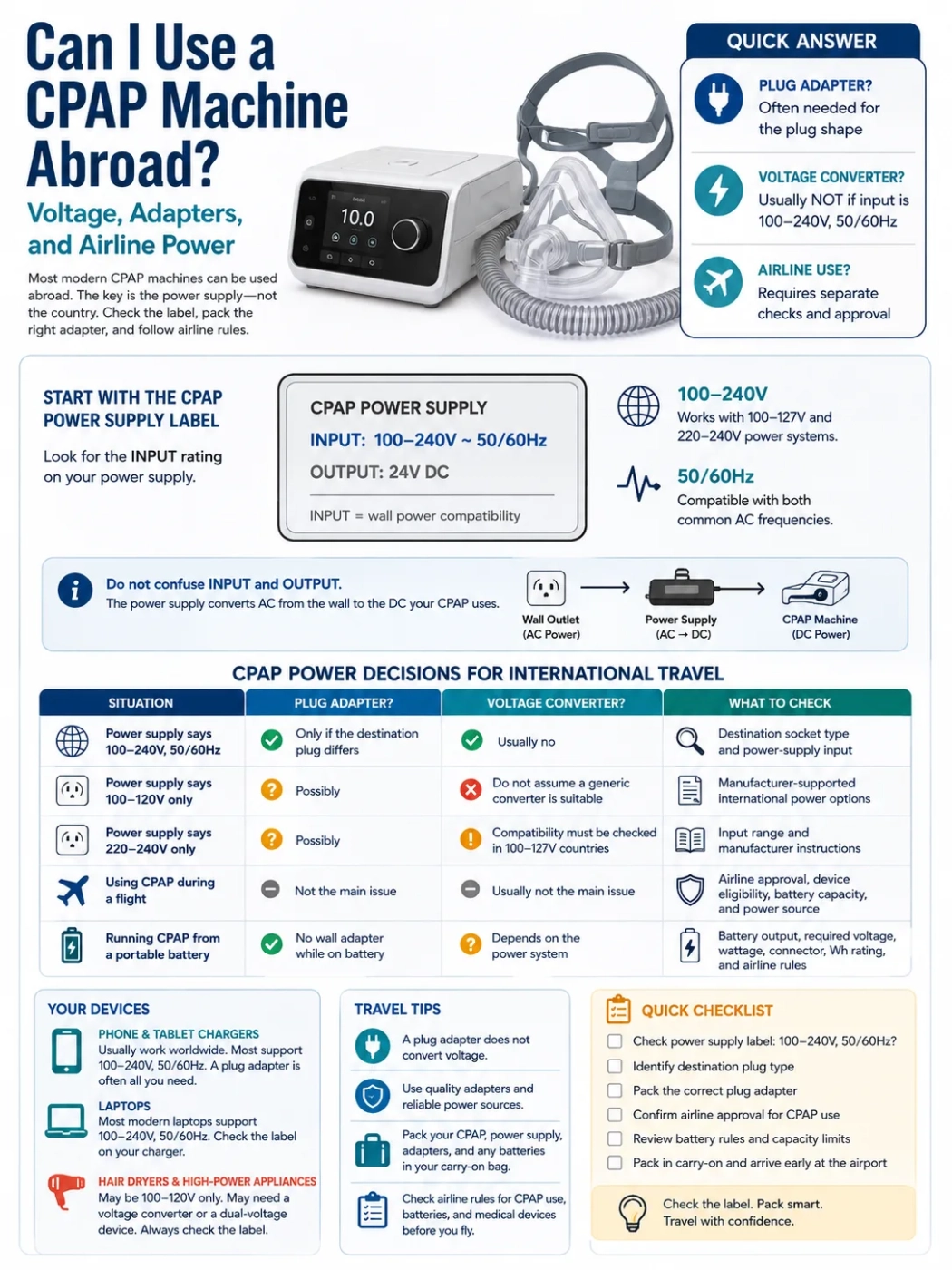
Most modern CPAP machines can be used abroad, but the answer depends on the power supply rather than the country alone. Check the adapter or power brick for Input: 100–240V, 50/60Hz. If you see that range, the power supply is designed for both common international voltage systems and usually needs only the correct plug adapter. A plug adapter does not convert voltage. Airline use requires a separate check because carrying a CPAP, operating it during a flight, using seat power, and carrying lithium batteries are different issues.
| Situation | Plug Adapter? | Voltage Converter? | What to Check |
|---|---|---|---|
| Power supply says 100–240V, 50/60Hz | Only if the destination plug differs | Usually no | Destination socket type and power-supply input |
| Power supply says 100–120V only | Possibly | Do not assume a generic converter is suitable | Manufacturer-supported international power options |
| Power supply says 220–240V only | Possibly | Compatibility must be checked in 100–127V countries | Input range and manufacturer instructions |
| Using CPAP during a flight | Not the main issue | Usually not the main issue | Airline approval, device eligibility, battery capacity, and power source |
| Running CPAP from a portable battery | No wall adapter while on battery | Depends on the power system | Battery output, required voltage, wattage, connector, Wh rating, and airline rules |
Start With the CPAP Power Supply Label
The most useful piece of information is usually printed on the CPAP power supply rather than on the front of the machine. Look for a line beginning with INPUT.
What “Input: 100–240V” Means
A rating such as Input: 100–240V means the power supply can normally accept electricity across the two voltage ranges travelers commonly encounter: approximately 100–127V and 220–240V.
If the same label also states 50/60Hz, the power supply is designed for both common AC frequencies. That removes another common international compatibility problem.
For example, a CPAP power supply rated 100–240V, 50/60Hz can normally accept a 120V/60Hz supply and a 230V/50Hz supply without a separate voltage converter. The physical plug may still need an adapter.
Do Not Confuse Input and Output Voltage
A CPAP power brick may say something such as Output: 24V DC. That does not mean you need a 24V hotel outlet.
The sequence is:
For international travel, the INPUT rating determines whether the power supply can accept the local mains voltage. The output rating tells you what the adapter supplies to the CPAP.
When a Plug Adapter Is Enough
If your CPAP power supply accepts 100–240V, 50/60Hz, international travel usually becomes a plug-shape problem rather than a voltage problem.
Suppose a traveler has a CPAP with a North American plug and a 100–240V power supply. In a destination using a different socket type, the traveler normally needs a compatible travel plug adapter between the CPAP plug and the wall outlet.
The adapter changes the physical connection. It does not change the electricity.
A plug adapter does not convert voltage. That is safe only when the CPAP power supply itself accepts the destination voltage.
| CPAP Power Supply | Destination Supply | Likely Decision |
|---|---|---|
| 100–240V, 50/60Hz | 230V, 50Hz | Check plug type; a voltage converter is usually unnecessary |
| 100–240V, 50/60Hz | 120V, 60Hz | Check plug type; a voltage converter is usually unnecessary |
| 100–120V only | 230V, 50Hz | Do not connect it through a basic plug adapter alone |
| 220–240V only | 120V, 60Hz | Verify the approved power arrangement before travel |
When the CPAP Is Not Dual Voltage
A single-voltage CPAP power supply requires more care. If the label accepts only 100–120V and the destination supplies around 220–240V, a simple mechanical travel adapter is not enough.
Do not connect a 120V-only CPAP power supply directly to a 230V outlet unless the equipment is specifically designed for that voltage.
A generic voltage converter should not automatically be treated as the preferred solution for medical equipment. Check whether the CPAP manufacturer provides an international power supply, approved DC converter, or another supported power arrangement for the exact machine.
The same caution applies in the opposite direction. A device designed only for 220–240V may not operate correctly from a 100–127V supply.
Does 50Hz vs 60Hz Matter for a CPAP?
The frequency question is usually simple when the power supply says 50/60Hz. That marking means the adapter is intended for either frequency.
If only one frequency appears on the label, do not assume the device will behave normally on the other. Check its technical instructions before relying on it abroad.
This is another reason the exact label matters more than broad statements such as “CPAP machines are dual voltage.” Many modern units have wide-range power supplies, but individual equipment can differ.
Universal Travel Adapters and CPAP Machines
A universal travel adapter can be useful when a CPAP already has a wide-range 100–240V power supply and the adapter supports the socket type at the destination.
It should still be treated as a plug interface, not as proof of electrical compatibility.
- Confirm that the CPAP power supply accepts the destination voltage.
- Confirm that the universal adapter supports the local socket type.
- Do not assume the adapter’s USB ports can power the CPAP.
- Do not defeat a required grounding connection just because an ungrounded adapter physically fits.
- Avoid a loose connection that leaves a heavy power brick hanging from the wall.
USB-A or USB-C ports built into a travel adapter are separate power outputs. They should be used for a CPAP only when the CPAP manufacturer supports that specific type of connection and the required voltage, wattage, and power-delivery profile are available.
Hotel Power Can Cause Problems Even When the Voltage Is Correct
A CPAP can be electrically compatible with the country and still be inconvenient to use in a hotel room.
No Useful Outlet Near the Bed
Check the room before bedtime. The nearest usable socket may be behind furniture or far from the bedside table. If an extension arrangement is needed, it should be suitable for the device and local power system rather than improvised at the last moment.
Room Power Controlled by a Key Card
Some hotel electrical systems switch parts of the room off when the guest key is removed. Verify that the outlet intended for the CPAP remains powered when you expect to use it.
Bathroom Shaver Sockets
Do not treat a bathroom outlet marked for shavers as an ordinary general-purpose socket. Such outlets can have different load limits and electrical arrangements from normal room outlets.
Universal-Looking Hotel Sockets
A multi-standard socket can accept several plug shapes, but it does not change the building’s supply voltage. A 120V-only CPAP power supply does not become 230V-compatible because its plug fits a universal-looking outlet.
Carrying a CPAP and Using It on a Plane Are Separate Issues
Being permitted to bring a CPAP into the cabin does not automatically mean it can be operated throughout the flight.
Before a flight where CPAP use is needed, check the operating airline’s requirements for:
- CPAP or portable electronic medical device acceptance
- Any required compliance marking or documentation
- Advance notice requirements
- Whether the device can be operated during the flight
- Battery quantity and capacity requirements
- Rules that apply during taxi, takeoff, and landing
This is especially important on codeshare itineraries. The airline that actually operates the aircraft may apply the relevant onboard equipment rules.
Do Not Depend on the Seat Outlet as Your CPAP Power Plan
Some aircraft seats provide AC or USB power. Availability alone does not make that power suitable for continuous medical-device use.
Seat outlets may be absent, disabled, limited in power, unavailable during part of the flight, or not intended to support passenger medical equipment.
If CPAP use is required during the flight, plan around an airline-accepted independent power source rather than assuming the seat outlet will be available.
A CPAP described as suitable for aircraft use is also not the same thing as guaranteed aircraft power. Device approval concerns whether it may be operated in the aircraft environment. It does not guarantee a working electrical outlet at your seat.
CPAP Batteries, Power Banks, and Portable Power Stations
Portable power products that look similar can fall into different practical and airline categories.
| Power Source | Typical Connection | Main Compatibility Check |
|---|---|---|
| Dedicated CPAP battery | Model-compatible DC or approved connection | Machine compatibility, runtime, Wh rating, airline acceptance |
| USB-C power bank | USB-C PD | Required PD voltage, wattage, cable, CPAP support, Wh rating |
| General USB power bank | USB-A or USB-C | Usually unsuitable unless the CPAP specifically supports the output |
| Portable power station | AC outlet or DC output | Output compatibility, battery chemistry, capacity, size, and airline restrictions |
A battery advertised as 20,000 mAh should not automatically be treated as a CPAP battery. The CPAP must receive the correct voltage and sufficient power through a compatible connection.
A cable that physically fits the machine is not proof that the electrical output is correct.
Why Watt-Hours Matter for Air Travel
Airline battery limits are normally easier to evaluate using watt-hours (Wh) than a marketing capacity stated only in milliamp-hours.
The basic relationship is:
Wh = V × Ah
If a battery label already lists Wh, use that value when checking airline rules. Do not estimate CPAP runtime solely from the printed mAh number because conversion losses, battery voltage, CPAP load, humidification, and other operating conditions affect usable runtime.
Power Banks Have Become More Restricted
Current international air-transport guidance treats power banks more strictly than many travelers expect. Power banks are generally subject to a 100 Wh ceiling per unit under current passenger guidance, with tighter controls on how many may be carried and when they may be used or charged onboard.
A battery built specifically for a portable medical electronic device can be treated differently from a general-purpose power bank, depending on its classification, capacity, airline policy, and route.
Do not rely only on wording such as “airline approved” printed in advertising. Check the battery’s Wh rating and how the operating airline classifies it.
How Much Battery Runtime Might a Flight Require?
For flights covered by U.S. disability air-travel rules, an airline may require a passenger using a qualifying respiratory assistive device such as a CPAP to carry enough fully charged batteries to operate it for at least 150% of the expected maximum flight duration.
This is not necessarily the same as multiplying the scheduled gate-to-gate time. The airline’s expected maximum duration can account for additional operating time and possible delays.
| Expected Maximum Flight Duration | 150% Powered Duration |
|---|---|
| 6 hours | 9 hours |
| 8 hours | 12 hours |
| 10 hours | 15 hours |
| 12 hours | 18 hours |
If one approved battery is rated by its manufacturer for 10 hours under the intended CPAP configuration and the required powered duration is 12 hours, one battery would not provide the required rated duration. Battery calculations should use the manufacturer’s applicable runtime information rather than an optimistic estimate.
Humidifiers and Heated Tubes Can Change Battery Runtime
CPAP battery life is not a fixed number. Runtime can change with the CPAP model, pressure settings, battery condition, humidification, heated tubing, environmental conditions, and the way power is converted.
A battery that lasts through a night with one setup may provide less runtime when additional powered accessories are used.
For air travel or an overnight stay where backup power matters, use runtime information that applies to the same configuration you expect to use. Medical settings should not be changed merely to meet an electrical travel target without appropriate clinical guidance.
AC Power and DC Power Are Different Travel Options
A battery system can sometimes power a CPAP in more than one way.
One arrangement may be:
Battery → AC inverter → CPAP AC power supply → CPAP
Another machine may support a manufacturer-approved DC arrangement:
Battery or vehicle DC source → approved DC converter → CPAP
These should not be treated as interchangeable. The supported voltage, polarity, connector, wattage, and conversion hardware depend on the CPAP.
Never assume that a third-party DC cable is safe simply because its connector fits the machine.
CPAP vs Other Travel Devices
CPAP power planning is different from both ordinary chargers and high-power heating appliances.
Many modern phone chargers, laptop chargers, camera chargers, and USB power supplies accept 100–240V, 50/60Hz, so travelers often need only a plug adapter.
Hair dryers, curling irons, kettles, clothes irons, and other heat-producing appliances are more likely to be single voltage or draw much more power. They should never be used as evidence that a CPAP will or will not work on the same outlet.
The CPAP should be evaluated from its own power-supply label and supported accessories.
Build the Travel Setup Around the Parts That Can Fail
- Pack the original CPAP power supply unless a supported travel alternative is being used.
- Check the destination’s socket type before departure.
- Carry the correct plug adapter if the CPAP plug will not fit.
- Photograph the CPAP model label and power-supply INPUT label.
- Verify that any backup battery supplies the exact power arrangement your CPAP requires.
- Check the battery’s Wh rating before flying.
- Check the operating airline’s CPAP and lithium-battery requirements before a flight where onboard use matters.
- Do not make seat power the only source available for required in-flight use.
- For multi-country trips, check each destination’s plug type even if the CPAP remains voltage-compatible throughout the trip.
One CPAP Can Need Different Plug Adapters on the Same Trip
A wide-range CPAP power supply can remain electrically compatible while the physical socket changes from country to country.
For example, a trip that passes through the United Kingdom and continental Europe can involve different plug shapes even though both locations commonly use mains voltage within the range accepted by a 100–240V CPAP power supply.
The lesson is simple: voltage compatibility can stay the same while plug compatibility changes.
A multi-country itinerary should therefore be checked by both socket type and voltage rather than by voltage alone.
If the CPAP Does Not Power On Abroad
The Adapter Fits but Nothing Happens
Start with the simple points: confirm that the wall outlet is live, the room power is active, the plug adapter is fully seated, the CPAP power supply is connected correctly, and its INPUT range includes the local voltage.
The CPAP Works on Wall Power but Not on a Battery
Check the battery output, required CPAP input voltage, wattage capability, cable or converter compatibility, and whether the CPAP supports that power method.
The Aircraft Outlet Keeps Switching Off
Do not treat repeated seat-power interruptions as a CPAP fault. Aircraft outlets can have power limits or operating restrictions. Use the independent power arrangement approved for the trip rather than relying on an unstable outlet.
The Plug Adapter Becomes Hot or Loose
Stop using an adapter that sparks, smells abnormal, becomes unusually hot, shows damage, or cannot maintain a secure connection.
CPAP Abroad Power Decision
1. Does the power supply say 100–240V, 50/60Hz?
If yes, voltage conversion is usually unnecessary. Check the destination plug type. If no, verify an approved international power arrangement before connecting the machine.
2. Does your plug fit the destination socket?
If not, use a suitable plug adapter. Remember that the adapter changes plug shape, not voltage.
3. Will the CPAP be used during a flight?
If yes, check the operating airline’s device-use requirements and plan an independent battery supply rather than assuming seat power will be available.
4. Are lithium batteries part of the setup?
Check the Wh rating, battery classification, quantity limits, cabin rules, and airline-specific restrictions before departure.
5. Are you using a humidifier, heated tube, DC converter, or nonstandard power cable?
Base the power plan on that exact configuration rather than on a generic CPAP runtime estimate.
Frequently Asked Questions
Do I need a voltage converter for my CPAP abroad?
Usually not if the CPAP power supply says Input: 100–240V, 50/60Hz. You may still need a plug adapter for the destination’s socket type.
Can I plug a CPAP into a 220V or 230V outlet?
Yes, if its power supply input range includes that voltage. A power supply marked 100–240V is normally designed for a 220–240V supply. A 120V-only unit should not be connected through a basic plug adapter alone.
Can I use a universal travel adapter with a CPAP?
It can provide physical plug compatibility when it supports the local socket type. The CPAP power supply must still accept the destination voltage, and required grounding should not be lost.
Can I run my CPAP from the airplane seat outlet?
Possibly on some aircraft, but seat power should not be assumed to be available, reliable, or approved for the intended use. If CPAP operation is required during the flight, check the airline’s rules and prepare an accepted independent power source.
Can a normal power bank run a CPAP?
Only when the power bank provides the voltage, wattage, connector, and power-delivery method supported by that CPAP. A high mAh number alone does not establish compatibility.
How many CPAP batteries should I take on a flight?
It depends on required runtime, each battery’s rated operating time, its Wh rating, and the operating airline’s rules. Some U.S.-covered flights may require enough battery capacity for 150% of the expected maximum flight duration.