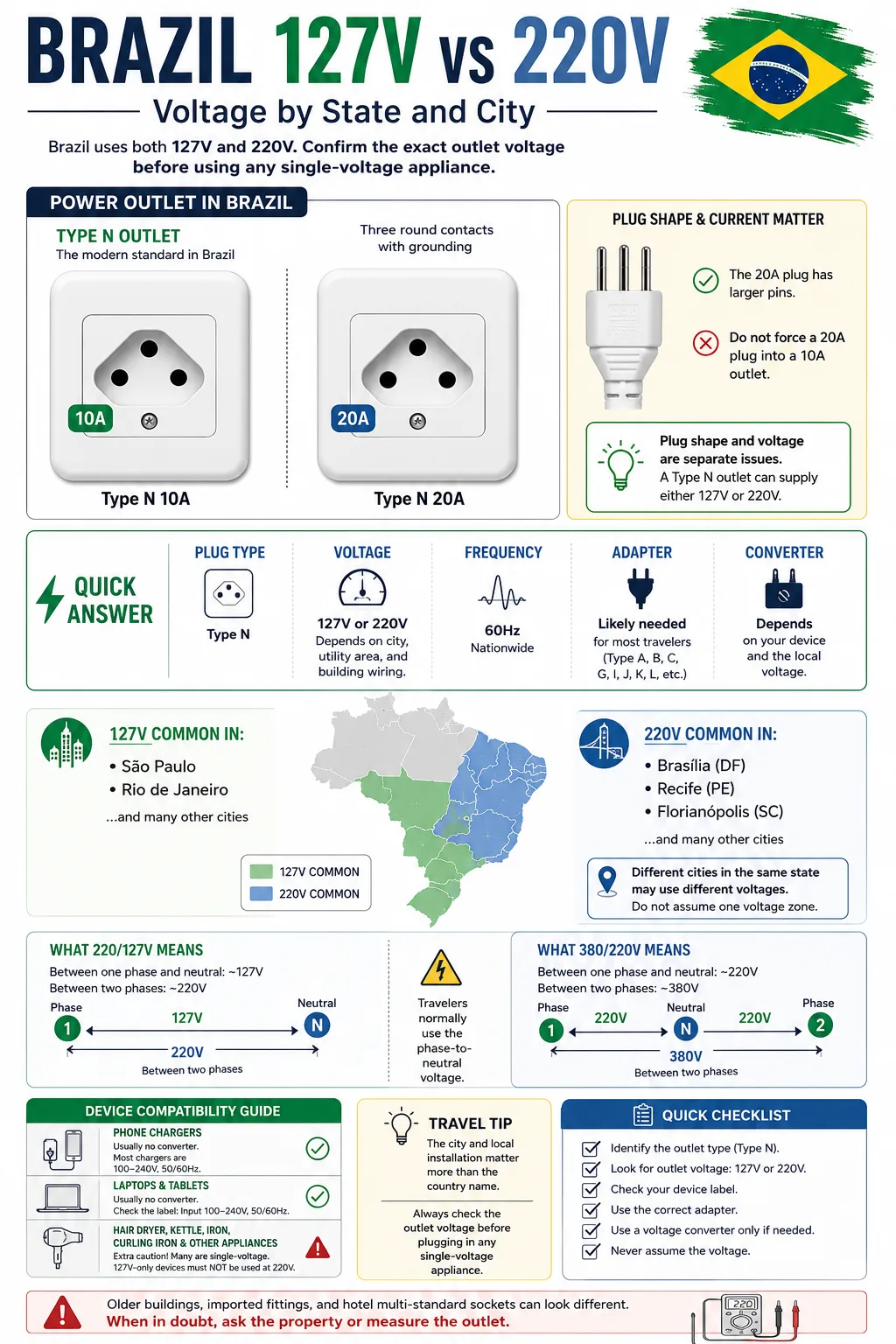
Brazil uses both 127V and 220V. The frequency is 60Hz nationwide, and the modern national socket is Type N, but the voltage at a regular wall outlet can change by city, utility area, and building wiring. São Paulo and Rio de Janeiro commonly use 127V outlets, while Brasília, Recife, and Florianópolis commonly use 220V. Confirm the exact outlet voltage before using a hair dryer, curling iron, kettle, iron, or any other single-voltage appliance.
| Travel power detail | Brazil | What it means for a traveler |
|---|---|---|
| Modern socket standard | Type N | A plug adapter is likely if your plug is Type A, B, G, I, J, K, L, or another incompatible shape. |
| Wall-outlet voltage | 127V or 220V | The city and local installation matter more than the country name alone. |
| Frequency | 60Hz | Most chargers marked 50/60Hz work normally. Some motors, clocks, and timing-based devices need a closer check. |
| Everyday term | “110V” usually refers to 127V | Use the printed device rating and the confirmed outlet voltage rather than relying on casual wording. |
| Voltage converter | Depends on the device and city | A charger marked Input: 100–240V, 50/60Hz usually needs no converter. A 127V-only appliance must not be connected to 220V. |
| Main local complication | Different cities in one state may use different voltages | Salvador and Porto Seguro, or Porto Alegre and Gramado, should not be treated as one voltage zone. |
What the Power Outlets Look Like
Type N has two main round contacts and a round grounding contact. Brazil uses 10A and 20A versions; the larger 20A plug is not meant to be forced into a 10A outlet. Older buildings, imported fittings, and hotel multi-standard sockets can look different. Plug shape and voltage are separate issues. A Type N outlet can supply either 127V or 220V.
Two-pin plugs associated with Type C may be usable in some Brazilian outlets, but grounded equipment needs a connection that preserves grounding. A mechanical fit does not prove that grounding, current rating, or voltage is suitable.
Why a Brazil Voltage Map Needs City-Level Checks
Brazil has one national frequency but not one national household voltage. Local distribution systems developed under different network arrangements, and current utility standards still include both 220/127V and 380/220V service. Changing every existing neighborhood to one voltage would involve transformers, building wiring, meters, protection equipment, and a large number of appliances.
A state label is therefore a planning reference rather than a guarantee. The capital may use 127V while another tourist city in the same state uses 220V. A hotel may also have 127V general outlets and separate 220V circuits for air conditioning, electric showers, or other high-load equipment.
What 220/127V means
In a 220/127V network, the voltage between one phase and neutral is about 127V, while the voltage between two phases is about 220V. Regular room outlets are commonly wired for 127V, but the property may also contain 220V circuits.
What 380/220V means
In a 380/220V network, the voltage between one phase and neutral is about 220V, while the phase-to-phase voltage is about 380V. A traveler normally encounters the 220V phase-to-neutral supply at an ordinary outlet, not a 380V industrial connection.
Brazil Voltage by State and Capital
The table uses the capital as the first travel reference. It does not claim that every municipality in the state uses the same outlet voltage. States with known city-level variation are marked for an extra check.
| Region | State or federal district | Capital | Common outlet voltage | State-level travel note |
|---|---|---|---|---|
| North | Acre | Rio Branco | 127V | 127V is the normal planning reference; confirm remote accommodation directly. |
| North | Amapá | Macapá | 127V | 220/127V distribution makes 127V common at phase-to-neutral outlets. |
| North | Amazonas | Manaus | 127V | Use 127V as the city reference; verify lodges and remote-area systems separately. |
| North | Pará | Belém | 127V | Belém and Santarém commonly use 127V; dedicated 220V circuits may still exist. |
| North | Rondônia | Porto Velho | 127V commonly; verify address | Local utility networks include more than one secondary configuration. |
| North | Roraima | Boa Vista | 127V | Confirm the property before using a single-voltage high-power appliance. |
| North | Tocantins | Palmas | 220V | Travelers with 120V-only appliances need extra caution. |
| Northeast | Alagoas | Maceió | 220V | Resort areas such as Maragogi also commonly use 220V. |
| Northeast | Bahia | Salvador | 127V | Mixed state: Porto Seguro, Lençóis, and Cairu commonly use 220V. |
| Northeast | Ceará | Fortaleza | 220V | Fortaleza and Jericoacoara are normally treated as 220V destinations. |
| Northeast | Maranhão | São Luís | 220V | Standard traveler planning should assume 220V unless the property states otherwise. |
| Northeast | Paraíba | João Pessoa | 220V | 220V is the normal city reference. |
| Northeast | Pernambuco | Recife | 220V | Recife and Porto de Galinhas commonly use 220V. |
| Northeast | Piauí | Teresina | 220V | 220V is the normal capital reference. |
| Northeast | Rio Grande do Norte | Natal | 220V | Natal and major coastal visitor areas commonly use 220V. |
| Northeast | Sergipe | Aracaju | 127V | Use 127V as the city reference, but check the exact installation. |
| Central-West | Federal District | Brasília | 220V | A 120V-only appliance must not be connected with only a plug adapter. |
| Central-West | Goiás | Goiânia | 220V | 220V is the normal city reference. |
| Central-West | Mato Grosso | Cuiabá | 127V | Utility configurations can vary; hotels should be checked directly. |
| Central-West | Mato Grosso do Sul | Campo Grande | 127V | Campo Grande and Bonito are commonly treated as 127V destinations. |
| Southeast | Espírito Santo | Vitória | 127V | Check the municipality and property when traveling outside Greater Vitória. |
| Southeast | Minas Gerais | Belo Horizonte | 127V | Many buildings also have dedicated 220V circuits for high-load equipment. |
| Southeast | Rio de Janeiro | Rio de Janeiro | 127V | Mixed state: some municipalities and individual circuits use 220V. |
| Southeast | São Paulo | São Paulo | 127V | 127V is common in the capital, but some cities, legacy networks, and dedicated circuits differ. |
| South | Paraná | Curitiba | 127V | Monophase service may provide only 127V; larger connections can also supply 220V circuits. |
| South | Rio Grande do Sul | Porto Alegre | 127V | Mixed state: Gramado, Canela, and Caxias do Sul commonly use 220V. |
| South | Santa Catarina | Florianópolis | 220V | Florianópolis, Joinville, Blumenau, and Balneário Camboriú commonly use 220V. |
Voltage in Major Brazilian Cities and Tourist Destinations
| Destination | State | Common outlet voltage | Practical warning |
|---|---|---|---|
| São Paulo | São Paulo | 127V | Hotels and apartments may also have labeled 220V circuits. |
| Rio de Janeiro | Rio de Janeiro | 127V | The urban network commonly uses 220/127V, so 220V circuits can exist in the same property. |
| Brasília | Federal District | 220V | Single-voltage 110–127V appliances need voltage conversion or a local alternative. |
| Belo Horizonte | Minas Gerais | 127V | Check any outlet labeled 220V before connecting a device. |
| Ouro Preto | Minas Gerais | 127V commonly | Confirm the exact room outlet; 127V is the normal city reference. |
| Vitória | Espírito Santo | 127V | Do not assume the same voltage for every coastal municipality. |
| Curitiba | Paraná | 127V | A building may still include separate 220V circuits. |
| Foz do Iguaçu | Paraná | 127V commonly | Check hotel outlets before using equipment brought from the 220–240V side of a regional trip. |
| Florianópolis | Santa Catarina | 220V | 120V-only heat appliances are a high-risk mismatch. |
| Balneário Camboriú | Santa Catarina | 220V | A universal-looking hotel socket does not lower the voltage. |
| Porto Alegre | Rio Grande do Sul | 127V | Do not extend this assumption to every city in the state. |
| Gramado | Rio Grande do Sul | 220V | The voltage changes from the common Porto Alegre reference. |
| Canela | Rio Grande do Sul | 220V | Check 127V-only hair tools and small appliances before use. |
| Caxias do Sul | Rio Grande do Sul | 220V | Do not rely on the state capital’s 127V voltage. |
| Salvador | Bahia | 127V | Other Bahia destinations may use 220V. |
| Praia do Forte | Bahia | 127V commonly | The surrounding municipality uses a 220/127V system; verify the room outlet. |
| Ilhéus | Bahia | 127V | Nearby destinations should still be checked by municipality. |
| Itacaré | Bahia | 127V | Do not assume all of Bahia’s coast uses 220V. |
| Porto Seguro | Bahia | 220V | This differs from Salvador’s common 127V outlet supply. |
| Arraial d’Ajuda and Trancoso | Bahia | 220V commonly | These destinations are within the Porto Seguro municipality. |
| Lençóis | Bahia | 220V | Check single-voltage appliances before a Chapada Diamantina stay. |
| Morro de São Paulo | Bahia | 220V commonly | The destination is in Cairu municipality, which uses a 380/220V system. |
| Fortaleza | Ceará | 220V | Most dual-voltage chargers work; 120V-only appliances do not. |
| Jericoacoara | Ceará | 220V commonly | Confirm remote accommodation and charging access as well as voltage. |
| Recife | Pernambuco | 220V | Check hair dryers, curling irons, and travel kettles from 120V countries. |
| Porto de Galinhas | Pernambuco | 220V commonly | Hotel multi-standard sockets still deliver the local voltage. |
| Maceió | Alagoas | 220V | Single-voltage 127V appliances need special care. |
| Natal | Rio Grande do Norte | 220V | Phone and laptop chargers are normally easy if marked 100–240V. |
| João Pessoa | Paraíba | 220V | An adapter changes the plug shape, not the supply. |
| Aracaju | Sergipe | 127V commonly | Confirm the accommodation because local network arrangements can vary. |
| São Luís | Maranhão | 220V | Check 120V-only appliances before plugging in. |
| Teresina | Piauí | 220V | Dual-voltage chargers normally need only plug compatibility. |
| Manaus | Amazonas | 127V | Check remote lodges directly before relying on the city voltage. |
| Belém | Pará | 127V | A property can still contain 220V circuits for specific equipment. |
| Santarém | Pará | 127V commonly | Check river lodges and remote accommodation directly. |
| Palmas | Tocantins | 220V | 120V-only devices need voltage review. |
| Goiânia | Goiás | 220V | Modern chargers marked 100–240V normally work without conversion. |
| Cuiabá | Mato Grosso | 127V commonly | Ask the hotel about guest-room outlets rather than only the building supply. |
| Campo Grande | Mato Grosso do Sul | 127V | Dedicated 220V circuits may exist. |
| Bonito | Mato Grosso do Sul | 127V commonly | Confirm lodge outlets before using a single-voltage device. |
| Porto Velho | Rondônia | 127V commonly; local confirmation advised | The utility area includes multiple secondary network configurations. |
Routes Where the Voltage Changes During the Same Trip
Salvador to Porto Seguro
Salvador commonly supplies 127V at regular outlets, while Porto Seguro commonly supplies 220V. This also affects stays in Arraial d’Ajuda and Trancoso. A phone charger marked 100–240V can normally handle both, but a 127V-only hair dryer that worked in Salvador can be damaged in Porto Seguro.
Porto Alegre to Gramado or Canela
Porto Alegre commonly uses 127V. Gramado and Canela commonly use 220V. The plug may look identical at both hotels, so the visual appearance of the socket gives no warning about the voltage change.
Rio de Janeiro to Florianópolis
Rio de Janeiro commonly uses 127V outlets, while Florianópolis commonly uses 220V. Travelers carrying North American 120V-only appliances should not treat both cities the same.
São Paulo to Brasília
São Paulo commonly uses 127V and Brasília uses 220V. Modern USB-C chargers are often compatible with both, but single-voltage heating appliances are not.
“110V” in Brazil Usually Means 127V
Hotels, hosts, shops, and local speakers may describe a 127V outlet as “110V.” This is common everyday language, but the nominal modern value is usually 127V. The difference matters when reading a device label.
A device marked only 110V or 120V should not automatically be treated as approved for 127V. Some appliances tolerate the difference; others run hotter, faster, or outside their intended rating. The manufacturer’s stated input range is the safer reference.
Adapter Only or Voltage Converter?
A travel adapter solves a physical plug mismatch. A voltage converter changes the electrical voltage. A plug adapter does not convert voltage.
| Device label | On a 127V outlet | On a 220V outlet | Travel decision |
|---|---|---|---|
| Input: 100–240V, 50/60Hz | Normally compatible | Normally compatible | Use a plug adapter if the plug shape does not fit. No voltage converter is normally needed. |
| Input: 110V or 120V only | Do not assume approval for 127V | Unsafe without suitable voltage conversion | Check the manual for 127V use. Avoid direct use on 220V. |
| Input: 127V only | Compatible when the outlet is confirmed as 127V | Do not connect directly | A properly rated step-down converter may be needed. |
| Input: 220–240V only | May not operate correctly | Normally compatible | A step-up converter may be required in a 127V city, though replacing or leaving the appliance is often simpler. |
| Manual 110/220V selector | Set to the lower-voltage position before connecting | Set to the 220V position before connecting | Confirm the switch position while the device is unplugged. |
| No readable input label | Do not guess | Do not guess | Check the manufacturer information before travel. |
Which Devices Usually Travel Easily?
Phone, tablet, laptop, camera, and USB chargers
Modern charging bricks are often designed for international power. Look on the wall charger or laptop power brick for Input: 100–240V, 50/60Hz. If that range is printed, the charger can normally accept both of Brazil’s common outlet voltages. You may still need a Type N plug adapter.
The voltage rating is on the power supply, not the USB cable. A USB-C cable does not make a 120V-only wall charger compatible with 220V.
Electric shavers and toothbrush charging bases
Some shavers accept 100–240V; others are sold in single-voltage versions. Check the charging base as well as the appliance. A base marked only 120V should not be used on a 220V outlet with a simple adapter.
CPAP machines and medical devices
Many CPAP power supplies support 100–240V and 50/60Hz, but this must be checked on the actual power brick and in the manufacturer’s travel instructions. Humidifier modules, battery chargers, and detachable power supplies can have separate ratings. Pack an adapter that preserves any required grounding, and do not rely on an unlabeled hotel socket.
High-Power Appliances Need a Separate Decision
Hair dryers, curling irons, hair straighteners, clothes irons, travel kettles, steamers, and heating appliances draw far more power than a phone charger. They are also commonly sold in single-voltage versions.
- A 127V hair dryer connected to 220V can overheat or fail very quickly.
- A 220–240V hair tool connected to 127V may heat weakly or fail to operate as intended.
- A small electronic travel converter may not support the wattage or operating time of a heating appliance.
- A dual-voltage hair tool may have a manual selector that must be set before use.
- The adapter, converter, extension lead, and outlet must all support the appliance current.
Always check the device label before using high-power appliances abroad. When the rating is unclear, using the hotel’s appliance or a locally compatible device is safer than testing it.
Brazil’s 60Hz Frequency
Brazil uses 60Hz across the country. A charger marked 50/60Hz is designed for either common frequency. This includes many phone chargers, laptop power supplies, camera chargers, and USB power adapters.
Frequency deserves more attention when a device contains an AC motor, mechanical timer, clock, pump, turntable, or frequency-dependent control. A European device marked 220–240V but only 50Hz may match the voltage in a 220V Brazilian city while still lacking 60Hz approval. Voltage compatibility alone does not settle the question.
Hotel and Apartment Outlets
Ask about the voltage of the regular guest-room wall outlets, not only the building’s electrical service. A property can have both 127V and 220V circuits. Air conditioners, electric showers, laundry equipment, and kitchen appliances may use a different circuit from the socket beside the bed.
Do not assume that a hotel’s universal-looking socket changes the voltage. Multi-standard sockets only accept more plug shapes unless the property explicitly provides a separate transformer system.
Outlet colors and labels can help when they are present, but color is not a reliable nationwide voltage code. A red socket may be used for 220V in one building and for another purpose elsewhere. The 10A or 20A Type N format also describes current capacity, not whether the outlet is 127V or 220V.
A clear question for a hotel or host
“Are the regular guest-room outlets 127V or 220V, and are any outlets in the room on a different voltage?”
Plug Adapter Planning by Home Region
Travelers from the United States, Canada, Mexico, and Japan
Type A and Type B plugs do not normally match Brazil’s Type N socket, so a plug adapter is usually needed. Most modern chargers marked 100–240V work in both 127V and 220V cities. A 120V-only hair dryer, curling iron, kettle, or shaver needs a city-specific voltage decision.
Travelers from the United Kingdom and Ireland
Type G plugs need an adapter for Type N outlets. Devices marked 220–240V may work normally in Brazilian 220V cities but may run poorly or not work in 127V cities. Universal-input chargers remain the easiest devices to carry.
Travelers from continental Europe
Small two-pin plugs may be physically compatible in some situations, but grounded European plugs and larger plug bodies can require an adapter. A 230V-only appliance matches Brazil’s 220V areas more closely than its 127V areas. Check the frequency rating for motor-driven equipment.
Travelers from Australia and New Zealand
Type I plugs require a Type N adapter. Devices marked 220–240V may be suitable in 220V destinations but not in 127V destinations. Phone and laptop chargers marked 100–240V normally handle both.
Before Connecting a Device in Brazil
- Confirm the city, not only the state.
- Ask the accommodation whether regular room outlets are 127V or 220V.
- Check the word Input on every charger, power brick, or appliance.
- Look for 100–240V, 50/60Hz on modern electronics.
- Separate plug-shape compatibility from voltage compatibility.
- Use a grounded adapter when the device requires grounding.
- Check the wattage before considering a voltage converter.
- Do not use outlet color, Type N shape, or 10A/20A size as proof of voltage.
- Recheck the voltage when moving between Brazilian cities.
FAQ
Is Brazil 110V or 220V?
Brazil uses both 127V and 220V. “110V” is a common informal name for 127V. The correct travel answer depends on the city and the actual outlet.
Does São Paulo use 127V or 220V?
Regular outlets in São Paulo commonly supply 127V, while many buildings also have separate 220V circuits. Check labels and ask the property before using a single-voltage appliance.
Does Rio de Janeiro use 127V?
Rio de Janeiro commonly uses 127V at regular wall outlets. Its 220/127V network also allows buildings to have 220V circuits for selected equipment.
Why are Salvador and Porto Seguro different?
They are served by different local low-voltage network arrangements. Salvador commonly has 127V regular outlets, while Porto Seguro commonly has 220V regular outlets.
Will a US phone charger work in Brazil?
Usually, if the charger says Input: 100–240V, 50/60Hz. A plug adapter is still normally needed for the Type N outlet.
Does a Type N travel adapter convert 220V to 127V?
No. A plug adapter does not convert voltage. It only changes the physical connection. A voltage converter is a separate device.